

Friday, January 26, 2018
A humanitarian aid worker is being charged with a felony after giving blankets, clothes, food and water to migrants crossing the desert. The group he volunteers with, No More Deaths, says the arrest was retaliation for a recent report on Border Patrol agents destroying life-saving supplies in the desert.
Scott Warren, an Arizona State University professor, was arrested on Jan. 17, near Ajo, at a location called “the Barn.” According to court documents, Border Patrol was surveilling the building when they saw Warren pull up in his vehicle and enter.
Along with Pima County Sheriff's Deputies, Border Patrol later knocked on the door and found two undocumented migrants inside, who said they found the location online as a place of refuge. The migrants said that Warren had given them supplies to survive for three days.
Warren’s official charge are “transportation of illegal aliens for profit,” and they were made eight hours after No More Deaths, or NMD, released a report detailing Border Patrol’s destruction of water, food and blankets left out for border crossers.
From 2012 to 2015, NMD distributed over 31,500 gallon jugs of water in the Southern Arizona desert, and more than 86 percent was used, according to the report. But roughly 3,500 gallon jugs of water were slashed, kicked over or poured out. The report included videos of Border Patrol agents vandalizing gallons of water, removing blankets and puncturing canned food.
The area where Warren gave supplies to the migrants is in a deadly stretch of desert where 45 percent of human remains from migrants who died in the desert while trying to reach the U.S., were found in 2017, according to NMD.
Before the year 2000, human remains were found in the desert, on average, once a month. But after 2000, remains were found every three days. The climbing number of people perishing in the desert appears directly related to a ramping up of the Border Patrol policy Prevention Through Deterrence, which closed down entry points in populated areas and pushed migrants into more remote areas.

Democrats in Congress ended the short-lived government shutdown, on Monday morning, which could have leveraged a fix for DACA. But instead, Senate Minority Leader Chuck Schumer settled for a vague promise from Majority Leader Mitch McConnell to schedule a vote by Feb. 8, once again leaving 3.6 million Dreamers, about 800,000 of which have legal status under DACA, in limbo.
At first, the shutdown gave local DACA recipient Ana Laura Mendoza a bit of hope that Congress would finally do something, but now she’s just frustrated by the “lack of action from both parties,” she says. “Democrats are full of empty promises and rhetoric… Once again, it was made public that our lives are not as important as they claim.”
During Donald Trump’s 2016 presidential campaign, he promised the day he took office, he would end DACA. Although he didn’t do so until almost eight months into his presidency, the DACA recipients’ purgatory began the day he was sworn in.
Mendoza says combatting the drawn-out emotional struggle is the worst part. She just wants to know if she’ll have legal status or not, either way. A second year political-science major at the University of Arizona, she’s unsure if she’ll be able to fulfill her aspirations of law school. She’s unsure if all the effort of college will even matter: What good is a degree if you’re not allowed to work?
Earlier this month, a federal judge order the Trump administration to temporarily continue allowing DACA recipients to renew their protected status. Mendoza was one such Dreamer, who didn’t make the cut for the previous deadline the administration had set. Nonetheless, she has mixed feelings: happy she and others like her could renew but upset for the prolonged uncertainty.
Without a fix for DACA, Mendoza will lose her work permit right as she’s finishing her bachelor’s. She will also lose her driver’s license, not to mention the ability to walk out her front door without the fear of being deported.
CNN reported on Tuesday that Sen. Schumer was rescinding a recent proposal to the White House, which included funding for a border wall in exchange for Dreamer protection.
“President Trump’s unwillingness to compromise caused the Trump shut down and brought us to this moment,” Schumer said in a televised speech.
On Tuesday night, Trump tweeted “Cryin’ Chuck Schumer fully understands, especially after his humiliating defeat, that if there is no Wall, there is no DACA”—making the GOP leadership’s “promise” on a DACA fix seem all the more obsolete.
As far as Mendoza is concerned, she can’t get behind the idea of any compromise that includes border security measures.
“It’s so easy for us to be used as pawns,” she says. “I’m not OK with allowing one part of my community to be attacked while another is safe… It’s not just legislature that’s being decided. It’s who gets to thrive and who gets to hardly make it.”
Tuesday, January 23, 2018

I compared elementary schools with similar racial and economic characteristics in Tucson, Sunnyside, Flowing Wells, Douglas, Nogales and Yuma. Since very few of the other districts had schools with fewer than 60 percent of their students on free or reduced lunch, I only compared schools with F/R lunch percentages of 60 percent or higher. All the districts other than Flowing Wells have a high percentage of Hispanic students.
I compared the districts' passing percentages with one another using all the schools I looked at. I also divided the schools into four groups based on the number of low income students, using the percent of students on free or reduced lunch as the measure—60-69 percent, 70-79 percent, 80-89 percent and 90-99 percent—and compared the districts' passing percentages within each of the four groups.
Here are the overall findings:
• When looking at the passing percentages of all the schools, Tucson, Douglas and Sunnyside have identical passing percentages in Language Arts. Douglas and Sunnyside have slightly higher passing percentages than Tucson in Math — by 3 and 5 percentage points. Yuma, Nogales and Flowing Wells have significantly higher passing percentages than the other three: 8-14 percent higher in Language Arts, about 10 percent higher in math.I also looked at the passing percentages for Hispanic students in the schools. The comparisons were close enough to what I found when I looked all the students that a separate analysis of Hispanic passing percentages doesn't yield significantly different results.
• When looking at the schools in the four categories based on income levels, Tucson's passing percentage is significantly lower than the others in the 60-69 percent F/R lunch category. The gap between Tucson and the other districts decreases as the number of low income students increases. In the 90-99 percent category, Tucson's passing percentage is about average.
• Tucson schools have significantly more variation in their passing percentages than other districts, with schools among the lowest and highest in all four categories.
Tags: AzMERIT , High stakes tests , Tucson school district , Sunnyside school district , Flowing Wells school district , Douglas school district , Nogales school district , Yuma school district , Image
Friday, January 19, 2018

On January 14, Ducey went on Sunday Square Off with Brahm Resnik. It was Ducey's first time on the show since he's been governor, and it may be his last, given the tough questions Resnik threw at him about his positions on education and his political debt to the multi-billionaire Koch Brothers. Before I get to the interview, some background is in order.
Doug Ducey first made a name for himself on the national anti-tax stage in 2012 when he was state treasurer and led the fight against Proposition 204, which would have added a billion dollars to education funding by increasing the sales tax. Anyone fighting a tax hike is a friend of the Kochs, and they showed their support by putting $1.8 million into the effort. Their money was instrumental in defeating the measure. [See Note at the end for a correction.]
In 2014, Ducey was running for governor, and he wanted to make sure his Koch connection was still solid.
The Kochs don't supply all the money for candidates and causes they support. Much of it flows from a loosely connected group of fabulously wealthy people who form the Koch network. They come together during regular summits at fancy resorts to plot their strategies and offer up the money necessary to put their political plans into motion.
Ducey attended the network summit in June, 2014, along with conservative favorites like Tom Cotton, Jodi Ernst and Cory Gardner. These gatherings are very secretive. Nothing is supposed to leak out. But someone managed to record the proceedings, including Ducey's moment in the spotlight.
Ducey was introduced to the gathering as someone who "really stood up to a lot of cronyism in the business community in Arizona and led the charge against a tax hike ballot initiative" — referring, of course, to his fight against Prop 204. Ducey followed his introduction with a five minute self-congratulatory talk which let the deep pockets in the room know he was their man. He told them about himself while he stroked their oversized egos, hoping to open their pocketbooks.
"I've been coming to this conference for years," Ducey told them. In politics, he continued, "You're known for the company you keep," referring to the ultra-rich members of the network and the politicians they support. He stated that he had “confidence in the messaging we have here at the conference.”
"I can’t emphasize enough the power of organizations like this," he said as he concluded. “I’m grateful for what this conference does.” What the conference does is fund candidates, both through direct contributions and infusions of dark money. That's "the power of organizations like this" Ducey was talking about.
Tags: Doug Ducey , Koch brothers network , Dark money , Prop 204 , Education funding , tax increase , Image
Thursday, January 18, 2018

I tried my damndest to pull together the details of Ducey's budget proposal by reading a bunch of accounts in the media, but my damndest wasn't good enough. Better would have been to go directly to the source, the official State of Arizona Executive Budget Summary, Fiscal Year 2019. Near as I can tell, Ducey's proposal contains $190.4 million in new money for K-12 education beyond adjustments for inflation and student growth. Here's the part of the proposal listing the education numbers.

Add together the two "Initiative" lists, and you get $190.4 million.
See the item near the bottom, "$5.1 million, New School Construction"? That's the first of 25 yearly payments to cover the $88.1 million needed to build or expand three schools in Chandler, one in Queen Creek and one in Tolleson Union High district. That means every year for the next 25 years, $5.5 million for those schools will be part of the education budget.
Tags: Education budget , Construction funds , Doug Ducey , Cave Creek school district , Chandler school district , Queen Creek school district , Vail school district , Tolleson school district , Image

The Sonoran hot dog evinces the flow of culinary and cultural influences from the U.S. to Mexico and back. Decades ago, elaborately dressed hot dogs began to appear as novelty imports on the streets of Hermosillo, the Sonoran capital. Today, Tucson is the American epicenter, and Daniel Contreras is the leading hotdoguero. A Sonoran native, Contreras was 33 in 1993 when he opened El Guero Canelo. The original stand is now a destination restaurant, outfitted with picnic tables and serviced by a walk-up order window. Fans converge for bacon-wrapped franks, stuffed into stubby bollilos, smothered with beans, onion, mustard, jalapeno sauce, and a squiggle of mayonnaise. Contreras operates three branches in Tucson, one in Phoenix, and a bakery to supply the split-top buns.
Monday, January 15, 2018

Ducey's proposed education budget is filled with items worth discussing, but I want to start here, with new money for school construction, because it's one of the indications that all school districts are not created equal when it comes to our meager state funding. Four districts will build new schools or expand existing schools, three of them in high rent districts. It may be a reasonable move. Population growth may have their buildings bursting at the seams. But at a time when additions to most school district budgets are being doled out by the teaspoon, these districts are getting money by the steam shovelful.
If you subtract the money going to the four districts from the two year education budget total, it gives the lie to Ducey's claim that he's spreading lots of new education dollars around the state. His claim is a wild exaggeration to begin with, considering how far we have to go to get back to 2009 spending levels, but even that exaggerates the benefits to most districts. Ducey says his 2018-19 budget proposal will bring $214 million in new education spending. Add that to last year's total, $163 million, and you get a two year total of $377 million. But about 40 percent of that figure, $152 million, is going to build schools in four districts. That leaves $225 million over two years for everyone else.
Tags: Education budget , Construction funds , Doug Ducey , Cave Creek school district , Chandler school district , Queen Creek school district , Vail school district , Tolleson school district , Image
Friday, January 12, 2018

The fate of DREAMers is uncertain, but one one Tucson DREAMer is confident Congress will find a legislative fix to replace Deferred Action for Childhood Arrivals.
Jesus Lucero, a member of Scholarship A-Z, an organization that works for access to higher education and equal rights for young immigrants, recently spent two-and-a-half weeks in the halls of Congress, telling politicians his story.
The morning after Thanksgiving, Lucero and about 20 other people loaded into two vans at 3 a.m. and drove 48 hours to Washington D.C. Many of them were DREAMers—the swath of American-grown youth brought into the U.S. as children without the legal status.
The group used the “bird-dog” approach—waiting for Congress members to come out of voting. Lucero said that often, Republican senators were the ones who took stopped to listen to his story while both Democratic and Republican congress members ignored him by getting on their phones.
“It’s really heartbreaking to open your heart to someone and have them shut you down,” he said.
Lucero’s been in the U.S. since he was 2. He’s about to turn 19. He was never able to get DACA because of a technicality. Among other things, in order to qualify, DREAMers had to prove they’d been in the U.S. continuously since June 15, 2007. Lucero says he was but lacked the documentation to prove it.
Although he is confident some form of DREAMer legislation will pass, he doubts it will be a “clean DREAM Act,” meaning free of other immigration enforcement measures. Many Democrats and even the occasional Republican have expressed the need for a clean DREAM Act.
Donald Trump has long said any protection for DREAMers needs to be attached to stricter border security measures, although on occasion, he’s flipped his position.
Trump prepared to ring in the new year with an ultimatum. On the morning of Dec. 29, he tweeted “The Democrats have been told, and fully understand, that there can be no DACA without the desperately needed WALL at the Southern Border and an END to the horrible Chain Migration & ridiculous Lottery System of Immigration etc. We must protect our Country at all cost!”
Then, in the first week of 2018, The Wall Street Journal reported that Trump clarified what he had in mind: $18 billion for his “big, beautiful wall. And he wants American taxpayers to pick up the bill, rather than Mexico, the country he has repeatedly said would pay for it. The billion-dollar plan would construct and replace barriers along 700 miles of border, which would cover just under half of the 2,000-mile U.S.-Mexico border.
And this week, on Tuesday, Jan. 9, in a rare televised meeting with members of Congress, Trump initially agreed with Sen. Dianne Feinstein that Congress should handle a DACA fix first, then move on to immigration reform. A Republican senator had to jump in and explain to Trump what he was agreeing to.

After a drastic and steady decrease in 2016, U.S. Customs and Border Protection reported a 23 percent increase in the number of “unaccompanied alien children” apprehended at the border from October to November of 2017.
Pima County, which shares about 100 miles with Mexico’s border, is home to a Southwest Key Programs facility, providing shelter for children and adolescents often fleeing violence in Central America. It was once an apartment complex called College Place, its leasing office designed like a hotel lobby, welcoming university students to their new home. But, these days a stay here is nothing like going to college.
The shelter is contained by a black iron security fence and concrete block walls. Near the central courtyard, a mural has been painted with kid-friendly colors, striking a garish contrast against the drab stucco that surrounds it.
Last month, 50 applicants showed up to Southwest Key’s Estrella Del Norte job fair in Tucson by 10 a.m. looking for anything from food service to clinical casework positions. Nearly all the job seekers were 25 to 35 years old, and Hispanic, according to a job hopeful who spoke with The Chronicle of Social Change.
Southwest Key is one of a number of private agencies that contract with the federal government to provide housing for unaccompanied minors and families detained at the border or apprehended in the U.S. and awaiting deportation proceedings. Of late, it is on a hiring spree. The agency had more than 200 open positions listed from Arizona to Texas as of December.
“This position is seasonal and is staffed as necessary in response to fluctuating business operations,” reads the agency’s job listing.
As The Chronicle reported in November, the federal Department of Health and Human Services (HHS) is suddenly desperate to find beds for unaccompanied minors. The department’s Office of Refugee Resettlement (ORR), which oversees the so-called Unaccompanied Alien Children (UAC) program, has reached 85 percent capacity among its network of providers, according to a memo obtained by The Chronicle in November.
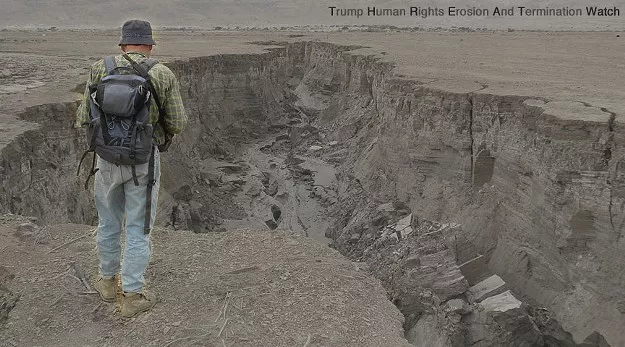
The most obviously vile, but not necessarily the most dangerous, of Trump's three recent statements is Thursday's reference to Haiti and African countries as "shitholes." Trump is a master at painting enemies in the worst possible light with his descriptors, and "shitholes" ranks among the best of them. It refers to a hole dug under an outhouse. While the rest of us walk on clean land, Trump's image has people living in those countries wallowing in the most disgusting kind of filth. For Trump, an admitted germaphobe, the image must be especially revolting.
The president has removed any remaining doubt that he's a racist. Up to this point, only a fan could question his obvious racial animus, but when Trump called countries populated by people of color "shitholes," even his most ardent supporters have their work cut out for them — at least those who are interested in defending him from the "racist" label. I'm sure white supremacists everywhere are overjoyed.
Immigrants of color, even those living here legally, have growing reasons to fear for their safety and security.
Tags: Donald Trump , "Shitholes , " Racism , Libel , Treason , Image

