

Friday, January 12, 2018

It didn't take a soothsayer or an entrail reader to get that one right. It's what he always says.
Don Quixote, who sang about dreaming the impossible dream in a musical based on the great 17th century novel, had gone mad from reading too many stories about knights and chivalry. He put on a suit of dented armor and rode forth, determined to right the wrongs of the world. He honestly thought a peasant woman was a princess under the spell of a wicked enchanter. He believed with all his heart that windmills were evil giants he could joust against and defeat while riding on the worn-out nag he thought was a noble steed. He believed in his own beautiful folly. His audience has spent five centuries laughing at him and crying with him, wishing they could believe as well.
Governor, I read Don Quixote. I knew Don Quixote literarily and think of him as a friend of mine. Governor, you're no Don Quixote.
Ducey isn't deluded. He knows his promise to add significant education funding to the state budget is a con job, because there's not enough money in the budget for a serious increase, and he has pledged to the state's businesses and wealthiest individuals — and to his greatest benefactors, the Koch Brothers — that he would only lower taxes, never raise them. His only mention of taxes in the address was an increased exemption for military retirement pay.
Ducey spoke of holding the line on prison spending, then said,
"Let’s spend these dollars – tens of millions of dollars combined – where they can go to better use: In our public schools and for our teachers."Some simple math. We have about a million K-12 students in Arizona. "Tens of millions of dollars" translates to tens of dollars per student. In a 30 student classroom, that comes to $300 a year. Ducey knows it. Everyone who understands the size of the education budget knows it. But Ducey hopes he can con potential voters into thinking he promised something real.
Tags: Doug Ducey , State of the State Address , Don Quixote , Education Budget , Image
Tuesday, January 9, 2018

Instead, a decade later, I find myself writing on The Range and competing with the mainstream media and any number of educational professional and volunteer groups for attention. With politicians as well. The governor touts his focus on improving education. His potential Democratic rivals for the office, Steve Farley and David Garcia, can't bring up the sorry state of education funding often enough.
If it sounds like I'm complaining, far from it. I love seeing the increased attention education has been getting in the state. The more the better. And in case this all sounds like bragging, like I think my blogging has pushed the topic front and center, far from it. I don't take a scintilla of credit. Education has bubbled to the surface in Arizona as one of the most important issues facing our state on its own. Its time has come. That's why our schools are at or near the top of every survey of voters' most important concern.
Weekend articles had headlines like "Arizona Legislature begins Monday with focus on education funding" and "School funding is first priority in new legislative session." A preview of the Ducey's coming address to the legislature has the headline, "State opioid crisis and education funding expected topics, State of the State address." Drug addiction seems like the only topic important enough to share the billing with schools.
Tags: Education , Doug Ducey , State of the State Address , Image
Friday, January 5, 2018

Arizona is spending less per student now than it was in 2008 using inflation-adjusted numbers. Exactly how much depends on how you crunch the numbers. AZ Schools Now says it would take a billion dollars, more or less, to get us back to 2008 levels.
A billion, more or less, to get us back where we were. The sad thing is, we've been beggaring our schools for so long, a billion is significantly less than we need. We're at or near the bottom of the country in per-student funding, and adding a billion dollars would only raise us two notches. We'd move past Oklahoma and pull even with Mississippi.
Even though it's not enough, an added billion would mean a hell of a lot to our teachers and students. If we boosted teacher salaries by a few thousand dollars, maybe we could hold on to teachers who are fleeing the state for better pay. And get some credentialed teachers who have left the profession to return to the classroom. And lure a few more college students into teaching programs to increase the future teacher pool. Add in a few dollars more for classroom supplies and equipment, and we'd move closer to giving our children the education they deserve.
But you can be sure our Koch-addicted Governor Ducey, who fancies himself the "education governor," will fight a substantial increase in education funding to his last breath, especially if any of the money comes from income or business taxes. In Ducey's world, if schools get any more money, it has to come from State Land Trust Funds, sales taxes or local taxes. His most solemn pledge is to keep income and business taxes moving downward. Not surprisingly, that's also the bottom line of the Koch Brothers donor network which Ducey counts on to pony up a big pot of money during campaign season.
At the end of last year, Trump and Republicans in Congress were told they had a choice: come up with tax breaks for the rich or No money for you. Ducey knows he's facing a similar ultimatum, and he also knows people are predicting a Democratic wave election in 2018. If the tsunami is big enough, even Arizona could see Republicans swallowed up, especially if they don't have dark money to keep them afloat.
Tags: AZ Schools Now , Education funding , Doug Ducey , Koch Brothers , Taxes , Image
Wednesday, January 3, 2018

I suggest the period beginning June 16, 2015, the day Trump announced his candidacy for president, should be referred to as the Age of "What The Fuck?!"
Thirty-plus years of teaching in a high school classroom trained me to keep it clean, in public anyway. Though my private conversations are laced with profanity, I watch my language when I'm in the public square. I broke with my normal decorum when I used "bullshit" in a post last March, but I made sure to give the word academic respectability by referring to the book, On Bullshit, by American philosopher Harry Frankfurt.
Today I'm throwing away my decades-old restraint. Nearly every night as I watch cable news, I yell, "What The Fuck?!" at the latest Trump outrage. Mornings, I growl the phrase as I pore over the paper and check the latest on the web.
Prior to the advent of Trump, I was often angered by what goes on in our political world. More than angered. Outraged. Incensed. Horrified. But I was rarely this astonished before The Donald descended the Trump Tower escalator and walked onto the political stage. I find myself doing mental double and triple takes at the unbelievable, frightening absurdity of our president's actions and utterances. Political humor on Saturday Night Live is meant to be satire. Lately it feels more like reportage.
Tags: Donald Trump , Tweets , Huma Abedin , Kim Jong-un , Image
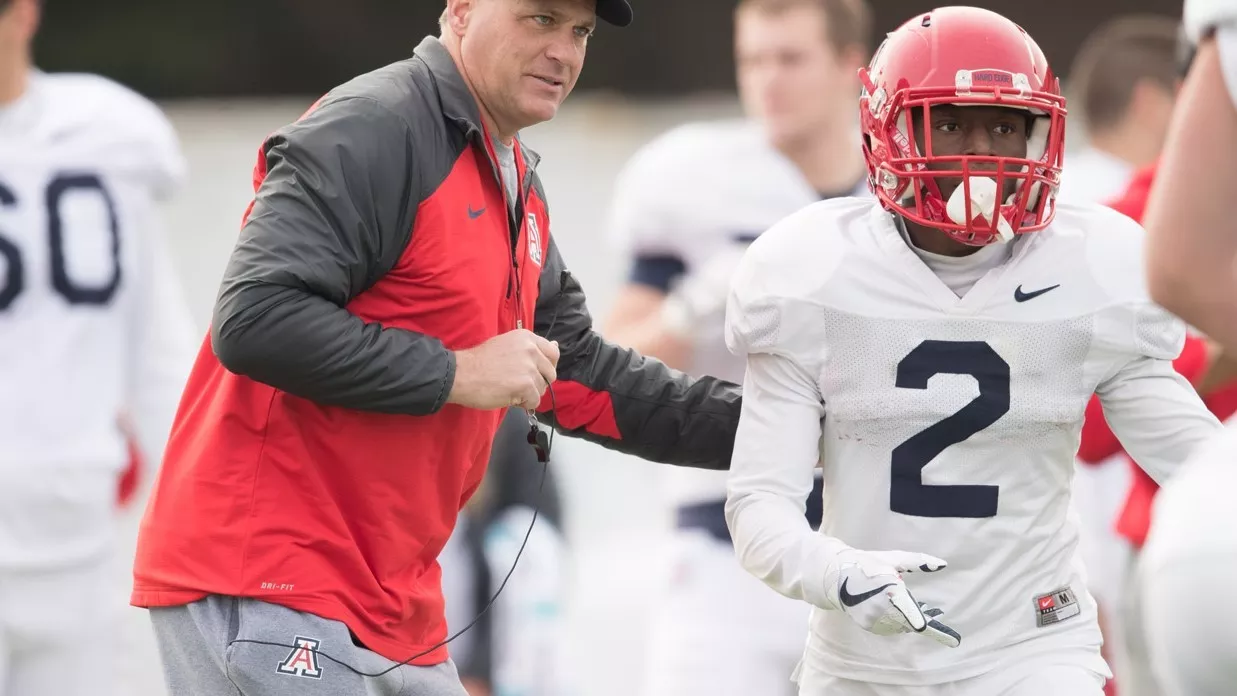
The claim, filed by the attorney for Melissa Wilhelmsen, alleges that Rodriguez forced her to help keep an affair secret from Rodriquez’s wife and later made sexual advances toward her. It also claims and that Rodriguez at one point typed up a book, called “The Hideaway Book,” which sought to establish secrecy within Rodriguez’s inner circle—including Wilhelmsen and then-assistants Charlie Ragle and Miguel Reveles.
The University of Arizona released a statement from UA President Robert C. Robbins and Athletic Director Dave Heeke Tuesday night announcing Rodriguez’s dismissal, saying that an independent investigation commissioned by the university could not substantiate Wilhelmsen’s original allegations, partly because she did not cooperate with the investigation.
But university officials decided to fire Rodriguez because "Arizona Athletics did become aware of information, both before and during the investigation, which caused it to be concerned with the direction and climate of the football program,” Robbins and Heeke said.
Wilhelmsen alleged that Rodriguez’s conduct veered from inappropriate to outright sexual harassment—including a request that she bring him his underwear from the equipment area and a conversation in which he told her his “preferred style of underwear ‘visually enhanced’ his genitalia when worn,” according to the claim.
Wilhelmsen also accused Rodriguez of touching the side of her breast, and then trying to kiss her during a meeting in January 2017, after telling her, “Whatever you need, I’m here for you.” The alleged incident occurred as Melissa and Jason were having marital troubles that stemmed from her stressful work environment, the claim said.
Wilhelmsen, according to the claim, tried to leave her role and join the athletic department’s development office after the kissing incident in March of 2017. She scheduled an appointment, but it was later canceled with no reason. She then tried to make another appointment a month later with the same person, but received no response, the claim said.
Wilhemsen said she felt trapped in her job with the Athletic Department because she feared for what would happen to her daughter—who also worked within the department and attended the UA at a discounted tuition rate because of Wilhemsen’s job, the claim said.
Wilhelmsen finally left the department in August for a non-University job, but was cornered by Rodriguez’s wife on her last day, before confessing to the truth about Rodriguez’s girlfriend, according to the claim.
Attorney Augustine B. Jimenez III, who represents Wilhelmsen, said in the claim that no public figure should be allowed to harass women with impunity.
“If this case were to go to trial, in the current climate where #MeToo is in the headlines on a daily basis, neither male nor female jurors would have any sympathy for a public figure who used his authority and power to oppress and degrade his female assistant in such ways. Undoubtedly, the verdict could be in the tens of millions of dollars because the jurors would want to send a message to such high-profile and highly paid coaches that such abuses of power are not acceptable,” Jimenez said.
In a statement on Twitter, Rodriquez admitted to an extramarital affair but said Wilhelmsen’s claims were “baseless and false” and vowed to “vigorously fight these fabricated and groundless claims.”
Read Wilhelmsen's notice of claim for yourself here:
Tuesday, January 2, 2018
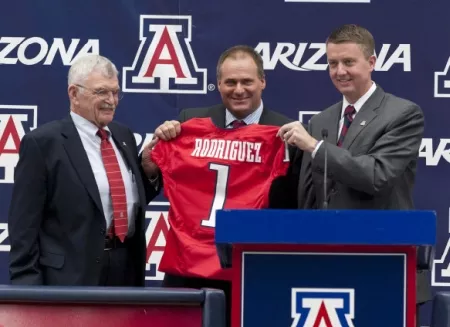
No exact reason was given for the school’s decision, though the university will honor the separation terms of Rodriguez’s contract, which include a $10.2 million buyout, according to USA Today.
Director of Athletics Dave Heeke cited the school’s investigation into allegations of sexual harassment against Rodriguez, which began in October.
That investigation, according to Heeke, did not find that Rodriguez posed any danger to members of the community, though the alleged victim chose to pursue further litigation.
“As a result, we have been reviewing the findings and deliberating our course of action. While this is a difficult decision, it is the right decision. And it is a decision that lives up to the core values of the University of Arizona,” Heeke said.
Update: Rodriguez took to Twitter Tuesday to release a statement regarding the UA's investigation.
He discussed a complaint by a former administrative assistant, who threatened to file a $7.5 million lawsuit alleging harassment.
Rodriguez said he cooperated with the 10-week-long investigation, taking a voluntary polygraph test, which he passed.
He admitted to have an extramarital affair with a woman not affiliated with the university and expressed regret for his conduct.
"It was wrong, and I have apologized to my wife and family. I am still working incredibly hard to repair the bonds I've broken and regain the trust of my wife and children, whom i love dearly," Rodriguez said.
Rodriguez thanked his staff and players for their commitment and effort during his tenure, and vowed to fight against the claims made against him going forward.
There is no timetable for naming Rodriguez’s replacement, though the National Signing Day for high school players is Feb. 7.
Here's the UA statement:
![Libertarians on Public ["Government"] Schools, From Milton Friedman to the Koch Brothers to UA and ASU: an Incomplete History](https://media.tucsonweekly.com/tucsonweekly/imager/u/original/13807979/bigstock--132043094.webp)
The Koch Brothers have invested in libertarian-themed outposts at University of Arizona and Arizona State University, and the state has upped the ante by adding $5 million worth of government funding for the centers in its recent budget. The UA bastion, the Freedom Center, created a high school course favoring libertarian views on economics and politics which is currently being offered in four Southern Arizona school districts and a smattering of charter schools, all government funded institutions. Yet the Koch Brothers invested at least $1.8 million in defeating a 2012 ballot measure which would have increased K-12 funding by a billion dollars. The Brothers also invested at least $1.4 million in the 2014 gubernatorial campaign of Doug Ducey, who bills himself as the "education governor" but rejects any substantive increase in school funding.
What are the Koch Brothers' views on education, and where do they come from?
The best place to start is with Milton Friedman, a Nobel Prize winning economist who is much revered by libertarians. In 1955, Friedman wrote The Role of Government in Education, which put the idea of school vouchers on the map and added the term "government schools" to our political lexicon. Friedman laid out the economic justification giving parents money for their children's educations and letting them spend it where they wish. He didn't advocate for getting rid of public schools entirely, but he put them at the end of his list of schools, almost as an afterthought.
"Such schools [funded by vouchers] would be conducted under a variety of auspices: by private enterprises operated for profit, non profit institutions established by private endowment, religious bodies, and some even by governmental units."His combination of "some" and "even" with schools run "by governmental units" shows he didn't think many of them would survive in a voucher-financed competition with the private sector.
Friedman thought vouchers should be limited to the amount it costs to provide what he calls "general education for citizenship." Though he didn't define the term exactly, he was clearly thinking about the minimum education needed to survive in our society and participate in our democracy. Parents would have to pay for anything beyond "general education."
One positive byproduct of limiting government's financing of education, according to Friedman, could be that families, especially poorer families, would have fewer children. Since parents would have to pay for everything beyond a minimal education, he reasoned, they would think twice about the financial burden of having to pay for educating too many children.
The only negative Friedman saw concerning his voucher plan was that, after the Supreme Court's 1954 Brown v. Board of Education decision mandating the desegregation of schools, parents were using vouchers to pay for whites-only private schools. Though he writes, "I deplore segregation and racial prejudice," Friedman claims that, just as every private business should have the right to hang out a "Whites only" sign in its window, schools should be allowed to be segregated. Let the invisible hand of the marketplace work its magic on schools rather than allow the heavy hand of government to impose desegregation.
Skip ahead 25 years to the 1980 presidential election.
Tags: Koch Brothers , University of Arizona , Freedom Center , Arizona State University , Center for the Study of Economic Liberty , Milton Friedman , Doug Ducey , David Schmidtz , William Boyes , Image
Friday, December 29, 2017
"[T]hese include the overthrow of our government, ethnic resentment, and the redefining of 'la familia.' The TUSD Mexican-American Ethnic Studies program is widely seen as a 'militant' model to be spread throughout the country."Horne was asked what TUSD could do to comply with then-Education Superintendent John Huppenthal's demands that the program comply with state law. He replied that the district's only option was "to terminate the program."
Horne said the program must be “destroyed,” invoking Cato’s obsessive call for warfare as a punch line, “Carthage must be destroyed.”Horne is an educated man, so he would have understood the implications of his Carthage analogy. Ancient Carthage, on the North African coast, posed an existential threat to Rome during the Punic Wars — think Hannibal and his elephants crossing the Alps in 218 BC. Rome eventually triumphed over the darker-skinned invaders, destroying Carthage completely and selling its remaining population into slavery. The comparison of Carthage invading from the south being driven back and destroyed by a lighter skinned civilization, to white Arizona fighting off the invasion of its education system by Mexican American radicals is too obvious, and too racist, to be coincidental.
On Wednesday, U.S. District Judge Wallace Tashima declared that the law, § 15-112, designed to destroy TUSD's Mexican American Studies, cannot be enforced, because it
"was enacted and enforced, not for a legitimate educational purpose, but for (i) an invidious discriminatory racial purpose, and (ii) a politically partisan purpose – to shut down the TUSD MAS Program – in violation of the First and Fourteenth Amendments to the Constitution."It's a fitting irony that the tactics used by Tom Horne and John Huppenthal against MAS were repudiated in a court of law while both men have seen their reputations tarnished — one could even say, destroyed — because of a string of personal and professional improprieties compounded by their publicly exposed racism.
Tags: Tucson Unified School District , Mexican American Studies , Tom Horne , John Huppental , U.S. District Judge Wallace Tashima
Wednesday, December 27, 2017
A Pima County jail inmate who allegedly killed his cellmate was undermedicated at the time of his cell mate’s death.
Branden Roth was found beaten and strangled to death, locked in a cell with King Yates, who was unharmed, on the morning of April 19.
Yates was awaiting trial for the murder of his wife Cassandra Yates. Roth had recently plead guilty to trafficking in stolen property for stealing a diagnostic tool from BrakeMax, which he pawned for a few hundred dollars.
In December 2015, Yates was found incompetent to stand trial on felony drug charges and was court ordered to take medication to restore him to competency. He was evaluated by Dr. Michael Christiansen, who diagnosed him with “Bipolar I Disorder vs Schizoaffective Disorder with Narcissistic personality traits,” according to court records.
The courts ordered Yates take a daily 700 mg of Seroquel to control psychosis. Christiansen said the medication was “ESSENTIAL in sustaining competency to stand trial. “Essential” was in all caps.
At the time of Roth’s murder, the jail was only giving Yates 225 mg of Seroquel. The jail’s medical records don’t give a reason for the lower dosage, according to court records. The day after Roth’s death, jail staff increased Yates’ medication to 400 mg.
An independent contractor, overseen by the county's behavioral health department, is responsible for deciding inmates’ medication dosages, according to the county's Public Communications Manager, Mark B. Evans
Since this new information came to light, prosecutors have withdrawn their intention to seek the death penalty.
Yates has a history of behavioral health issues. Court documents show that when he allegedly shot his wife, he told a friend, only minutes after the murder, that Cassandra had been trying to kill him. Yates’ public defender in that case told the courts she does not believe he was medicated at the time of the murder.
Tags: Branden Roth , King Yates , jail murder , Pima County jail
So, who can you give the money to? Any district or charter school. You can even divvy your credit up among a number of schools.
What is the money used for? Schools can only use it for extracurricular or character education programs, not for classroom-based education. I don't much like that restriction, but that's the way the law was written. Still, lots of important education and recreation happens in schools outside the classroom—sports, music, art, science, field trips, clubs. Especially in schools with lots of children from low income families, the donations can be the difference between the kids participating or being left out.
How do you give? Most school districts have a link on their website's home page which has all the information you need. You can pay online with a credit card or download a form and mail in a check.
How do you choose the school or schools to give your money to? The answer is probably easy for people whose children are in school. For everyone else, my suggestion is, give it to school with lots of low income students. If parents and community members pay little or no state taxes because they don't make much money, they can't take advantage of the credit, which means their schools don't get a whole lot of this extra money, while schools in more affluent areas get many times more.
Tags: Public school tax credit , Tucson Unified School District , Sunnyside Unified School District

