

Wednesday, June 7, 2017
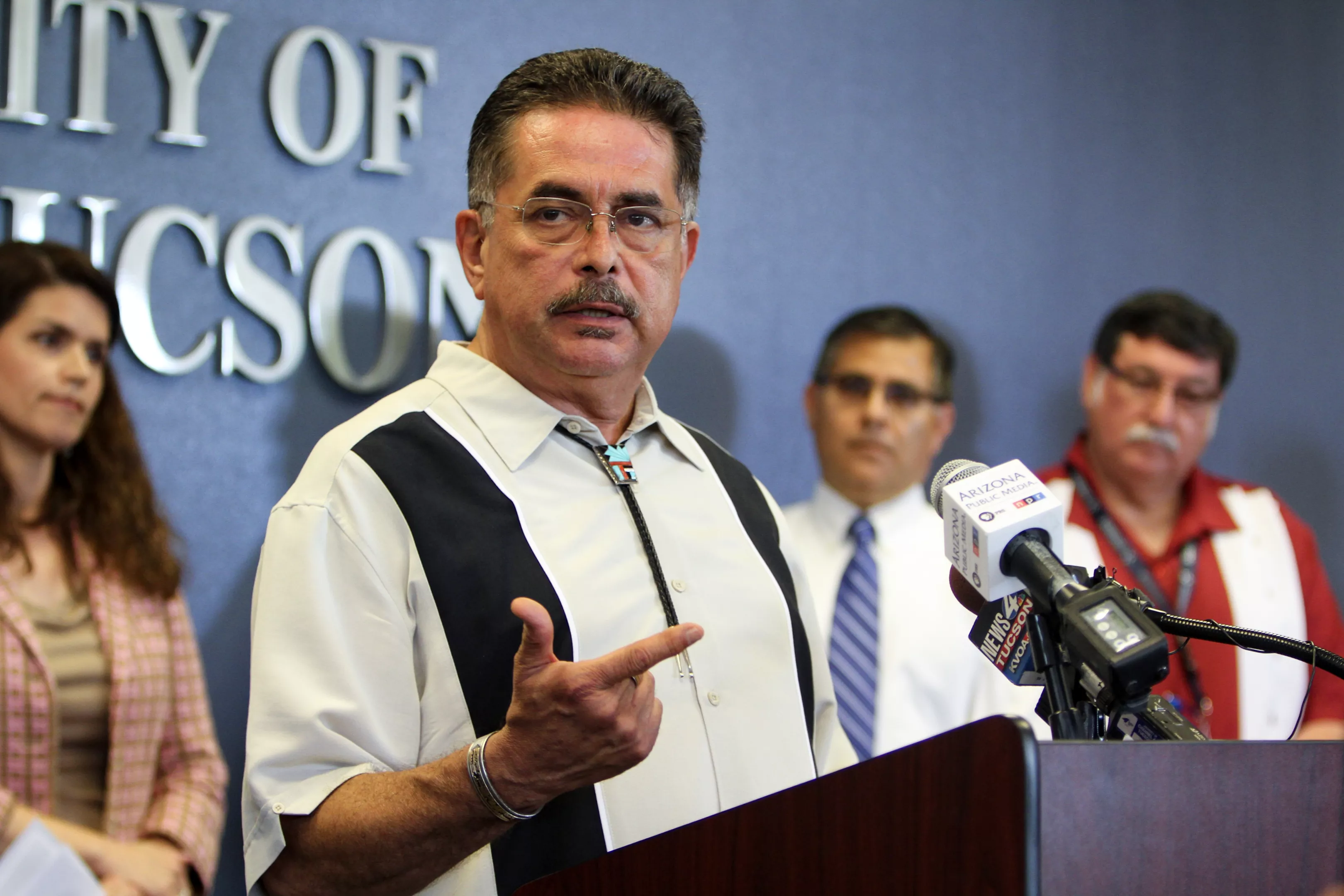
Few places in the country interact with Mexico as much as Southern Arizona, and several of the region’s jurisdictions have taken a collective stand against President Donald Trump’s proposed border wall expansion along the nation’s southern border. Following the lead of the Tohono O’odham Legislative Council and the National Congress of American Indians, both the Pima County Board of Supervisors and the Tucson City Council approved a joint resolution standing in opposition to the border wall on Tuesday, June 6.
Unanimously approved by the Tucson City Council and approved by a 3-2 vote by the county board (Republican Supervisors Ally Miller and Steve Christy were opposed), the resolutions state—among other things—that the proposed wall construction stands against the core values of “inclusiveness and tolerance” and will cause “substantial environmental damage” to the region.
District 5 Supervisor Richard Elías, who along with Tucson Councilwoman Regina Romero was the prime sponsor of the joint resolutions, said the day was about standing together with the people of the region to object to the “abomination that is the border wall.”
‘We continue to understand the borderlands because we have lived here all our lives, and know this border wall is in opposition to our values,” Elias said. “We know that the border wall is in opposition to what we share in terms of the business that we conduct. We know that the environmental damage that is going to be done to wildlife, to the fauna, to the beautiful Sonoran Desert that we all share…we have to be the stewards that protect it.”
Both the county and the city have denounced Executive Order 13767, which aims to construct an expanded border wall, and the resolutions also calls for a “thorough and comprehensive analysis of the cost, effectiveness, necessity and consequences of a U.S. border-security policy and this Executive Order.”
The city’s resolution takes it several steps further, calling for the billions of dollars potentially allocated to construction to be instead spent on health care, education, housing, infrastructure repair, alleviating poverty, increasing economic opportunity and “safeguarding the health and well-being of all Americans.” The council resolution also states that the current wall has caused “substantial” environmental damage, and is “and offensive and damaging symbol of fear and division.”
Tucson Mayor Jonathan Rothschild called the proposed wall a “terrible” policy decision and a “waste of tax dollars.”
In passing its resolution, Tucson also calls for a cost-benefit analysis, stands in opposition of “continuing expenditure of federal funding directed to private, for-profit prisons for the detention and incarceration of immigrants.”
Most controversially, and drawing immediate criticism from local chambers of commerce, was the city’s inclusion of a section which allows the council to identify companies involved in designing, building and financing border wall construction, and divest from each, as the law allows.
Monday, June 5, 2017
I beg to differ. It's not enough, not nearly. And most of it will find its way to fewer than 20 percent of the state's public schools.
Here's an example of the new spin on education funding from an Arizona Capitol Times article. The headline: Public education advocates bemoan school money still not enough. The word choices tell the tale. Education advocates "bemoan" the money. Complain, complain, complain. They say it's "still not enough." Will nothing satisfy them?
Here's how the article begins:
Education issues captured much of the attention this legislative session, but public school advocates say they’re disappointed with the outcome.A news release from the "Reelect Doug Ducey" committee couldn't put the budget in a more favorable light.
It’s hard to argue the budget doesn’t focus on education when much of the new spending focuses on K-12 or university education initiatives. The fiscal year 2018 budget adds $163 million above inflation funding to schools.
Let's take a look at that $163 million in new education dollars. $163 million. That sounds like serious money. But let's remember, the Arizona legislature began stealing from schools back in 2009, and the new $163 million, even when it's added to the money voted in with Prop. 123, still doesn't bring education funding back to the level mandated by Prop. 301 which passed in 2000. We're still not back to the "good old days" eight years ago when funding was merely awful. We sure haven't invested more in our children's educations. The Republican obsession with tax breaks and tax cuts for the wealthy and the business community made sure of that, beggaring the state budget so it can't even find the money to fund schools at a level required by law. You don't steal $100 out of someone's pocket, give back $60 and expect a thank you.
Then there's Arizona's national standing. Add the new $163 million to the Prop. 123 money, and we're still in 49th place in funding per student, trailing 48th place Oklahoma. Another $100 million could put us in 48th place, barely. If we aspire to take 47th place from Mississippi, well, we're not even close. The 47th slot would cost us $600 million, almost four times this year's added money. And if we wanted to dream the impossible dream of reaching the national average, that would cost us $3.5 billion more a year.
We're spending less than we did in 2009. Mississippi-level education funding is a bridge too far. The national average might as well be on another planet. But education advocates should be satisfied with the governor's gesture financial largesse? Sorry. No.
Tags: Arizona state budget , Education budget , Teacher raises , Results-based funding , New school funding , Building renewal funding , Doug Ducey. Vail school district. Queen Creek school district. Chandler school district.
Friday, June 2, 2017
The pro-voucher narrative is lovely and seductive. Lots of parents who want private school for their children just can't afford it, advocates say. Vouchers allow those parents the opportunity to choose, so of course lots of children will switch from public to private schools. Vouch it, and they will come. As the student population expands, the advocates continue, it diversifies. Minority students who otherwise couldn't afford tuition will take advantage of the vouchers and flock to private schools. And really, they conclude, vouchers are a break-even proposition, since all those new students using vouchers mean fewer students attending public schools. Vouchers pay for themselves.
That's their story. Now here's the truth. In the 20 years since Arizona began its first voucher program, private schools have gained less than 900 students. During the same 20 years, public schools added over 350,000 students. And while Arizona's Hispanic student population has increased dramatically, the ethnic mix of private school students hasn't kept up.
Before I start into a numbers dive, let me give you my sources, which are as legit and unbiased as I could find. The public school numbers are from the National Center for Educational Statistics, a vast U.S. government data archive where even an amateur like me can sort through the data to find the information I'm looking for. The private school numbers are from a 2016 study, Exploring Arizona's Private Education Sector, created by the pro-voucher organization, EDCHOICE. I begin in 1995, two years before Arizona passed its tuition tax credit law, and follow the numbers through 2014, which is the most recent year with complete data. Empowerment Scholarship Accounts began in 2011, so they're only a small part of the 20 year history.
Tags: Vouchers , Tuition tax credits , Empowerment Scholarship Accounts , Public schools , Private schools
Tuesday, May 30, 2017
"That's right, so long as it's in a subject that's taught in middle school or high school."
"I'm an American History major."
"Then you can teach history to 6th through 12th graders in any public school in Arizona."
"It's just temporary, right? I won't be a real teacher."
"Yes, you'll be a real teacher. They'll give you a Subject Matter Expert Standard teaching certificate. That means you'll be a real teacher with your own classroom full of students."
"Not a student teacher? I won't have, you know, a real teacher in there with me?"
"Nope. On the first day, you'll be on your own."
"But I'll have to take a test first, right? To see if I know enough to teach? I mean, I'm not sure I'm, um, qualified. I just barely passed some of my classes, and I've never really thought about teaching before."
"No, you don't have to pass a test or do anything else to demonstrate knowledge of your field. You'll be exempt from the professional knowledge proficiency requirements other teachers have to worry about. That diploma in your hand is all you need, along with a fingerprint clearance card to show you're not a criminal."
"OK, but they'll make me take some of those education classes other teachers take, right?"
"No, not that either. You can start teaching without any education classes, and you're not required to take any in the future."
"But what if I bomb out? Will they take away my, whadayacallit, my . . .?"
"Your Subject Matter Expert Standard teaching certificate? No, the worst thing that can happen is, if in two years the district decides you don't meet the professional knowledge requirements, your certificate can be suspended. Later, if you can convince them you've learned what you need to know, it'll be reinstated."
"Does this thing, this certificate, expire? I probably won't teach that long, but if I decide I want to, do I need to get a real teaching certificate?"
"Not according to the law that just passed. This is a real certificate, and it looks like it's good as long as you want to teach."
"Like I said, I don't think I want to teach all that long. I mean, I never even thought about it until you brought it up. But I guess I can give teaching a try. What do I have to lose? I mean, I kinda know what teachers do. I've been sitting in their classrooms since I was five. You think I should do it?"
"Let me tell you something, buddy, you're not going to keep living in your bedroom eating free food for the rest of your life, and I don't see anyone knocking on your door offering you a job. Those schools are so desperate for teachers, they'll take just about anyone. Even you."
"OK, mom, I'm convinced. Can you drive me down to pick up a teaching application?"
Tags: Teacher certification rules , Subject Matter Expert Standard teaching certificate , SB1042
Friday, May 26, 2017
Anyone Can Teach. It's Easy! (At Least That's What Republican Legislators and the Governor Tell Me.)
Teaching is easy, right? That's why they passed a bill saying anyone with a bachelor's degree in an appropriate field can teach — and you don't even need a bachelor's if you've taught in a postgraduate school or worked in an appropriate field. The clever people who voted for the new rules should be able to step in and lend a hand, no sweat. Why, they'll even get a few months salary, including the 25 cents-an-hour raise they voted for, in the bargain. On top of all that, they'll get an official Subject Matter Expert Standard Teaching Certificate to hang on their refrigerators. Everyone's a winner! (For those legislators who aren't college grads or did their college work in a field not taught in public schools, I say give them a break and let them teach anyway. They've demonstrated how much more they know about education than educators by passing bills most professionals in the field disagree with.)
For the rest of us, here's a little fun we can have. Everyone who wants can put ten bucks into a statewide version of an office pool. Half the money will go to winners in various categories like: Which legislator is the first to say, "That's it! I'm not going back to that classroom tomorrow, or ever!" What's the date that first legislator/teacher bails out? How many legislators will make it until winter break? And which ones will admit publicly, "I had no idea teaching was this hard. We need to give teachers the respect and money they deserve!" All legislators in that last group will receive a special trophy: a glowing light bulb mounted on a pedestal with the words "I finally get it!" engraved at the bottom. The other half of the pooled money will go to buy extra supplies for students in classrooms without regular teachers.
Tags: Teacher certification , Arizona legislators , Subject Matter Expert Standard Teaching Certificate
Wednesday, May 24, 2017
Now, here's the bad news you knew was coming. Our new results-based funding law is designed to reverse the state's equalization gains, increasing the funding differences between districts, mainly by giving big chunks of extra money to schools in high rent districts.
Here's the history. Before 1980, Arizona, like most states, gave each school district a minimum level of funding, and the rest came from local property taxes. If one district brought in lots of property tax money for education, its schools were well funded. If another district brought in less in property taxes, its schools were poorly funded. Naturally, that meant wealthy districts tended to have significantly better funded schools than poorer districts, though not always because they taxed themselves at a higher rate. A district with lots of expensive homes could bring in more money for schools with a lower dollars-per-thousand property tax rate than a district with lower value homes and a higher tax rate. Million dollar homes generate more in property tax funds than $100,000 homes, even if the high priced district has a lower tax rate. The best discussion of this subject is Jonathan Kozol's classic 1991 book, Savage Inequalities.
When a successful lawsuit in California in 1980 challenged the state's inequitable funding system and won, Arizona saw the writing on the wall and passed legislation to create an "equalizing" formula for its schools. The state became responsible for the funding, which meant property tax money dedicated to schools was doled out based on a complex per-student formula which took a number of factors into account to decide how much money would go to the education of each student. That's the system we have today. It's far from perfect, but it puts us at number 15 in the nation in funding equity.
Tags: Results-based funding , Education funding equalization , Arizona , California
Tuesday, May 23, 2017
Results-based funding is designed to distribute $37.6 million to 15 to 17 percent of Arizona's district and charter schools. Schools with fewer than 60 percent of their students on free or reduced lunch will get $225 per student, and schools with more than 60 percent of their students on FRL will get $400 per student. That sounds fair, giving more money to schools with more low income students. And it is reasonably fair, for year one, anyway. A little more than half of the money will go to schools with lower income students in the upcoming 2017-18 year, because that's the way the law is written—for the first year. That distribution system stops the second year of the program. From then on, the money will be only go to schools with a state grade of A.
For the past few years as we've transitioned from the AIMS to the AzMERIT state test, Arizona hasn't given out school grades. That's why A-F grades can't be used to determine who gets results-based funding the first year. When the grading system starts up again in the second year of the program, two things will be different from the way things were before. First, new items will be added to the grading rubric which will make state test scores a little less important. That will mean schools with lower income students who generally get lower state test scores will have a better chance of getting a higher state grade. Second, the number of A grades the state gives out will be cut almost in half. In 2014, more than 30 percent of Arizona's schools got an A. In 2018-19 and following, the grading curve will change so only 15 to 17 percent of schools get an A. That has to happen. If every A school gets a slice of the $37.6 million results-based funding pie and there's only enough pie for 15 to 17 percent of schools, that means you have to adjust the number of A schools to match the money.
Tags: Results-based funding , AIMS state tests , AzMERIT state tests
Friday, May 19, 2017
Voters decisively rejected the will of the . . . Legislature and governor Tuesday, defeating what would have been the nation's most comprehensive education voucher program in a referendum blowout.That's an actual opening paragraph of an article, but not here in Arizona. It's from Utah's Salt Lake Tribune (I put three dots where the state name should be) on November 7, 2007. A recently formed group, Save Our Schools, has begun collecting signatures to put a similar referendum on Arizona's November, 2018, ballot to overturn the bill expanding empowerment scholarship accounts to all Arizona children. If the referendum succeeds, Arizona journalists have their opening paragraph written for them.
Since 1990, people across the country have voted against vouchers every time they've had a chance. The No votes have ranged from 60 to 71 percent. The last vote was in Utah in 2007, and the circumstances were similar to ours. The Utah legislature passed its voucher law by one vote. This year, our legislature passed SB1431 by three votes in the House and Senate. With one more Democratic representative and senator, it would have been a one vote margin. (Two more Democrats in either the House or the Senate, and the bill would have gone down.) Utah's voucher opponents collected 124,000 signatures. This year Arizona needs 152,000 valid signatures. In Utah, the teachers union led the signature gathering effort. At this point, Arizona's teachers unions haven't been a visible presence, though it's still early.
Tags: Vouchers , Empowerment scholarship accounts , Utah referendum , Arizona referendum
Wednesday, May 17, 2017
Fat cat tax. That's one of the ideas in the Britain Labour Party's election manifesto where it proposes a tax hike on the top 5 percent. The party's new platform is more radical than anything our Democratic Party has suggested or is likely to suggest, but Labour is trying to get back to its left-wing roots which it abandoned during the Tony Blair era. Based on its weak numbers lately, the move to the right hadn't done it any good. Getting a little radical and earning some extra media can't hurt. See for example: Bernie Sanders.
Here's the plan. The vast majority of Brits, 95 percent of them, would pay no more taxes than they do now. Taxes would rise for anyone making more than the equivalent of $103,000 American. The rate would go up still more for those making over $159,000. Now, here's where the "fat cat tax" part comes in. Companies would pay an extra 2.5 percent in taxes on every salary more than $425,000, and an extra 5 percent for anyone who makes over $645,000.
Why does the Labour Party want all that extra money? Because it wants to spend more, of course, on things like getting rid of university tuition, building homes and improving health and social care. Call them the "tax and spend" Labour Party if you want. I'm good with that, except I would rephrase it. "Tax and spend" is a phrase the right wing came up with to make it sound like the left wants to tax people for spite and spend money for the hell of it. A more accurate way to say it is, "Tax so you can spend on things the society needs."
Tags: "Fat Cat Tax". Labour Party , Britain , Taxes , Democrats , Republicans
Tuesday, May 16, 2017
Here's what the new certification rules say as I read them. If you have a baccalaureate degree and nothing more, you can teach at a public middle or high school in a subject relevant to your content area. Even if you don't have a baccalaureate degree, you can teach if you've previously taught three years in an accredited postsecondary institution or if you've worked in a relevant field for five years. If you meet any of the three criteria—any of them—you qualify for a Subject Matter Expert Standard Teaching Certificate and can jump right into the classroom. You'll never be required to take an education course, and you'll never have to take a professional knowledge proficiency exam, ever. The only other thing you'll need is a fingerprint clearance card.
That's it. That's all you need to start teaching. A bachelor's degree in a field taught in 6th through 12th grade. Or three years teaching in an accredited post-high school setting. Or five years working in a relevant field. Any of the three will do. The earlier version of the law, which applied only to teachers in STEM (science, technology, engineering and mathematics) fields, said you had to have both a bachelor's and three years of post-high school teaching experience to qualify for a specialized teaching certificate. The new version applies to all 6th through 12th grade subjects, and it says either of those will do, then it adds five years of work experience as a third option.
All other media reports I've read say you need a bachelor's degree plus teaching or work experience to qualify. Uh uh. It's not both/and. It's either/or. To me, the law is clear as day, and it sets the bar for teaching far lower than other media reports have stated. If I've got it wrong, I'm fine with that. But until someone can show me the error of my ways, I'm going to continue to believe I've read the bill more carefully, and more accurately, than other people who've written about it.
Tags: SB1042 , Arizona teaching certificates

