

Friday, May 14, 2021

Pima County and Tucson Medical Center are offering 800 free swim lessons to children at three Pima County pools.
The free lessons will be available at:
- Kino Pool, 2805 E. Ajo Way
- Los Niños Pool, 5432 S. Bryant Ave.
- Flowing Wells Pool, 4545 N. La Cholla Blvd.
The lessons are part of an overall water safety effort to teach children proper swimming techniques and how to be safe in and around water.
Register at pima.gov/swimlessons or (520) 724-5171.
“Drowning is 100 percent preventable. Offering free swimming lessons to the community is critically important to reducing the risk of a future drowning,” said Grant Bourguet, program manager at Pima County Natural Resources, Parks and Recreation.
Thursday, May 13, 2021

Fully vaccinated individuals can resume activities without wearing a mask and physical distancing in indoor or outdoor settings, in most cases, according to the Centers for Disease Control and Prevention’s updated public health guidance released Thursday.
“Today brings more encouraging news for those fully vaccinated against COVID-19 — and another reason for everyone else to get their shot,” wrote Arizona Department of Health Services Dr. Cara Christ on Thursday's blog post. “This is a very big step toward returning to our pre-pandemic way of life.”
But the Pima County’s mask mandate remains in effect, which does not differentiate between fully and non-vaccinated individuals.
The Board of Supervisors is seeking legal guidance from County Attorney’s Office and should be reviewing the recommendation with the Health Department to advise the board of supervisors, according to Chair Sharon Bronson.
The Board of Supervisors will meet Friday at 3 p.m. to discuss the updated CDC guidance.
Supervisor Adelita Grijalva said she was still reviewing the new guidelines. She said she was unsure whether changes would be made without more people getting vaccinated, with a goal to reach 75% of the population to achieve herd immunity.
In Arizona 5,431,712 COVID-19 vaccine doses have been administered, with 35.4% of Arizonans fully vaccinated. Christ notes in her blog that the CDC’s announcement comes the same day as children across the nation ages 12 to 15 may receive the Pfizer vaccine, which could potentially add more fully vaccinated individuals.
According to CDC’s updated guidance, fully vaccinated individuals can go unmasked in an indoor high-intensity exercise class, a full-capacity worship service or a crowded, outdoor event, such as a concert or sporting event. However, they are still subject to federal, state or local jurisdictions laws and regulations, including local business and workplace guidance.
Also, fully vaccinated individuals traveling in the U.S., no longer need to get tested before or after travel, or self-quarantine after travel. Those boarding an international flight to the U.S., however, must show a negative COVID-19 test result or documentation of recovery before boarding. Self-quarantine is no longer required after arriving in the U.S. Individuals are still required to wear a mask on public transportation traveling into, within or out of the U.S. in places like planes, buses and trains, as well as airports and stations.
Additionally, the CDC advises individuals to watch for COVID-19 symptoms, especially if around someone who is sick. If displaying symptoms, people should get tested and stay home and away from others.
The CDC also notes that even fully vaccinated individuals who have a condition or are taking medications that weaken their immune system may need to continue taking all precautions to prevent contracting COVID-19 and advises they speak with their healthcare provider to discuss their activities.
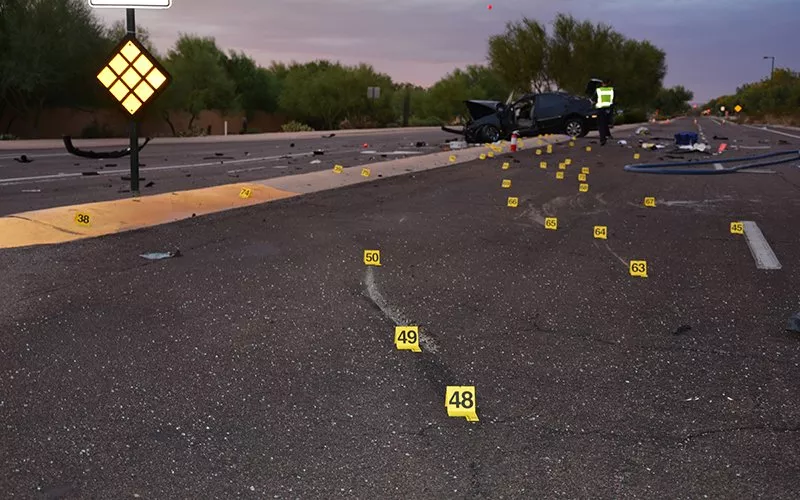
PHOENIX – Ramon Angel Carrasco and his girlfriend were driving home from a Scottsdale bakery in a white BMW in August 2019 when Robert J. Foster pulled up next to them in a light blue Lamborghini.
According to a witness account provided to police, Carrasco and Foster revved their engines at a red light on Hayden Road before heading north, and within seconds they were traveling more than 100 mph.
Meanwhile, Cynthia Ann Fisher was driving south on the same stretch of Hayden. The 68-year-old hairdresser had just left the grocery store and was planning to make breakfast the next morning for a new roommate, said Leah Stenzel, her friend and boss.
Fisher was turning left onto Williams Drive when Carrasco’s BMW struck the passenger side of her black Camry, propelling her car 160 feet from the impact, according to police records. Fisher, who was a minute from her home, was declared dead at the scene.
Carrasco and his girlfriend, Jaymi Lynn Chagolla, suffered minor injuries. Carrasco told police he had nothing to do with the Lamborghini and refused to speak further without an attorney present, but Chagolla confirmed what multiple witnesses who called police had reported.
“Yes, we did a pull against a Lamborghini,” she said when police asked whether the cars were racing.
Friday, May 7, 2021
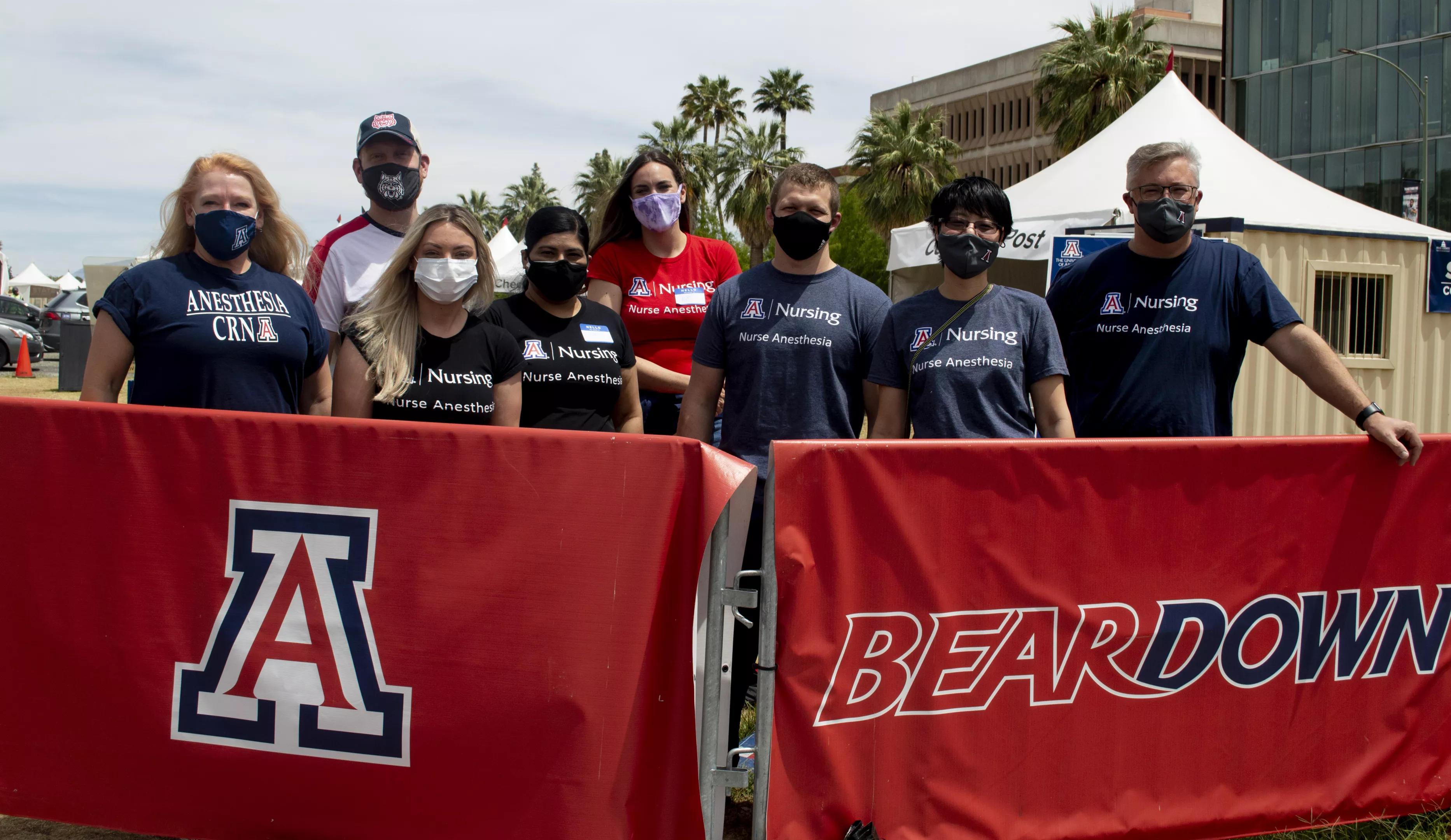
University of Arizona College of Nursing faculty and students with first-hand experience of the human cost of COVID-19 ran a vaccination clinic last weekend.
Led by Kristie Hoch, UA clinical assistant professor and program administrator of the Nurse Anesthesia Specialty, volunteer Certified Registered Nurse Anesthetists (CRNAs) and student registered nurse anesthetists (SRNAs) administered vaccines to people at the drive-thru.
For about 150 years, CRNAs have been preparing patients for anesthesia before surgical procedures, said Hoch.
“We ensure patients are safe and comfortable during their anesthesia and this piece for us is part of ensuring our community is safe,” said Hoch, referring to vaccinations as part of that work.
Since the onset of the pandemic, CRNAs have found themselves outside of the operating room.
“Really the entire scope, not just for surgery pre-intra and postoperative care, but we’ve been called to take care of patients who are acutely and chronically ill with COVID,” said Charles Elam, clinical assistant professor at the College of Nursing. He said he and his partner were hired to manage acutely ill COVID patients in Green Valley. They installed central lines, big IVs that go into the neck or chest, and arterial lines that go into arteries. They also managed ventilators and sedated patients.
“This was above and beyond what we typically do, but because we are airway experts we were called upon and stepped up to do what we needed to do,” said Hoch.
Phillip Bullington, 31, one of the five doctoral students in the Nurse Anesthesia program who volunteered at the vaccination event, worked as a nurse before beginning his doctoral project and has experience dealing with people who are severely ill.
However, what he experienced as an SRNA in the ICU during the pandemic was beyond his expectations.
“We never really expected the way everything happened and then it just got crazy,” recalled Bullington. "Where there's people on ventilators just taking up all the ICUs. We're turning other floors into ICUs and we're running out of places for patients to go. And then they would get sick, but they were healthy enough that they would still live for a while, but they weren't getting better. So just a piling of people who would get more sick and there was nowhere for them to go.”
Tuesday, May 4, 2021
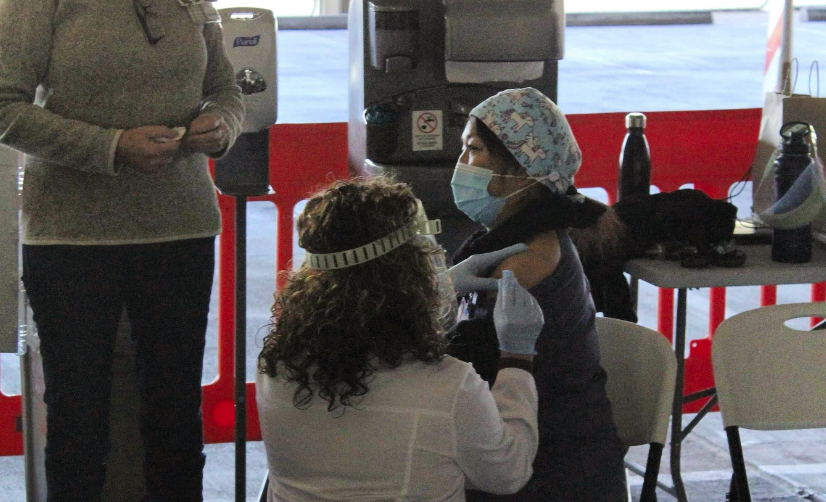
The University of Arizona plans to decommission its vaccination site as of June 25 and announced new hours last Thursday.
With the decline in vaccine demand and “as other avenues for vaccination become more readily available,” the UA POD plans to scale back its hours and on Monday transitioned to fully indoors at the Ina E. Gittings Building, closing the drive-thru as the days get hotter, announced UA President Robert C. Robbins at the university update on Monday morning.
At the start of next week the UA POD will shorten its hours to 10 a.m. to 5 p.m., then on June 1 will continue with new hours only offering second doses.
“We're going to stop taking first dose appointments, relatively soon, just to make sure that the second dose is booked here at the University of Arizona POD, so that we will finish all shots that we started here,” said Vice President of Communications Holly Jensen.
The new POD schedule will be:
Friday, April 30, 2021
PHOENIX – GateWay Community College coach Rob Shabansky admits he wasn’t a huge fan of technology and analytics in baseball.
He didn’t understand its true purpose, or the information it produced. He couldn’t grasp how this data could help improve the performance of his players on the diamond.
Shabansky, like many others in the baseball industry, was skeptical of this numbers-based approach.
“A lot of that information was, to a certain degree, recoded for people who really knew it,” Shabansky said. “But if you didn’t know it, you didn’t get much from it.”
Then Shabansky started talking to coaches he trusted in the collegiate and professional ranks who were familiar with the data, like Vanderbilt pitching coach Scott Brown and Arizona pitching coach Nate Yeskie. The more he learned from their experiences and about the data itself, the more he wanted to learn about how he could use it, too.
Shabansky’s views began to change and he isn’t alone in embracing a new approach. Across all levels of baseball in Arizona, coaches and players are following the lead of Major League Baseball innovators and turning their attention toward analytics-based development.
Even some high schools have gone that route although it is still more exception than rule. Cronkite News surveyed various Arizona high school baseball coaches and asked them to rank their use of analytics compared to their competitors on a scale of one to 10. The average score among 30 respondents was 4.6.

The Federal Emergency Management Agency (FEMA) is sending mobile vaccination units and staff to Pima County to reach vulnerable communities with high risks of COVID-19 exposure and infection.
This follows the decision by the Arizona Department of Emergency and Military Affairs to not sign an agreement that would set up a federal vaccination site, independent of the state, as the state and FEMA failed to agree on the terms, according to an email released by County Administrator Chuck Huckelberry, However, DEMA made clear it would support the county’s “Plan B.” At last Tuesday’s Board of Supervisors meeting, Huckelberry announced “Plan B” would include six mobile PODs, but plan has since changed.
According to the announcement Thursday, the operation includes two mobile vaccination units (MVUs), able to administer 250 vaccines per day each, along with administrative staff and federal vaccinators with 70 personnel from FEMA, Health and Human Services, the Environmental Protection Agency and Department of Labor.
The units will run through June 26, operating at two concurrent locations for three days, with one day to tear down and move to the next location. The locations were selected based on census tract data and the Social Vulnerability Index of the area to identify highly vulnerable communities.
“We’re extremely grateful to FEMA for partnering with us on this effort to reach pockets of the community who may not have easy access to this life-saving vaccine,” said Huckelberry. “The ability to offer vaccines during evenings and weekends will enable us to reach folks whose work or school schedules prevent them from getting a vaccine now. With this effort, there’s truly no reason not to roll up your sleeve and get your shot so we can start putting this pandemic behind us.”
From May 3 to May 5, two MVUs will be on-site from 10 a.m. to 8 p.m. at the Pima Community College Desert Vista (5901 S. Calle Santa Cruz) and Pima Community College West (2202 W. Anklam Road).
Thursday, April 29, 2021

The Rio Nuevo board advanced three projects in an effort to recovery after the COVID pandemic:
- The board unanimously approved extensions to Gadsden Company's funding and construction deadlines for its new Monier Luxury Apartment complex, which are expected to begin renting as early as June.
- Reilly Craft Pizza and Drink was granted $100,000 to assist in the construction of a new rooftop bar and deck that will sit atop its beer garden building just north of the main restaurant.
- Eight restaurants were awarded $10,000 each in Parklet Grants.
Friday, April 23, 2021
The Pima County Health Department has pivoted in the direction of “Plan B” after plans for a federal POD died before implementation.
At the Tuesday Board of Supervisors meeting, County Administrator Chuck Huckelberry announced the Arizona Department of Emergency Management Division had informed them that the State Department of Health and the Federal Emergency Management Agency could not agree on the terms for the federal POD in Pima County.
“Team, after much consideration, and our best efforts, we were unable to find a fair and workable solution related to the FEMA-State agreement," Director of Emergency Management Allen Clark wrote in an email that Huckelberry shared with the board. "Therefore, DEMA, on behalf of the state will not sign the agreement.”
The original FEMA offer, made in March, would have brought enough vaccine to Pima County outside of the state's normal allocation for a six-week clinic that could have vaccinated an estimated 210,000 residents in low-income and minority neighborhoods, as those groups have lagged behind affluent white people in vaccination rates.
The federal POD, which required state approval, was originally denied by Governor Doug Ducey in March. On March 26, Dr. Cara Christ announced they would allow the county to move forward, so long as the site is independent of the state.
The agreement proposed by the state and released by the county on April 13 made clear the state would not be responsible or provide any assistance or resources for the federal POD. They also requested the county use its own registration system different from the state’s system. In the April 13 memo, Huckelberry said some of the terms and conditions appeared “particularly draconian.”
From March until now the vaccination effort has slowed, with the county and the state working on vaccinating individuals who may not have ready access to a vaccine or are vaccine hesitant, as well as dealing with the pause of the Johnson & Johnson vaccine.
Pima County Medical Director Dr. Francisco Garcia said there is much more vaccine available now than there was when state officials were rejecting the deal, so it amounted to a lost opportunity, but the county had other ways to partner with FEMA.
“At the time that we made our ask and if in the timeframe that we would have gotten that resource it would have been terrific," Garcia said. "But given that the state and FEMA could not come to an agreement on the contractual language to allow us to pull in a large federal POD, what we have done is we have pivoted to our Plan B.”
Wednesday, April 21, 2021

Pima County Supervisor Steve Christy cited a bogus study making its way around right-wing websites when he made a run at lifting Pima County’s mask ordinance at yesterday’s board meeting.
Christy's motion died for lack of a second.
In justifying his push to lift the ordinance that requires Pima County residents to wear face masks in public when they can’t physically distance from other people (and also requires businesses to ask customers to wear masks), Christy cited a study he said was from “the Medical Center at Stanford University” that purported to show that wearing masks did nothing to stop the spread of COVID and could in fact be hazardous to people’s health.
Christy asked Dr. Francisco Garcia, the county’s chief medical officer, if he was familiar with the study.
Garcia said he was aware of that study and “the variety of different studies that come to different conclusions.” Garcia added that the Arizona Department of Health Services has advised that wearing marks is an effective “mitigation strategy against the coronavirus.”
“I guess these Stanford guys don’t know what they’re talking about,” Christy responded.
But as it turns out, Christy appears to have been hoodwinked by the alleged Stanford study, which has been making the rounds on right-wing websites and social media.
An AP fact check published yesterday reveals that the study is bogus.
“In reality, the study is not affiliated with Stanford and is based on debunked claims about face masks, including the false notion that wearing a face covering decreases oxygen levels and increases carbon dioxide levels,” AP reported.
Titled “Facemasks in the COVID-19 era: A health hypothesis,” the study was first published in the medical journal “Medical Hypotheses.” One doctor who blogs about medical misinformation told AP that the journal published “fringe science and hypotheses.”

