

Monday, March 1, 2021
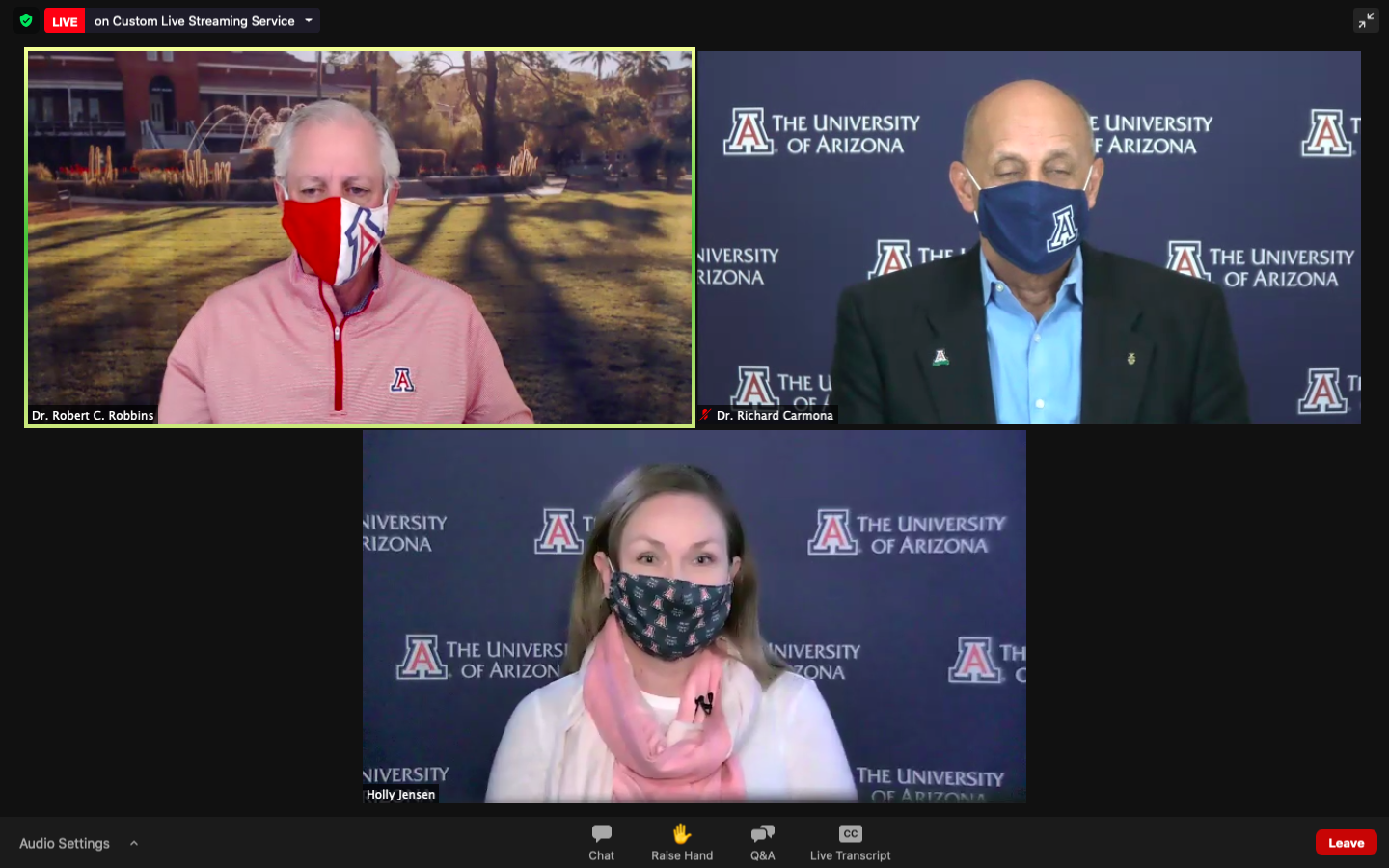
Additional vaccine appointments beginning Sunday for the University of Arizona POD will be made available soon, said UA President Dr. Robert C. Robbins at a press conference this morning.
Robbins asks the public to continue to check for appointments and reminded the public that the number of appointments available is directly proportional to the number of vaccine doses.
The university is scheduled to receive 16,380 doses this week and has distributed more than 35,000 doses, said Robbins.
The POD continues to run from 10 a.m. to 10 p.m. seven days a week, but with an increase in vaccines, the hours may be expanded to become a 24/7 POD by the end of March or the beginning of April, said Arizona Health Director Dr. Cara Christ during a news conference last week.
Robbins said the issue is a supply problem, as with the expanded hours, the vaccine distribution center could deliver 6,000 to 7,000 doses per day with 24-hour service.
"As soon as the state can give us the vaccine that we need, we'll gladly go 24/7, seven days a week, until we get as many people vaccinated as soon as possible," said Robbins.
As vaccines become available at pharmacies like CVS and Walgreens, Dr. Richard Carmona, UA's reentry task force director, hopes people will go to where they can get a vaccine as quickly as they can.
“The more places we have that allow vaccines to be given is clearly part of our value proposition to accelerate herd immunity,” said Carmona.
Tags: UA POD , tucson vaccine , where to get a vaccine in tucson , COVID Robbins , Carmona , Uarizona news , Tucson news , arizona news , Image
With 1,039 new cases reported today, the total number of Arizona’s confirmed novel coronavirus cases closed in on 818,000 as of Monday, March 1, according to the Arizona Department of Health Services.
Pima County, which reported 113 new cases today, has seen 109,601 of the state’s 817,821 confirmed cases.
A total of 15,971 Arizonans have died after contracting COVID-19, including 2,216 deaths in Pima County, according to the March 1 report.
The number of hospitalized COVID cases statewide has declined in recent weeks, with 1,241 coronavirus patients in the hospital as of Feb. 28. That’s less than a fourth of the number hospitalized at the peak of the winter surge, which reached 5,082 on Jan. 11. The summer peak was 3,517, which was set on July 13, 2020. The subsequent lowest number of hospitalized COVID patients was 468, set on Sept. 27, 2020.
A total of 952 people visited emergency rooms on Feb. 28 with COVID symptoms, a big drop from the record high of 2,341 set on Tuesday, Dec. 29, 2020. That number had peaked during the summer wave at 2,008 on July 7, 2020; it hit a subsequent low of 653 on Sept. 28, 2020.
A total of 382 COVID-19 patients were in intensive care unit beds on Feb. 25, less than a third of the record 1,183 set on Jan. 11. The summer’s record number of patients in ICU beds was 970, set on July 13, 2020. The subsequent low was 114 on Sept. 22, 2020.
How to get a vaccine
While supplies are limited, Pima County is providing vaccination shots to people 65 and older as well as educators, first responders and healthcare workers. Those who qualify in Pima County’s 1B priority group of eligible vaccine recipients can register for a vaccine at www.pima.gov/covid19vaccineregistration or by calling 520-222-0119.
A state-run vaccination site opening at the University of Arizona was not accepting first-dose appointments as of Monday, March 1. When accepting new appointments, the site follows the state’s current vaccine eligibility, which includes those 65 and older, educators, childcare workers and protective service workers.
As the state-run POD, or point of distribution, registrations will go through ADHS’s website. When online registration resumes, you can make an appointment at at pod vaccine.azdhs.gov, and those who need assistance can call 1-844-542-8201. More details here.
Eight CVS pharmacies throughout Arizona began offering COVID-19 vaccines starting last week.
Patients must register in advance at CVS.com or through the CVS Pharmacy app. People without online access can contact CVS Customer Service: (800) 746-7287. Walk-in vaccinations without an appointment will not be provided. Per the state of Arizona, eligible individuals for the Federal Retail Pharmacy Program are people age 65 and over, health care workers, protective services, teachers and childcare providers.
As more supply becomes available, the company will expand vaccine access through an increasing number of store locations and in more Arizona counties.
Click here register in advance for a vaccine at a CVS location.
Cases continue decline, health officials say relaxed restrictions on horizon
With the winter wave of coronavirus cases receding and more Pima County residents getting vaccinated, local officials say they may soon loosen COVID-related restrictions on crowd sizes and similar measures meant to slow the spread of the disease.
Dr. Theresa Cullen, head of the Pima County Public Health Department, said last week that as long as current trends continue, she expected that she’d release a new Public Health Advisory that would offer relaxed recommendations in the near future.
“If you go look at the Public Health Advisory, it still recommends that people stay in groups of 10, that would be a thing we would loosen up,” said Cullen. “We loosen up the concept of having spectators at external sporting events, which I know is near and dear to many people.”
However people should still expect the “three W's” (wear a mask, wash your hands, and wait) to remain in place as well as a physical distance of six feet, said Cullen.
Dr. Cara Christ, the head of the Arizona Department of Health, said that the state will also look at easing restrictions on large gatherings and other COVID-related regulations if the numbers continue a downward slide.
“We'd normally wait for all of the metrics to get down into the yellow for two weeks before we would start loosening some of those things,” said Christ.
Dr. Joe Gerald, an associate professor at the UA College of Public Health who puts out a weekly tracker of COVID trends, noted that for the week ending Feb. 21, at least 9,646 COVID cases were diagnosed in Arizona, which represented a 16% drop in the previous week’s numbers. That’s the lowest weekly number since Nov. 1 and marked six straight weeks of decline, but Arizona still had the 17th highest rate of transmission in the nation, according to the CDC.
In his weekly report released over the weekend, Gerald noted that the number of COVID patients in both general-ward and ICU beds dropped by 20 percent compared to the previous week. “While Arizona hospitals’ safety margins remain low, they are slowly improving,” Gerald wrote.
He urged people to continue wearing masks in public, avoid social gatherings, maintain physical distance from people not in your household and spend less than 15 minutes in indoor spaces, but said people could likely resume lower-risk activities once rates fall below 100 new diagnoses per 100,000 residents per week.
While the week ending Jan. 17 remained Arizona’s deadliest with 1,021 people dying after contracting COVID, Gerald estimated that the coronavirus death toll would be above 200 a week for another two to four weeks and falling below 200 a week by the end of March.
A total of 1,093 Pima County residents tested positive for COVID-19 in the week ending Feb. 21, which was a 34% drop from the 1,666 cases in the previous week. Pima County saw 104 new cases per 100,000 residents in the week ending Feb. 21, according to Gerald.
Vaccination progress
As of last Friday, Feb. 26, more than 1 million Arizonans have received at least the first dose of the vaccine with over 1.6 million doses administered, according to Dr. Cara Christ, head of the Arizona Department of Health Services.
With an expected increase in vaccine doses with the FDA’s approval of the Johnson & Johnson vaccine, Christ anticipates expanding the pool of people eligible to receive a vaccine at a state point of distribution sometime this month.
“If it's approved, we anticipate receiving the (Johnson & Johnson) vaccine in early March,” Christ said.
Christ said while the state was still working out the details, she expected to get between 50,000 and 60,000 Johnson & Johnson doses. Because people only need one shot of the Johnson & Johnson vaccine, it would be ideal for hard-to-track populations.
“This would be a great thing for doing mobile vaccination, especially out in rural communities,” said Christ. “You only have to go once and they are considered a completed dose, so they don't have to go back for that second dose.”
An estimated 15,000 to 20,000 Pima County residents in the 65+ group remained to be vaccinated as of last Friday, Feb. 26, said Dr. Theresa Cullen, head of the Pima County Health Department. Pima County had administered more than 250,000 vaccinations, with roughly 173,000 people receiving the first dose and roughly 80,000 people fully vaccinated.
However, expanding the pool of people eligible for the vaccine will depend on balancing second shots for those who have received their first one with scheduling first shots for 1B patients.
“We are in the process of working with both TCC and TMC which are our large efficient pods, as well as Banner to figure out how to appropriately get the first shots into the system,“ said Cullen
For the current week, the health department requested 40,000 doses independent of the UA POD, and received 24,000 Moderna doses, along with 17,550 Pfizer doses for Banner North and UMC for a total of 41,550 doses, said Cullen.
Get tested: Pima County has free COVID testing
After the state agreed to provide additional funding to keep testing centers open through at least March 2, Pima County is continuing to offer a number of testing centers around town.
You’ll have a nasal swab test at the Kino Event Center (2805 E. Ajo Way), the Udall Center (7200 E. Tanque Verde Road) and downtown (88 E. Broadway).
The center at the northside Ellie Towne Flowing Wells Community Center, 1660 W. Ruthrauff Road, involves a saliva test designed by ASU.
In addition, the Pima County Health Department, Pima Community College and Arizona State University have partnered to create new drive-thru COVID-19 testing sites at three Pima Community College locations. At the drive-thru sites, COVID-19 testing will be offered through spit samples instead of nasal canal swabs. Each site will conduct testing from 9 a.m. to noon, and registration is required in advance. Only patients 5 years or older can be tested.
Schedule an appointment at these or other pop-up sites at pima.gov/covid19testing.
The University of Arizona’s antibody testing has been opened to all Arizonans as the state attempts to get a handle on how many people have been exposed to COVID-19 but were asymptomatic or otherwise did not get a test while they were ill. To sign up for testing, visit https://covid19antibodytesting.arizona.edu/home.
—with additional reporting from Austin Counts, Christina Duran, Jeff Gardner and Mike Truelsen
Saturday, February 27, 2021
In a quaint, affluent neighborhood near the Catalina Foothills, weeks of harassment against a Pima County judge culminated in the justice of the peace firing his handgun as a warning shot to the perpetrator, who was once a plaintiff in his courtroom.
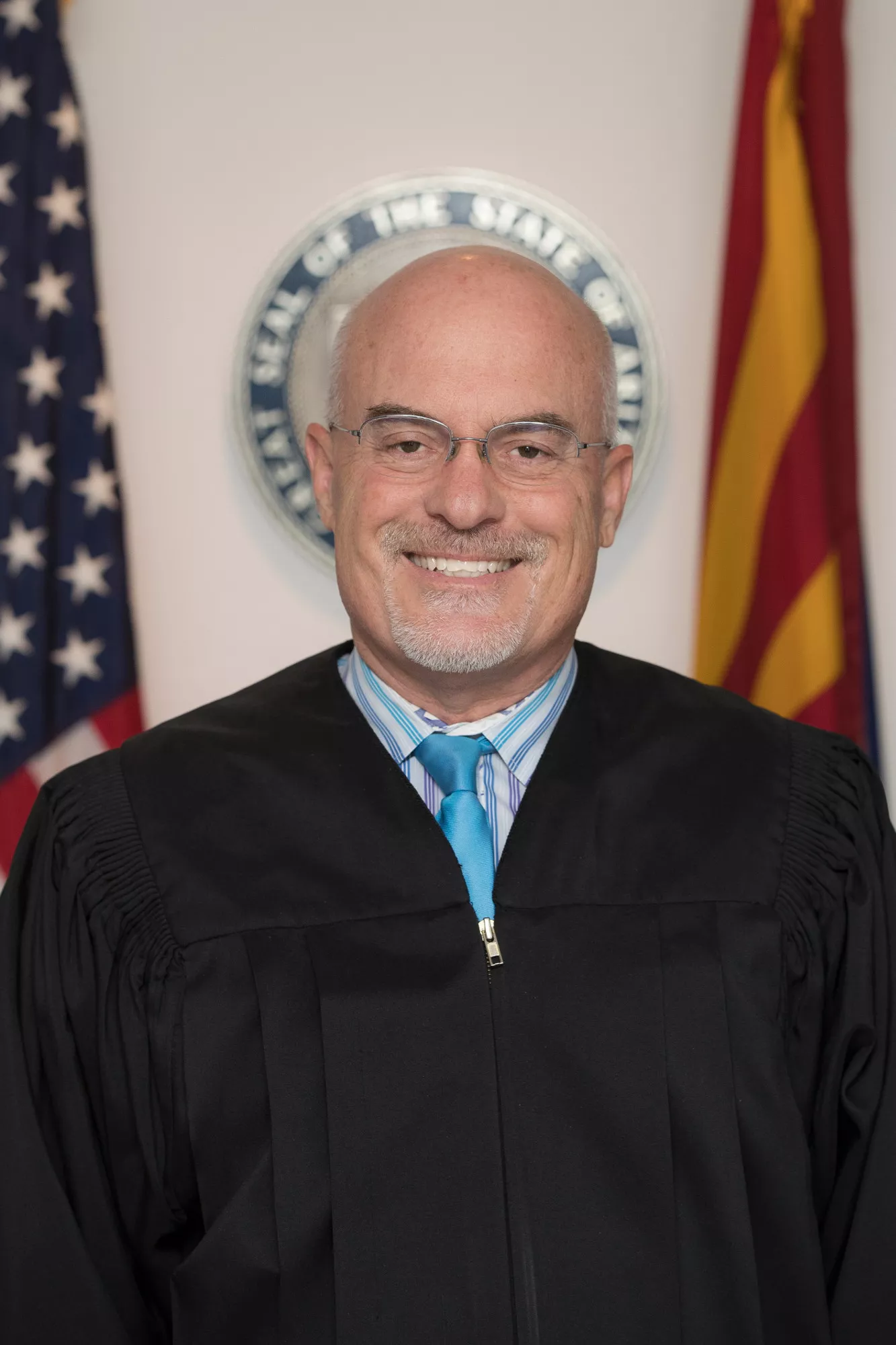
Judge Adam Watters, the justice of the peace for Precinct 1, fired a bullet at the ground to scare off a landlord, Fei Qin, 38, who was part of an eviction case he presided over in January.
The judge claims for weeks, the man dumped trash on Watters’ property and slashed his truck tires on two separate occasions.
In an incident report from the Pima County Sheriff’s Department, Watters, 59, told officers he went to leave for work on the morning of Feb. 5 to find the tires of Ford F-150 sliced open and deflated.
Watters’ wife, Jill Watters, told police she heard her dogs barking the night before and went to investigate, but found nothing. The next morning, she learned all four of her husband’s tires had been slashed while a bag of trash was left sitting on the roadway near the truck.
“She advised in her neighborhood, there was not so much as a grocery bag blowing around, so it looked to be out of place,” the police report said.
Judge Watters, who did not respond to multiple requests for an interview for this story, hoped the tire vandalism would be a one-time incident—perhaps someone he put in jail or an individual who was unhappy with a judgment and sought retribution.
But as the days went by, the Watters family continued to find trash littering their property.
The morning of Feb. 11, Watters told police his wife came inside the house visibly upset and said: “They’ve done it again.”
All four of Watters’ truck tires had been slashed a second time. He said another bag of trash was left in place of the one left behind in the first vandalism.
The report said in one of the trash dumps on Feb. 13, police found a letter addressed to Shayna Serrato, a tenant of Qin’s he attempted to evict in a case Watters presided over.
Watters arranged a periodic check-in with the Pima County Sheriff’s Department. Police would drive by to check on the residence due to the ongoing littering and vandalism reports. The judge told police he’d seen deputies driving by in the early morning hours, as the stress of the situation kept him from sleeping.
Neighbors had documented a grey Subaru station wagon driving past the house. Esther Underwood, head of the neighborhood watch, told police she once saw a man exit the vehicle and slowly walk up to the residence and return to his car again.
While Underwood was able to take photos of the car and its license plate, the driver’s face had yet to be captured.
According to the incident report, on Feb. 14, Watters’ set out on a mission to capture a photo of the litterer’s face. The man would usually make his drive-bys around noon.
The morning of Valentine’s Day, Watters went out to breakfast with his wife and bought her flowers. He then set up a green lawn chair in the desert surrounding his residence and armed himself with a handgun.
His daughters, Caitlin and Cassandra, also set up chairs by the family’s guest house and waited for the man to arrive. The women were armed with a shotgun.
Watters told police Caitlin brought the shotgun to the house for her mother, who was often home alone. At the time, Caitlin Watters worked at the Pima County Attorney’s Office, although she has since resigned.
The judge said, at first, they didn’t expect to observe another trash dumping drive-by in their makeshift stake out—the man usually did them on weekdays. Then, Watters recounts hearing one of his daughters make the chilling statement: “He’s here.”
Wednesday, February 24, 2021

But TUSD Superintendent Gabriel Trujillo said teachers remained concerned about vaccination appointments and class sizes, among other issues.
“I don't think it's any secret that our teachers are not happy,” he said. “They're very concerned right now about coming back.”
Trujillo said the district would be surveying employees and hoped that many of their concerns would be worked out before students return to campus.
Trujillo also said that the district would extend a Feb. 28 deadline for parents to choose their learning option to March 7 because more than four out of 10 parents have yet to make a choice about whether they want to return to school or remain remote.
So far, 30% of TUSD parents have said they will continue with remote learning, 29% have said they will return to in-school instruction and 41% have yet to make a choice.
“If this trend holds up for the remaining 41%, it looks like we're going to be an even 50/50 split, in terms of a district that has half of its student body studying remotely and half of it studying in some sort of in-person learning opportunity,” Trujillo said.
For elementary schools grades K-5 and three K-8 schools (Drachman, C.E. Rose and McCorkle), there are two options available: either attend full-time on-campus Monday through Friday or remain 100% remote. High schools and middle schools, grades 6-12, also have two options. A parent can choose to have their child stay 100% remote or four half-days of in-person learning, meaning students will be on-campus in the morning and remote learning in the afternoon, with Wednesday as 100% remote learning.
Trujillo said the district also came to an agreement with the Tucson Education Association and the Educational Leadership Institute to allow teachers to simultaneously teach both in-person and remote learning students at elementary schools.
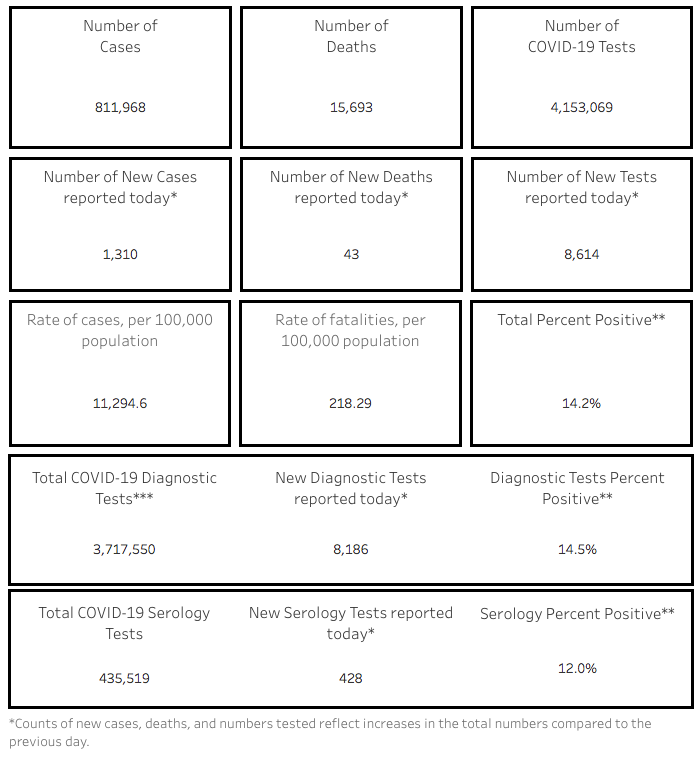
With 1,310 new cases reported today, the total number of Arizona’s confirmed novel coronavirus cases closed in on 812,000 as of Wednesday, Feb. 24, according to the Arizona Department of Health Services.

Pima County, which reported 142 new cases today, has seen 108,772 of the state’s 811,968 confirmed cases.
With 43 new deaths reported today, a total of 15,693 Arizonans have died after contracting COVID-19, including 2,186 deaths in Pima County, according to the Feb. 24 report.
The number of hospitalized COVID cases statewide has declined in recent weeks, with 1,449 coronavirus patients in the hospital as of Feb. 23. That’s less than a third of the number hospitalized at the peak of the winter surge, which reached 5,082 on Jan. 11. The summer peak was 3,517, which was set on July 13, 2020. The subsequent lowest number of hospitalized COVID patients was 468, set on Sept. 27, 2020.
A total of 1,208 people visited emergency rooms on Feb. 23 with COVID symptoms, a big drop from the record high of 2,341 set on Tuesday, Dec. 29, 2020. That number had peaked during the summer wave at 2,008 on July 7, 2020; it hit a subsequent low of 653 on Sept. 28, 2020.
A total of 430 COVID-19 patients were in intensive care unit beds on Feb. 22, down from a peak of 1,183 set on Jan. 11. The summer’s record number of patients in ICU beds was 970, set on July 13, 2020. The subsequent low was 114 on Sept. 22, 2020.
How to get a vaccine
While supplies are limited, Pima County is providing vaccination shots to people 65 and older as well as educators, first responders and healthcare workers. Those who qualify in Pima County’s 1B priority group of eligible vaccine recipients can register for a vaccine at www.pima.gov/covid19vaccineregistration or by calling 520-222-0119.
A state-run vaccination site opening at the University of Arizona began appointments last week. The new site follows the state’s current vaccine eligibility, which includes those 65 and older, educators, childcare workers and protective service workers.
The POD is expanding its hours of operation from 10 a.m. to 10 p.m seven days a week.
As the state-run POD, or point of distribution, registrations will go through ADHS’s website. Online registration will be available at podvaccine.azdhs.gov, and those who need assistance can call 1-844-542-8201. More details here.
FDA says Johnson & Johnson vaccine is good to go for emergency use
The Food and Drug Administration announced his morning that the Johnson & Johnson COVID vaccine meets requirements for emergency use, according to CNN.
The Vaccines and related Biological Products Advisory Committee plans to meet Friday to recommend whether the vaccine should be approved for use.
Tuesday, February 23, 2021
After hearing the distressing story of a mother desperate to conceive children only to find out the artificial insemination treatments she received were sourced from the very doctor she entrusted to provide her sperm from an anonymous donor, Arizona Sen. Victoria Steele (D-Tucson) decided to use her position of power to help other victims.
When Kristen Finlayson took an Ancestry DNA kit in 2019, her mother, Debra Guilmette, discovered that Dr. James Blute III, who provided her fertility treatments in the ’80s, used his own sperm to inseminate her instead of using sperm from an anonymous Hispanic donor as she requested.
Finlayson went 34 years believing she was of Hispanic descent, only to find out the DNA test results showed she had no Hispanic DNA and was primarily Irish. The Ancestry site shows that Finlayson has 12 half-siblings, including children of the doctor who delivered her.

Finlayson’s DNA tests revealed that Blute is her biological father.
Steele saw the story, first reported by Lupita Murillo of KVOA News 4 Tucson, and drafted a bill that would make fertility fraud a criminal offense in Arizona as it is in California, Indiana and Texas.
Steele introduced the bill before the 2021 state legislative session began, but her bill was never assigned to a committee.
“I requested a meeting with [Senate President Karen Fann], I said I'd like to see her because I want to ask her to please reconsider, and please assign this to a committee so it can get a hearing,” Steele said. “I think that she may be thinking that this is a controversial bill, but I think that actually, I put a bill up here that everybody can get behind, and we could have a real bipartisan bill . . . I assumed that in a few days, it would be assigned to a committee because she would look at it, and in her heart of hearts, she would get that this really does make sense.”
On Jan. 20, Steele found out a bill criminalizing fertility fraud did make it to a committee to be voted on, but it was not hers.
Sen. Nancy Barto, R-Phoenix, had introduced a similar bill that would make fertility fraud a criminal offense. It was assigned to the Senate Judiciary Committee on Jan. 20.
“I was floored. I knew [Barto] would like it, but I didn't know she'd like it that much,” Steele said. “It's not against the rules, and so she has every right to take my bill and put it in and take credit for it. It doesn't matter, as long as the bill gets passed. But it does matter because that kind of highly unethical behavior makes it really difficult to have bipartisanship, and it's really difficult to get good bills to pass.”
Barto said she never knew about Steele’s bill, but that she was contacted by a constituent who had a story of fertility fraud and felt moved to draft legislation to criminalize the act.
Barto’s bill, SB 1237, proposed making “human reproductive material fraud” a class 6 felony while providing victims liquidated damages of $10,000.
Pima County’s COVID-19 testing program will continue for at least another week.
County Administrator Chuck Huckelberry asked the Pima County Board of Supervisors to consider suspending the county’s free COVID-19 testing program due to a lack of funds from the state, but the county is maintaining the program until at least March 2 following an announcement from the state health department that they’ll provide Pima County around $14.4 million to support testing efforts.
Huckelberry first suggested halting the testing program in a memo released Feb. 18 after state officials told the county they would only reimburse $1 million in testing costs out of the $47,750,000 in COVID-19 testing the county incurred since April 2020.
While initially running the county’s testing operations under the assumption Pima County would be covered by the $416 million provided to Arizona for testing through the 2021 Consolidated Appropriations Act, Huckelberry wrote in the memo that the federal funds are “being used by the State for other purposes,” adding, “It appears the uses for which the State will be using these funds is for everything but COVID-19 testing.”
With no state reimbursement, any further county testing operations would incur deficit costs.
On Feb. 19, the Arizona Department of Health Services sent out a press release announcing it will release $100 million in federal funding to support testing across the state.
ADHS is disbursing the funds to counties using a formula of a $100,000 base amount with additional funding based on the county’s percentage of the state’s population. Pima County should receive $14.36 million.
After receiving the notification before a joint special meeting between the Pima County Board of Supervisors and Tucson City Council on Friday, Feb. 19, the Board of Supervisors decided to postpone the vote to halt testing until the next board meeting on March 2.
Monday, February 22, 2021
For the fifth straight week, COVID-19 conditions improved across the state.
The week ending Feb. 14 saw a 35% decrease in total COVID-19 cases across the state from the week prior, according to Dr. Joe Gerald, a University of Arizona professor who creates weekly coronavirus epidemiology reports based on Arizona Department of Health Services data.
In Pima County, cases declined 31% from the week before, Gerald said in the report.
The past four weeks have seen 5,308 COVID-19 cases the week beginning Jan. 17, 3,782 cases the week of Jan. 24, 2,473 cases the week of Jan. 31 and 1,586 cases from Feb. 7 to Feb. 13, according to the most-recent Pima County data.
Hospitalizations have also decreased in these four weeks, with 283 reported the week of Jan. 17, 242 the week of Jan. 24, 140 the week of Jan. 31 and 99 the week of Feb. 7.
In the same four-week timeframe, the county reported 173, 101, 64 and 23 coronavirus deaths respectively.
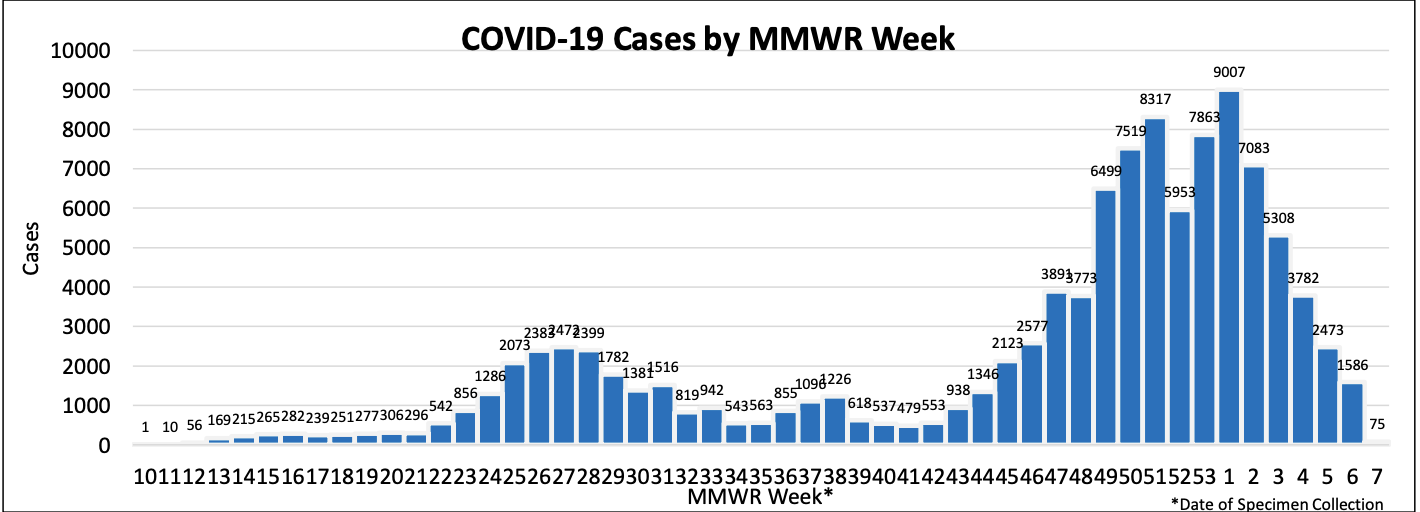
Gerald’s report says the week ending Jan. 17 remains Arizona’s deadliest at 1,011 coronavirus deaths across the state.
COVID-19 cases continue to remain above the threshold of 100 new weekly cases per 100,000 residents, which signifies elevated risk. Gerald said the week of Feb. 14 saw 158 new cases per 100,000 of the population.
As of Monday, Arizona holds the 17th highest rate for transmission in the country, according to CDC data. Gerald says the state is the sixth hardest hit in terms of identified cases.
Arizona saw a 28% decrease in general ward hospital bed usage among COVID-19 patients during the week of Feb. 19, while the number of coronavirus patients occupying ICU beds dropped 26% from the previous week, according to Gerald’s data.

WASHINGTON – Arizona continues to be one of the worst states in the nation when it comes to funding higher education, still reeling from deep budget cuts that were made during the recession, according to a new national report.
The Center on Budget and Policy Priorities studied state funds from the time of the Great Recession in 2008 until 2019, right before the COVID-19 pandemic hit.
When adjusted for inflation, Arizona spending per student in the state decreased by 54.3%, the largest drop in all 50 states. Louisiana was in second place, with an inflation-adjusted drop of 37.7% in state support.
Arizona also had the second-highest percentage increase in tuition during the period, with its 78% hike trailing only Louisiana’s 96.8%. But Arizona’s increase was the largest in terms of actual dollars, rising $5,224 over 11 years to an average of $11,921 for in-state Arizona students across all public four-year colleges and universities.
David Lujan, director of the Arizona Center for Economic Progress, called the state’s budget priorities skewed.
“Arizona actually provides more funding each year to our state Department of Corrections to incarcerate people than we provide to all three of our state universities combined,” Lujan said in a conference call to release the report.
Friday, February 19, 2021
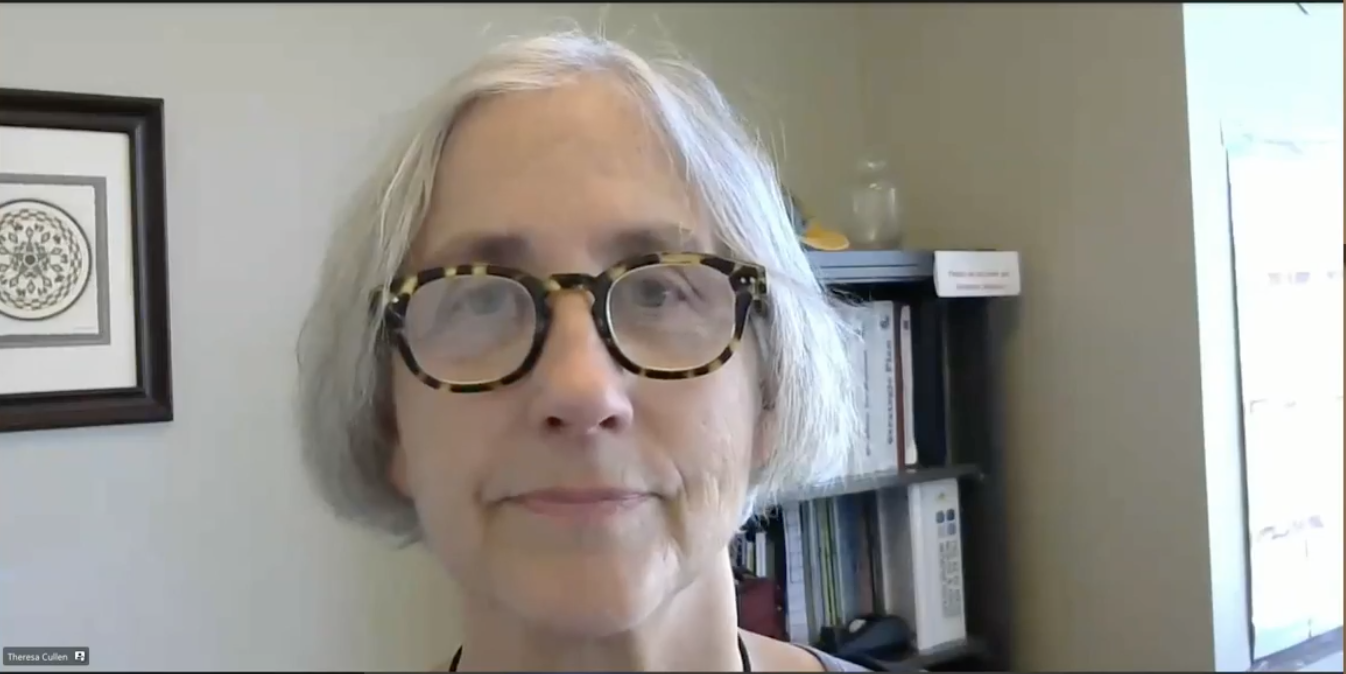
After the initial announcement Pima County would only receive 12,500 COVID-19 vaccines next week, the county health department announced they expect to receive another 4,600 doses.
The 17,100 doses of the Moderna vaccine will be coupled with the doses that were delayed this week due to harsh winter weather conditions across the U.S. for a total of 33,400 doses.
Pima County Health Department Director Dr. Theresa Cullen said this week’s 16,300 delayed doses are stuck at a FedEx facility in Memphis, Tenn., and will arrive Monday, Tuesday or Wednesday next week.
This week, the 17,100 doses allocated to the county from the state are expected to arrive Tuesday or Wednesday, Cullen said.
The county now only has insight into the allocation of Moderna vaccines, as the state health department has taken over all Pfizer allotments.
“When we opened up the allotment tool on Wednesday night, we got allotted 12,500,” Cullen said. “At that point, we thought we were canceling almost 4,800 appointments. Today, lo and behold, out of the blue, we get a text that says, ‘Oh, there's 4,600 more doses coming your way.’”

