

Tuesday, August 25, 2020
ProPublica is a nonprofit newsroom that investigates abuses of power. Click here to read their biggest stories as soon as they’re published.
This article is co-published with The Texas Tribune, a nonprofit, nonpartisan local newsroom that informs and engages with Texans.
Near the end of a lengthy indictment detailing fraud allegations against Stephen Bannon, former Donald Trump campaign CEO and chief strategist and his associates, federal prosecutors reveal that they intend to seize the assets of a murky nonprofit organization Bannon launched in 2017 to promote “economic nationalism.”
The group is Citizens of the American Republic, a California-based nonprofit that serves as a platform for Bannon’s films and podcasts that promote Trump’s ideology. Throughout the 24-page indictment, the group appears to be referenced as “Non-Profit-1” in a scheme in which Bannon and his partners were allegedly looting a crowdsourced charity, We Build the Wall, for personal gain. The indictment never outright states that “Non-Profit-1” is Citizens of the American Republic, but it describes it as an “organization founded by [Bannon] with the stated purpose of promoting economic nationalism and American sovereignty,” which closely matches the nonprofit’s own stated aims.
The indictment alleges that “Non-Profit-1” received over $1 million through the scheme and funneled part of it to Brian Kolfage, the military veteran who raised money to build a privately funded wall to help Trump block off the southern border.

This article is co-published with The Texas Tribune, a nonprofit, nonpartisan local newsroom that informs and engages with Texans.
Near the end of a lengthy indictment detailing fraud allegations against Stephen Bannon, former Donald Trump campaign CEO and chief strategist and his associates, federal prosecutors reveal that they intend to seize the assets of a murky nonprofit organization Bannon launched in 2017 to promote “economic nationalism.”
The group is Citizens of the American Republic, a California-based nonprofit that serves as a platform for Bannon’s films and podcasts that promote Trump’s ideology. Throughout the 24-page indictment, the group appears to be referenced as “Non-Profit-1” in a scheme in which Bannon and his partners were allegedly looting a crowdsourced charity, We Build the Wall, for personal gain. The indictment never outright states that “Non-Profit-1” is Citizens of the American Republic, but it describes it as an “organization founded by [Bannon] with the stated purpose of promoting economic nationalism and American sovereignty,” which closely matches the nonprofit’s own stated aims.
The indictment alleges that “Non-Profit-1” received over $1 million through the scheme and funneled part of it to Brian Kolfage, the military veteran who raised money to build a privately funded wall to help Trump block off the southern border.
This story was supported by the Pulitzer Center.
PHOENIX – Nearly 200 tents stand inches apart on the scorching gravel lots, many covered in blankets for an extra layer of relief from the desert sun. Outside, their occupants sit on hot ground or in folding chairs, nearby palm trees providing no shade. Despite 12-foot-square sections painted in the gravel, there is little social distancing for Phoenix’s homeless population.
Created by local officials in late April as a temporary solution for some of the estimated 3,700 unsheltered homeless, the fenced-in lots on the edge of downtown promised round-the-clock security, social distancing and access to water and toilets. But residents complain that hygiene supplies have become scarce, and measures meant to contain the spread of COVID-19 are not enforced.
“We have been, like, ignored,” said Elisheyah, 61. “There’s no safety, nothing to guarantee you can be safe out here.”
Homeless people are one of the most vulnerable populations in the coronavirus pandemic, yet they’re largely invisible victims of the crisis. Very little is known about how they’re faring, in part because the Department of Housing and Urban Development – the main federal agency overseeing programs for them – has not required its national network of providers to gather information on infections or deaths. That’s despite the fact that unlike other high-risk, congregate-living groups, such as nursing home residents and prisoners, homeless people interact more with the general public.
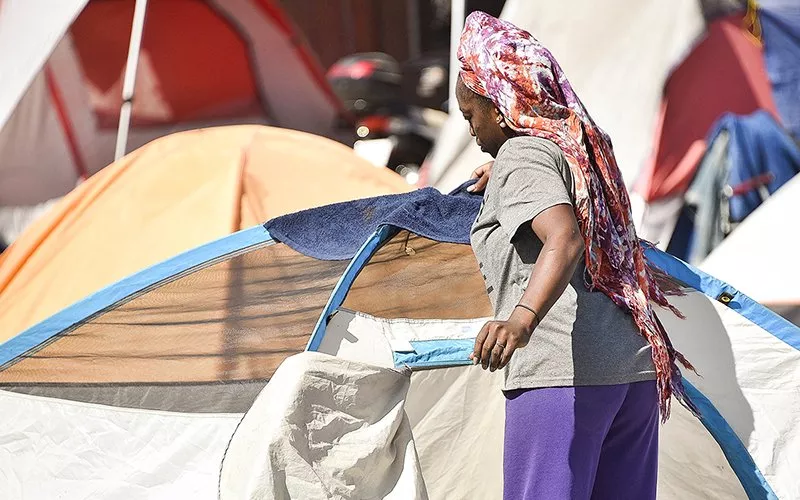
PHOENIX – Nearly 200 tents stand inches apart on the scorching gravel lots, many covered in blankets for an extra layer of relief from the desert sun. Outside, their occupants sit on hot ground or in folding chairs, nearby palm trees providing no shade. Despite 12-foot-square sections painted in the gravel, there is little social distancing for Phoenix’s homeless population.
Created by local officials in late April as a temporary solution for some of the estimated 3,700 unsheltered homeless, the fenced-in lots on the edge of downtown promised round-the-clock security, social distancing and access to water and toilets. But residents complain that hygiene supplies have become scarce, and measures meant to contain the spread of COVID-19 are not enforced.
“We have been, like, ignored,” said Elisheyah, 61. “There’s no safety, nothing to guarantee you can be safe out here.”
Homeless people are one of the most vulnerable populations in the coronavirus pandemic, yet they’re largely invisible victims of the crisis. Very little is known about how they’re faring, in part because the Department of Housing and Urban Development – the main federal agency overseeing programs for them – has not required its national network of providers to gather information on infections or deaths. That’s despite the fact that unlike other high-risk, congregate-living groups, such as nursing home residents and prisoners, homeless people interact more with the general public.
WASHINGTON – Rep. Paul Gosar, R-Prescott, joined a chorus of Republicans defending the changes to the Postal Service and accusing Democrats in a sometimes-heated hearing of conspiring to create problems with this fall’s presidential election.
“I want to clear up some obvious political disinformation that the majority is putting out,” Gosar said at the House Oversight and Government Reform Committee meeting where Republicans defended cost-cutting moves by new Postmaster General Louis DeJoy.
But Democrats said DeJoy’s decisions to remove some mail equipment, cut back on overtime and other changes have directly affected the delivery of mail, which they fear could hamper mail-in balloting this fall.
“Our entire country is experiencing these delays as a result of Mr. DeJoy’s actions,” said Rep. Carolyn B. Maloney, D-New York, and chairwoman of the committee.
The hearing came two days after the House, in a largely partisan vote, approved the “Delivering for America Act” Saturday 257-150, with the no votes coming from 149 Republicans and one independent member.
Arizona lawmakers followed suit, with all five Democrats in the House voting for the bill and all four Republicans opposing it.
Maloney’s office said the bill would provide the Postal Service with $25 billion “to help weather the coronavirus crisis and returns operations to the way they were before the Postmaster General recently caused nationwide delays in the mail.”

“I want to clear up some obvious political disinformation that the majority is putting out,” Gosar said at the House Oversight and Government Reform Committee meeting where Republicans defended cost-cutting moves by new Postmaster General Louis DeJoy.
But Democrats said DeJoy’s decisions to remove some mail equipment, cut back on overtime and other changes have directly affected the delivery of mail, which they fear could hamper mail-in balloting this fall.
“Our entire country is experiencing these delays as a result of Mr. DeJoy’s actions,” said Rep. Carolyn B. Maloney, D-New York, and chairwoman of the committee.
The hearing came two days after the House, in a largely partisan vote, approved the “Delivering for America Act” Saturday 257-150, with the no votes coming from 149 Republicans and one independent member.
Arizona lawmakers followed suit, with all five Democrats in the House voting for the bill and all four Republicans opposing it.
Maloney’s office said the bill would provide the Postal Service with $25 billion “to help weather the coronavirus crisis and returns operations to the way they were before the Postmaster General recently caused nationwide delays in the mail.”

Photo by Bytemarks/Creative Commons
Record numbers of Americans are receiving unemployment insurance during the pandemic. That’s because of the enormous scale of jobs lost — but also because Congress greatly expanded the number of workers eligible for benefits. For the first time, thanks to the Pandemic Unemployment Assistance program, part-timers, independent contractors and gig workers qualify for unemployment payments. Black workers are overrepresented in these nontraditional positions, which in the past has contributed to making them less likely to receive unemployment payments than other groups.
Yet despite the expansion of eligibility, a smaller percentage of unemployed Black workers are receiving unemployment benefits than white workers during the pandemic, according to national survey data from NORC at the University of Chicago: 13% of jobless Black workers received such payments between April and June, compared with 22% for Hispanic workers and 24% for white workers.
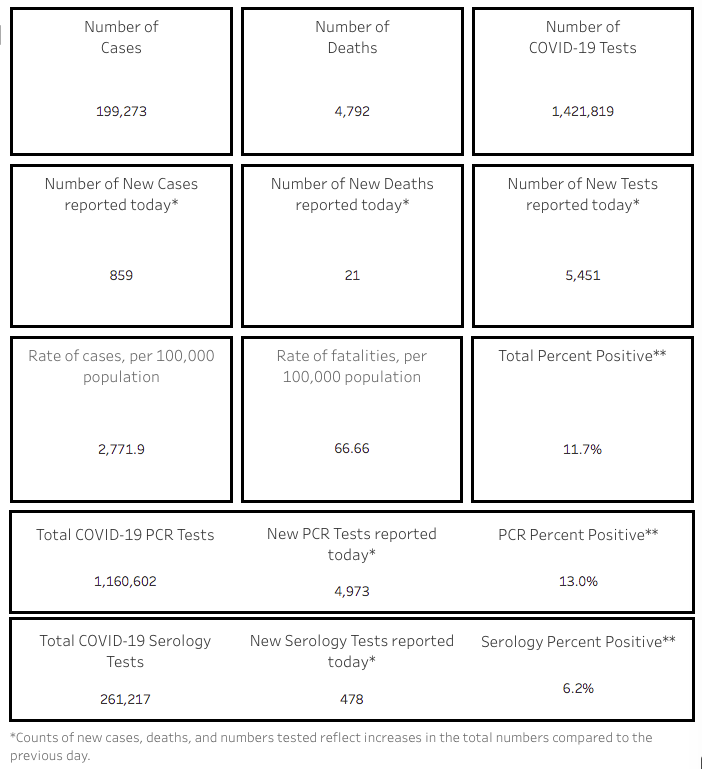
The number of Arizona’s confirmed novel coronavirus cases topped 199,000 as of Tuesday, Aug. 25, according to the Arizona Department of Health Services.
Pima County had seen 20,919 of the state’s 199,273 confirmed cases.

With 21 new deaths reported today, a total of 4,792 Arizonans had died after contracting COVID-19, according to the Aug. 25 report.
The number of hospitalized COVID cases remained below 1,000 yesterday. ADHS reported that 999 COVID patients were hospitalized in the state. That number peaked at 3,517 on July 13.
A total of 900 people visited ERs on Aug. 24 with COVID symptoms. That number peaked at 2,008 on July 7.
A total of 319 COVID-19 patients were in intensive care unit beds on Aug. 24, the lowest that number has been since May 22, when 309 people were in ICU. The number in ICUs peaked at 970 on July 13.
In Pima County, the week-by-week counting of cases peaked the week ending July 4 with 2,398 cases, according to an Aug. 19 report from the Pima County Health Department. Those numbers have dropped with Pima County requiring the wearing of masks in public but they have plateaued in recent weeks, with 832 cases in the week ending Aug. 8 and 819 cases in the week ending Aug. 15. (Not all recent cases may have been reported.)
Deaths in Pima County are down from a peak of 54 in the week ending July 4 to 19 for the week ending Aug. 8.
Hospitalization peaked the week ending July 18 with 247 COVID patients admitted to Pima County hospitals. For the week ending Aug. 8, 88 COVID patients were admitted to Pima County hospitals.
City of Tucson offering rental assistance, grants for those affected by pandemic
The City of Tucson has allocated $4.5 million of federal CARES Act funding for an emergency rent and utility assistance program available to city residents.
To be eligible for the financial assistance, participating renters must have been financially impacted by the COVID-19 pandemic and the household income cannot exceed $68,400.
One application will be accepted per household, and each household can receive up to $2,500 to cover up to three months of late or upcoming rent or utility payments that were incurred after March 1, 2020.
All applicants will need to provide copies of their identification, bills, proof of income and other household information. The city’s Housing and Community Development department is partnering with several nonprofit organizations to administer these funds, including Primavera, Interfaith Community Services, Catholic Community Services and the International Rescue Committee.
Representatives from one of these agencies will contact applicants within five days for a phone interview and may ask for additional information. The funds will be sent directly to each applicants’ landlord and/or utility company.
“Keeping Tucsonans safe and healthy in their homes is the most important thing as many of our residents have been greatly impacted financially by this pandemic,” said Housing and Community Development Director Liz Morales in a press release.
The application process is open and renters are encouraged to apply as soon as possible. Visit www.tucsonaz.gov/hcd/rent-help to complete an application. If you need assistance or are unable to complete the application online, call (520) 837-5364 or email [email protected].
The city is also setting aside $3 million of CARES Act funding to be distributed to local workers and families that have been negatively impacted by the crisis.
The grant program, named the “We Are One | Somos Unos Resiliency Fund” will focus on individuals and households that have not received any state or federal COVID-19 relief money and whose income does not reach Pima County’s self-sufficiency standard.
The self-sufficiency standard measures how much money an individual or family needs to earn to be able to meet their basic needs with no public or private financial assistance. In 2018, the self-sufficiency standard for a single adult in Pima County was $9.66 per hour or $1,700 per month. For a household with two adults and two young children, the standard was $13.22 per hour for both adults, or $4,711 per month.
The city is partnering with the Women’s Foundation of Southern Arizona, which will administer the grants and accept applications until 5 p.m. on Wednesday, Sept. 9.
In addition, the city’s We Are One | Somos Unos Resiliency Fund recently received a $1.25 million donation to provide financial relief for Tucson’s immigrant communities during the COVID-19 pandemic.
The donations, from the Open Society Foundations and an anonymous donor, will provide funds to immigrants living in the City of Tucson and the City of South Tucson. These are people who have been significantly impacted by COVID-19 but are often excluded from federal aid.
The Open Society Foundations is a worldwide philanthropic organization run by billionaire George Soros.
The $1.25 million will be disbursed through grants to those who were not eligible to receive federal CARES Act stimulus checks earlier this year, and who face additional barriers to financial assistance programs, according to a city press release.
“It is unconscionable that many of our fellow Tucsonans do not have access to federal aid despite risking their lives serving as essential workers during this pandemic,” said Mayor Regina Romero in the release. “No one should suffer hardship in the shadows and, unfortunately, that’s the painful reality many immigrants are enduring.”
Tucson council member Lane Santa Cruz said that early in the COVID-19 pandemic advocates from the Immigrant Empowerment Taskforce shared information about how immigrant families were being affected. In the release, Santa Cruz said they were grateful for the donations which will help the city address these economic injustices.
The Sunnyside Foundation has been designated as the administrator of the funds, and details on how to receive aid will be shared on Sept. 1 at www.sunnysidefoundation.org.
“Entire families in our community are being evicted from their homes, losing jobs, and having to decide between buying groceries or paying utility bills,” said Sunnyside Foundation Executive Director Kerri Lopez-Howell in the release. “We are honored to steward these resources and eager to work alongside grassroots community leaders, organizers, and advocates to ensure that those most impacted receive these dollars.”
Rent assistance available for biz closed by Ducey’s executive order
Gov. Doug Ducey's administration and the Local First Arizona Foundation will accept applications for a new grant program that aims to provide $10 million in financial assistance to small businesses across the state.
The Arizona Small Business Rent and Mortgage Relief Grant program will focus on helping local businesses that had to close their operations during the COVID-19 pandemic. The governor’s office is partnering with the foundation in order to facilitate the disbursements.
“The partnership leverages the grantmaking experience and small business expertise of Local First Arizona Foundation, which has already distributed over $2 million in grant funds to small businesses across the state of Arizona, to continue their work of putting small businesses on a path for recovery,” said Local First Communications Manager Maria Lopez in a press release.
The grants will provide up to two months of rent or mortgage payments for small businesses headquartered in Arizona that were directly impacted by the governor’s Executive Order 2020-43, which shuttered gyms, fitness centers, bars, nightclubs, indoor movie theatres, water parks and tubing operators in response to the spread of COVID-19 throughout the state.
Qualifying businesses can receive up to $25,000, and the money will be prioritized for businesses that are struggling the most to meet their financial obligations and do not have access to other financial support, the release states.
In order to be eligible for this grant program, businesses must have been operating in Arizona prior to Jan. 1, 2020; must be directly impacted by the executive order; must be renting or leasing a physical location outside the owner’s personal residence and must be employing fewer than 50 workers.
Each business owner can only apply for one grant. In order to apply, owners are encouraged to provide rent or mortgage statements for June through October, income source information, attestation of cash on hand and/or attestation of good standing with the Arizona Department of Revenue.
The grant program will give preference to businesses that are the primary or sole source of income for its owners.
The application process opened this morning. Interested individuals can fill out an application at www.localfirstaz.com/azsmallbizrent.
Get tested: Pima County has several testing centers
Pima County has three free testing centers with easy-to-schedule appointments—often with same-day availability—and you get results in less than 72 hours.
Centers offering a nasal swab are at the Kino Event Center, 2805 E. Ajo Way, and the Udall Center, 7200 E. Tanque Verde Road. The center at the northside Ellie Towne Flowing Wells Community Center, 1660 W. Ruthrauff Road, involves a saliva test designed by ASU.
Schedule an appointment at pima.gov/covid19testing.
The centers are also tied into Pima County’s developing contact tracing operation, which aims to be able to identify potential clusters and warn people if they have been in contact with someone who is COVID-positive.
If you’re interested in a test to determine if you’ve already had COVID-19, the UA has expanded a free COVID-19 antibody testing program to include 15 new categories of essential workers considered at high risk for exposure. The antibody test, developed by researchers at UA Health Sciences, determines who has been exposed to and developed an immune response against COVID-19.
In addition to healthcare workers and first responders, the test program is now open to educators, childcare workers, agriculture, grocery and foodservice workers, hospitality employees, solid-waste collection workers, transportation services workers and members of the National Guard. More information and registration for the test is available at covid19antibodytesting.arizona.edu.
—with additional reporting from Kathleen B. Kunz, Austin Counts, Jeff Gardner and Tara Foulkrod
Monday, August 24, 2020
Facebook
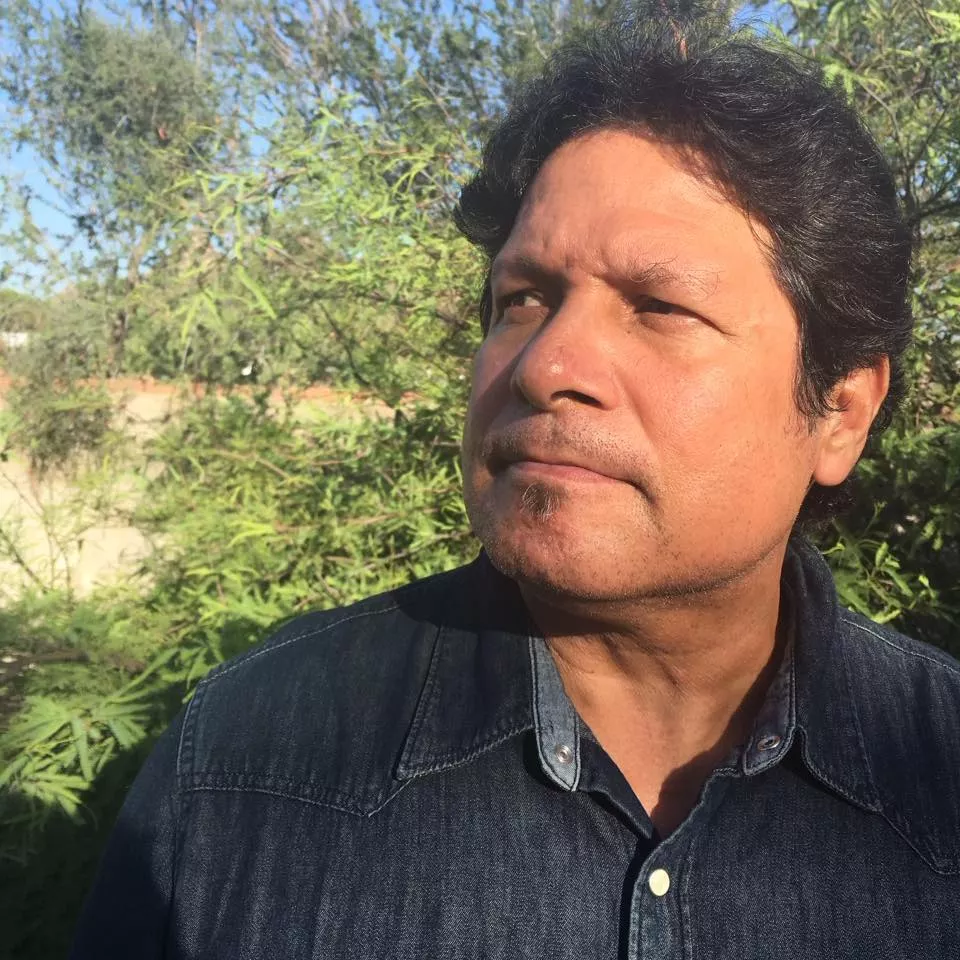
Pima County Constable Oscar Vasquez has faced disciplinary action as a result of his bad driving, altercations with Pima County residents and public urination.
Vasquez then walked up to her neighbor’s door and tried to serve the papers. When the neighbor told Vasquez that Carpenter lived next door, he first insisted that his GPS was telling him he had the right home. When the neighbor finally convinced Vasquez that he needed to go next door, he also warned Vasquez that Carpenter had dogs. Vasquez responded that he was armed with a taser.
Vasquez drove next door but Carpenter wasn’t home, so he drove his truck across her front yard, leaving behind a rut of visible tire tracks, according to a complaint Carpenter filed with the Constable Ethics, Standards & Training Board.
In his response to the complaint, Vasquez apologized for peeing in public. He said it “was not done out of malcontent.” Vasquez just really had to go: “I needed to urgently relieve myself and with the nearest restroom being nine miles away, I immediately relieved myself in order to avoid wetting myself due to being older.”
Vasquez, a Democrat who did not return a phone call from the Weekly, said in his defense that he suffered from a medical condition and was seeking treatment.
The public urination episode was only one of many that have required the Constable Ethics, Standards & Training Board to investigate and reprimand Vasquez in his first term as an elected constable with the job of delivering eviction notices and other legal summons. The string of abuses—including driving county cars at excessive speeds and smashing them up; chasing down a motorist after a near-miss accident at a four-way stop; and a recent failure to take online classes in driving safety and anger management—now has the constable ethics board asking the Pima County Board of Supervisors to suspend Vasquez without pay for at least for 30 days.
* * *
The 144-page report compiled as background for supervisors to read reveals an elected official who just can’t stay out of trouble.
WASHINGTON – Spoiled medication and missing rent checks are just some of the problems that Arizonans have seen as a result of recent postal system changes, Sen. Kyrsten Sinema said during a grilling Friday of Postmaster General Louis DeJoy.
“Over the past week, my office has heard from over 18,000 Arizonans about the importance of the Postal Service,” but many also said that the service is getting worse, the Arizona Democrat said during the Senate Homeland Security and Governmental Affairs Committee hearing.
DeJoy has come under fire for several cost-cutting changes that have led to disruptions and delays in deliveries, and raised fears about the agency’s ability to deliver mail-in ballots in this fall’s presidential election.
DeJoy defended the changes that he said were made to cut costs and have long-term efficiency benefits at an agency that stands to lose $11 billion this year, after losing $9 billion in fiscal 2019.
He told lawmakers that there “will be absolutely no issue” with mail-in ballots, noting that the Postal Service handles two to three times as much mail in a single day as it expects to handle during election week.
DeJoy also said he has ordered a pause in some changes until after Election Day “given recent customer concerns.” But the House is scheduled to vote Saturday on a bill that would mandate that freeze until the end of the year or the end of the COVID-19 pandemic.

“Over the past week, my office has heard from over 18,000 Arizonans about the importance of the Postal Service,” but many also said that the service is getting worse, the Arizona Democrat said during the Senate Homeland Security and Governmental Affairs Committee hearing.
DeJoy has come under fire for several cost-cutting changes that have led to disruptions and delays in deliveries, and raised fears about the agency’s ability to deliver mail-in ballots in this fall’s presidential election.
DeJoy defended the changes that he said were made to cut costs and have long-term efficiency benefits at an agency that stands to lose $11 billion this year, after losing $9 billion in fiscal 2019.
He told lawmakers that there “will be absolutely no issue” with mail-in ballots, noting that the Postal Service handles two to three times as much mail in a single day as it expects to handle during election week.
DeJoy also said he has ordered a pause in some changes until after Election Day “given recent customer concerns.” But the House is scheduled to vote Saturday on a bill that would mandate that freeze until the end of the year or the end of the COVID-19 pandemic.
WASHINGTON – For Hispanic Democrats upset with what they see as a failure to adequately feature Latinos
in the just-ended Democratic National Convention, one set of numbers was particularly striking.
John Kasich, the Republican former governor of Ohio, got four minutes to speak, while Rep. Alexandria Ocasio-Cortez, D-New York, got just 60 seconds.
For Joseph Garcia, director of Chicanos Por La Causa in Arizona, the numbers were not surprising.
“The message is not: Yes, we welcome you into the party,” Garcia said of the number of Latino speakers. “Part of it is figuring, ‘Latinos got nowhere to go. They have to vote for us because they’re not going to vote for Republicans with their harsh line on immigration and other issues.'”
The message that Arizona convention delegate Leyna Negron heard was that the party values her vote, but not her voice.
“We need to be included in more than just discussions of ‘get out the vote.’ We need to be seen in leadership positions,” Leyna Negron said. “And that’s not happening.”
But Jessica Mejia insists that’s not the case. Mejia, the Arizona state director for Biden for President, said this year’s DNC was the “most diverse national political convention in history.”

John Kasich, the Republican former governor of Ohio, got four minutes to speak, while Rep. Alexandria Ocasio-Cortez, D-New York, got just 60 seconds.
For Joseph Garcia, director of Chicanos Por La Causa in Arizona, the numbers were not surprising.
“The message is not: Yes, we welcome you into the party,” Garcia said of the number of Latino speakers. “Part of it is figuring, ‘Latinos got nowhere to go. They have to vote for us because they’re not going to vote for Republicans with their harsh line on immigration and other issues.'”
The message that Arizona convention delegate Leyna Negron heard was that the party values her vote, but not her voice.
“We need to be included in more than just discussions of ‘get out the vote.’ We need to be seen in leadership positions,” Leyna Negron said. “And that’s not happening.”
But Jessica Mejia insists that’s not the case. Mejia, the Arizona state director for Biden for President, said this year’s DNC was the “most diverse national political convention in history.”
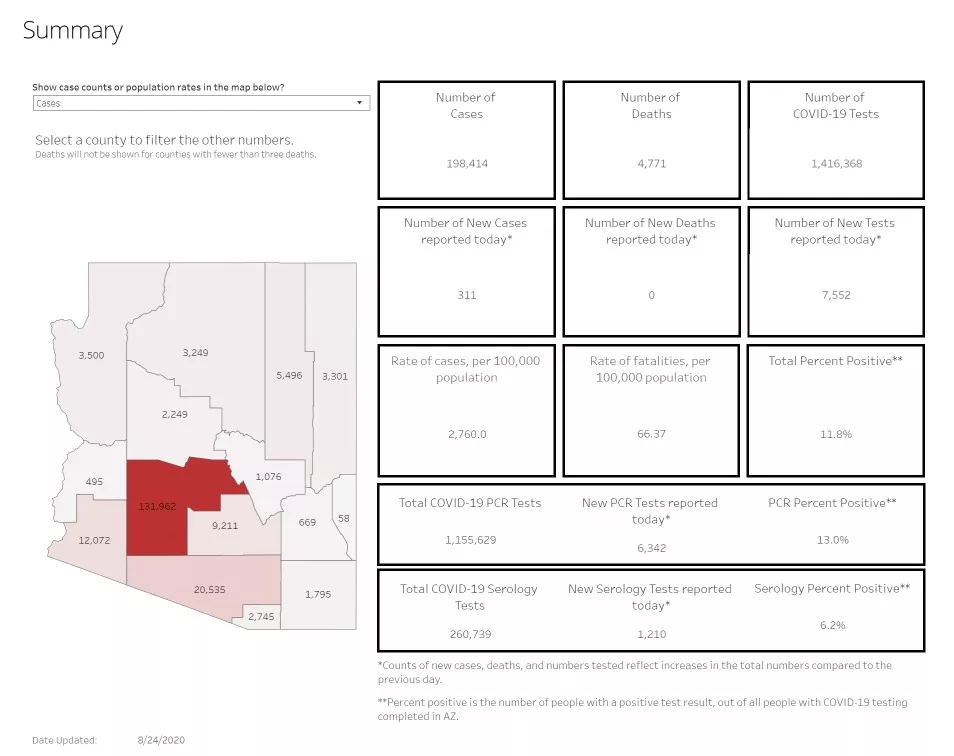
The number of Arizona’s confirmed novel coronavirus cases closed in on 199,000 as of Monday, Aug. 24, according to the Arizona Department of Health Services.
Pima County had seen 20,535 of the state’s 198,414 confirmed cases.
With 0 new deaths reported today, a total of 4,771 Arizonans had died after contracting COVID-19, according to the Aug. 24 report.
The number of hospitalized COVID cases continues to decline. ADHS reported that as of Aug. 23, 908 COVID patients were hospitalized in the state, the lowest that number has been since June 1, when 1,009 people were hospitalized. That number peaked at 3,517 on July 13.
A total of 896 people visited ERs on Aug. 23 with COVID symptoms. That number, which peaked at 2,008 on July 7, has been on a plateau for most of this month, bouncing between 1,100 and 900 since Aug. 8.
A total of 345 COVID-19 patients were in intensive care unit beds on Aug. 23, with lows rivaling numbers since May 25, when 337 people were in ICU. The number in ICUs peaked at 970 on July 13.
In Pima County, the week-by-week counting of cases peaked the week ending July 4 with 2,398 cases, according to an Aug. 19 report from the Pima County Health Department. Those numbers have dropped with Pima County requiring the wearing of masks in public but they have plateaued in recent weeks, with 832 cases in the week ending Aug. 8 and 819 cases in the week ending Aug. 15. (Not all recent cases may have been reported.)
Deaths in Pima County are down from a peak of 54 in the week ending July 4 to 19 for the week ending Aug. 8.
Hospitalization peaked the week ending July 18 with 247 COVID patients in Pima County hospitals. For the week ending Aug. 8, 88 COVID patients were in Pima County hospitals.
Ducey: Stay the Course
In a brief press conference last week that did not include Ducey’s usual PowerPoint presentation regarding statistics, Gov. Doug Ducey thanks the Trump administration, local authorities and the National Guard for their work during the pandemic.
Ducey said the state was making progress in the fight against the virus and Arizonans should continue taking precautions such as avoiding large gatherings, staying home when possible, washing hands and wearing a mask.
“We’re going to continue to be guided by the data and the doctors,” Ducey said. “Returning our kids to the classroom, reuniting with our loved ones, all of these depend on continued responsible behavior you have demonstrated so well for so long. So I urge everyone to stay the course, stay physical distanced, stay smart and healthy and continue to mask up.”
Unemployment numbers creeping upward
Pima County had seen 20,535 of the state’s 198,414 confirmed cases.
With 0 new deaths reported today, a total of 4,771 Arizonans had died after contracting COVID-19, according to the Aug. 24 report.
The number of hospitalized COVID cases continues to decline. ADHS reported that as of Aug. 23, 908 COVID patients were hospitalized in the state, the lowest that number has been since June 1, when 1,009 people were hospitalized. That number peaked at 3,517 on July 13.
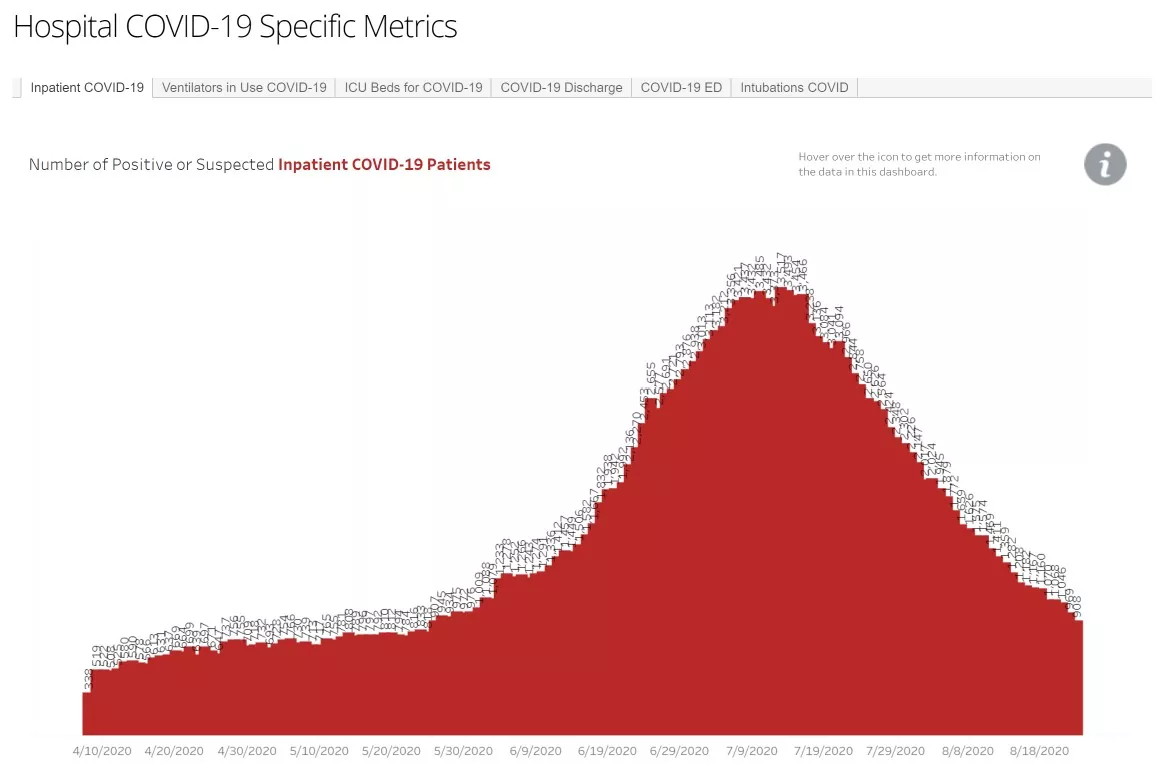
A total of 896 people visited ERs on Aug. 23 with COVID symptoms. That number, which peaked at 2,008 on July 7, has been on a plateau for most of this month, bouncing between 1,100 and 900 since Aug. 8.
A total of 345 COVID-19 patients were in intensive care unit beds on Aug. 23, with lows rivaling numbers since May 25, when 337 people were in ICU. The number in ICUs peaked at 970 on July 13.
In Pima County, the week-by-week counting of cases peaked the week ending July 4 with 2,398 cases, according to an Aug. 19 report from the Pima County Health Department. Those numbers have dropped with Pima County requiring the wearing of masks in public but they have plateaued in recent weeks, with 832 cases in the week ending Aug. 8 and 819 cases in the week ending Aug. 15. (Not all recent cases may have been reported.)
Deaths in Pima County are down from a peak of 54 in the week ending July 4 to 19 for the week ending Aug. 8.
Hospitalization peaked the week ending July 18 with 247 COVID patients in Pima County hospitals. For the week ending Aug. 8, 88 COVID patients were in Pima County hospitals.
Ducey: Stay the Course
In a brief press conference last week that did not include Ducey’s usual PowerPoint presentation regarding statistics, Gov. Doug Ducey thanks the Trump administration, local authorities and the National Guard for their work during the pandemic.
Ducey said the state was making progress in the fight against the virus and Arizonans should continue taking precautions such as avoiding large gatherings, staying home when possible, washing hands and wearing a mask.
“We’re going to continue to be guided by the data and the doctors,” Ducey said. “Returning our kids to the classroom, reuniting with our loved ones, all of these depend on continued responsible behavior you have demonstrated so well for so long. So I urge everyone to stay the course, stay physical distanced, stay smart and healthy and continue to mask up.”
Unemployment numbers creeping upward
Friday, August 21, 2020
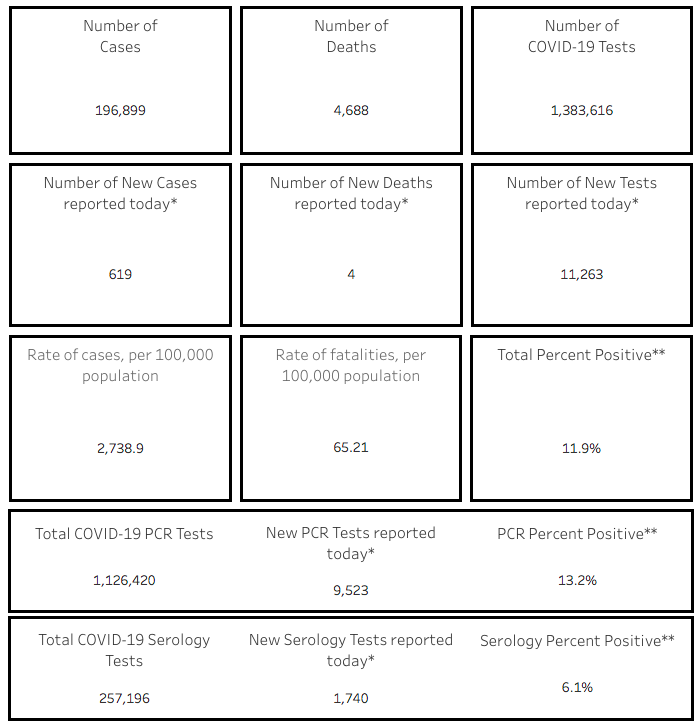
The number of Arizona’s confirmed novel coronavirus cases closed in on 197,000 as of Friday, Aug 21, according to the Arizona Department of Health Services.
Pima County had seen 20,173 of the state’s 196,899 confirmed cases.

With four new deaths reported today, a total of 4,688 Arizonans had died after contracting COVID-19, according to the Aug. 21 report.
The number of hospitalized COVID cases continues to decline. ADHS reported that as of Aug. 20, 1,068 COVID patients were hospitalized in the state, the lowest that number has been since June 1, when 1,009 people were hospitalized. That number peaked at 3,517 on July 13.
A total of 982 people visited ERs on Aug. 20 with COVID symptoms. That number, which peaked at 2,008 on July 7, has been on a plateau for most of this month, bouncing between 1,100 and 900 since Aug. 8.
A total of 365 COVID-19 patients were in intensive care unit beds on Aug. 20, the lowest that number has been since May 25, when 337 people were in ICU. The number in ICUs peaked at 970 on July 13.
Ducey: "Stay the Course"
In a brief press conference yesterday that did not include Ducey’s usual PowerPoint presentation regarding statistics, Gov. Doug Ducey thanks the Trump administration, local authorities and the National Guard for their work during the pandemic.
Ducey said the state was making progress in the fight against the virus and Arizonans should continue taking precautions such as avoiding large gatherings, staying home when possible, washing hands and wearing a mask.
“We’re going to continue to be guided by the data and the doctors,” Ducey said. “Returning our kids to the classroom, reuniting with our loved ones, all of these depend on continued responsible behavior you have demonstrated so well for so long. So I urge everyone to stay the course, stay physical distanced, stay smart and healthy and continue to mask up.”
City of Tucson offering rental assistance, grants for those affected by pandemic
The City of Tucson has allocated $4.5 million of federal CARES Act funding for an emergency rent and utility assistance program available to city residents.
To be eligible for the financial assistance, participating renters must have been financially impacted by the COVID-19 pandemic and the household income cannot exceed $68,400.

