

Thursday, August 20, 2020

This fall’s elections are the latest chapter in the slow-motion collapse of the U.S. Postal Service, one of America’s most venerated institutions. As November approaches, members of Congress and state election officials have grown increasingly concerned that the USPS will fail at a critical moment: a closely contested vote that will involve a record number of people casting a ballot by mail.
That worry was fueled by President Donald Trump’s unfounded allegation that voting by mail leads to massive fraud and by reports from Postal Service employees that key equipment was being removed and overtime was being slashed. The newly appointed postmaster general, Louis DeJoy, responded to what he termed “areas of concern” by announcing that he would approve overtime “as needed” and delay the removal of mail sorting machines until after the election. But the problems at the Postal Service go well beyond those issues and predate DeJoy. Earlier this month, the USPS warned state election officials that it might not be able to meet deadlines for delivering ballots for the November elections.
With DeJoy scheduled to testify before an emergency session of Congress on Friday, here’s a guide to help you understand the issues and what remedies lawmakers could provide.
What’s going on at the Postal Service under DeJoy? Is mail being slowed intentionally?
There are at least three possible reasons for the unusual recent delays in mail delivery.

The Pima County Board of Supervisors on Monday approved a new partnership with the Community Investment Corporation to distribute more than $3.6 million to local residents facing evictions.
The Community Investment Corporation is an economic development nonprofit working to assist in education, home ownership and entrepreneurship for Pima County residents. This partnership is part of the county’s larger commitment to distribute $20.5 million from six different funding sources for rental assistance, associated deposits and related legal fees.
The CIC will lead a coalition of nonprofit housing providers to serve at least 600 low-income renters that are currently in eviction proceedings because of COVID-19.
Financial assistance will go toward unpaid rent from as far back as March 1, 2020—if landlords agree to waive late fees, withdraw the eviction and enter into a payment plan with their tenant, according to a county press release. Legal and court fees incurred since March are also eligible for reimbursement through this program.
Pima County has hired additional workers to expedite rental assistance applications, which can be accessed through the Arizona Department of Housing’s website. The county constables will also be integral for working with tenants and landlords to generate direct referrals for the program and distribute the funds quickly to those most in need, the release states.
Tags: Rental Assistance , Eviction Prevention , Pima County , Community Investment Corporation , Grant Program , Renter , Tenant , Landlord , Image

Something gets lost in the convention experience when it is held online, as this year’s convention has been, the Arizona delegates said.
“We’re missing the camaraderie and just the energy that exudes during a convention, and missing out on meeting other delegates as well as opening up lines of communication across states,” Ford said. “They may be doing something we haven’t even thought about.”
For Engstrom, who admits to “feeling a little lost” as a first-timer, it is an honor to be a delegate but unfortunate that “we can’t be together as a whole group.”
“You miss that part because it’s that meeting and learning with people from across the country,” Engstrom said. “We can do stuff on Facebook and do Zooms here and there, but that connection is a little hard to make.”
Democrats originally planned a traditional convention in Milwaukee, where thousands of delegates, party officials, reporters and others were scheduled to gather in mid-July. But the ongoing COVID-19 pandemic forced the convention to be pushed back and then to be canceled in-person because of concerns of bringing that many people together.

Beginning today, Gov. Doug Ducey's administration and the Local First Arizona Foundation will accept applications for a new grant program that aims to provide $10 million in financial assistance to small businesses across the state.
The Arizona Small Business Rent and Mortgage Relief Grant program will focus on helping local businesses that had to close their operations during the COVID-19 pandemic. The governor’s office is partnering with the foundation in order to facilitate the disbursements.
“The partnership leverages the grantmaking experience and small business expertise of Local First Arizona Foundation, which has already distributed over $2 million in grant funds to small businesses across the state of Arizona, to continue their work of putting small businesses on a path for recovery,” said Local First Communications Manager Maria Lopez in a press release.
The grants will provide up to two months of rent or mortgage payments for small businesses headquartered in Arizona that were directly impacted by the governor’s Executive Order 2020-43, which shuttered gyms, fitness centers, bars, nightclubs, indoor movie theatres, water parks and tubing operators in response to the spread of COVID-19 throughout the state.
Qualifying businesses can receive up to $25,000, and the money will be prioritized for businesses that are struggling the most to meet their financial obligations and do not have access to other financial support, the release states.
In order to be eligible for this grant program, businesses must have been operating in Arizona prior to Jan. 1, 2020; must be directly impacted by the executive order; must be renting or leasing a physical location outside the owner’s personal residence and must be employing fewer than 50 workers.
Each business owner can only apply for one grant. In order to apply, owners are encouraged to provide rent or mortgage statements for June through October, income source information, attestation of cash on hand and/or attestation of good standing with the Arizona Department of Revenue.
The grant program will give preference to businesses that are the primary or sole source of income for its owners.
The application process opened this morning. Interested individuals can fill out an application at www.localfirstaz.com/azsmallbizrent.
Tags: COVID-19 , Coronavirus , Small Business , Executive Order , Doug Ducey , Local First Arizona Foundation , Grant Program , Image

The Watershed Management Group is hosting their first Monsoon Film Festival on Thursday, Sept. 24, and is currently seeking film submissions from the public. The virtual Monsoon Film Festival is planned to share audience stories and perspectives from the Santa Cruz Watershed and beyond.
Videos can be submitted to one of five categories:
- By or For Children: For all videos made by children or created for a young audience
- College: For films made by any college student
- We Are One Watershed: For films emphasizing WMG's values of diversity and equity
- Science: For shorts that emphasize the different scientific disciplines that relate to water, such as biology, ecology, etc.
- Steward In Place: For films that show what you can do on your own to make positive change for the environment
The only requirement is that the videos are five minutes or less and are received by Monday, Sept. 7. No experience required.
The Watershed Management Group is a Tucson-based nonprofit organization supporting sustainable communities.
Democrat Gabby Giffords, whose career in Congress was cut short after she survived an assassination attempt that ended with six dead and 12 others wounded in a 2011 mass shooting in Tucson, spoke last night at the DNC.
Giffords tied her own fight to recover from her injuries to the importance of fighting against the Trump administration.
"Confronted by despair, I'm summoned hope," Giffords said. "Confronted by paralysis and aphasia, I'm responded with grit and determination."
Giffords talked about the struggle to recover her ability to speak.
"Words once came easily but today, I struggle to speak," Giffords said. "But I have not lost my voice. America needs all of us to speak out, even when you have to fight to find the words."
She ended her brief speech with a call to elect Democratic presidential nominee Joe Biden.
"We can protect our families, our future," Giffords said. "We can vote. We can be on the right side of history. We must elect Joe Biden. He was there for me. He'll be there for you, too. Join us in this vote. Vote! Vote! Vote!"
Giffords' husband, former NASA astronaut Mark Kelly, is leading in the polls as he challenges appointed U.S. Sen. Martha McSally in Arizona this year.
The number of Arizona’s confirmed novel coronavirus cases topped 196,000 as of Thursday, Aug 20, according to the Arizona Department of Health Services.
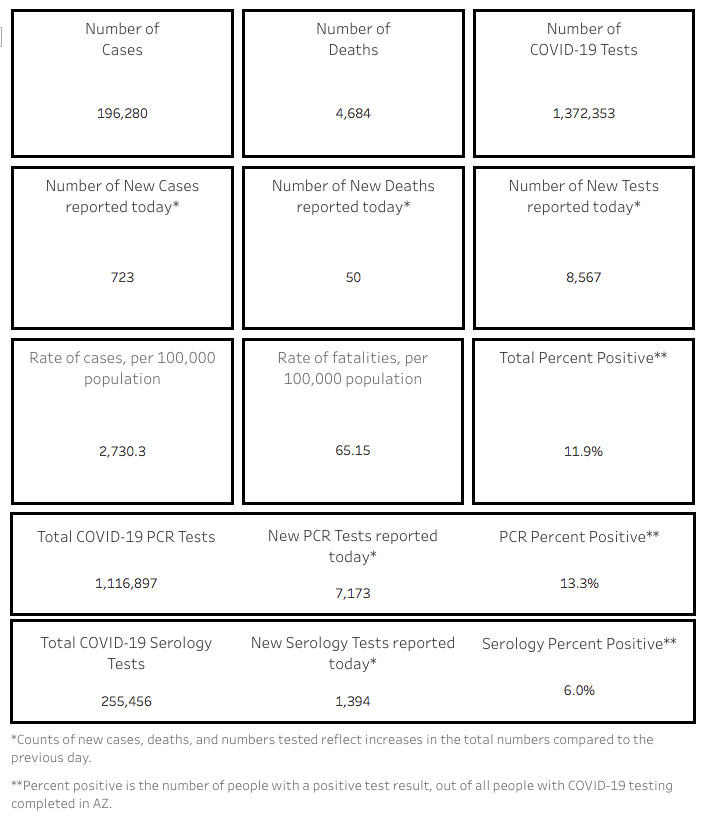
Pima County had seen 20,139 of the state’s 196,280 confirmed cases.

With 50 new deaths reported today, a total of 4,684 Arizonans had died after contracting COVID-19, including 534 in Pima County, according to the Aug. 20 report.
The number of hospitalized COVID cases continues to decline. ADHS reported that as of Aug. 19, 1,070 COVID patients were hospitalized in the state, the lowest that number has been since June 1, when 1,009 people were hospitalized. That number peaked at 3,517 on July 13.
A total of 1,035 people visited ERs on Aug. 19 with COVID symptoms. That number, which peaked at 2,008 on July 7, has plateaued at between 1,100 and 900 since Aug. 8.
A total of 388 COVID-19 patients were in intensive care unit beds on Aug. 19, the lowest that number has been since June 4, when 372 people were in ICU. The number in ICUs peaked at 970 on July 13.
City of Tucson offering rental assistance, grants for those affected by pandemic
The City of Tucson has allocated $4.5 million of federal CARES Act funding for an emergency rent and utility assistance program available to city residents.
To be eligible for the financial assistance, participating renters must have been financially impacted by the COVID-19 pandemic and the household income cannot exceed $68,400.
One application will be accepted per household, and each household can receive up to $2,500 to cover up to three months of late or upcoming rent or utility payments that were incurred after March 1, 2020.

The City of Tucson’s We Are One | Somos Unos Resiliency Fund recently received a $1.25 million donation to provide financial relief for Tucson’s immigrant communities during the COVID-19 pandemic.
The donations, from the Open Society Foundations and an anonymous donor, will provide funds to immigrants living in the City of Tucson and the City of South Tucson. These are people who have been significantly impacted by COVID-19 but are often excluded from federal aid.
The Open Society Foundations is a worldwide philanthropic organization run by billionaire George Soros.
The $1.25 million will be disbursed through grants to those who were not eligible to receive federal CARES Act stimulus checks earlier this year, and who face additional barriers to financial assistance programs, according to a city press release.
“It is unconscionable that many of our fellow Tucsonans do not have access to federal aid despite risking their lives serving as essential workers during this pandemic,” said Mayor Regina Romero in the release. “No one should suffer hardship in the shadows and, unfortunately, that’s the painful reality many immigrants are enduring.”
Tucson council member Lane Santa Cruz said that early in the COVID-19 pandemic advocates from the Immigrant Empowerment Taskforce shared information about how immigrant families were being affected. In the release, Santa Cruz said they were grateful for the donations which will help the city address these economic injustices.
The Sunnyside Foundation has been designated as the administrator of the funds, and details on how to receive aid will be shared on Sept. 1 at www.sunnysidefoundation.org.
“Entire families in our community are being evicted from their homes, losing jobs, and having to decide between buying groceries or paying utility bills,” said Sunnyside Foundation Executive Director Kerri Lopez-Howell in the release. “We are honored to steward these resources and eager to work alongside grassroots community leaders, organizers, and advocates to ensure that those most impacted receive these dollars.”
Tags: COVID-19 , Coronavirus , Relief , Financial Assistance , City of Tucson , We Are One Somos Unos Resliency Fund , Open Society Foundations , Sunnyside Foundation , Image
Wednesday, August 19, 2020

The Arizona Supreme Court will allow the Invest in Education initiative to appear on the November 2020 ballot after it was previously tossed out by a Maricopa County Superior Court Judge, who ruled its petition summary was “fraudulent or substantially confusing to Arizona voters."
The initiative proposes a 3.5 percent surcharge in state income tax on Arizona’s wealthiest residents—individuals earning more than $250,000 per year or couples earning more than $500,000 per year.
The measure could potentially raise about $940 million in tax revenue per year for the benefit of Arizona public schools and their stakeholders and would affect only the top 1 percent of Arizona earners, according to the Invest in Ed campaign.
Maricopa County Superior Court Judge Christopher Coury made the ruling to toss the initiative last month, saying that their 100-word description on petitions signed by voters didn’t include key components of what the initiative would actually do.
The Invest in Education campaign appealed his ruling, and today the Arizona Supreme Court unanimously agreed that the initiative’s description “did not create a significant danger of confusion or unfairness and reverses the trial court ruling.”
“Today’s ruling by the Arizona Supreme Court keeping Invest in Education on the November ballot is an important victory because it gives millions of Arizona voters the opportunity to put more resources into our schools,” said Invest in Education Chairwoman Amber Gould in a press release. “We are confident voters will say ‘yes’ to improving Arizona’s K-12 schools by voting ‘yes’ on Invest in Education this November. The Invest in Education Initiative was crafted to benefit all Arizona’s 1.1 million K-12 students while not taxing working and middle-class families impacted by the pandemic.”
Election officials are expected to complete a review of petition signatures for the proposition this week.
To learn more about the ballot initiative, visit investined.com.
Tags: Invest in Ed , Ballot Initiative , Arizona Supreme Court , Image
Who spent much of her allotted 30 seconds in the national spotlight talking about the reopening schools during the COVID-19 pandemic.
It was part of an unorthodox roll call of the states during an unorthodox Democratic National Convention, where almost all of the business is being conducted virtually because of coronavirus concerns.
As they announced the voted that led to former Vice President Joe Biden’s official nomination Tuesday, delegates from each of the 50 states and seven U.S. territories were encouraged to spend part of their time talking about an issue important to them – and the party.
For Garcia, that was the challenges schools are facing.
“So clearly as an Arizona educator I wanted to talk about what reopening schools is looking like for us. I wanted to talk about being a mother of a high school freshman,” she said Tuesday.
“I wanted to talk about being a union leader in this state and then I also wanted to talk about the fact that I am a very proud Chicana Latina living in Arizona where the majority of us are really going to take our chance and have our voices heard this fall,” Garcia said.

