

Monday, July 20, 2020
ProPublica is a nonprofit newsroom that investigates abuses of power. Click here to read their biggest stories as soon as they’re published.
Last August, Adam Durand, legislative director for Minnesota Rep. Collin Peterson, fired off an email on behalf of an important state manufacturer that was waging a frustrating fight for relief from President Donald Trump’s China tariffs.
“I wanted to let you know that the executive team with Polaris is meeting with Chairman Peterson this afternoon,” he wrote to Haley Dorval, an assistant to the chief of staff at the office of the U.S. Trade Representative. “It would be greatly helpful if I could talk to someone by early afternoon about the status of this issue.”
Durand’s boss had pressured USTR all year about tariffs that were costing the company millions of dollars every month. Polaris, which imports parts for its off-road vehicles and motor boats, was working every Washington angle to win tariff exemptions. An administration-backed trade bill, the U.S.-Mexico-Canada Agreement, was coming up for a vote and Polaris CEO Scott Wine told investors last summer that he was “trying to leverage votes for USMCA to help us get tariff relief.”

Last August, Adam Durand, legislative director for Minnesota Rep. Collin Peterson, fired off an email on behalf of an important state manufacturer that was waging a frustrating fight for relief from President Donald Trump’s China tariffs.
“I wanted to let you know that the executive team with Polaris is meeting with Chairman Peterson this afternoon,” he wrote to Haley Dorval, an assistant to the chief of staff at the office of the U.S. Trade Representative. “It would be greatly helpful if I could talk to someone by early afternoon about the status of this issue.”
Durand’s boss had pressured USTR all year about tariffs that were costing the company millions of dollars every month. Polaris, which imports parts for its off-road vehicles and motor boats, was working every Washington angle to win tariff exemptions. An administration-backed trade bill, the U.S.-Mexico-Canada Agreement, was coming up for a vote and Polaris CEO Scott Wine told investors last summer that he was “trying to leverage votes for USMCA to help us get tariff relief.”
PHOENIX – Arizona is one of 18 states in the coronavirus “red zone” that should take stricter action to curb the rapid spread of COVID-19, according to an internal White House report unveiled Thursday.
The document, first reported by the Washington-based nonprofit Center for Public Integrity, categorizes states as being in the red zone if they exceeded 100 new cases per 100,000 residents last week and had more than 10% positive tests for the virus. Arizona topped both categories, with 349 new cases per 100,000 residents and a 20% positive test rate, according to the document.
The report came the same day Gov. Doug Ducey said the state’s COVID-19 numbers were headed in the right direction, even as he warned state residents that the virus is here to stay and urged people to wear masks, socially distance and take other measures to curb its spread.
The report also came one day before Arizona recorded 91 new deaths, to top 2,500 for the first time, and added 3,910 new cases.
Calls seeking comment from Ducey’s office and the Arizona Department of Health Services seeking comment on the White House report were not immediately returned Friday.
But the executive director of the Arizona Public Health Association said it is important that people see the numbers in the report. Will Humble said that the percentage of positive tests, in particular, gives a clearer picture of the situation.

The document, first reported by the Washington-based nonprofit Center for Public Integrity, categorizes states as being in the red zone if they exceeded 100 new cases per 100,000 residents last week and had more than 10% positive tests for the virus. Arizona topped both categories, with 349 new cases per 100,000 residents and a 20% positive test rate, according to the document.
The report came the same day Gov. Doug Ducey said the state’s COVID-19 numbers were headed in the right direction, even as he warned state residents that the virus is here to stay and urged people to wear masks, socially distance and take other measures to curb its spread.
The report also came one day before Arizona recorded 91 new deaths, to top 2,500 for the first time, and added 3,910 new cases.
Calls seeking comment from Ducey’s office and the Arizona Department of Health Services seeking comment on the White House report were not immediately returned Friday.
But the executive director of the Arizona Public Health Association said it is important that people see the numbers in the report. Will Humble said that the percentage of positive tests, in particular, gives a clearer picture of the situation.
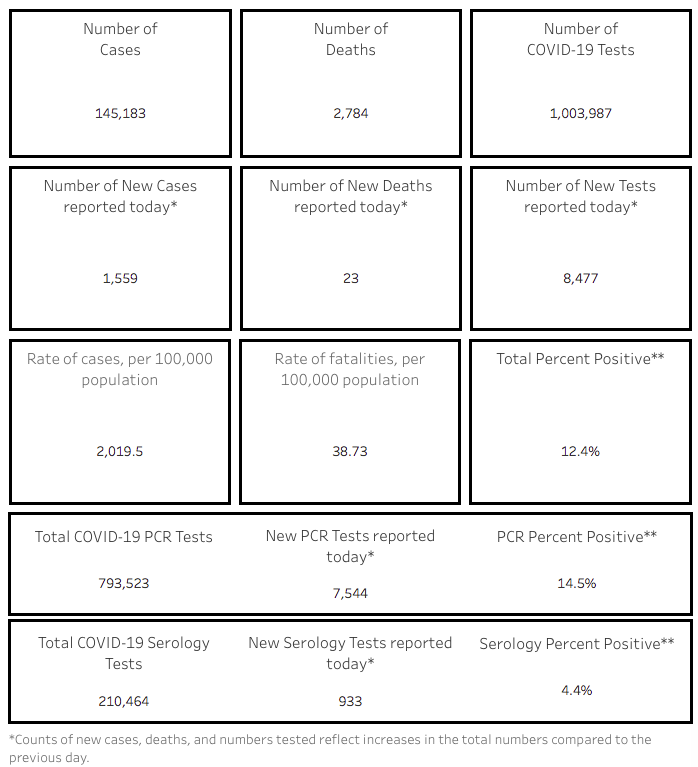
The total number of confirmed coronavirus cases in Arizona climbed past 145,000 as of Monday, July 20, after the state reported 1,559 new cases this morning, according to the Arizona Department of Health Services.
Pima County had seen 13,994 of the state's 145,183 confirmed cases.

A total of 2,784 people have died after contracting the virus, including 382 in Pima County.
Maricopa County has 96,711 of the state's cases.
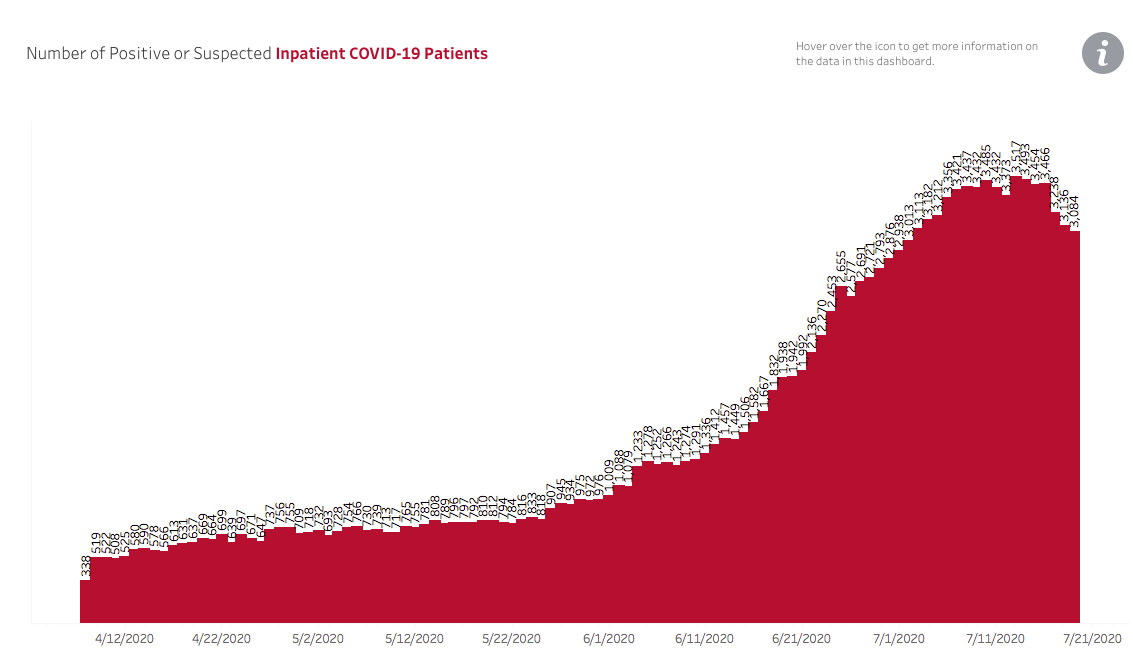
Hospitals remain under pressure, although they report in slight decrease in the number of Arizonans hospitalized with COVID-19-related symptoms. The report shows that 3,084 COVID patients were hospitalized yesterday in the state, down from a peak of 3,517 on Monday, July 13.
AZ Dept of Health
The number of people hospitalized for COVID complications has declined slightly in recent days.
A total of 1,357 people visited ERs yesterday with COVID-like symptoms. That number peaked at 2,008 on July 7.
A total of 886 COVID-19 patients were in ICU beds yesterday. That number peaked at 970 on July 13.
Gov. Doug Ducey said last week that mask-wearing and steps to reduce the interaction of people in large groups had resulted in some positive signs regarding the spread of the virus. He cited a slight drop in the percentage of people visiting emergency rooms exhibiting COVID-like illness in the last week, as well as a drop in the total number of cases on a week-to-week basis.
But Ducey warned the state still had a long road ahead in the fight against the deadly virus.
"I want people to get their heads around this," Ducey said. "There's no end in sight today."
Figures from Pima County show that on a week-by-week basis, cases here may have also peaked in the week ending June 27, with new cases reaching 2,300. Pima County Administrator Chuck Huckelberry noted that the two subsequent weeks could still be adjusted upwards, but during the week ending July 4, 2,092 cases were reported. However, Huckelberry noted that the week ending July 4, the county saw a peak of 37 deaths, up from 18 the previous week.
While coronavirus cases may be on a slight downward trend in the state, Ducey urged Arizonans to stay vigilant by staying at home and wearing masks while practicing social distancing when out in public to continue the fight against the virus.
"There will be no victory laps," said Ducey, who praised measures set by local authorities to require masks were helping reduce spread, but once again stopped short of a statewide mandate.
PHOENIX — Melissa Calles used to walk her dog to the park every day, and she was part of a dance group. Life changed for the 26-year-old Phoenix resident on May 15 when she fell ill. After tests, her doctor informed her she had COVID-19.
“I lost my sense of smell, that was the first symptom in my experience, and I had a mild fever and headache,” she said. “But the most prominent symptom was shortness of breath.”
According to Maricopa County’s website, 50% of COVID-19 cases and 40% of hospitalizations in the county involve Hispanics, including Calles.
“I felt like I was running a marathon,” she said of her fatigue. “Even going to the bathroom left me agitated and lightheaded, and I have to take a break from that.”
Calles is among the estimated 24% of Arizona’s eligible voters who are Latino. A Jan. 30 report by the Pew Research Center indicates that Arizona is among the top states for Latino eligible voters in the 2020 election, with 1.2 million.
Members of Mi Familia Vota, a national nonprofit working to unite the Latino community through voter participation, said they are watching the high numbers of COVID-19 cases in Maricopa County. They are informing the Hispanic community about taking health precautions while voting.
“You don’t have to line up, you don’t have to be in big groups because of the pandemic we’re living in,” said Cristian Avila, the group’s national coordinator for civic engagement.
“I lost my sense of smell, that was the first symptom in my experience, and I had a mild fever and headache,” she said. “But the most prominent symptom was shortness of breath.”
According to Maricopa County’s website, 50% of COVID-19 cases and 40% of hospitalizations in the county involve Hispanics, including Calles.
“I felt like I was running a marathon,” she said of her fatigue. “Even going to the bathroom left me agitated and lightheaded, and I have to take a break from that.”
Calles is among the estimated 24% of Arizona’s eligible voters who are Latino. A Jan. 30 report by the Pew Research Center indicates that Arizona is among the top states for Latino eligible voters in the 2020 election, with 1.2 million.
Members of Mi Familia Vota, a national nonprofit working to unite the Latino community through voter participation, said they are watching the high numbers of COVID-19 cases in Maricopa County. They are informing the Hispanic community about taking health precautions while voting.
“You don’t have to line up, you don’t have to be in big groups because of the pandemic we’re living in,” said Cristian Avila, the group’s national coordinator for civic engagement.
Friday, July 17, 2020
ICYMI, here are the stories we covered today:

- The total number of confirmed coronavirus cases in Arizona climbed past 138K as of Friday, July 17, after the state reported 3,910 new cases this morning, according to the Arizona Department of Health Services.
- In yet another sign that Arizona is in play in this year's presidential race (as in the U.S. Senate race between appointed Republican Sen. Martha McSally and Democrat Mark Kelly), the Democratic National Committee is launching a new ad on Tucson airwaves.
- The Outpost—based on a real-life battle that took place at an American base poorly placed in the middle of a mountainous Afghanistan—is a harrowing and frustrating experience.
- As COVID-19 began to spread across the Southwest in March, lawyers representing incarcerated Arizonans reported “unsanitary conditions,” “inadequate medical staffing and treatment” and a “failure to take strong and sensible precautionary measures” in state prisons.
- Strewn across parking lots, in rivers and washing up on beaches, disposable face masks, gloves and other personal protection equipment are turning up everywhere except where they should be – in the landfill.
- As hospitals across the United States brace for a difficult six months — with the first wave of the coronavirus pandemic still raging and concerns about a second wave in the fall — some are acutely short-staffed because of an ill-timed change to immigration policy and its inconsistent implementation.
- Gov. Doug Ducey extended the state’s eviction moratorium and announced an additional $5 million for renters and measures to prevent foreclosure as the state continues to grapple with unemployment and housing problems caused by COVID-19.
- Hospitalizations for COVID-19 have been seen as a key metric of both the coronavirus’s toll and the health care system’s ability to deal with it. Recent federal actions may strike a blow to the public’s ability to track them.
- Arizona’s U.S. senators are pushing legislation to renew a federal program that fights diabetes in Indian Country – an initiative tribal leaders say is vital amid the COVID-19 pandemic.
PHOENIX — Arizona’s U.S. senators are pushing legislation to renew a federal program that fights diabetes in Indian Country – an initiative tribal leaders say is vital amid the COVID-19 pandemic.
“The Special Diabetes Program for Indians is critical in our fight against diabetes and viruses such as COVID-19,” Navajo President Jonathan Nez said in a statement. “If we want our people to be stronger and able to prevent and fight off viruses, then we need our people to eat healthy foods and build their immune system.”
The reauthorization bill – introduced by Sen. Martha McSally, Republican, and co-sponsored by Sen. Kyrsten Sinema, Democrat – seeks to reauthorize the program for five more years and increase funding to $200 million a year from $150 million. The measure is pending in the Senate Indian Affairs Committee.
COVID-19, which is more dangerous and deadly for people with diabetes and other underlying health conditions, has devastated parts of Indian Country. As of Wednesday, the Navajo Nation had 8,370 cases and 405 fatalities.
Native American adults have the highest rates of diabetes in the U.S. and are twice as likely as white adults to have the chronic disease, according to the Centers for Disease Control and Prevention.
Congress in 1997 established the Special Diabetes Program for Indians to provide funding for diabetes prevention and treatment programs. The initiative has received $150 million a year since 2004.
“The Special Diabetes Program for Indians is critical in our fight against diabetes and viruses such as COVID-19,” Navajo President Jonathan Nez said in a statement. “If we want our people to be stronger and able to prevent and fight off viruses, then we need our people to eat healthy foods and build their immune system.”
The reauthorization bill – introduced by Sen. Martha McSally, Republican, and co-sponsored by Sen. Kyrsten Sinema, Democrat – seeks to reauthorize the program for five more years and increase funding to $200 million a year from $150 million. The measure is pending in the Senate Indian Affairs Committee.
COVID-19, which is more dangerous and deadly for people with diabetes and other underlying health conditions, has devastated parts of Indian Country. As of Wednesday, the Navajo Nation had 8,370 cases and 405 fatalities.
Native American adults have the highest rates of diabetes in the U.S. and are twice as likely as white adults to have the chronic disease, according to the Centers for Disease Control and Prevention.
Congress in 1997 established the Special Diabetes Program for Indians to provide funding for diabetes prevention and treatment programs. The initiative has received $150 million a year since 2004.
ProPublica is a nonprofit newsroom that investigates abuses of power. Click here to read their biggest stories as soon as they’re published.
Hospitalizations for COVID-19 have been seen as a key metric of both the coronavirus’s toll and the health care system’s ability to deal with it. Recent federal actions may strike a blow to the public’s ability to track them.
The U.S. Centers for Disease Control and Prevention removed from its website, and then restored, data on hospital capacity across the country to deal with the COVID-19 pandemic. But in a note, the agency indicated that the data may no longer be updated because of a change in federal reporting requirements to hospitals.
On Wednesday, ProPublica noticed that the CDC’s website had stopped displaying hospital capacity information, which was seen as a good barometer of whether hospitals in certain states had enough beds to deal with surges in COVID-19 cases. The data showed that more than 70% of intensive care unit beds in some states, including Texas and Arizona, were filled. That had been viewed by some experts as a benchmark for safely reopening businesses.

Hospitalizations for COVID-19 have been seen as a key metric of both the coronavirus’s toll and the health care system’s ability to deal with it. Recent federal actions may strike a blow to the public’s ability to track them.
The U.S. Centers for Disease Control and Prevention removed from its website, and then restored, data on hospital capacity across the country to deal with the COVID-19 pandemic. But in a note, the agency indicated that the data may no longer be updated because of a change in federal reporting requirements to hospitals.
On Wednesday, ProPublica noticed that the CDC’s website had stopped displaying hospital capacity information, which was seen as a good barometer of whether hospitals in certain states had enough beds to deal with surges in COVID-19 cases. The data showed that more than 70% of intensive care unit beds in some states, including Texas and Arizona, were filled. That had been viewed by some experts as a benchmark for safely reopening businesses.
Looks like @CDCgov national map on hospital capacity is no longer working. A consequence of the data move yesterday to change reporting to @HHSGov? How is less public info a good thing? https://t.co/QQslh3BcSk @ngusletter pic.twitter.com/8ky2K1PnpR
— Charles Ornstein (@charlesornstein) July 15, 2020
PHOENIX – Gov. Doug Ducey extended the state’s eviction moratorium and announced an additional $5 million for renters and measures to prevent foreclosure as the state continues to grapple with unemployment and housing problems caused by COVID-19.
“Today’s plan protects families and individuals impacted by COVID-19 while empowering them to keep making rent payments,” Ducey told a news conference Thursday. “We’ll continue working with our partners at the county and local levels to make resources and assistance available for all those impacted by COVID-19.”
Housing advocates this week had raised the alarm that with the moratorium slated to end July 25, many Arizonans were in danger of losing housing or facing hardship, the Arizona Daily Star reported.
The second-term Republican governor voiced optimism about the latest numbers in Arizona, stating that the percentage of positive tests is trending downward.
“Much of this gives us reason to be very cautious, but to have some hope and optimism about what is possible in the very near future in the state of Arizona,” he said.

“Today’s plan protects families and individuals impacted by COVID-19 while empowering them to keep making rent payments,” Ducey told a news conference Thursday. “We’ll continue working with our partners at the county and local levels to make resources and assistance available for all those impacted by COVID-19.”
Housing advocates this week had raised the alarm that with the moratorium slated to end July 25, many Arizonans were in danger of losing housing or facing hardship, the Arizona Daily Star reported.
The second-term Republican governor voiced optimism about the latest numbers in Arizona, stating that the percentage of positive tests is trending downward.
“Much of this gives us reason to be very cautious, but to have some hope and optimism about what is possible in the very near future in the state of Arizona,” he said.
ProPublica is a nonprofit newsroom that investigates abuses of power. Click here to read their biggest stories as soon as they’re published.
As hospitals across the United States brace for a difficult six months — with the first wave of the coronavirus pandemic still raging and concerns about a second wave in the fall — some are acutely short-staffed because of an ill-timed change to immigration policy and its inconsistent implementation.
A proclamation issued by President Donald Trump on June 22, barring the entry of most immigrants on work visas, came right as hospitals were expecting a new class of medical residents. Hundreds of young doctors were unable to start their residencies on time.
Trump’s order included the H1-B visa for highly skilled workers, which is used by some practicing doctors abroad who get U.S. residency slots. The proclamation stated that doctors “involved with the provision of medical care to individuals who have contracted COVID-19 and are currently hospitalized” should be exempt from the ban, but it delegated the issuing of guidance to the departments of State and Homeland Security. That guidance has been slow and inconsistent.

As hospitals across the United States brace for a difficult six months — with the first wave of the coronavirus pandemic still raging and concerns about a second wave in the fall — some are acutely short-staffed because of an ill-timed change to immigration policy and its inconsistent implementation.
A proclamation issued by President Donald Trump on June 22, barring the entry of most immigrants on work visas, came right as hospitals were expecting a new class of medical residents. Hundreds of young doctors were unable to start their residencies on time.
Trump’s order included the H1-B visa for highly skilled workers, which is used by some practicing doctors abroad who get U.S. residency slots. The proclamation stated that doctors “involved with the provision of medical care to individuals who have contracted COVID-19 and are currently hospitalized” should be exempt from the ban, but it delegated the issuing of guidance to the departments of State and Homeland Security. That guidance has been slow and inconsistent.
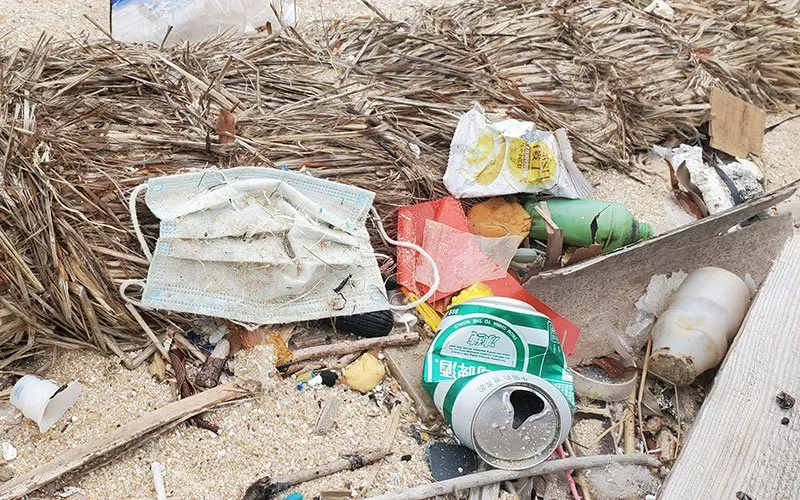
PHOENIX – Strewn across parking lots, in rivers and washing up on beaches, disposable face masks, gloves and other personal protection equipment are turning up everywhere except where they should be – in the landfill.
With the production and use of PPE surging during the COVID-19 pandemic, many experts are worried this new type of pollution, which is in the early stages of study, could have an array of lasting environmental impacts.
One researcher who is developing a way to track such waste said the effects may be seen for years to come.
“If it’s on your streets, it’s going to the ocean because it’s one rainfall away from getting into a storm water system, and then being carried into a river and into the ocean. Like any other plastic, this stuff is going to break down under ultraviolet light into smaller pieces,” said Mark Benfield, a zooplankton ecologist and professor in the department of oceanography and coastal sciences at Louisiana State University in Baton Rouge.
The recent influx of PPE waste is among the 8 million metric tons of plastic estimated to enter the oceans each year, according to the National Oceanic and Atmospheric Administration’s National Ocean Service.
With the production and use of PPE surging during the COVID-19 pandemic, many experts are worried this new type of pollution, which is in the early stages of study, could have an array of lasting environmental impacts.
One researcher who is developing a way to track such waste said the effects may be seen for years to come.
“If it’s on your streets, it’s going to the ocean because it’s one rainfall away from getting into a storm water system, and then being carried into a river and into the ocean. Like any other plastic, this stuff is going to break down under ultraviolet light into smaller pieces,” said Mark Benfield, a zooplankton ecologist and professor in the department of oceanography and coastal sciences at Louisiana State University in Baton Rouge.
The recent influx of PPE waste is among the 8 million metric tons of plastic estimated to enter the oceans each year, according to the National Oceanic and Atmospheric Administration’s National Ocean Service.

