
Friday, July 17, 2020
As COVID-19 began to spread across the Southwest in March, lawyers representing incarcerated Arizonans reported “unsanitary conditions,” “inadequate medical staffing and treatment” and a “failure to take strong and sensible precautionary measures” in state prisons.
The combination left prisoners “highly vulnerable to outbreaks,” the attorneys wrote in a letter to the state before asking a federal judge to intervene. The judge did by issuing an order for officials to release more information, but prison advocates say it hasn’t been enough.
Nearly four months later, complaints of insufficient safety measures and subpar medical care continue to plague Arizona prisons. At least 569 prisoners at 13 of the state’s 16 prison complexes had tested positive for COVID-19 as of July 15, according to the Department of Corrections, Rehabilitation and Reentry, and at least 371 staffers have reported positive results.
Justice reform advocates and others with ties to the correctional system worry the state is running out of time to prevent an even more dangerous surge in cases. COVID-19 can spread swiftly in crowded indoor spaces and among individuals with chronic health problems.
“(Inmates) are scared,” said Jared Wagoner, who was incarcerated in the Cibola Unit at the Arizona State Prison Complex in Yuma until June 8. He cited close quarters, insufficient testing and indifferent medical staff as ongoing obstacles.
“They’re scared that their two-year sentence is going to become a life sentence,” Wagoner said.

The combination left prisoners “highly vulnerable to outbreaks,” the attorneys wrote in a letter to the state before asking a federal judge to intervene. The judge did by issuing an order for officials to release more information, but prison advocates say it hasn’t been enough.
Nearly four months later, complaints of insufficient safety measures and subpar medical care continue to plague Arizona prisons. At least 569 prisoners at 13 of the state’s 16 prison complexes had tested positive for COVID-19 as of July 15, according to the Department of Corrections, Rehabilitation and Reentry, and at least 371 staffers have reported positive results.
Justice reform advocates and others with ties to the correctional system worry the state is running out of time to prevent an even more dangerous surge in cases. COVID-19 can spread swiftly in crowded indoor spaces and among individuals with chronic health problems.
“(Inmates) are scared,” said Jared Wagoner, who was incarcerated in the Cibola Unit at the Arizona State Prison Complex in Yuma until June 8. He cited close quarters, insufficient testing and indifferent medical staff as ongoing obstacles.
“They’re scared that their two-year sentence is going to become a life sentence,” Wagoner said.
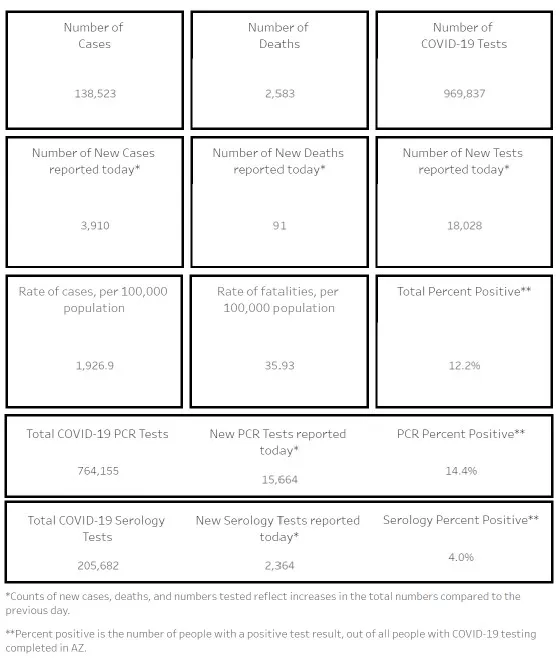
The total number of confirmed coronavirus cases in Arizona climbed past 138K as of Friday, July 17, after the state reported 3,910 new cases this morning, according to the Arizona Department of Health Services.
Pima County had seen 13,058 of the state's 138,523 confirmed cases.
A total of 2,583 people have died after contracting the virus.
Maricopa County has 91,863 of the state's cases.
Hospitals remain under pressure. The report shows that 3,466 COVID patients were hospitalized yesterday in the state.
A total of 1,574 people visited ERs yesterday.
A total of 944 COVID-19 patients were in ICU beds yesterday.
Gov. Doug Ducey said yesterday that mask-wearing and steps to reduce the interaction of people in large groups had resulted in some positive signs regarding the spread of the virus. He cited a slight drop in the percentage of people visiting emergency rooms exhibiting COVID-like illness in the last week, as well as a drop in the total number of cases on a week-to-week basis (although all test results may not be in yet for tests in recent days).
Ducey also said Arizona R-naught number—or the number of people with the virus who are infecting other people—dropped to .98 as of yesterday, meaning the infection rate has slowed. An R-naught of less than 1 means the virus is in decline.
But Ducey warned the state still had a long road ahead in the fight against the deadly virus.
"I want people to get their heads around this," Ducey said. "There's no end in sight today."
Figures from Pima County show that on a week-by-week basis, cases here may have also peaked in the week ending June 27, with new cases reaching 2,300. Pima County Administrator Chuck Huckelberry noted that the two subsequent weeks could still be adjusted upwards, but during the week ending July 4, 2,092 cases were reported. But Huckelberry noted that the week ending July 4, the county saw a peak of 37 deaths so the county is far from out of the woods.
Pima County had seen 13,058 of the state's 138,523 confirmed cases.
A total of 2,583 people have died after contracting the virus.
Maricopa County has 91,863 of the state's cases.
Hospitals remain under pressure. The report shows that 3,466 COVID patients were hospitalized yesterday in the state.
A total of 1,574 people visited ERs yesterday.
A total of 944 COVID-19 patients were in ICU beds yesterday.
Gov. Doug Ducey said yesterday that mask-wearing and steps to reduce the interaction of people in large groups had resulted in some positive signs regarding the spread of the virus. He cited a slight drop in the percentage of people visiting emergency rooms exhibiting COVID-like illness in the last week, as well as a drop in the total number of cases on a week-to-week basis (although all test results may not be in yet for tests in recent days).
AZ Dept of Health Services
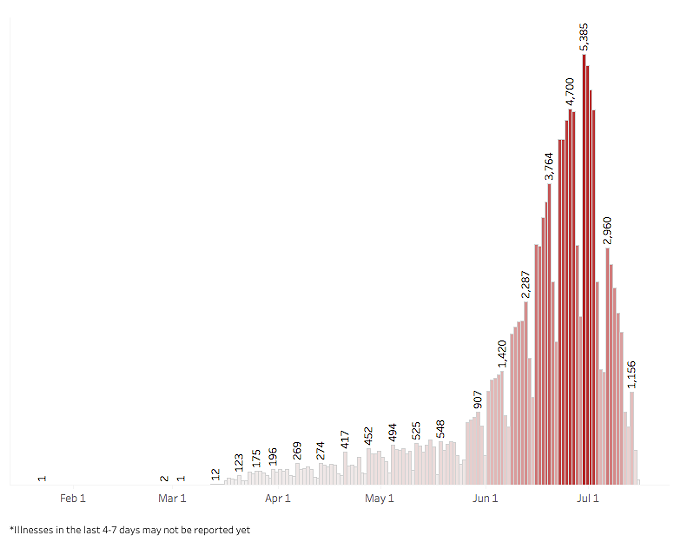
Arizona's epic-curve is seeing a decline in the number of cases reported by day, although all data from recent days is not yet available.
Ducey also said Arizona R-naught number—or the number of people with the virus who are infecting other people—dropped to .98 as of yesterday, meaning the infection rate has slowed. An R-naught of less than 1 means the virus is in decline.
But Ducey warned the state still had a long road ahead in the fight against the deadly virus.
"I want people to get their heads around this," Ducey said. "There's no end in sight today."
Figures from Pima County show that on a week-by-week basis, cases here may have also peaked in the week ending June 27, with new cases reaching 2,300. Pima County Administrator Chuck Huckelberry noted that the two subsequent weeks could still be adjusted upwards, but during the week ending July 4, 2,092 cases were reported. But Huckelberry noted that the week ending July 4, the county saw a peak of 37 deaths so the county is far from out of the woods.
In yet another sign that Arizona is in play in this year's presidential race (as in the U.S. Senate race between appointed Republican Sen. Martha McSally and Democrat Mark Kelly), the Democratic National Committee is launching a new ad on Tucson airwaves.NEW AD: With tens of thousands of older Americans dead thanks to his disastrous coronavirus response, Trump is throwing America to the wolves. pic.twitter.com/L9o8o20Ayz
— DNC War Room (@DNCWarRoom) July 16, 2020
The ad, "Wolves," criticizes President Donald Trump's response to the COVID-19 outbreak, with a particular focus on the impact on seniors.
“America’s seniors raised us," DNC Chair Tom Perez said in a prepared statement. "They fought for our country, and they worked to build us a better future. But when experts warned that coronavirus would hit older Arizonans hard, Trump refused to listen. He didn’t care — in fact, he pushed to open our country without the necessary safety measures, jeopardizing their health, because he thought it would help his reelection."
The Tucson run is part of a six-figure DNC buy across battleground states with additional national placement.
Recent polling has shown Democrat Joe Biden with a narrow lead over Donald Trump, who won Arizona by 3.5 percentage points. Poll aggregator FiveThirtyEight.com shows that Biden is leading AZ by 2.6 percentage points as July 16.
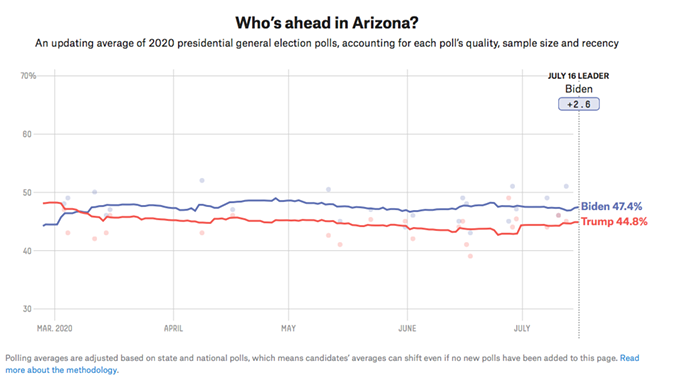
FiveThirtyEight.com screenshot
FiveThirtyEight's Nathaniel Rakich suggests Latino voters are playing a big role in Arizona's purple colors:
Now, in 2020, Joe Biden looks like he has a chance to actually win Arizona’s 11 electoral votes. As of June 29, Biden led Trump by 4.7 points in our Arizona polling average. And it looks like Democrats could flip another Senate seat here too, as Democrat Mark Kelly leads Republican Sen. Martha McSally by double digits in numerous polls.
Much of that is because of an extremely pro-Democratic national environment; according to our polling averages, Arizona is still a bit more Republican-leaning than the nation as a whole (4.6 points more Republican-leaning, to be precise). But if the final election results were to exactly match our current polling averages, it would still represent the third consecutive presidential election where Arizona has moved left.
So what’s driving this shift?
Part of it is the same reason people have been predicting a blue Arizona for years: Latino voters. Along with the state’s small Black and Native American populations, Latinos constitute the Democratic base in Arizona. In 2016, a precinct-level regression analysis estimated that Clinton won more than 80 percent of the Latino vote in Arizona. And according to an analysis from the Center for American Progress, the share of eligible Latinos who voted also increased from 37 percent in 2012 to 42 percent in 2016.
Thursday, July 16, 2020
Gov. Doug Ducey said the state was seeing some reduction in the spread of COVID-19 virus but warned the state had a long road ahead in the fight against the deadly virus.
"I want people to get their heads around this," Ducey said. "There's no end in sight today. … There will be no victory laps."
Ducey announced a new executive order extending the residential eviction moratorium until Halloween and said he was in conversations with school leaders and university presidents about the best way to move forward with the school year.
The previous residential eviction moratorium was set to expire on Saturday, July 25.
“It’s been some time since we’ve talked about the March 24 executive order to delay evictions for those impacted by COVID-19,” Ducey said. “I’ve got an update on this along with a new executive order extending the eviction moratorium on residential evictions until Oct. 31."
Ducey announced $650,000 would go to various community action agencies to improve staffing and help administer rental assistance programs for Arizonans statewide. Approximately $1.2 million in assistance has been distributed to Arizona renters since late March, according to the Governor's Office.
Additionally, Ducey announced $5 million to establish the Foreclosure Prevention Program to help residential landlords dependent on rental income to survive.
“This will provide targeted relief to homeowners who rely on income from tenants to help them avoid foreclosure,” Ducey said. “In total, state and local governments have directed more than $80 million on programs to assist renters and prevent homelessness.”

"I want people to get their heads around this," Ducey said. "There's no end in sight today. … There will be no victory laps."
Ducey announced a new executive order extending the residential eviction moratorium until Halloween and said he was in conversations with school leaders and university presidents about the best way to move forward with the school year.
The previous residential eviction moratorium was set to expire on Saturday, July 25.
“It’s been some time since we’ve talked about the March 24 executive order to delay evictions for those impacted by COVID-19,” Ducey said. “I’ve got an update on this along with a new executive order extending the eviction moratorium on residential evictions until Oct. 31."
Ducey announced $650,000 would go to various community action agencies to improve staffing and help administer rental assistance programs for Arizonans statewide. Approximately $1.2 million in assistance has been distributed to Arizona renters since late March, according to the Governor's Office.
Additionally, Ducey announced $5 million to establish the Foreclosure Prevention Program to help residential landlords dependent on rental income to survive.
“This will provide targeted relief to homeowners who rely on income from tenants to help them avoid foreclosure,” Ducey said. “In total, state and local governments have directed more than $80 million on programs to assist renters and prevent homelessness.”
ProPublica is a nonprofit newsroom that investigates abuses of power. Click here to read their biggest stories as soon as they’re published.
In the middle of March, as the coronavirus pandemic was shutting down the country, McKinsey & Co., the giant management consulting firm, saw opportunity. The firm sprang into sales mode, deploying its partners across the country to seek contracts with federal agencies, state governments and city halls. Government organizations had been caught unprepared by the virus, and there was a lot of money to be made advising them on how to address it.
That month, a partner in McKinsey’s Washington, D.C., office, Scott Blackburn, got in touch with an old colleague. Deb Kramer had just been promoted to become an acting assistant undersecretary at the Department of Veterans Affairs, where Blackburn, whom McKinsey declined to make available for an interview, had held senior roles between 2014 and 2018. During that period, the two had overseen a major overhaul of the agency called “MyVA,” a project McKinsey had worked on as well. Blackburn had worked at McKinsey before going to the VA, and he returned to the firm afterward. He and Kramer were in touch repeatedly in the middle of March, according to a person familiar with the exchanges.
On March 19, Kramer made a highly unusual request: The VA, she said, needed to hire McKinsey within 24 hours. The VA runs a sprawling health care system that serves 9 million veterans, many of them older and plagued by chronic health problems, and typically takes many months to solicit and accept bids and vet bidders for a contract. The health system’s leadership wanted to sign a multimillion-dollar contract with McKinsey to spend up to a year consulting on “all aspects” of the system’s operations during the COVID-19 pandemic, Kramer told a VA contracting officer, Nathan Pennington. Pennington memorialized parts of the exchange in a public contracting document.

In the middle of March, as the coronavirus pandemic was shutting down the country, McKinsey & Co., the giant management consulting firm, saw opportunity. The firm sprang into sales mode, deploying its partners across the country to seek contracts with federal agencies, state governments and city halls. Government organizations had been caught unprepared by the virus, and there was a lot of money to be made advising them on how to address it.
That month, a partner in McKinsey’s Washington, D.C., office, Scott Blackburn, got in touch with an old colleague. Deb Kramer had just been promoted to become an acting assistant undersecretary at the Department of Veterans Affairs, where Blackburn, whom McKinsey declined to make available for an interview, had held senior roles between 2014 and 2018. During that period, the two had overseen a major overhaul of the agency called “MyVA,” a project McKinsey had worked on as well. Blackburn had worked at McKinsey before going to the VA, and he returned to the firm afterward. He and Kramer were in touch repeatedly in the middle of March, according to a person familiar with the exchanges.
On March 19, Kramer made a highly unusual request: The VA, she said, needed to hire McKinsey within 24 hours. The VA runs a sprawling health care system that serves 9 million veterans, many of them older and plagued by chronic health problems, and typically takes many months to solicit and accept bids and vet bidders for a contract. The health system’s leadership wanted to sign a multimillion-dollar contract with McKinsey to spend up to a year consulting on “all aspects” of the system’s operations during the COVID-19 pandemic, Kramer told a VA contracting officer, Nathan Pennington. Pennington memorialized parts of the exchange in a public contracting document.
ProPublica is a nonprofit newsroom that investigates abuses of power. Click here to read their biggest stories as soon as they’re published.
On April 3, Terrence K. Williams, a politically conservative actor and comedian who’s been praised by President Donald Trump, assured his nearly 3 million followers on Facebook that Democrats would light ballots on fire or throw them away. Wearing a red “Keep America Great” hat, Williams declared, “If you mail in your vote, your vote will be in Barack Obama’s fireplace.” The video has been viewed more than 350,000 times.
On May 8, Peggy Hubbard, a Navy veteran and police officer who this year sought the Republican nomination for a U.S. Senate seat from Illinois, warned on Facebook that the country was heading toward civil war. “Your democracy, your freedom is being stripped away from you, and if you allow that then everything this country stood for, fought for, bled for is all in vain.” The cause? California’s recent expansion of voting by mail: “The only way you will be able to vote in the upcoming election in November is by mail only,” Hubbard said. The video has attracted more than 209,000 views.
On June 27, Pamela Geller, an anti-Muslim activist with nearly 1.3 million followers, weighed in. “Mail-in ballots guarantee that the Democrats will commit voter fraud,” she said on Facebook.
There’s no evidence for any of these statements. While California will mail absentee ballots to all registered voters, polling places will also be available. Voter fraud is exceedingly rare, including with mail-in ballots. A recent Washington Post analysis analyzed three states with all-mail elections — Colorado, Oregon and Washington — and found just 372 potential irregularities among 14.6 million votes, or 0.0025%.

On April 3, Terrence K. Williams, a politically conservative actor and comedian who’s been praised by President Donald Trump, assured his nearly 3 million followers on Facebook that Democrats would light ballots on fire or throw them away. Wearing a red “Keep America Great” hat, Williams declared, “If you mail in your vote, your vote will be in Barack Obama’s fireplace.” The video has been viewed more than 350,000 times.
On May 8, Peggy Hubbard, a Navy veteran and police officer who this year sought the Republican nomination for a U.S. Senate seat from Illinois, warned on Facebook that the country was heading toward civil war. “Your democracy, your freedom is being stripped away from you, and if you allow that then everything this country stood for, fought for, bled for is all in vain.” The cause? California’s recent expansion of voting by mail: “The only way you will be able to vote in the upcoming election in November is by mail only,” Hubbard said. The video has attracted more than 209,000 views.
On June 27, Pamela Geller, an anti-Muslim activist with nearly 1.3 million followers, weighed in. “Mail-in ballots guarantee that the Democrats will commit voter fraud,” she said on Facebook.
There’s no evidence for any of these statements. While California will mail absentee ballots to all registered voters, polling places will also be available. Voter fraud is exceedingly rare, including with mail-in ballots. A recent Washington Post analysis analyzed three states with all-mail elections — Colorado, Oregon and Washington — and found just 372 potential irregularities among 14.6 million votes, or 0.0025%.
Bertha spent 17 days in her bedroom after testing positive for COVID-19.
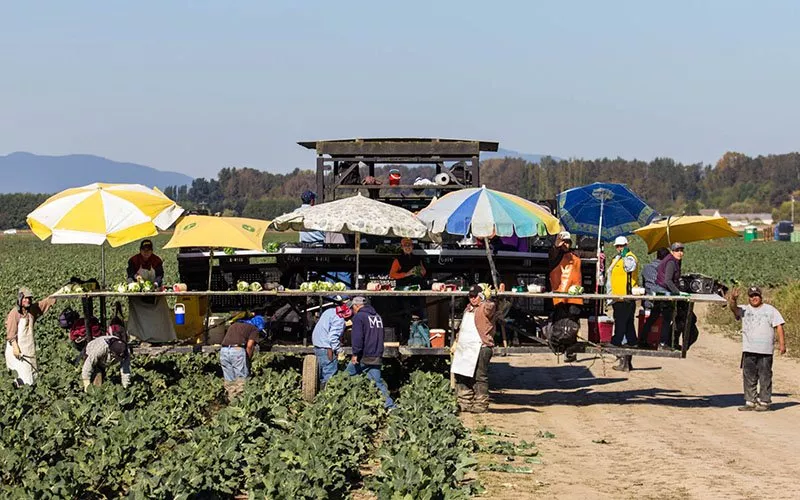
There, she made the soup and the “hot, hot tea” that helped her endure the headaches and coughing fits associated with the contagious respiratory disease. Bertha, an agricultural worker, said she couldn’t risk going to the kitchen or other parts of the house and infecting her 18-year-old daughter.
The two-plus weeks of isolation seem to have paid off: Her doctor recently cleared her to resume normal activities, Bertha said, and her daughter was never infected. But Bertha worries that if she returns to work processing pistachios for Primex Farms LLC – a California-based grower and exporter of nuts and dried fruits – she will bring the virus home again.
Bertha, who agreed to speak on the condition her last name not be published for fear of retaliation, said she doesn’t know whether she can trust the company’s attempts at disinfecting the space and implementing safety measures. Even before she tested positive, she thought the farm’s safety precautions were insufficient.
From a lack of social distancing in dining areas to employees handling pistachios without gloves, she estimates “many pounds” of pistachios passed through the hands of workers infected with COVID-19.
There, she made the soup and the “hot, hot tea” that helped her endure the headaches and coughing fits associated with the contagious respiratory disease. Bertha, an agricultural worker, said she couldn’t risk going to the kitchen or other parts of the house and infecting her 18-year-old daughter.
The two-plus weeks of isolation seem to have paid off: Her doctor recently cleared her to resume normal activities, Bertha said, and her daughter was never infected. But Bertha worries that if she returns to work processing pistachios for Primex Farms LLC – a California-based grower and exporter of nuts and dried fruits – she will bring the virus home again.
Bertha, who agreed to speak on the condition her last name not be published for fear of retaliation, said she doesn’t know whether she can trust the company’s attempts at disinfecting the space and implementing safety measures. Even before she tested positive, she thought the farm’s safety precautions were insufficient.
From a lack of social distancing in dining areas to employees handling pistachios without gloves, she estimates “many pounds” of pistachios passed through the hands of workers infected with COVID-19.
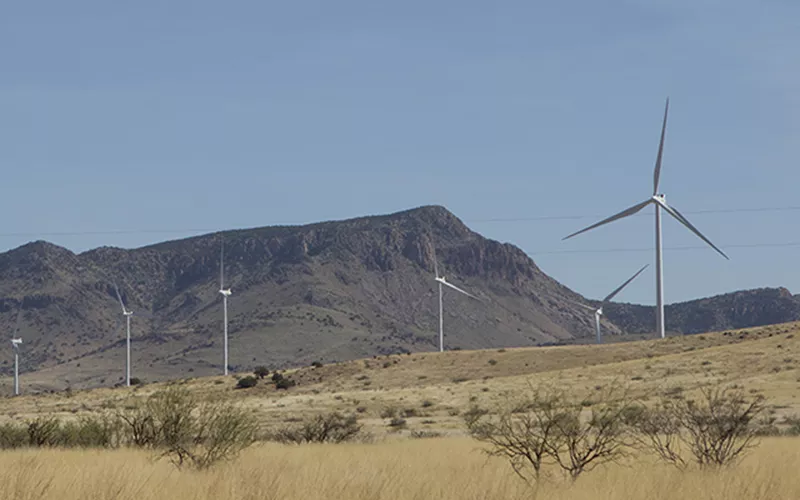
PHOENIX – The fight over whether Arizona should get half of its electricity from solar, wind and other renewable sources turned bitter election night when Attorney General Mark Brnovich called out California billionaire Tom Steyer for using California’s energy policies to try to influence Arizona’s policies.
“I’ve got a message for Tom Steyer,” Brnovich said Tuesday night at the Republican watch party in Scottsdale. “When you mess with the Brno, you’re going to get the burn, but you’re never going to get my O.”
Brnovich told partygoers to go outside to dunk a Steyer mannequin in the dunk tank that was set up. It was a moment that marked the end of a long election struggle over Proposition 127, which would have required Arizona’s 16 regulated utilities to get 50 percent of their energy from renewable sources by 2030. The current standard of 15 percent by 2025 was set by the Arizona Corporation Commission.
Through his environmental advocacy nonprofit NextGen Climate Action, Steyer, a hedge fund manager, funneled millions of dollars to finance campaigns behind Prop. 127 and Nevada’s Question 6. Both ballot initiatives set the same goal and timeframe.
“I’ve got a message for Tom Steyer,” Brnovich said Tuesday night at the Republican watch party in Scottsdale. “When you mess with the Brno, you’re going to get the burn, but you’re never going to get my O.”
Brnovich told partygoers to go outside to dunk a Steyer mannequin in the dunk tank that was set up. It was a moment that marked the end of a long election struggle over Proposition 127, which would have required Arizona’s 16 regulated utilities to get 50 percent of their energy from renewable sources by 2030. The current standard of 15 percent by 2025 was set by the Arizona Corporation Commission.
Through his environmental advocacy nonprofit NextGen Climate Action, Steyer, a hedge fund manager, funneled millions of dollars to finance campaigns behind Prop. 127 and Nevada’s Question 6. Both ballot initiatives set the same goal and timeframe.
PHOENIX – The head of Arizona State University’s Biodesign Institute painted a glum picture Wednesday of current COVID-19 trends in the state, but he also suggested that the trend could be slowly improving.
Joshua LaBaer, executive director of the Biodesign Institute, noted that virus cases are soaring across the country, and that Arizona is one of the states leading the surge. Some hospitals have temporarily run out of beds in their intensive care units, and death rates are going up, he said during a virtual press briefing Wednesday.
“If you look at each of the different counties here, you’ll see that . . . most of them are trending upwards,” said LaBaer as he showed off a dashboard designed by ASU’s Clinical Testing Laboratory.
The briefing came as the number of cases in the state topped 130,000 and the number of deaths topped 2,400 for the first time.

Joshua LaBaer, executive director of the Biodesign Institute, noted that virus cases are soaring across the country, and that Arizona is one of the states leading the surge. Some hospitals have temporarily run out of beds in their intensive care units, and death rates are going up, he said during a virtual press briefing Wednesday.
“If you look at each of the different counties here, you’ll see that . . . most of them are trending upwards,” said LaBaer as he showed off a dashboard designed by ASU’s Clinical Testing Laboratory.
The briefing came as the number of cases in the state topped 130,000 and the number of deaths topped 2,400 for the first time.
WASHINGTON – Arizona’s interstate highways are in generally good shape, but they experienced the highest rate of fatalities in the nation in 2018, according to a national report released Tuesday.
The report by The Road Information Program said that Arizona recorded 1.09 highway deaths per 100 million vehicle miles traveled on the state’s interstate highways in 2018, almost twice the national average of 0.58 deaths that year.
Authors of the TRIP report – titled “Restoring the Interstate Highway System” – used it as a call for more funding to rebuild and modernize the nation’s 64-year-old interstate system, claiming that deteriorating roads pose a threat to commerce and to safety.
“Deteriorating conditions and fatality rate are because of poor funding,” said Carolyn Bonifas Kelly, director of communications and research at TRIP.
But public and private officials in Arizona said it’s not the roads that are the issue, it’s driver behaviors.

The report by The Road Information Program said that Arizona recorded 1.09 highway deaths per 100 million vehicle miles traveled on the state’s interstate highways in 2018, almost twice the national average of 0.58 deaths that year.
Authors of the TRIP report – titled “Restoring the Interstate Highway System” – used it as a call for more funding to rebuild and modernize the nation’s 64-year-old interstate system, claiming that deteriorating roads pose a threat to commerce and to safety.
“Deteriorating conditions and fatality rate are because of poor funding,” said Carolyn Bonifas Kelly, director of communications and research at TRIP.
But public and private officials in Arizona said it’s not the roads that are the issue, it’s driver behaviors.