

Monday, July 20, 2020
ProPublica is a nonprofit newsroom that investigates abuses of power. Click here to read their biggest stories as soon as they’re published.
Last August, Adam Durand, legislative director for Minnesota Rep. Collin Peterson, fired off an email on behalf of an important state manufacturer that was waging a frustrating fight for relief from President Donald Trump’s China tariffs.
“I wanted to let you know that the executive team with Polaris is meeting with Chairman Peterson this afternoon,” he wrote to Haley Dorval, an assistant to the chief of staff at the office of the U.S. Trade Representative. “It would be greatly helpful if I could talk to someone by early afternoon about the status of this issue.”
Durand’s boss had pressured USTR all year about tariffs that were costing the company millions of dollars every month. Polaris, which imports parts for its off-road vehicles and motor boats, was working every Washington angle to win tariff exemptions. An administration-backed trade bill, the U.S.-Mexico-Canada Agreement, was coming up for a vote and Polaris CEO Scott Wine told investors last summer that he was “trying to leverage votes for USMCA to help us get tariff relief.”

Last August, Adam Durand, legislative director for Minnesota Rep. Collin Peterson, fired off an email on behalf of an important state manufacturer that was waging a frustrating fight for relief from President Donald Trump’s China tariffs.
“I wanted to let you know that the executive team with Polaris is meeting with Chairman Peterson this afternoon,” he wrote to Haley Dorval, an assistant to the chief of staff at the office of the U.S. Trade Representative. “It would be greatly helpful if I could talk to someone by early afternoon about the status of this issue.”
Durand’s boss had pressured USTR all year about tariffs that were costing the company millions of dollars every month. Polaris, which imports parts for its off-road vehicles and motor boats, was working every Washington angle to win tariff exemptions. An administration-backed trade bill, the U.S.-Mexico-Canada Agreement, was coming up for a vote and Polaris CEO Scott Wine told investors last summer that he was “trying to leverage votes for USMCA to help us get tariff relief.”
PHOENIX — Melissa Calles used to walk her dog to the park every day, and she was part of a dance group. Life changed for the 26-year-old Phoenix resident on May 15 when she fell ill. After tests, her doctor informed her she had COVID-19.
“I lost my sense of smell, that was the first symptom in my experience, and I had a mild fever and headache,” she said. “But the most prominent symptom was shortness of breath.”
According to Maricopa County’s website, 50% of COVID-19 cases and 40% of hospitalizations in the county involve Hispanics, including Calles.
“I felt like I was running a marathon,” she said of her fatigue. “Even going to the bathroom left me agitated and lightheaded, and I have to take a break from that.”
Calles is among the estimated 24% of Arizona’s eligible voters who are Latino. A Jan. 30 report by the Pew Research Center indicates that Arizona is among the top states for Latino eligible voters in the 2020 election, with 1.2 million.
Members of Mi Familia Vota, a national nonprofit working to unite the Latino community through voter participation, said they are watching the high numbers of COVID-19 cases in Maricopa County. They are informing the Hispanic community about taking health precautions while voting.
“You don’t have to line up, you don’t have to be in big groups because of the pandemic we’re living in,” said Cristian Avila, the group’s national coordinator for civic engagement.
“I lost my sense of smell, that was the first symptom in my experience, and I had a mild fever and headache,” she said. “But the most prominent symptom was shortness of breath.”
According to Maricopa County’s website, 50% of COVID-19 cases and 40% of hospitalizations in the county involve Hispanics, including Calles.
“I felt like I was running a marathon,” she said of her fatigue. “Even going to the bathroom left me agitated and lightheaded, and I have to take a break from that.”
Calles is among the estimated 24% of Arizona’s eligible voters who are Latino. A Jan. 30 report by the Pew Research Center indicates that Arizona is among the top states for Latino eligible voters in the 2020 election, with 1.2 million.
Members of Mi Familia Vota, a national nonprofit working to unite the Latino community through voter participation, said they are watching the high numbers of COVID-19 cases in Maricopa County. They are informing the Hispanic community about taking health precautions while voting.
“You don’t have to line up, you don’t have to be in big groups because of the pandemic we’re living in,” said Cristian Avila, the group’s national coordinator for civic engagement.
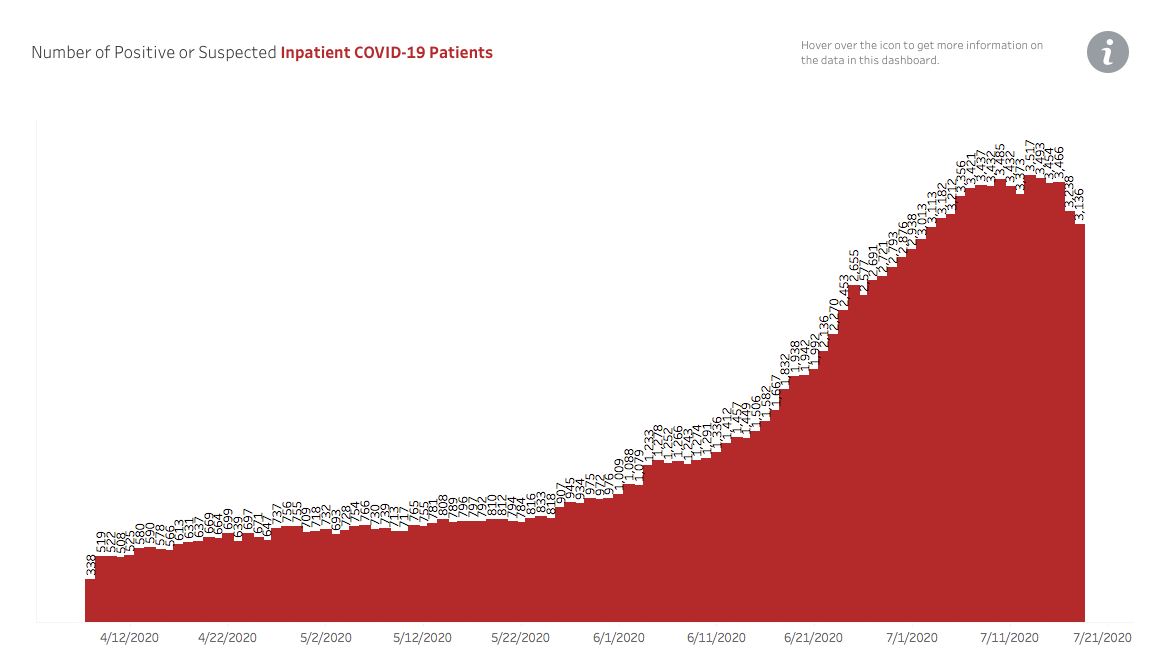
AZ Dept of Health Services
If we're lucky, Arizona has hit a peak in COVID-19 hospitalizations, but it could still be a long way before we're off a plateau if people don't stay home, wear masks when out in public and wash their hands.
The Big Bang Theory had a recurring character, a likeable dimwit named Zach who was best-known for saying things like, “That’s one of the great things about science—there’s no one right answer.” That’s cute (and utterly false), but in the Time of the Pandemic, in these life-or-death days, being dimwitted (especially intentionally so) is not likeable or useful or acceptable. It’s criminal.
Not everybody is good at math and science. That’s just a fact of life. However, I’ve never understood why it’s socially acceptable to brag about one’s deficiency in that area. (“Oh, I’m horrible at math…giggle”). It’s like standing up at a formal dinner party and announcing that you have really bad incontinence. It happens, but keep it to yourself (in both word and deed).
It was obvious from the start of this mess that the media would often take the lazy route and just throw a bunch of numbers at the watchers/listeners/ readers. That way, there is something for everybody and essentially nothing for anybody. You give people a smorgasbord of figures and they can pick and choose what they want to bolster their argument or (as is more often the case) to give themselves an excuse to ignore the reality that’s right in front of their faces.
I could spout real (and important) raw numbers, but then I would be engaging in the same folly I just criticized. More enlightening are trends.
The main problems with numbers are twofold. First, unless you’re like John Nash (of “A Beautiful Mind”) or Srinivasa Ramanujan (who had an even more-beautiful mind), a series of numbers thrown at even a well-educated person will eventually begin to cascade and dissolve into mathematical gibberish. (So imagine what it must do to the average Trump voter.)
It’s okay if the figures are online or in a newspaper or magazine because the reader has time to pore over the numbers and try to make sense of them. But when they are presented on the radio or (especially) television, it does a disservice to the person who is trying to get pertinent information. Again, trends are more informative than raw numbers. If the TV talking head comes on and says that Arizona had 314 confirmed cases of COVID-19 on May 1 and then, just two months later, that number was 4,877, people would say “Wow, that’s a bigger number.” But if the TV guy said (on July 1), “Today, Arizona is reporting 16 times as many cases of the virus as we did just two months ago,” that actually conveys information that, which less specific, is actually more significant.
Of course, the other main problem is that numbers can be misused. And it’s not just the Benjamin Disraeli (and Mark Twain) quote about, “There are lies, damned lies, and statistics.” People have long cherry-picked stats to bolster their argument, but in the Trump era, the lazy bastards don’t even bother. They just make stuff up and their audiences lap it up. (I read a disturbing thing about Trump followers who refuse to believe their own eyes. Three-and-a-half years after the fact, they had a bunch of them look at the aerial shots of the Obama and Trump Inaugurations and they still swear that they see more people in the Trump picture, apparently seeing tightly packed-together white people who showed up for the thing disguised as empty sidewalk.)
The other day, I was listening to the local morning Trump licker and he was trying to claim that things have not gotten worse in Arizona since Ducey re-opened the state. (The radio talker was an early cheerleader for opening things up and God forbid that he admit that he was wrong.) So, he's going on this rant and he finishes by claiming that “things have gone down 17 days in a row in Arizona.”
What could he possibly be talking about? Over that 17-day period, the number of confirmed cases in Arizona went up eight times over the previous day and went down nine times, so nothing has happened 17 days in a row. Likewise for the number of deaths—up eight times, down nine times. And, in both cases, the total on the last day of that period was higher than the number on the first day. (The number of ICU beds occupied by COVID patients also went up sharply over that 17-day period.)
So, what then? Obviously, from experience, he knows that he can just make stuff up and nobody is going to question him. (Stations like that will never take callers with an opposing viewpoint. Their preference of callers, in ascending order, is Angry Supporter, Loud Angry Supporter, and Loud Angry Supporter With a Side of Racism.)
Friday, July 17, 2020
ICYMI, here are the stories we covered today:

- The total number of confirmed coronavirus cases in Arizona climbed past 138K as of Friday, July 17, after the state reported 3,910 new cases this morning, according to the Arizona Department of Health Services.
- In yet another sign that Arizona is in play in this year's presidential race (as in the U.S. Senate race between appointed Republican Sen. Martha McSally and Democrat Mark Kelly), the Democratic National Committee is launching a new ad on Tucson airwaves.
- The Outpost—based on a real-life battle that took place at an American base poorly placed in the middle of a mountainous Afghanistan—is a harrowing and frustrating experience.
- As COVID-19 began to spread across the Southwest in March, lawyers representing incarcerated Arizonans reported “unsanitary conditions,” “inadequate medical staffing and treatment” and a “failure to take strong and sensible precautionary measures” in state prisons.
- Strewn across parking lots, in rivers and washing up on beaches, disposable face masks, gloves and other personal protection equipment are turning up everywhere except where they should be – in the landfill.
- As hospitals across the United States brace for a difficult six months — with the first wave of the coronavirus pandemic still raging and concerns about a second wave in the fall — some are acutely short-staffed because of an ill-timed change to immigration policy and its inconsistent implementation.
- Gov. Doug Ducey extended the state’s eviction moratorium and announced an additional $5 million for renters and measures to prevent foreclosure as the state continues to grapple with unemployment and housing problems caused by COVID-19.
- Hospitalizations for COVID-19 have been seen as a key metric of both the coronavirus’s toll and the health care system’s ability to deal with it. Recent federal actions may strike a blow to the public’s ability to track them.
- Arizona’s U.S. senators are pushing legislation to renew a federal program that fights diabetes in Indian Country – an initiative tribal leaders say is vital amid the COVID-19 pandemic.
ProPublica is a nonprofit newsroom that investigates abuses of power. Click here to read their biggest stories as soon as they’re published.
Hospitalizations for COVID-19 have been seen as a key metric of both the coronavirus’s toll and the health care system’s ability to deal with it. Recent federal actions may strike a blow to the public’s ability to track them.
The U.S. Centers for Disease Control and Prevention removed from its website, and then restored, data on hospital capacity across the country to deal with the COVID-19 pandemic. But in a note, the agency indicated that the data may no longer be updated because of a change in federal reporting requirements to hospitals.
On Wednesday, ProPublica noticed that the CDC’s website had stopped displaying hospital capacity information, which was seen as a good barometer of whether hospitals in certain states had enough beds to deal with surges in COVID-19 cases. The data showed that more than 70% of intensive care unit beds in some states, including Texas and Arizona, were filled. That had been viewed by some experts as a benchmark for safely reopening businesses.

Hospitalizations for COVID-19 have been seen as a key metric of both the coronavirus’s toll and the health care system’s ability to deal with it. Recent federal actions may strike a blow to the public’s ability to track them.
The U.S. Centers for Disease Control and Prevention removed from its website, and then restored, data on hospital capacity across the country to deal with the COVID-19 pandemic. But in a note, the agency indicated that the data may no longer be updated because of a change in federal reporting requirements to hospitals.
On Wednesday, ProPublica noticed that the CDC’s website had stopped displaying hospital capacity information, which was seen as a good barometer of whether hospitals in certain states had enough beds to deal with surges in COVID-19 cases. The data showed that more than 70% of intensive care unit beds in some states, including Texas and Arizona, were filled. That had been viewed by some experts as a benchmark for safely reopening businesses.
Looks like @CDCgov national map on hospital capacity is no longer working. A consequence of the data move yesterday to change reporting to @HHSGov? How is less public info a good thing? https://t.co/QQslh3BcSk @ngusletter pic.twitter.com/8ky2K1PnpR
— Charles Ornstein (@charlesornstein) July 15, 2020
ProPublica is a nonprofit newsroom that investigates abuses of power. Click here to read their biggest stories as soon as they’re published.
As hospitals across the United States brace for a difficult six months — with the first wave of the coronavirus pandemic still raging and concerns about a second wave in the fall — some are acutely short-staffed because of an ill-timed change to immigration policy and its inconsistent implementation.
A proclamation issued by President Donald Trump on June 22, barring the entry of most immigrants on work visas, came right as hospitals were expecting a new class of medical residents. Hundreds of young doctors were unable to start their residencies on time.
Trump’s order included the H1-B visa for highly skilled workers, which is used by some practicing doctors abroad who get U.S. residency slots. The proclamation stated that doctors “involved with the provision of medical care to individuals who have contracted COVID-19 and are currently hospitalized” should be exempt from the ban, but it delegated the issuing of guidance to the departments of State and Homeland Security. That guidance has been slow and inconsistent.

As hospitals across the United States brace for a difficult six months — with the first wave of the coronavirus pandemic still raging and concerns about a second wave in the fall — some are acutely short-staffed because of an ill-timed change to immigration policy and its inconsistent implementation.
A proclamation issued by President Donald Trump on June 22, barring the entry of most immigrants on work visas, came right as hospitals were expecting a new class of medical residents. Hundreds of young doctors were unable to start their residencies on time.
Trump’s order included the H1-B visa for highly skilled workers, which is used by some practicing doctors abroad who get U.S. residency slots. The proclamation stated that doctors “involved with the provision of medical care to individuals who have contracted COVID-19 and are currently hospitalized” should be exempt from the ban, but it delegated the issuing of guidance to the departments of State and Homeland Security. That guidance has been slow and inconsistent.
In yet another sign that Arizona is in play in this year's presidential race (as in the U.S. Senate race between appointed Republican Sen. Martha McSally and Democrat Mark Kelly), the Democratic National Committee is launching a new ad on Tucson airwaves.NEW AD: With tens of thousands of older Americans dead thanks to his disastrous coronavirus response, Trump is throwing America to the wolves. pic.twitter.com/L9o8o20Ayz
— DNC War Room (@DNCWarRoom) July 16, 2020
The ad, "Wolves," criticizes President Donald Trump's response to the COVID-19 outbreak, with a particular focus on the impact on seniors.
“America’s seniors raised us," DNC Chair Tom Perez said in a prepared statement. "They fought for our country, and they worked to build us a better future. But when experts warned that coronavirus would hit older Arizonans hard, Trump refused to listen. He didn’t care — in fact, he pushed to open our country without the necessary safety measures, jeopardizing their health, because he thought it would help his reelection."
The Tucson run is part of a six-figure DNC buy across battleground states with additional national placement.
Recent polling has shown Democrat Joe Biden with a narrow lead over Donald Trump, who won Arizona by 3.5 percentage points. Poll aggregator FiveThirtyEight.com shows that Biden is leading AZ by 2.6 percentage points as July 16.
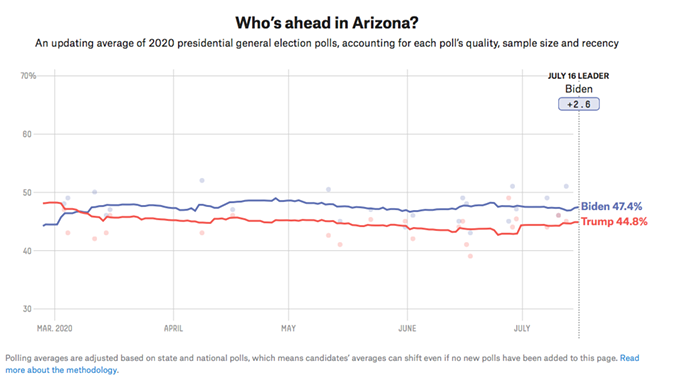
FiveThirtyEight.com screenshot
FiveThirtyEight's Nathaniel Rakich suggests Latino voters are playing a big role in Arizona's purple colors:
Now, in 2020, Joe Biden looks like he has a chance to actually win Arizona’s 11 electoral votes. As of June 29, Biden led Trump by 4.7 points in our Arizona polling average. And it looks like Democrats could flip another Senate seat here too, as Democrat Mark Kelly leads Republican Sen. Martha McSally by double digits in numerous polls.
Much of that is because of an extremely pro-Democratic national environment; according to our polling averages, Arizona is still a bit more Republican-leaning than the nation as a whole (4.6 points more Republican-leaning, to be precise). But if the final election results were to exactly match our current polling averages, it would still represent the third consecutive presidential election where Arizona has moved left.
So what’s driving this shift?
Part of it is the same reason people have been predicting a blue Arizona for years: Latino voters. Along with the state’s small Black and Native American populations, Latinos constitute the Democratic base in Arizona. In 2016, a precinct-level regression analysis estimated that Clinton won more than 80 percent of the Latino vote in Arizona. And according to an analysis from the Center for American Progress, the share of eligible Latinos who voted also increased from 37 percent in 2012 to 42 percent in 2016.
Thursday, July 16, 2020
Gov. Doug Ducey said the state was seeing some reduction in the spread of COVID-19 virus but warned the state had a long road ahead in the fight against the deadly virus.
"I want people to get their heads around this," Ducey said. "There's no end in sight today. … There will be no victory laps."
Ducey announced a new executive order extending the residential eviction moratorium until Halloween and said he was in conversations with school leaders and university presidents about the best way to move forward with the school year.
The previous residential eviction moratorium was set to expire on Saturday, July 25.
“It’s been some time since we’ve talked about the March 24 executive order to delay evictions for those impacted by COVID-19,” Ducey said. “I’ve got an update on this along with a new executive order extending the eviction moratorium on residential evictions until Oct. 31."
Ducey announced $650,000 would go to various community action agencies to improve staffing and help administer rental assistance programs for Arizonans statewide. Approximately $1.2 million in assistance has been distributed to Arizona renters since late March, according to the Governor's Office.
Additionally, Ducey announced $5 million to establish the Foreclosure Prevention Program to help residential landlords dependent on rental income to survive.
“This will provide targeted relief to homeowners who rely on income from tenants to help them avoid foreclosure,” Ducey said. “In total, state and local governments have directed more than $80 million on programs to assist renters and prevent homelessness.”

"I want people to get their heads around this," Ducey said. "There's no end in sight today. … There will be no victory laps."
Ducey announced a new executive order extending the residential eviction moratorium until Halloween and said he was in conversations with school leaders and university presidents about the best way to move forward with the school year.
The previous residential eviction moratorium was set to expire on Saturday, July 25.
“It’s been some time since we’ve talked about the March 24 executive order to delay evictions for those impacted by COVID-19,” Ducey said. “I’ve got an update on this along with a new executive order extending the eviction moratorium on residential evictions until Oct. 31."
Ducey announced $650,000 would go to various community action agencies to improve staffing and help administer rental assistance programs for Arizonans statewide. Approximately $1.2 million in assistance has been distributed to Arizona renters since late March, according to the Governor's Office.
Additionally, Ducey announced $5 million to establish the Foreclosure Prevention Program to help residential landlords dependent on rental income to survive.
“This will provide targeted relief to homeowners who rely on income from tenants to help them avoid foreclosure,” Ducey said. “In total, state and local governments have directed more than $80 million on programs to assist renters and prevent homelessness.”
ProPublica is a nonprofit newsroom that investigates abuses of power. Click here to read their biggest stories as soon as they’re published.
In the middle of March, as the coronavirus pandemic was shutting down the country, McKinsey & Co., the giant management consulting firm, saw opportunity. The firm sprang into sales mode, deploying its partners across the country to seek contracts with federal agencies, state governments and city halls. Government organizations had been caught unprepared by the virus, and there was a lot of money to be made advising them on how to address it.
That month, a partner in McKinsey’s Washington, D.C., office, Scott Blackburn, got in touch with an old colleague. Deb Kramer had just been promoted to become an acting assistant undersecretary at the Department of Veterans Affairs, where Blackburn, whom McKinsey declined to make available for an interview, had held senior roles between 2014 and 2018. During that period, the two had overseen a major overhaul of the agency called “MyVA,” a project McKinsey had worked on as well. Blackburn had worked at McKinsey before going to the VA, and he returned to the firm afterward. He and Kramer were in touch repeatedly in the middle of March, according to a person familiar with the exchanges.
On March 19, Kramer made a highly unusual request: The VA, she said, needed to hire McKinsey within 24 hours. The VA runs a sprawling health care system that serves 9 million veterans, many of them older and plagued by chronic health problems, and typically takes many months to solicit and accept bids and vet bidders for a contract. The health system’s leadership wanted to sign a multimillion-dollar contract with McKinsey to spend up to a year consulting on “all aspects” of the system’s operations during the COVID-19 pandemic, Kramer told a VA contracting officer, Nathan Pennington. Pennington memorialized parts of the exchange in a public contracting document.

In the middle of March, as the coronavirus pandemic was shutting down the country, McKinsey & Co., the giant management consulting firm, saw opportunity. The firm sprang into sales mode, deploying its partners across the country to seek contracts with federal agencies, state governments and city halls. Government organizations had been caught unprepared by the virus, and there was a lot of money to be made advising them on how to address it.
That month, a partner in McKinsey’s Washington, D.C., office, Scott Blackburn, got in touch with an old colleague. Deb Kramer had just been promoted to become an acting assistant undersecretary at the Department of Veterans Affairs, where Blackburn, whom McKinsey declined to make available for an interview, had held senior roles between 2014 and 2018. During that period, the two had overseen a major overhaul of the agency called “MyVA,” a project McKinsey had worked on as well. Blackburn had worked at McKinsey before going to the VA, and he returned to the firm afterward. He and Kramer were in touch repeatedly in the middle of March, according to a person familiar with the exchanges.
On March 19, Kramer made a highly unusual request: The VA, she said, needed to hire McKinsey within 24 hours. The VA runs a sprawling health care system that serves 9 million veterans, many of them older and plagued by chronic health problems, and typically takes many months to solicit and accept bids and vet bidders for a contract. The health system’s leadership wanted to sign a multimillion-dollar contract with McKinsey to spend up to a year consulting on “all aspects” of the system’s operations during the COVID-19 pandemic, Kramer told a VA contracting officer, Nathan Pennington. Pennington memorialized parts of the exchange in a public contracting document.
ProPublica is a nonprofit newsroom that investigates abuses of power. Click here to read their biggest stories as soon as they’re published.
On April 3, Terrence K. Williams, a politically conservative actor and comedian who’s been praised by President Donald Trump, assured his nearly 3 million followers on Facebook that Democrats would light ballots on fire or throw them away. Wearing a red “Keep America Great” hat, Williams declared, “If you mail in your vote, your vote will be in Barack Obama’s fireplace.” The video has been viewed more than 350,000 times.
On May 8, Peggy Hubbard, a Navy veteran and police officer who this year sought the Republican nomination for a U.S. Senate seat from Illinois, warned on Facebook that the country was heading toward civil war. “Your democracy, your freedom is being stripped away from you, and if you allow that then everything this country stood for, fought for, bled for is all in vain.” The cause? California’s recent expansion of voting by mail: “The only way you will be able to vote in the upcoming election in November is by mail only,” Hubbard said. The video has attracted more than 209,000 views.
On June 27, Pamela Geller, an anti-Muslim activist with nearly 1.3 million followers, weighed in. “Mail-in ballots guarantee that the Democrats will commit voter fraud,” she said on Facebook.
There’s no evidence for any of these statements. While California will mail absentee ballots to all registered voters, polling places will also be available. Voter fraud is exceedingly rare, including with mail-in ballots. A recent Washington Post analysis analyzed three states with all-mail elections — Colorado, Oregon and Washington — and found just 372 potential irregularities among 14.6 million votes, or 0.0025%.

On April 3, Terrence K. Williams, a politically conservative actor and comedian who’s been praised by President Donald Trump, assured his nearly 3 million followers on Facebook that Democrats would light ballots on fire or throw them away. Wearing a red “Keep America Great” hat, Williams declared, “If you mail in your vote, your vote will be in Barack Obama’s fireplace.” The video has been viewed more than 350,000 times.
On May 8, Peggy Hubbard, a Navy veteran and police officer who this year sought the Republican nomination for a U.S. Senate seat from Illinois, warned on Facebook that the country was heading toward civil war. “Your democracy, your freedom is being stripped away from you, and if you allow that then everything this country stood for, fought for, bled for is all in vain.” The cause? California’s recent expansion of voting by mail: “The only way you will be able to vote in the upcoming election in November is by mail only,” Hubbard said. The video has attracted more than 209,000 views.
On June 27, Pamela Geller, an anti-Muslim activist with nearly 1.3 million followers, weighed in. “Mail-in ballots guarantee that the Democrats will commit voter fraud,” she said on Facebook.
There’s no evidence for any of these statements. While California will mail absentee ballots to all registered voters, polling places will also be available. Voter fraud is exceedingly rare, including with mail-in ballots. A recent Washington Post analysis analyzed three states with all-mail elections — Colorado, Oregon and Washington — and found just 372 potential irregularities among 14.6 million votes, or 0.0025%.

