

Thursday, May 14, 2020

Wednesday, May 13, 2020
In a 3-2 vote, the Pima County Board of Supervisors approved to immediately update the county's health code to include 15 of the 17 new guidelines recommended by the Pima County Health Department during today's emergency meeting. Supervisors Ally Miller and Steve Christy voted against updating the health code.
"Restaurants and other industries have suffered terribly, have been devastated for many weeks now," Christy said. "Finally, they're open by the governor and in Pima County the first thing that hits these suffering businesses are burdensome regulations and the threat of fines. Does this say Pima County is open for business?"
The health department issued the new guidelines to help combat the spread of COVID-19 as bars and restaurants reopen to dine-in service on May 11. Christy's main beef with these new guidelines vetted by the county's Bars and Restaurant Task Force as a part of the Back To Business initiative is that Arizona Restaurant Association didn't get a chance to review the proposed regulations before the board voted today, although Arizona Restaurant Association Chief Operating Officer Dan Bogert is a member of the Bars and Restaurant Task Force.
"The task force that was created by the Back to Business in Pima County never had the opportunity to hear objections from I think the most significant entity, the Arizona Restaurant Association," Christy said. "Why are we moving so fast without input from such significant entities?"
Among the new protective measures the ARA, Christy, and Miller take issue with is health and wellness checks of all vendors and people making third-party deliveries before coming on-premise or starting a shift.
"This one is very troublesome. I think it really is an overstep requiring (businesses) to do that for deliveries," Miller said. " I think the point (the ATA) made is, 'This is a violation. We're not medical workers so why should we be required to test everybody else's employees?'"
Christy asked for a "friendly amendment" to hold the vote until their regularly scheduled meeting next Tuesday. He would like to see business owners implement the changes without fear of repercussions if not followed perfectly.
"The county assumes right off the bat that business will do the wrong thing, that business can't be trusted," Christy said. "Governments need to get out of the way and allow businesses to do what they do best and that is to adopt new process changes."
Chairman Ramon Valadez declined Christy's request, saying the county did not have the time to wait because the county's new guidelines needed to be updated immediately to keep customers safe and build consumer confidence.
"Look, these conditions are not meant to keep restaurants out of business. The truth is the intent of this is when there are patrons in these restaurants they can feel certain that we are ensuring their safety as best as we can," Valadez said. "This is not a disease that discriminates. This is not a disease that is gone. The truth is we have a responsibility."
The Protective Measures are:
Minimum Employee, Vendor, Delivery Service and Patron health and wellness measures:
-Wellness/symptom checks, including temperature checks for all restaurant personnel, vendors, contractors, third party delivery service workers, etc. as they arrive on-premises and before opening of a restaurant.
-Cloth masks and gloves and frequent handwashing is required for all servers and restaurant personnel (except gloves not required for servers if hands are sanitized between servings).
-Any patron exhibiting symptoms of COVID-19 is prohibited from entering the facility.
Minimum restaurant operation measures:
-Physical and electronic signage posting at the restaurant entrance of public health advisories prohibiting individuals who are symptomatic from entering the premises.
-Indoor occupancy limited to 50 percent or lower.
-Service by take out, reservation or call ahead seating only, including text and/or telephone notification of patrons requesting restaurant in-person service, allowing restaurant patrons to physical distance until called for service.
-Physical distancing of six feet minimum between tables.
-Clearly marked six-foot spacing marks throughout the restaurant, along entrances, hallways, restrooms and any other location within a restaurant.
-Parties no larger than 10 allowed per table and bar top seating is not allowed.
-Menus must be in a format that does not promote potential virus transmission e.g. menu boards, single-use menus.
-Elimination of self-service stations including salad bars, buffets, soda refill stations, and table-side food preparation.
-Expansion of outdoor service areas to increase physical distancing standards.
-Hand sanitizers available at entrances to the facility, restrooms and in employee work areas.
-Sanitize customer areas after each sitting with EPA-registered disinfectant, including but not limited to: Tables, Tablecloths, Chairs/booth seats, Table-top condiments and condiment holders.
-Post documentation cleaning logs online and at the entrance documenting cleaning of all public areas (inclusive of countertops, door handles, waiting areas, etc.) at least every two to three hours.
Additional measures to consider:
-Restaurant personnel should have a national certification in food safety and handling, as well as specific training in the prevention of COVID-19.
-Implement touchless payment methods.
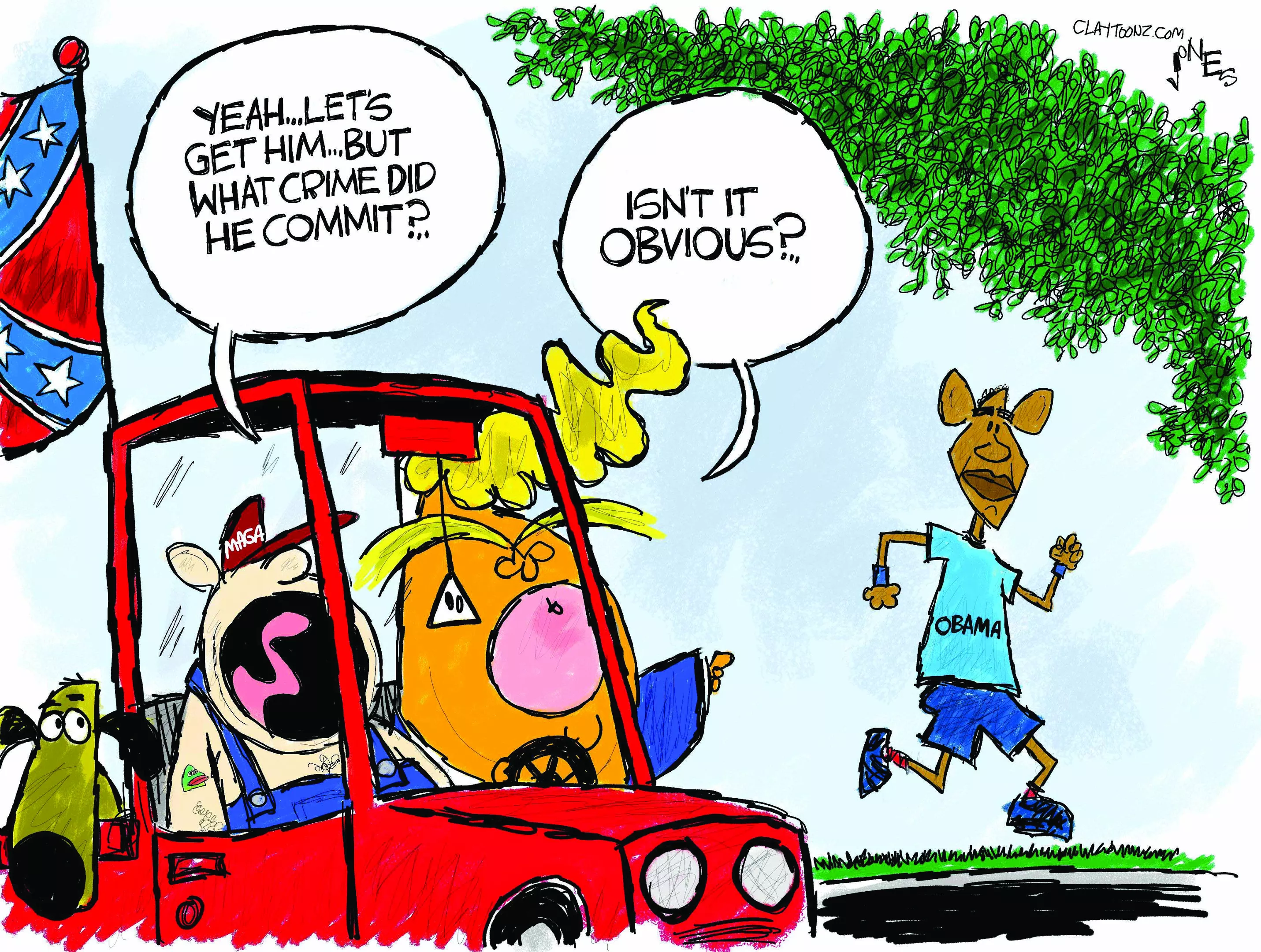
Tags: maga , trump , obama , crime , obvious , political , cartoon , Image
Tuesday, May 12, 2020

Monday, May 11, 2020

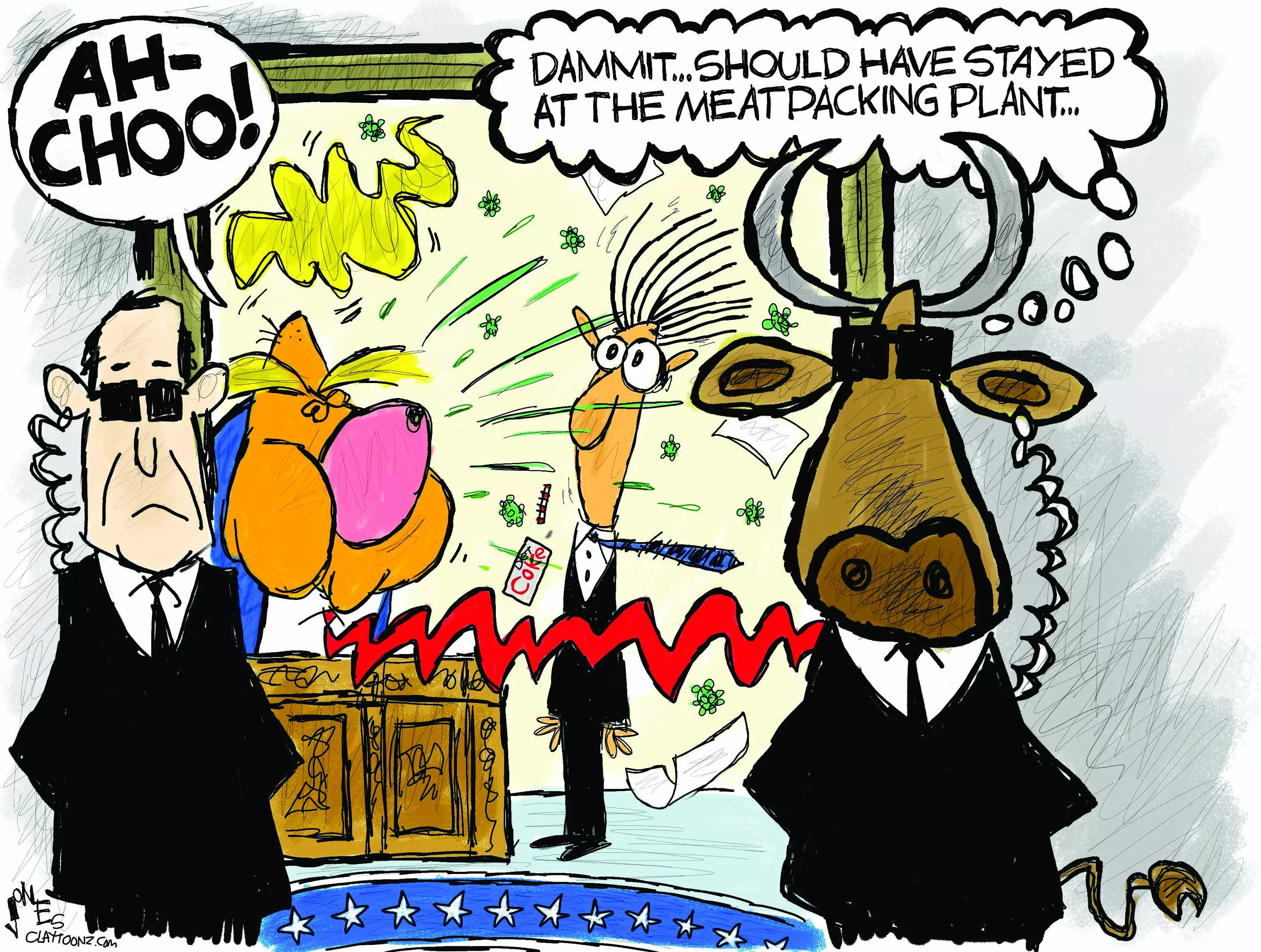
On Tuesday, March 31, an emergency room doctor at the main hospital in Grand Island, Nebraska, sent an urgent email to the regional health department: “Numerous patients” from the JBS beef packing plant had tested positive for COVID-19. The plant, he feared, was becoming a coronavirus “hot spot.”
The town’s medical clinics were also reporting a rapid increase in cases among JBS workers. The next day, Dr. Rebecca Steinke, a family medicine doctor at one of the clinics, wrote to the department’s director: “Our message is really that JBS should shut down for 2 weeks and have a solid screening plan before re-opening.”
Teresa Anderson, the regional health director, immediately drafted a letter to the governor.
But during a conference call that Sunday, Gov. Pete Ricketts made it clear that the plant, which produces nearly 1 billion pounds of beef a year and is the town’s largest employer, would not be shut down.

The links to the viral video “Plandemic” started showing up in my Facebook feed Wednesday. “Very interesting,” one of my friends wrote about it. I saw several subsequent posts about it, and then my brother texted me, “Got a sec?”
My brother is a pastor in Colorado and had someone he respects urge him to watch “Plandemic,” a 26-minute video that promises to reveal the “hidden agenda” behind the COVID-19 pandemic. I called him and he shared his concern: People seem to be taking the conspiracy theories presented in “Plandemic” seriously. He wondered if I could write something up that he could pass along to them, to help people distinguish between sound reporting and conspiracy thinking or propaganda.
So I watched “Plandemic.” I did not find it credible, as I will explain below. YouTube, Facebook and Vimeo have since removed it from their platforms for violating their guidelines. Now it’s available on its own site.

Ten weeks into the worst crisis in 90 years, the government’s effort to save the economy has been both a spectacular success and a catastrophic failure.
The clearest illustration of that came on Friday, when the government reported that 20.5 million people lost their jobs in April. It marked a period of unfathomable pain across the country not seen since the Great Depression. Also on Friday, the stock market rallied.
The S&P 500 is now up 30% from its lows in mid-March and back to where it was last October, when the outlook for 2020 corporate earnings looked sunshiny. Companies have sold record amounts of debt in recent weeks for investment-grade companies. Junk bonds, historically dodgy during an economic swoon, have roared back.
If you’re looking for investors’ verdict on who has won the bailout, consider these returns: Shares of Apollo Group, the giant private equity firm, have soared 80% from their lows. The stock of Blackstone, another private equity behemoth, has risen 50%.
The reason: Asset holders like Apollo and Blackstone — disproportionately the wealthiest and most influential — have been insured by the world’s most powerful central bank. This largess is boundless and without conditions. “Even if a second wave of outbreaks were to occur,” JPMorgan economists wrote in a celebratory note on Friday, “the Fed has explicitly indicated that there is no dollar limit and no danger of running out of ammunition.”
Friday, May 8, 2020

On Donald Trump’s first day in office he signed his Global Gag Rule, an executive order that restricts international health care providers that receives U.S. aid from simply mentioning abortion services. We’re several years and a pandemic away from Trump’s first day in office, so why does this matter right now?
Because people don’t stop needing reproductive health care services amidst a pandemic, and Trump’s Global Gag Rule has already made these services, amongst others, near-impossible to access in communities around the world. As reproductive health services are scaled back to focus on responding to COVID-19, people around the world are forced to forgo health care.
The World Health Organization lists abortion as an essential service; the last time I checked, you can’t pause a pregnancy until a pandemic passes.
Trump’s Global Gag Rule doesn’t just impact reproductive health care services, but all health services. This is because programs and clinics in countries around the world have lost millions of dollars in USAID, leading to staffing cutbacks and clinic closures. These clinics are often the only trusted health care providers in the communities they serve. By forcing these clinics to close, Trump’s Global Gag Rule limits interventions to stop the spread of coronavirus in vulnerable communities around the world. During a health care crisis, do we want leaders who are cutting funding and access to health care?
No. I am ashamed that Sen. Martha McSally (R-AZ) has failed to co-sponsor the Global Health, Empowerment and Rights (HER) Act to permanently repeal the Global Gag Rule and safeguard the right to reproductive health access around the world.
I’m a young woman with a woman senator who doesn’t respect or stand up for my health care rights.
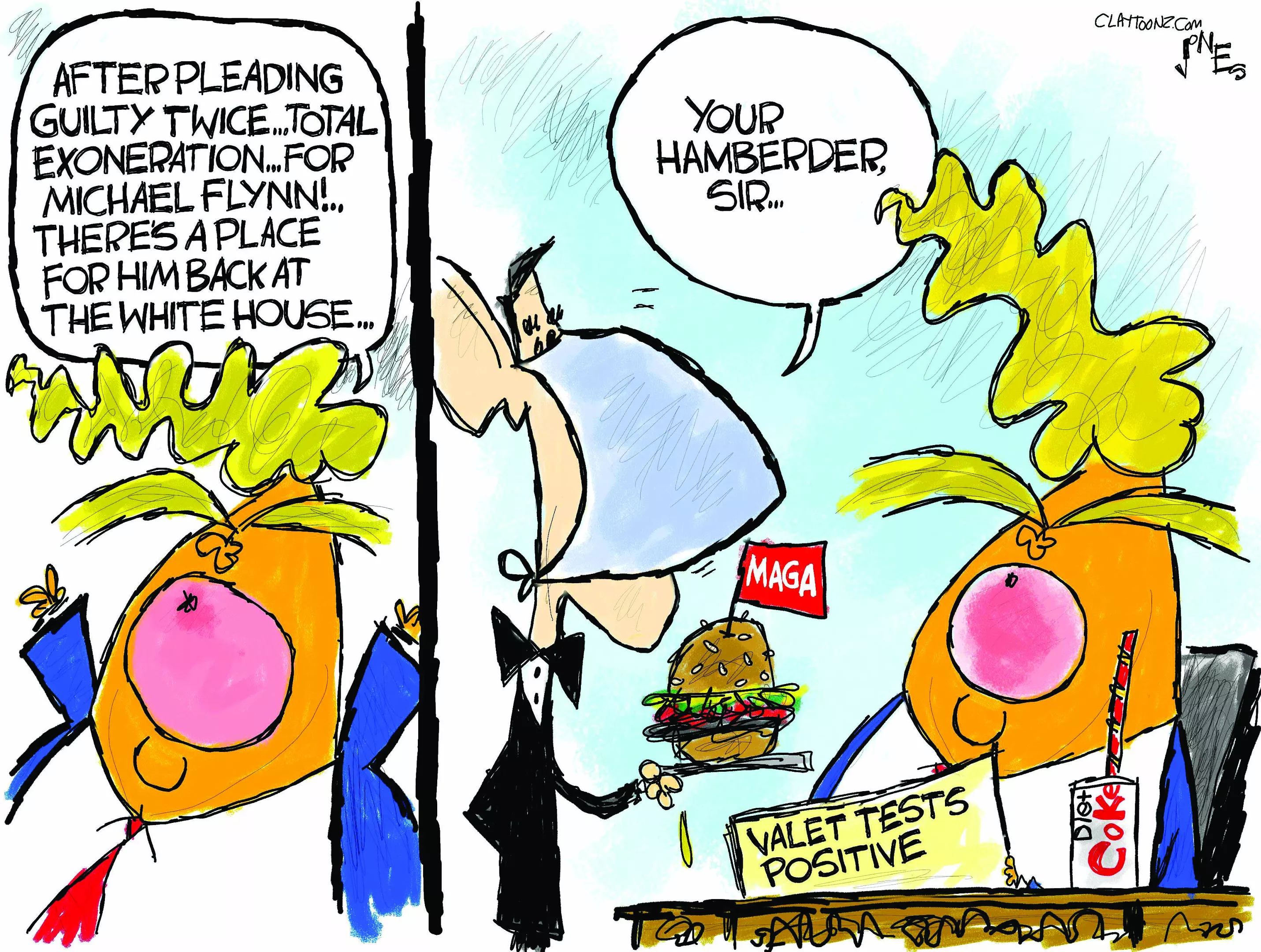
Tags: maga , trump , tests , hamberders , political cartoon , Image

