

Sunday, April 12, 2020
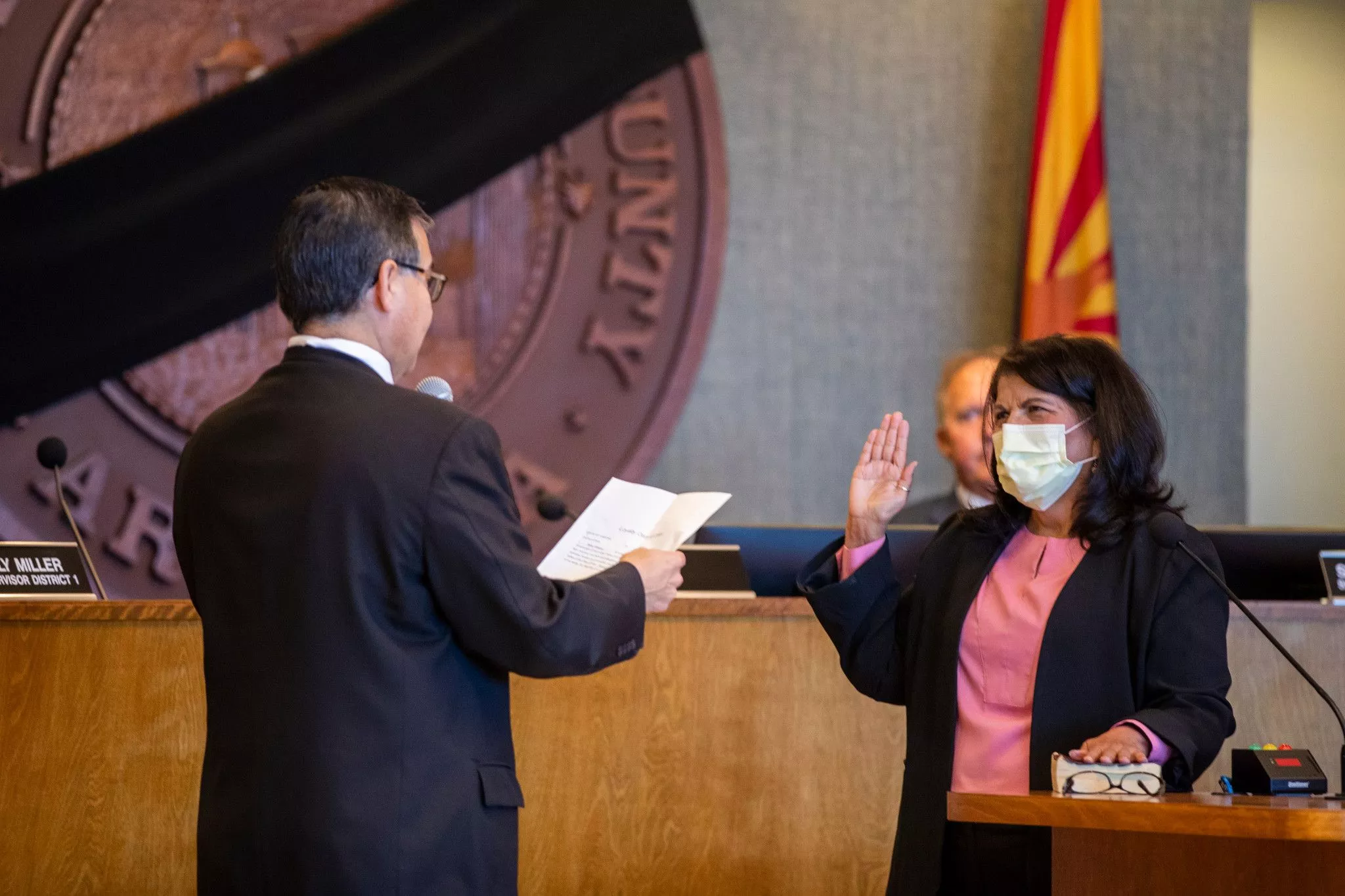
Incoming District 5 Supervisor Betty Villegas is sworn in by Chairman Ramon Valadez on Thursday, April 9. The Pima County Board of Supervisors appointed Villegas after a 3-1 vote on Tuesday, April 7.
Newly minted Pima County Supervisor Betty Villegas describes her first day on the job as bittersweet as she enters the office of her former colleague and friend, Democrat Richard Elias, who died of a heart attack in late March after nearly two decades representing District 5.
The Pima County Board of Supervisors appointed Villegas to the position in a 3-1 vote earlier this week.
“This experience is bittersweet. I never really imagined I would find myself in this position,” Villegas said. “It feels almost surreal to be in his office where I visited many times. I told Mr. Huckleberry I want to leave everything as-is.”
Villegas said she was surprised to see a gift she had given Elias when he first appointed District 5 supervisor was still in his office. Elias took over for then-Supervisor Raul Grijalva, who left the office in 2002 to run for the congressional seat he still holds today.
“I remember when he was first appointed going in (Elias’ office) and it was pretty empty at the time,” Villegas said “I gave him a zen rock garden, you know, with the sand and little rake. He still has it there."
The incoming supervisor said everything in Elias’ office—gifts, awards, things he collected—is a reflection of who he was as a person and what the community thought of him. She hopes to continue Elias’ legacy of being dedicated to the community he loved.
“It’s very inspiring to do (Elias’) work and do it right. So that’s what I’m going to concentrate on,” Villegas said. “You can’t fill his shoes. He was a huge personality who cared for his community. I’ll do the best that I can.”
This isn’t the first time Villegas has taken over a position held by Elias. She took over as program manager for Pima County Affordable Housing Department after Elias was appointed to Grijalva’s District 5 seat.
“The ironic thing is that I moved into (Elias’) spot when he moved to county supervisor and now I’m taking his spot again,” Villegas said.
While in office, Villegas said her focus is going to be on helping Pima County constituents during the COVID-19 outbreak by making sure state and federal funding is going where it needs to go in a quick and uncomplicated manner.
“Going into this position when nothing is normal you have to think, “What can I do with my experience and skills, and what would Richard do?” Villegas said. “Even though the funding has been allocated, the process of how to get it out to the masses is still not really clear. But we need to make it as uncomplicated as possible.”
Friday, April 10, 2020
ProPublica is a nonprofit newsroom that investigates abuses of power. Click here to read their biggest stories as soon as they’re published.
Late last month, Vice President Mike Pence sent a letter to administrators of the nation’s 6,000 hospitals requesting a favor.
He asked them to complete a form each day with data on the patients they are treating with COVID-19, the disease caused by the novel coronavirus, and submit it to the Centers for Disease Control and Prevention.
“The data will help us better understand disease patterns and develop policies for prevention and control of health problems related to COVID-19,” Pence wrote.
Now, as COVID-19 nears an apex in some parts of the country, it’s unclear how many hospitals have submitted the requested information. For its part, the CDC has not released the data publicly, saying only that it plans to do so soon.

Late last month, Vice President Mike Pence sent a letter to administrators of the nation’s 6,000 hospitals requesting a favor.
He asked them to complete a form each day with data on the patients they are treating with COVID-19, the disease caused by the novel coronavirus, and submit it to the Centers for Disease Control and Prevention.
“The data will help us better understand disease patterns and develop policies for prevention and control of health problems related to COVID-19,” Pence wrote.
Now, as COVID-19 nears an apex in some parts of the country, it’s unclear how many hospitals have submitted the requested information. For its part, the CDC has not released the data publicly, saying only that it plans to do so soon.
ProPublica is a nonprofit newsroom that investigates abuses of power. Click here to read their biggest stories as soon as they’re published.
In the wake of President Trump’s move to push aside the official who was supposed to lead the coronavirus bailout watchdog group, four other members are just as vulnerable.
Trump was able to remove the panel’s chosen head, Glenn Fine, by naming a new Defense Department inspector general and bumping Fine to the No. 2 job at the Pentagon watchdog office. No longer an acting inspector general, Fine was disqualified from serving on the panel he was supposed to lead.
Fine’s removal sounded an alarm among Democrats in Congress, who had demanded that spending safeguards be built into the $2 trillion recovery package. House Democrats rushed out a proposed tweak that would stop further removals like Fine’s by opening up eligibility to senior officials in IG offices, not just IGs themselves.

In the wake of President Trump’s move to push aside the official who was supposed to lead the coronavirus bailout watchdog group, four other members are just as vulnerable.
Trump was able to remove the panel’s chosen head, Glenn Fine, by naming a new Defense Department inspector general and bumping Fine to the No. 2 job at the Pentagon watchdog office. No longer an acting inspector general, Fine was disqualified from serving on the panel he was supposed to lead.
Fine’s removal sounded an alarm among Democrats in Congress, who had demanded that spending safeguards be built into the $2 trillion recovery package. House Democrats rushed out a proposed tweak that would stop further removals like Fine’s by opening up eligibility to senior officials in IG offices, not just IGs themselves.
Thursday, April 9, 2020
TOMORROW: I’m hosting a telephone town hall with special guest Larry Kudlow, the president’s top economic advisor, to provide an update on the economic resources available to Arizonans during the COVID-19 outbreak.
— Martha McSally (@SenMcSallyAZ) April 8, 2020
Call 855-962-1520 to join us and ask us a question! pic.twitter.com/Lap3A4VZkV
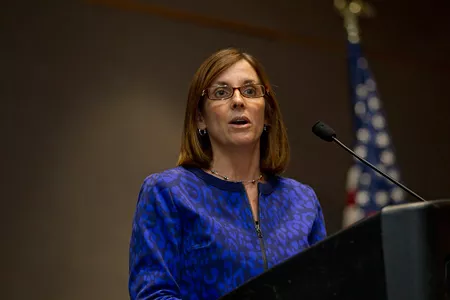
Courtesy of pima.gov
Congresswoman Martha McSally, who has voted to explode the federal deficit even before the COVID-19 outbreak, is now gaslighting Arizonans with the help of conservative hack Larry Kudlow.
Appointed Sen. Martha McSally has settled comfortably into the pocket of President Donald Trump over the last three years. For example, despite the obvious and growing evident that Trump ignored multiple warnings about the danger that COVID-19 presented to the United States, McSally has just blamed China for everything. (While it's true that China could have been more forthright about its own battle with the virus, it's also true that Trump had plenty of warning about it and chose to pretend it wouldn't be a problem.)
Given McSally relentless support of the Gaslighter-in-Chief, it's no surprise that she's delighted to have Larry Kudlow as her guest at a town hall later today. Kudlow has been remarkable wrong about the COVID-19 outbreak from the jump. He told CNBC back on Feb. 25, when the stock market was starting to crash, that COVID-19 was going to be no big deal in the United States, despite warnings from the CDC that it was going to be a major outbreak. As Politico reported:
White House National Economic Council Director Larry Kudlow said Tuesday that the U.S. has “contained” the threat of a domestic coronavirus outbreak, breaking with the warnings of officials from the Centers for Disease Control and Prevention.
“We have contained this, I won’t say airtight but pretty close to airtight,” Kudlow told CNBC’s Kelly Evans on Tuesday afternoon.Kudlow’s confidence was set against U.S. stocks, which suffered their worst day in two years on Monday and were down again Tuesday amid fears that the coronavirus could mushroom into a pandemic. But the White House economic adviser suggested that the virus’ impact is “not going to last forever.”
“This is a human tragedy,” particularly in China, Kudlow emphasized multiple times. But warning against overreaction, he added, “The business and the economic side, I don’t think it’s going to be an economic tragedy at all. There’ll be some stumbles.”
Yeah, you might call record unemployment numbers and the current economic calamity a "stumble."
Kudlow has made a career of calling for tax cuts as the solution to every economic problem. He's been wrong over and over again, but his willingness to stick with the party line has, of course, made him a perfect economic advisor in the Trump White House.
Jonathan Chait of New York magazine has done a marvelous job of tracking Kudlow's consistently wrong predictions about the economy. As Chait writes in his roundup of Kudlow's many wrong predictions:
The purest supply-siders, like Kudlow, go further and deeper in their commitment. Kudlow attributes every positive economic indicator to lower taxes, and every piece of negative news to higher taxes. While that sounds absurd, it is the consistent theme he has maintained throughout his career as a prognosticator. It’s not even a complex form of kookery, if you recognize the pattern. It’s a very simple and blunt kind of kookery.Given McSally's record on budget balancing—she, like most Republicans, complains mightily about deficit spending while voting for budgets that drive it higher and higher—and her consistent lying about her record on health care (yes, Martha, you have repeatedly voted to strip away regulations to a prevent insurance company from discriminating against people with pre-existing conditions), it's hardly a surprise that she considers Kudlow a reliable source. She may not like liberal hacks, but she has no problem with conservative ones.
Wednesday, April 8, 2020
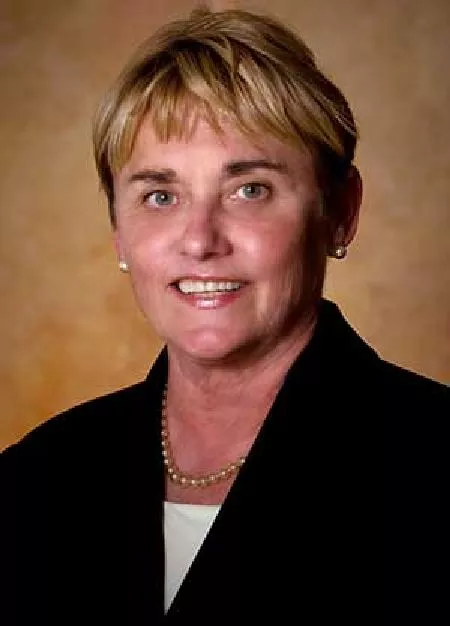
Courtesy Photo
Pima County Supervisor Sharon Bronson is facing both primary and general election challenges as she seeks a seventh term.
But candidates may face legal challenges to their nominating petitions if their opponents can find deficiencies among their signatures, which were due Monday, April 6.
In District 1, where Miller is stepping down after two contentious terms on the Board of Supervisor, the GOP candidates include Oro Valley Town Council member Rhonda Pina; Bill Beard, a former Pima County Republican Party chair; former state lawmaker Vic Williams; and Steve Spain, a political newcomer who has already won Miller’s endorsement.
District 1, which includes Oro Valley, Marana, Casas Adobes and the Catalina Foothills areas, leans Republican. But an underdog status hasn’t prevented two Democrats from climbing into the Democratic primary ring: retired school administrator Rex Scott, who has campaign experience on both sides of the aisle, and Brian Radford, a political newcomer who previously worked in corrections. But Radford only filed 224 signatures on his petitions, just three over the necessary 221 valid signatures to appear on the ballot, leaving him vulnerable to a legal challenge.
In District 4, Supervisor Steve Christy faces a Republican primary challenge from John Backer as he seeks a second term in the largely rural district that includes eastern Pima County and Green Valley. Backer is a political ally of the departing Miller, who has frequently clashed with Christy and briefly employed Backer as an aide.
[image-1]
ProPublica is a nonprofit newsroom that investigates abuses of power. Click here to read their biggest stories as soon as they’re published.
Democratic members of the Senate Judiciary Committee are demanding information about what they call an “unprecedented expansion of executive power” by the Trump administration at the the U.S.-Mexico border, after a ProPublica story revealed how the administration has used emergency powers to bypass asylum law and summarily expel thousands of migrants.
In a letter written by Sen. Patrick Leahy, D-Vt., he and nine colleagues give the Department of Homeland Security until April 15 to explain why it believes it can use one section of U.S. law — which gives emergency powers to the U.S. Centers for Disease Control and Prevention to prohibit the entry of people or things that might “introduce” infectious disease — to preempt the government’s obligation under another section of federal law protecting migrants fearing persecution in their home countries.
“We are deeply concerned that DHS is blatantly misinterpreting its limited authorities under the CDC’s Title 42 order to override existing federal statutes — a move with no known precedent or clear legal rationale,” the letter states. “Making matters worse, this unprecedented expansion of executive power appears to be entirely hidden from public and Congressional oversight.”
Democratic members of the Senate Judiciary Committee are demanding information about what they call an “unprecedented expansion of executive power” by the Trump administration at the the U.S.-Mexico border, after a ProPublica story revealed how the administration has used emergency powers to bypass asylum law and summarily expel thousands of migrants.
In a letter written by Sen. Patrick Leahy, D-Vt., he and nine colleagues give the Department of Homeland Security until April 15 to explain why it believes it can use one section of U.S. law — which gives emergency powers to the U.S. Centers for Disease Control and Prevention to prohibit the entry of people or things that might “introduce” infectious disease — to preempt the government’s obligation under another section of federal law protecting migrants fearing persecution in their home countries.
“We are deeply concerned that DHS is blatantly misinterpreting its limited authorities under the CDC’s Title 42 order to override existing federal statutes — a move with no known precedent or clear legal rationale,” the letter states. “Making matters worse, this unprecedented expansion of executive power appears to be entirely hidden from public and Congressional oversight.”
Tuesday, April 7, 2020
Out-of-state travelers from areas with substantial community spread of COVID-19 will have to isolate or quarantine themselves for 14 days under a new executive order from Gov. Doug Ducey.
“Slowing the spread of COVID-19 remains our top priority,” said Ducey. “Today’s action aligns with guidance from public health officials, while ensuring those traveling for essential functions can continue to do so. We will take all necessary precautions to keep Arizonans safe.”
The order does not apply to airline employees, military personnel, healthcare workers, human services personnel, workers conducting essential infrastructure operations and workers providing essential governmental functions.
Ducey issued a number of other executive orders today regarding the outbreak. He instituted new guidelines for residential care facilities, nursing homes and other similar institutions. Staff will have to use appropriate personal protection equipment and institute symptom checks for anyone entering facilities. The order also requires healthcare facilities to supply residents with some kind of video device so they can stay in touch with family and loved ones.
“Arizona will continue to take proactive measures to protect our seniors and vulnerable populations,” said Ducey. “This order helps protect seniors and those living in health care facilities, as well as the staff and health care professionals caring for patients. My thanks to these individuals working to protect Arizona’s most vulnerable as we work to slow the spread of COVID-19.”
Ducey also loosened restrictions on restaurants so they can repackage sell grocery items they have on hand even if packaging labels say “not for resale.”
“Even with dine-in and carry-out options still available to patrons, many Arizona restaurants are struggling due to COVID-19,” Ducey said. “Today’s executive order provides flexibility for restaurant owners to safely sell prepared and bulk foods or supplies they have on hand and can’t use right now. We are proud to support Arizona restaurants with this reform.”
Hospital and health care providers will have to better track data related to COVID-19, including the number of ICU beds and ventilators in use by COVID-19 patients, the number of suspected COVID-19 patients visiting emergency rooms and estimated amount of personal protective equipment being used each day.
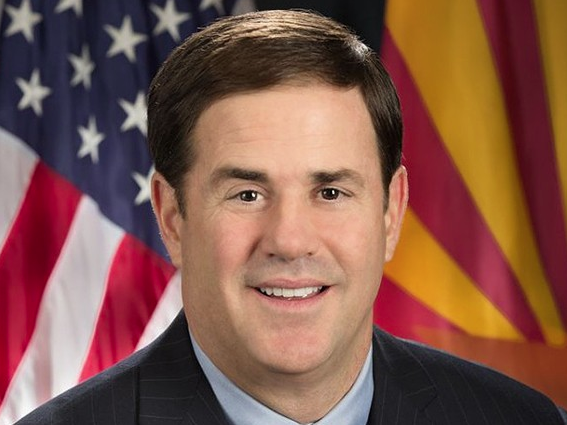
“Slowing the spread of COVID-19 remains our top priority,” said Ducey. “Today’s action aligns with guidance from public health officials, while ensuring those traveling for essential functions can continue to do so. We will take all necessary precautions to keep Arizonans safe.”
The order does not apply to airline employees, military personnel, healthcare workers, human services personnel, workers conducting essential infrastructure operations and workers providing essential governmental functions.
Ducey issued a number of other executive orders today regarding the outbreak. He instituted new guidelines for residential care facilities, nursing homes and other similar institutions. Staff will have to use appropriate personal protection equipment and institute symptom checks for anyone entering facilities. The order also requires healthcare facilities to supply residents with some kind of video device so they can stay in touch with family and loved ones.
“Arizona will continue to take proactive measures to protect our seniors and vulnerable populations,” said Ducey. “This order helps protect seniors and those living in health care facilities, as well as the staff and health care professionals caring for patients. My thanks to these individuals working to protect Arizona’s most vulnerable as we work to slow the spread of COVID-19.”
Ducey also loosened restrictions on restaurants so they can repackage sell grocery items they have on hand even if packaging labels say “not for resale.”
“Even with dine-in and carry-out options still available to patrons, many Arizona restaurants are struggling due to COVID-19,” Ducey said. “Today’s executive order provides flexibility for restaurant owners to safely sell prepared and bulk foods or supplies they have on hand and can’t use right now. We are proud to support Arizona restaurants with this reform.”
Hospital and health care providers will have to better track data related to COVID-19, including the number of ICU beds and ventilators in use by COVID-19 patients, the number of suspected COVID-19 patients visiting emergency rooms and estimated amount of personal protective equipment being used each day.
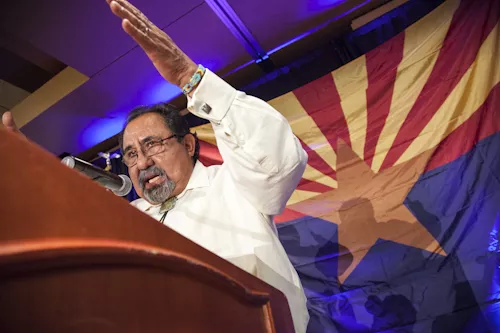
Rep. Raúl Grijalva: "While many white-collar professionals can follow social distancing guidelines, essential bluecollar workers are tasked with holding our country together by delivering the hands-on vital services we need to survive."
An excerpt from the letter:
As the COVID-19 crisis expands so do obvious distinctions between socio-economic classes. While many white-collar professionals can follow social distancing guidelines, essential bluecollar workers are tasked with holding our country together by delivering the hands-on vital services we need to survive. We ask that the next COVID-19 bill require employers take action to protect workers and include premium pay to supplement low-income workers and to ensure this crisis doesn’t further exacerbate class inequalities.
Future legislation should support supplemental pay that reflects the work and hazards these individuals are encountering on a daily basis. Eligibility for the additional pay should include, but not be limited to, health care workers along the spectrum of care, grocery workers, restaurant workers, child care providers, public sector workers (including police, fire, corrections, postal), farmworkers, utility workers, transportation workers, sanitation workers and other hourly employees deemed essential. Federal employees who are required to report to work, including Title 38 employees with the Department of Veterans Affairs, the Transportation Security Administration, and the Federal Aviation Administration should also be included. Federal workers who cannot work remotely are in immediate danger of exposure, and current protocols have no guarantees of protection. The legislation should include a full tax credit or other form of reimbursement for businesses under 500, to be appropriately scaled down for larger employers. Business participation in the supplemental compensation should be mandatory.
We are asking these individuals and their families to sacrifice so much for our nation. It is imperative that we make every effort to prevent this crisis from being one that is disproportionately borne by the working class. Instead we should use this as an opportunity to pay them their full worth—a worth that has been undervalued in many cases for far too long.
The Pima County Board of Supervisors approved Betty Villegas as the new District 5 Supervisor in a 3-1 vote during this morning's meeting. District 4 Supervisor Steve Christy was the lone vote against Villegas.
The Elias family expressed their wish for Villegas to take over the District 5 seat after Supervisor Richard Elias died of a heart attack last month. Villegas is the former housing program manager for the Pima County Housing Center and also ran for Legislative District 3 in 2018.
District 3 Supervisor Sharon Bronson made the motion to appoint Villegas to fill the seat immediately due to urgent issues during this unprecedented time. The motion was seconded by Valadez.
The criteria to be appointed to the board are:
Valadez reminded Christy that every appointment for 32 years -from Dan Eckstrom in 1988 to Valadez's own appointment in 2003- has been done through legislative appointment. Chief Civil Deputy County Attorney Andrew Flagg confirmed Valadez's statement.
County supervisors also passed a proclamation dedicating the month of April 2020 to the memory of Supervisor Elias, asking departments to create an appropriate memorial for “remembrance and reflection”, said Chairman Ramon Valadez.
“The Friday before his passing, he and I were on the phone and we talked about what was going on. We talked about each of you. We talked about his family, his wife, his daughter, and he had such concern and compassion for each one of us. And he was concerned for each of you.”
TW staff reporter Kathleen B. Kunz profiled Villegas in 2018:

The Elias family expressed their wish for Villegas to take over the District 5 seat after Supervisor Richard Elias died of a heart attack last month. Villegas is the former housing program manager for the Pima County Housing Center and also ran for Legislative District 3 in 2018.
District 3 Supervisor Sharon Bronson made the motion to appoint Villegas to fill the seat immediately due to urgent issues during this unprecedented time. The motion was seconded by Valadez.
The criteria to be appointed to the board are:
- Must be the same political party; in this case Democrat
- Must be a registered voter
- Must be a resident of Arizona
- Must be at least 18 years old
- Must be able to read and write english
Valadez reminded Christy that every appointment for 32 years -from Dan Eckstrom in 1988 to Valadez's own appointment in 2003- has been done through legislative appointment. Chief Civil Deputy County Attorney Andrew Flagg confirmed Valadez's statement.
County supervisors also passed a proclamation dedicating the month of April 2020 to the memory of Supervisor Elias, asking departments to create an appropriate memorial for “remembrance and reflection”, said Chairman Ramon Valadez.
“The Friday before his passing, he and I were on the phone and we talked about what was going on. We talked about each of you. We talked about his family, his wife, his daughter, and he had such concern and compassion for each one of us. And he was concerned for each of you.”
TW staff reporter Kathleen B. Kunz profiled Villegas in 2018:
Villegas, who is running for an LD-3 Senate seat, said her campaign is focused on housing reform. For 17 years, she served as the Affordable Housing Program Manager for Pima County. Villegas said there’s no one in the current Arizona legislature who has experience with affordable housing issues.
“In District 3, 50 percent of the people are paying over 50 percent of their income towards housing expense,” she said. “It’s not going to be too much longer before we’re another San Diego. The cost of housing is continuing to go up, and we need to find new ways of trying to help and trying to cut that."
Villegas is also a long-time local volunteer who has served on numerous commissions in the Tucson area. She said those experiences gave her an deeper understanding about her community before she ran for office.
“It’s so important to be civically engaged and community engaged. It gives you a voice at the table, and as a Latina, we are sometimes missing at that table,” she said. “On the historic preservation commission, I’m the only person of color there. So I’m constantly telling the people that appoint me and that appoint others: ‘We really need to get a more diverse commission.’"
Thursday, April 2, 2020
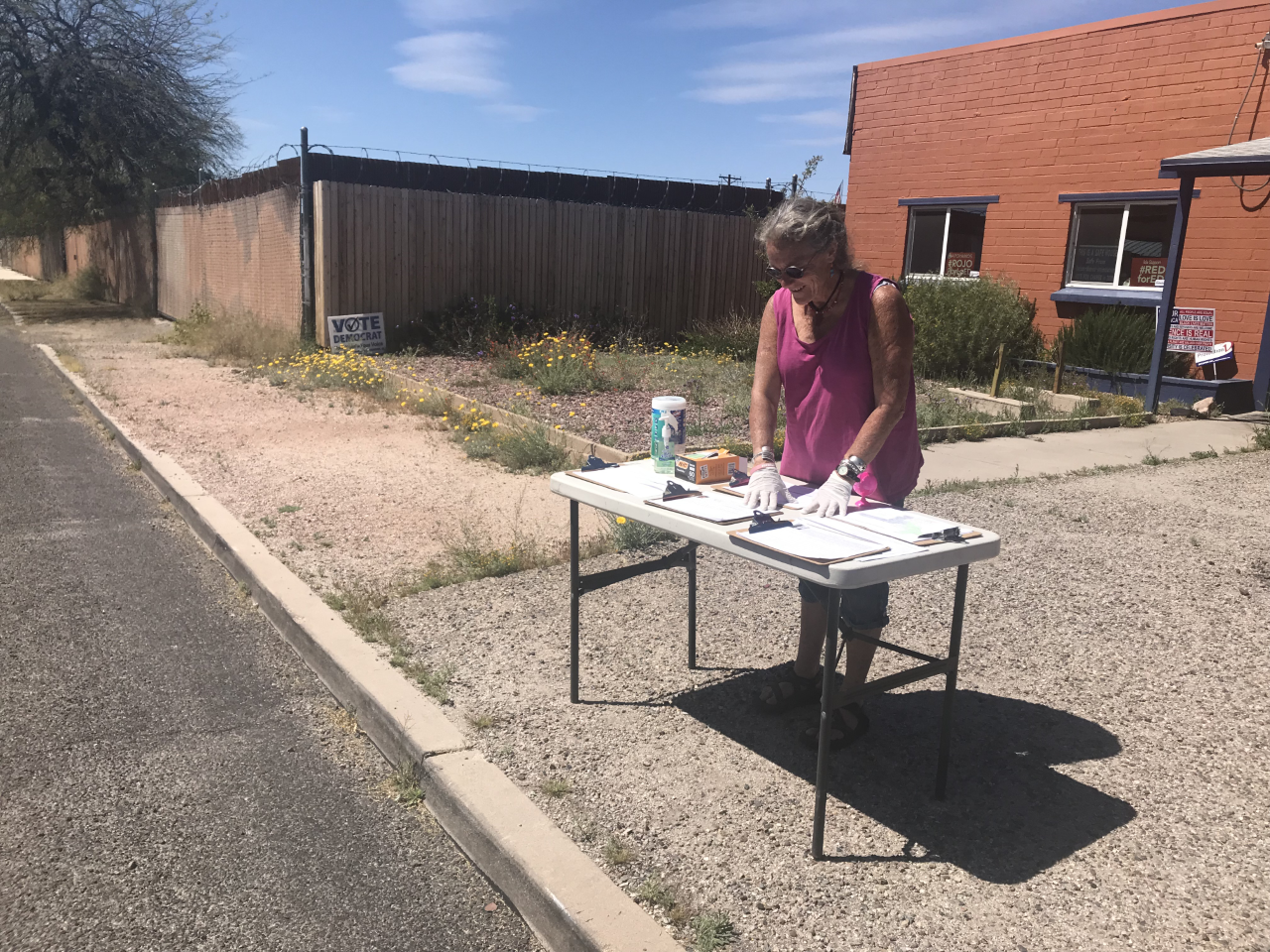
Volunteer Betts Putnam-Hildalgo sets up her table to host drive-up signature gathering at the Pima County Democratic Party Headquarters at 4639 E. 1st Avenue from 11 A.M. to 2 P.M. today through Saturday.
Four Democratic hopefuls filed paperwork days after District 5 Supervisor Richard Eliás died of an apparent heart attack last weekend. TUSD School Board Member Adelita Grijalva and SUSD Governing Board Member Consuelo Hernandez both filed on March 30, while political newcomers Steven Washburn and Joseph Miller filed the following day.
To help the candidates make the tight deadline, the Pima County Democratic Party is setting up a drive-up signature-gathering event in front of their headquarters for District 5 candidates who have already delivered blank petitions to the party HQ. Petitions will be available to sign between 11 a.m. to 2 p.m. today through Saturday.
“We’re only (collecting signatures) for the District 5 office because of the special circumstances with Richard Eliás’ passing,” said Alison Jones, chair of the Pima County Democratic Party. “The candidates are still going to have to do much of the work themselves. This is not going to get any candidate the signatures they’ll need.”
The Democrats are currently collecting signatures for Adelita Grijalva, Consuelo Hernandez and Trista Tramosch Di Genova-Chang. Miller, who is active in the Midvale neighborhood association, is expected to drop off his petitions to be signed today, Jones said. Washburn, who serves on the Tucson Water Advisory Committee, also dropped off petitions to sign.
“We’ve reached out to all of the candidates and let them know this service is available,” Jones said.

