
Thursday, February 13, 2020
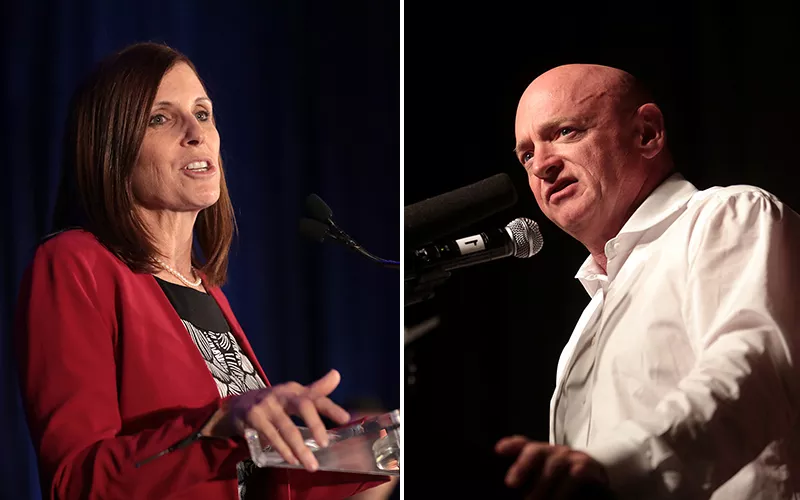
McSally currently trails likely Democratic challenger Mark Kelly in fundraising, bringing in $12.6 million by the end of last year to his $20.2 million. Together, they have outraised all but one Senate race in the country, and are already closing in on the $38 million raised for the entire 2018 Senate campaign in Arizona.
“Arizona’s days of small-dollar Senate races are over,” said Mike Noble, chief of research at OH Predictive Insights. “We saw the amount of money spent last time and Arizona’s implications in the national tug of war … in Washington.”
Analysts said that while McSally “certainly has a challenge,” she should have more than enough money to get her message out before Election Day.
The Federal Election Commission reported that Kelly had raised more than any other Senate candidate in the country in 2019 and McSally was in sixth place on that list. Only the Senate race in Kentucky brought in more total money last year, with Republican Majority Leader Mitch McConnell and Democratic challenger Amy McGrath raising $18 million and $16.9 million, respectively.
The Arizona race pits two well-known candidates with atypical political backgrounds against each other.
McSally is an Air Force veteran who was the first woman to fly a fighter jet in combat. She served two terms in the House from Tucson before deciding to run for Senate in 2018.
Kelly is a former Navy pilot and former astronaut who is married former Rep. Gabrielle Giffords, the Democrat who was representing Tucson in the House when she was severely wounded in a 2011 assassination attempt. He has not held elective office but has had a high-profile role working with Giffords’ national gun-safety group.
A December poll by OH Predictive Insights showed 47% of Arizona voters supporting Kelly, who had strong backing among women, and 44% of voters supporting McSally, who did well among male voters. The poll, with a margin of error of plus or minus 3.1%, was closer than previous polls and was called a statistical dead heat by the firm.
Nathan Gonzales, an editor and publisher at Inside Elections, said it should come as no surprise that Arizona has become a battleground state, because of Republican struggles in the suburbs and Arizona Democrat Kyrsten Sinema’s defeat of McSally in the 2018 race for Senate.
After Sinema won that race to replace outgoing Republican Sen. Jeff Flake, Gov. Doug Ducey appointed McSally to fill the remaining term of the late Sen. John McCain, who died in 2018. McCain’s term expires in 2020.
It was no surprise that McSally would run again, and she made it official Tuesday with the release of a campaign video announcing her bid. That video highlighted her key messages of improving mental health care for veterans, tackling sexual assault and the opioid epidemic, and lowering prescription drug prices.
While McSally enters the race trailing Kelly in fundraising, Noble said she is “no slouch” in terms of fundraising, noting that she is “off to an even faster start than two years ago.”
Other analysts agreed, but said Kelly’s fundraising is still impressive, if not surprising.
“Mark Kelly is one of the best Senate fundraisers I’ve ever seen and he is building up a sizable cash-on-hand advantage,” said Kyle Kondik, managing editor of Sabato’s Crystal Ball at the University of Virginia Center for Politics.
Kelly reported having $13.6 million in cash on hand in his Dec. 31 FEC report, while McSally reported finishing 2019 with $7.7 million on hand.
While Kelly could have more money to spend in the general election, Kondik said McSally is raising money at an “impressive clip” and that spending by outside groups in the high-profile race could help “blunt that edge” that Kelly has.
McSally’s campaign manager Dylan Lefler said in a statement Wednesday while “more is always better,” the campaign is pleased with the amount that the senator has been able to raise for the race. He criticized the amount of out-of-state money going to Kelly’s campaign.
But Kelly had also raised $9.2 million in unitemized individual contributions, donations of $200 or less, while McSally raised $4.2 million, according to their FEC filings.
Kelly campaign manager Jen Cox said in a statement that the campaign “took off like a rocket at the beginning of last year and hasn’t slowed down.”
Mark Schmitt, director of a political reform program at New America, called Kelly’s fundraising an “impressive show of strength,” but not surprising given his well-known marriage to Giffords.
He said McSally might be in more trouble if she did not have access to President Donald Trump’s fundraising machine. But ultimately, he said, the fundraising numbers should not make much of a difference in the election.
“In high-profile races like this, both candidates are going to have enough money to be competitive,” Schmitt said. “Even if Kelly spends 10 million more than McSally does, that’s not what’s going to make the difference.”
Gonzales said in an email that money will continue to flow in to the race because the Senate majority is in play. While Kentucky may end up as the most expensive Senate race, it will not be as competitive as Arizona, he said.
It’s too early to write McSally off, Gonzales said, but she “certainly has a challenge.”
“The governor’s victory in 2018 was evidence that voters are willing to make a distinction between races, and that should concern McSally,” he said. “Even another Trump victory in Arizona doesn’t guarantee a win for her.”
Tags: Martha McSally , Senate , Mark Kelly , elections , campaigns , Image
Wednesday, February 12, 2020
Tags: comics , Trump , MAGA , Claytoonz , Rodger Stone , Nixon , subpoenas , Image
Tuesday, February 11, 2020

Monday, February 10, 2020
Thursday, February 6, 2020
Tags: comics , politics , Claytoonz , Clay Jones , Maga , Republicans , Trump , Mitt Romney , Image
Wednesday, February 5, 2020
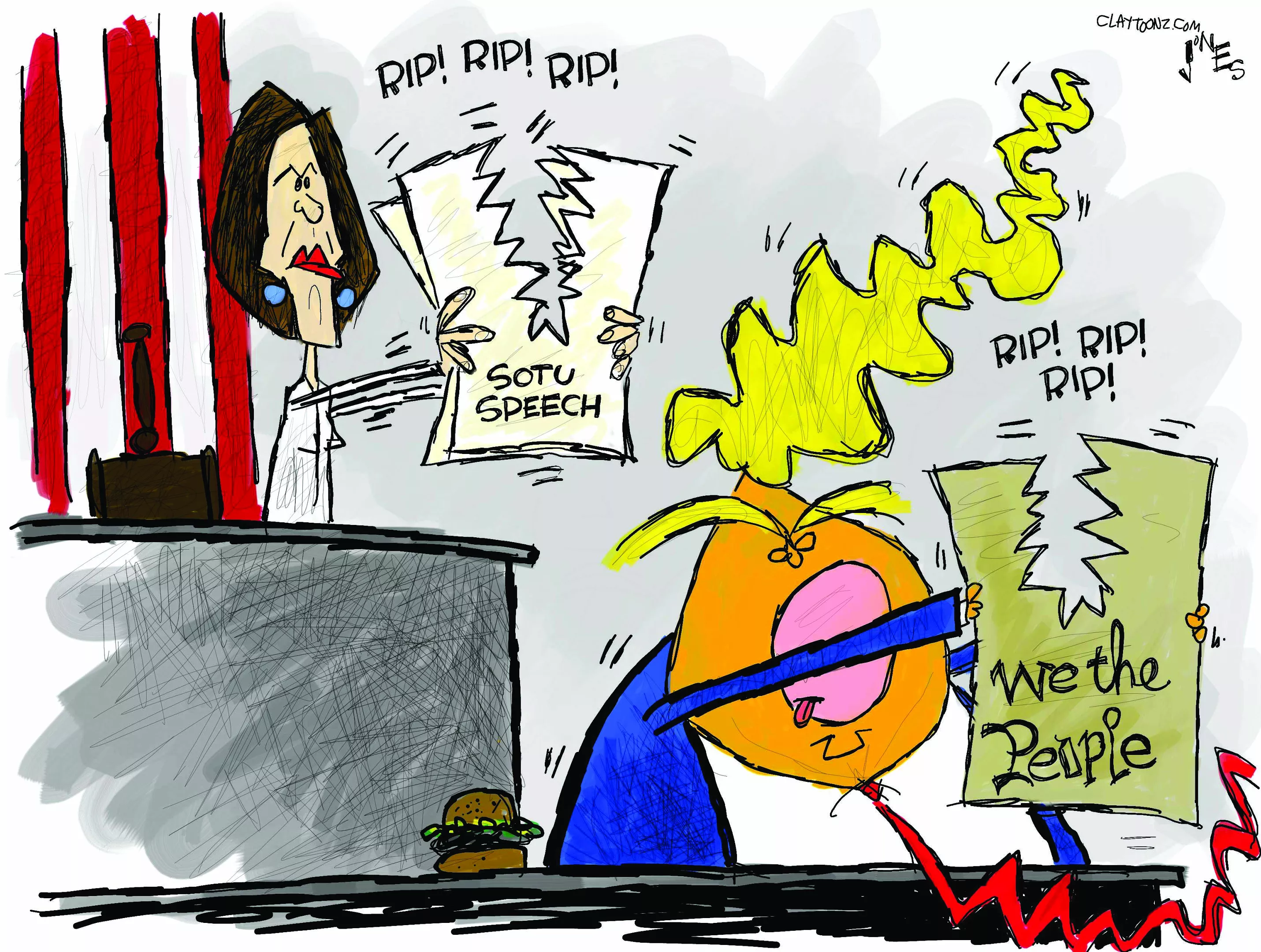
Tags: Trump , Pelosi , State of the Union , rip , speech , politics , Image
Tuesday, February 4, 2020

Tags: Trump , windmills , lung cancer , politics , MAGA , Claytoonz , comics , Image

In 2015, Trump told a conservative publication affiliated with the Heritage Foundation, “I’m not going to cut Social Security like every other Republican and I’m not going to cut Medicare or Medicaid.”
The very first thing he tried was repealing the Affordable Care Act, which included a popular bi-partisan expansion of Medicaid. Here in Arizona, the ACA’s Medicaid expansion is one of Governor Jan Brewer’s proudest accomplishments. If Trump had succeeded, more than 400,000 Arizonans would have lost their health coverage. Thankfully, Senator John McCain put a stop to Trump’s plan.
So much for not cutting Medicaid.
But it gets worse.
Under Trump, we are undergoing a huge spike in drug prices. Trump’s response? Give drug companies billions of dollars in tax breaks and oppose giving Medicare the authority to negotiate lower drug prices—the most effective solution to this problem. Though Trump pretends that drug prices are coming down, the truth is that drug companies have consistently raised their prices and reaped massive profits. In 2017, the prescription drug Lantus, used by patients with Diabetes, cost Arizonans $4,702 annually. It was $2,907 in 2012. Arizonans have experienced so many significant increases in the cost of medication that we are often forced to make the difficult decision of whether to pay for medication or buy groceries. This is just plain wrong.
Tags: politics , health care , State of the Union address , Protect Our Care Arizona , Image
Today the Pima County Board of Supervisors voted to reject more than $1.8 million in federal Operation Stonegarden funds. This money would have gone toward Pima County sheriff’s deputies overtime, mileage and equipment related to federal immigration missions.
Democratic Supervisors Sharon Bronson, Ramón Valadez and Richard Elías voted against the funds, while Republican Supervisors Steve Christy and Ally Miller voted in favor.
Last May, the supervisors voted 3-2 to accept Stonegarden funding on the condition that more than $200,000 of those funds go toward reimbursement for the county’s cost of housing and providing services to the large influx of asylum seekers experienced during that time.
District 3 Supervisor Bronson was the swing vote in favor of that decision. Supervisors Miller and Christy also voted in favor, while Supervisors Elías and Valadez voted to reject the money.
In December, it was revealed that federal and state officials denied the supervisors’ request to use the money for that purpose. Officials from US Border Patrol and the Federal Emergency Management Agency claimed “there is no border security operational benefit derived from this reallocation request.”
As a result, the Pima County Sheriff’s Department received no Stonegarden funds last year.
Before September 2018, Operation Stonegarden had been accepted by the Pima County Board of Supervisors for 12 consecutive years. In response to mounting opposition from community members, the supervisors rejected it for the first time at a 3-1 vote that year.
Sheriff Mark Napier was an avid supporter of the federal program, saying the funds were instrumental to their operations and maintaining public safety in the region.
But critics of Operation Stonegarden say the program does the opposite. They believe it promotes collaboration between local law enforcement and federal immigration agents, which targets immigrant communities within Southern Arizona.
At the Feb. 4 meeting, Napier said the department needs the proper tools to address cross-border crimes. He said they are actively interdicting large amounts of fentanyl, opioids, heroin and methamphetamine coming into Pima County through the border, as well as cases of human trafficking.
He said they are dependent on this funding from the federal government, but he wants to get to a point in the budget where they are no longer in that position.
Napier said he recognized some of the “collateral damage” caused by these grants, and made an offer to the supervisors to limit the overtime participation by deputies to eight hours per pay period, in order to minimize the fiscal impact of long-term pension obligations.
Napier rejected the notion of racial bias in the sheriff’s department as a result of taking the federal grant and called it “offensive.”
Elías said the criticism about Stonegarden leading to racial profiling is not an attack on officers, but rather an indicator of the federal government not fixing a broken immigration system.
Despite Napier’s comments in favor of the funding, Elías said the Stonegarden grant is still problematic and has a lack of transparency surrounding the “true cost” behind it, regarding the sheriff’s deputies pension liability and lack of humanitarian aid granted.
Elías added that he believes the Department of Homeland Security is a “rogue agency” that doesn't serve the interests of citizens.
Bronson said it's clear the grant hasn't changed or adapted to today’s border conditions. But she said it's still compelling because of a new federal policy, the Migrant Protection Plan. She commented that most migrants who die in the rural desert land of Pima County are in District 3, her district. She believes law enforcement needs to be present in those rural areas to rescue and save lives, which they currently are not doing due to a lack of staffing.
She supported County Administrator Chuck Huckelberry’s continued effort to receive reimbursement for humanitarian aid costs incurred by the county. But since those aren’t included in the current grant, she said she couldn’t support it.
“I think everyone loses no matter how this vote goes down today,” Bronson said.
Tags: Operation Stonegarden , Board of Supervisors , Department of Homeland Security , US Border Patrol , Richard Elías , Sharon Bronson , Steve Christy , Ally Miller , Ramón Valadez , Image
Monday, February 3, 2020
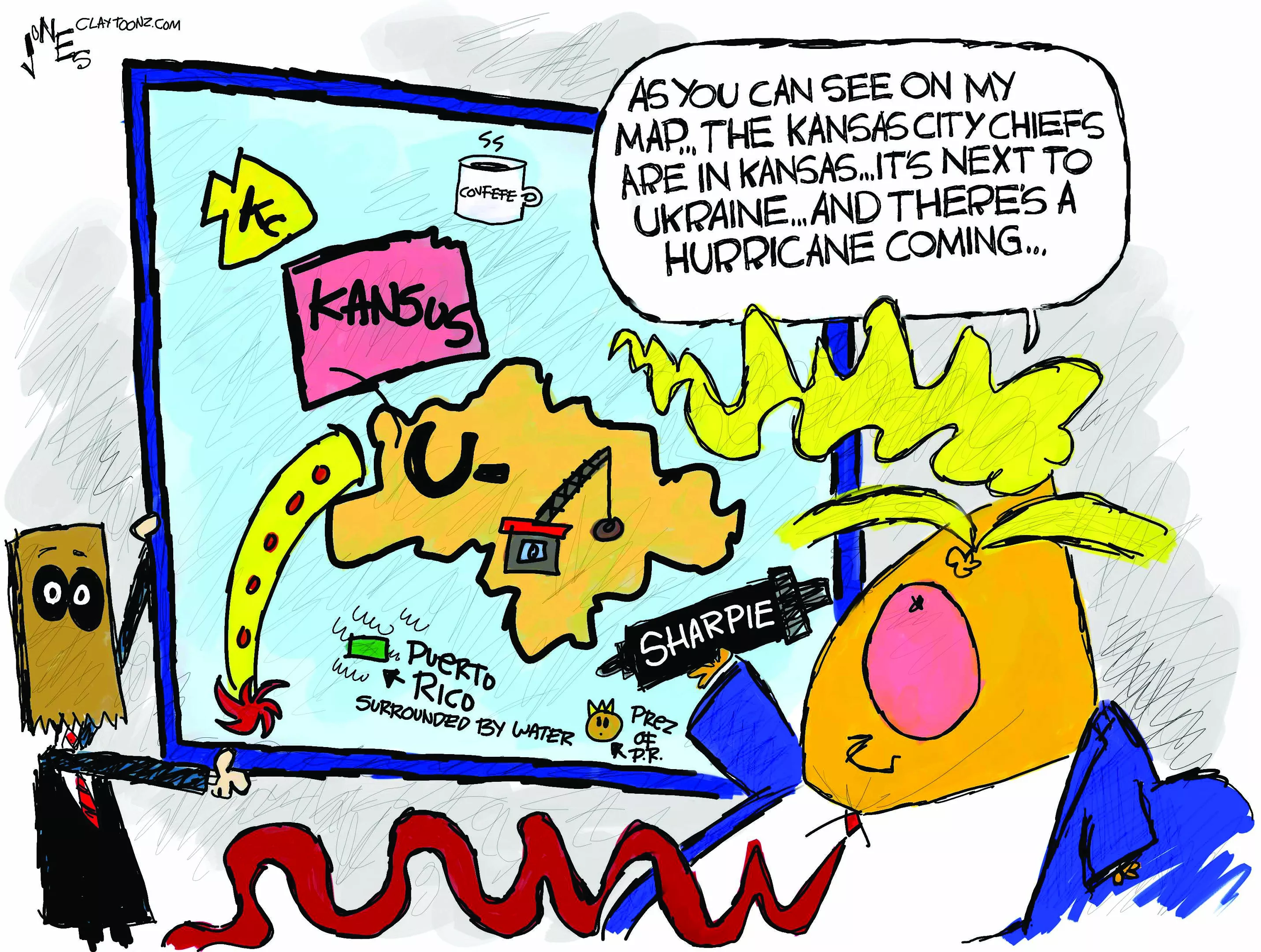
Tags: Trump , Superbowl , Kansas , map , where's Kansas City , MAGA , Claytoonz , Image