Wednesday, July 17, 2019
Tags: Claytoonz , Kellyanne Conway , politics , Image
Tuesday, July 16, 2019

ProPublica is a nonprofit newsroom that investigates abuses of power. Sign up for ProPublica’s Big Story newsletter to receive stories like this one in your inbox as soon as they are published.
The Border Patrol agent, a veteran with 13 years on the job, had been assigned to the agency’s detention center in McAllen, Texas, for close to a month when the team of court-appointed lawyers and doctors showed up one day at the end of June.
Taking in the squalor, the stench of unwashed bodies, and the poor health and vacant eyes of the hundreds of children held there, the group members appeared stunned.
Then, their outrage rolled through the facility like a thunderstorm. One lawyer emerged from a conference room clutching her cellphone to her ear, her voice trembling with urgency and frustration. “There’s a crisis down here,” the agent recalled her shouting.
At that moment, the agent, a father of a 2-year-old, realized that something in him had shifted during his weeks in the McAllen center. “I don’t know why she’s shouting,” he remembered thinking. “No one on the other end of the line cares. If they did, this wouldn’t be happening.”
As he turned away to return to his duties, the agent recalled feeling sorry for the lawyer. “I wanted to tell her the rest of us have given up.”
It’s rare to hear from Border Patrol agents, especially since the Trump administration has put them at the front lines of its sweeping immigration crackdown. Public access to them is typically controlled and choreographed. When approached off duty, agents say they risk their jobs if they speak about their work without permission. As a result, much about the country’s largest federal law enforcement agency — with some 20,000 agents policing the borders and ports — remains shrouded in secrecy, even from congressional oversight, making it nearly impossible to hold it accountable.
Disturbing glimpses of some agents have recently begun to fill the void, including some that were published recently after ProPublica obtained screenshots from a secret Facebook group for current and former Border Patrol agents that showed several agents and at least one supervisor had posted crude, racist and misogynistic comments about immigrants and Democratic members of Congress. The posts raised questions about whether the deplorable detention conditions on the border were out of the control of Customs and Border Protection, as the agency had asserted, or a reflection of its culture.
Other reports followed, including one from CNN that described agents attempting to humiliate a Honduran immigrant by trying to force him to be photographed holding a sign that read in Spanish, “I like men.” The Intercept published more degrading posts from the secret Facebook group, and it reported that it appeared that Border Patrol Chief Carla Provost had once been a member. Provost has not commented.
But there was some nuance. An account of life inside a Border Patrol detention facility outside El Paso, Texas, by The New York Times and The El Paso Times, revealed that two agents there had expressed concerns about the conditions to their supervisors.
The agent who spent June in McAllen doesn’t see his reality in any of those depictions. He’s in his late 30s and is a husband and father who served overseas in the military before joining the Border Patrol. He asked not to be identified because he worried that his candor could cost him his job and thrust him and his family into the middle of the angry public debate over the Trump administration’s border policies.
His comments come at a particularly fraught moment, as politicians on the left compare the Border Patrol’s detention facilities to “concentration camps” and senior Trump administration officials, including most recently Vice President Mike Pence, dismiss descriptions of the inhumane conditions as “unsubstantiated.”
When asked about Pence’s comments, the agent said the damning descriptions of the facilities are “more substantiated than not.” And, while he didn’t embrace the term concentration camp, he didn’t dispute it either. He searched out loud for a term that might be more accurate. Gulag felt too strong. Jail didn’t feel strong enough.
He came around to this: “It’s kind of like torture in the army. It starts out with just sleep deprivation, then the next guys come in and sleep deprivation is normal, so they ramp it up. Then the next guys ramp it up some more, and then the next guys, until you have full blown torture going on. That becomes the new normal.”
Referring back to the grim conditions inside the Border Patrol holding centers, he said: “Somewhere down the line people just accepted what’s going on as normal. That includes the people responsible for fixing the problems.”
He spoke at length in several interviews, making clear that the views and motivations he articulated were his alone. He said he’s not on Facebook, much less a member of any secret Border Patrol social media groups. He also said he did not witness any egregious behavior by his colleagues during his time in McAllen. But he said the agents who were permanently posted there had the shortest fuses, and he’d heard them launch into condescending harangues at the young migrants, blaming them for crossing the border illegally and denying their requests for extra food, water or information about when they’d be released.
Most of his colleagues, he said, fall into one of two camps. There are the “law-and-order types” who see the immigrants in their custody, as, first and foremost, criminals. Then, he said, there are those who are “just tired of all the chaos” of a broken immigration system and “see no end in sight.”
“The only possible end to this that I see is if there’s some change after the next election,” he said, referring to what might finally end the stalemate in Washington over how to reform the system. “Either this president will win again, and Congress will be forced to work with him. Or a new president will get elected and do things a different way.”
In addition to the interviews, the agent shared a journal entry about his time in McAllen, which he wrote in a tentative attempt to sort through what he described as the “roughest” experience of his career; a month that he said revealed a disturbing capacity for detachment.
“What happened to me in Texas is that I realized I had walled off my emotions so I could do my job without getting hurt,” he said. “I’d see kids crying because they want to see their dads, and I couldn’t console them because I had 500 to 600 other kids to watch over and make sure they’re not getting in trouble. All I could do was make sure they’re physically OK. I couldn’t let them see their fathers because that was against the rules.
“I might not like the rules,” he added. “I might think that what we’re doing wasn’t the correct way to hold children. But what was I going to do? Walk away? What difference would that make to anyone’s life but mine?”
When asked whether he simply stopped caring, he said: “Exactly, to a point that’s kind of dangerous. But once you do, you feel better.”
Part of that feeling, the agent said, comes from experience. He’s served Republican and Democratic administrations, each one with its own border crisis and wildly unpopular responses. Other people might find it hard to view his agency outside the context of their political leanings, but he said that he didn’t join because he feels strongly one way or the other. He has a criminal justice degree and was looking for a federal law enforcement job that would provide him financial security, without requiring him to go overseas.
What keeps him in now, even as his job has morphed into one he and his wife are uncomfortable talking about in public, is that he earns about $100,000 a year, including overtime and holiday pay. He has a top-of-the-line health insurance plan that, among other things, covered nearly the entire cost of his child’s birth. In a little more than a decade, when he turns 51, he’ll be eligible to retire with a full pension that probably won’t cover the cost of a house on the beach, he said, but will give him the freedom to “do just about anything else I want, and not have to worry.”
The agent, tall and fit with dirty blond hair, said he thinks of his time left in the Border Patrol like the home stretch of a marathon. He does his work with blinders on to everything but his family and the finish line. “I’m already starting to attend retirement seminars,” he said. “All I’m trying to do is get through the next decade.”
That was his mindset, he said, when he landed in McAllen. It was his first time on the border since he was a rookie. He’d spent most of his career posted in the eastern part of the United States, investigating smuggling organizations rather than intercepting undocumented immigrants. But as huge numbers of Central American migrants came to the Rio Grande Valley, he and hundreds of agents across the country were summoned to help.
In his journal entry, the agent described what he saw when he arrived at the Border Patrol detention center as a “scene from a zombie apocalypse movie.”
His colleagues, he said, wore surgical masks and rubber gloves because there was “sickness and filth everywhere.” And he said the facility “looked like a walled-off compound where the government had the last safe zone and was taking in refugees fleeing the deadly zombie virus.”
The scene that struck the agent the hardest that first day was the sight of dozens of children being held in cages — an image publicized this year to widespread condemnation. The children seemed about the same age as his 2-year-old son, but that’s where the similarities ended. “My kid would have been running laps around that entire building, nonstop,” the agent said. “But the boys my kid’s age, they were just there. They weren’t running or playing, even though they had been pent up all day.”
The agent said he suspected that the kids were lethargic because they hadn’t been given enough to eat. He said he wondered, “Why are things like this?” He said he didn’t look for answers because he didn’t expect he’d find any. “I decided not to dwell on it, and just do my job.”
He went on that way for weeks, seeing things without dwelling on them. His interactions with individual immigrants, he said, are a blur. He vaguely recalled a government staffer combing lice out of a little girl’s hair; 7- and 8-year-olds pacing in circles and sobbing inconsolably because they’d been separated from their parents; a teenage mother who’d swaddled her baby in a filthy sweatshirt that she’d borrowed from another detainee because she’d been forced to throw away the clothes she brought.
Only a few of those encounters are mentioned in the agent’s written account of his experiences in McAllen. Most of it reads like a chronicle of a mundane work trip. He got Memorial Day off. He bought groceries and stopped drinking soda. A colleague who was staying at the Residence Inn shared enough free gym passes to last the entire trip, and his waist size went from 33 inches to 32. He started listening to music again: “Not a specific style, language or rhythm rather music that expressed passion.” And he tried meditation.
The visit by the team of lawyers to the facility near the end of June seemed to shake up the agent. The team, led by a California attorney named Hope Frye, had arrived to interview children being detained in McAllen. The agent’s duties placed him close enough to them to observe their work.
Frye said that typically during such visits, the agents tend to blend into the background; silent and straight-faced, in their badges and drab green uniforms. They didn’t engage much with her because they were instructed not to. She said years of hearing immigrant children tell her how badly they’d been treated in detention had long made her worry about the agents’ humanity. “I’ll look at them and wonder sometimes, ‘What kind of a parent are you when you spend your entire day filled with hate and victimizing other people?’”
But to get her work done, Frye said, she tries to keep such thoughts to herself. At some point in McAllen, however, she let a comment slip to the agent about a young child who had been separated from his family. The agent, she said, blurted out that he knew of another woman who was separated from her family and raising a 2-year-old on her own.
Frye, 68, said she asked the agent if he was referring to his own family. Her question started a series of exchanges that didn’t diminish her suspicions about the Border Patrol, Frye said, but did change her thinking a bit about the agent.
“If what happened was a film, you’d see an older woman with many years of experience, her eyes lined from seeing these poor children, and a young man, with a young family, seeing this nightmare for the first time,” Frye said, recalling her encounter with the agent. “What I thought to myself was, ‘How sad is it that this young man who probably wants to be of service to his country is stuck doing this.’”
Referring to the agent’s initial outburst, she said, “I think he was trying to tell me, ‘Hey, I’m human too.’”
Katherine Hagan, a Spanish interpreter who worked alongside Frye, also interacted briefly with the agent, and, although he didn’t say it in so many words, she felt he was struggling to reckon with his role at the facility, as if, she said, “he had become so accustomed to seeing children behind wire cages that he had assimilated it as normal and necessary.”
At one moment, she said, she recalled him scrambling to find clothes for the baby girl wrapped in the sweatshirt. The baby was so dirty that Frye wiped away rings of black dirt from around her neck. But at another point the agent lectured Hagan about indulging the immigrant children, warning her not to let “the aliens” use the officers’ bathrooms.
“I’m trying to find the right words to describe his demeanor,” Hagan, a graduate of the Harvard Divinity School, said of the agent. “I could tell he felt embarrassed and potentially kind of exposed. I don’t know whether he was having some kind of epiphany. But it was clear he knew that I saw him — really saw him — in the middle of this horrible situation.”
When asked about the interactions, the agent said he was trying to communicate to the lawyers that the detainees were not the only ones at the facility who felt trapped. Walking away, at least in his mind, was not an option. Trying to change things on “a macro level,” the agent said, was for fools.
“The most I felt I could do was make sure toilet paper was stocked. Or if someone wanted an extra juice, I’d give them an extra juice. Or maybe do something to make someone’s day a little nicer; maybe smile and treat them with respect. That’s all I felt I had the power to do,” the agent said. “The ones that try to save the world, they’re the ones who either get burned out or put on a leash.”
The agent compared himself to the cynical donkey in George Orwell’s “Animal Farm” who survives by never sticking his neck out.
“I’ve decided that I’m not interested in advancement,” he said. “I’d rather be a full-time father than a full-time Border Patrol agent.”
But now that he’s home, he feels the experience has somehow followed him.
“I go to the playground with my kid, and I say to myself, ‘Why am I not enjoying this?’”
If you have any information about the Border Patrol you’d like to share, please email us at [email protected]. For more secure ways to send us information, please see our instructions.
Tags: Border Patrol , Immigration , detention center , Texas , Propublica , detainees , children , investigation , Trump administration , immigration , Image
Congresswoman Ann Kirkpatrick, a Democrat who represents Southern Arizona's CD2, came out today in support of an impeachment inquiry against President Donald Trump.
Kirkpatrick had shied away from the "I" word until now (except during a campaign appearance in which she told someone that she would support impeachment) but explained that the Trump administration's stonewalling of various investigations by the Democrat-held House of Representatives had persuaded her that impeachment was the way to go.
From Kirkpatrick's comments on the House floor:
After meeting with countless Southern Arizonans, reading the Special Council’s report, and seeing the President and his administration defy Congressional subpoenas, I have concluded that the United States House of Representatives must open an impeachment inquiry into President Donald Trump. Following Mueller’s alarming report, it is Congress’ job to conduct oversight and deliver answers to the American people. Instead, the President has called upon his administration officials to ignore Congressional subpoenas and break the law, not just related to the Special Counsel’s investigation into collusion, but all areas of Congressional oversight — including census hearings, campaign finance violations, family separation, and so many more.
As a Congresswoman, former prosecutor and American citizen, I have a responsibility to stand up for the rule of law and defend our Constitution. This should not be made into a partisan fight or a debate about long-term election strategy, it’s about protecting our democracy. Nobody is above the law, especially not the President.
House Speaker Nancy Pelosi has dismissed talk of impeachment, instead focusing on the various investigations that the Trump administration has been stonewalling. But as Lawrence Robbins has written in Slate, moving forward with an impeachment proceeding would give Trump's attorney little room to fight over what records must be turned over:
Crucially, a Senate impeachment trial could not get mired in multiple layers of district court and appellate court litigation. Under Article I, Section 3, Clause 6 of the Constitution, “when the President of the United States is tried, the Chief Justice shall preside.” As the “Presiding Officer,” under Senate impeachment Rule V, the chief justice has the power “to make and issue … all orders, mandates, writs, and precepts authorized by these rules or by the Senate.” The chief justice likewise has full authority to “direct all the forms of proceedings while the Senate is sitting for the purpose of trying an impeachment, and all forms during the trial not otherwise specially provided for.” According to the Senate rules, it is the chief justice as presiding officer who gets to “rule on all questions of evidence including, but not limited to, questions of relevancy, materiality, and redundancy of evidence and incidental questions.” And while Rule VII permits a member of the Senate to demand a Senate vote on the chief’s rulings, it is difficult to imagine even Mitch McConnell seeking to overrule Chief Justice John Roberts. Indeed, no senator challenged a single ruling by Chief Justice William Rehnquist during the Bill Clinton impeachment trial.
Whatever then happens for any given witness or exhibit, the chief’s rulings are apt to be prompt and efficient. There would be no reams of legal briefing, no extended oral arguments, no endless appeals. The parties would cut right to the chase, and the substance of the Mueller report allegations—not to mention the role of Individual 1 in providing hush money on the eve of the 2016 election—would play out on live TV.
So, for example, if the House impeachment managers call Don McGahn to testify, the White House cannot rush off to court to block his attendance. The president must make his objections to the chief justice, who will issue an effectively unreviewable order on “relevancy, materiality, and redundancy.” Given the central role McGahn played in Trump’s obstruction of justice, it is hard to imagine that the chief justice would restrict him from testifying. So too for most of the key players in Volume II of the Mueller report. And unlike what the Trump administration may do in the face of adverse rulings in the lower federal courts, it seems exceedingly unlikely—even with this president—that the administration would defy a ruling by the chief justice sitting as the presiding officer in an impeachment trial.
National Republican Congressional Committee spokeswoman Torunn Sinclair reacted to Kirkpatrick's support for impeachment by calling Kirkpatrick "a socialist Democrat whose blind hatred of President Trump impacts her ability to do her job.”
Tags: News , Politics , Ann Kirkpatrick , Trump , Impeachment , Nancy Pelosi , Congress , Image
Monday, July 15, 2019

Friday, July 12, 2019

Students and staff filled the bleachers in the gym on either side of the basketball court. We knew pretty much what to expect. The pep band would play. Some students might perform a skit, present some awards or give us a little pep talk. The girl's drill team might dance. For certain, we'd hear a coach or two tell us about that night's boys basketball game.
What we didn't know until the coach walked out in the middle of the court and announced it was that we would be watching a 10 minute scrimmage by the girls basketball team.
I knew we had a girls basketball team. Title IX mandated it. But that was all I and most of the rest of the crowd in the bleachers knew. Few people other than family and friends had gone to any of their games. We had no idea what to expect.
As I waited for the team to come out onto the court, I turned my eyes toward the gym ceiling and said a silent teacher's prayer. "Please let the young women do a competent job out there on the court. Please don't let them make fools of themselves. And if they don't play well, please, students, please don't laugh and make things even worse."
The team, divided into two squads, ran onto the court and began their pregame warmups. They looked . . . not bad. It was a promising beginning.
A few moments later, out came a half dozen of the school's jockiest boy athletes decked out in full cheerleader regalia — short skirts, sweaters with padded bras underneath, pompoms. They skipped and whooped and waved their pompoms in the air, then assumed their cheerleading positions in front of the crowd. Because, the boys decided, if the girls were going to invade their turf on the court, the boys would take the cheerleaders' places on the sidelines. Fun!
I was still in full teacher prayer mode when the scrimmage began. A minute into the game, I realized the girls didn't need any divine, or teacherly, intervention. They were moving the ball up and down the court, dribbling and passing effectively. They knew how to shoot.
They were good!
Tags: Clackamas High School , Girls basketball , Title IX , Image
Tuesday, July 9, 2019

The U.S. Women's Soccer Team, new World Cup champions, deserve every bit of praise and glory bestowed upon them by their fans and the media. But somewhere in the midst of the speechifying, it would be great to hear one of them say, "I want to thank the U.S. Congress, without which this victory would not have been
That's the 1972 Congress I'm talking about, the one that voted Title IX into existence. We can thank that piece of legislation for the dominance of U.S. women athletes on the world stage.
Title IX changed everything for women's athletic programs in our schools, though not a word of it refers to sports. It reads,
"No person in the United States shall, on the basis of sex, be excluded from participation in, be denied the benefits of, or be subjected to discrimination under any education program or activity receiving Federal financial assistance."The crafters of Title IX knew how revolutionary those 36 words were, and they were crafty enough to keep that to themselves until it worked its way through Congress and was signed into law by President Nixon. Most legislators thought Title IX had something to do with equal pay at universities, if they thought about it at all.
But Title IX changed the playing field, literally. It meant women's sports were supposed to receive equal funding to men's sports. Women and girls had the same right to participate in school sports as men and boys, in colleges and K-12 schools.
Take Jackie Joyner-Kersee, the three time gold medalist in Olympic track and field. As a young girl, she was a cheerleader, because that's what girls did if they wanted to be part of a school sports program. Thanks to Title IX, she became a member of her high school track team, and the rest is herstory. Joyner-Kersee was one of countless women who found their athletic calling — or simply had a chance to participate in sports at the schools they attended — because of Title IX.
It's a wonderful story, but as often happens when a group of people are granted rights they hadn't previously enjoyed, it wasn't as simple as that. The implementation of Title IX followed a bumpy road.
Tags: U.S. Women's Soccer Team , Title IX , Supreme Court , Ronald Reagan , Jackie Joyner-Kersee , Image
Friday, July 5, 2019

Two men I admire, Jim Nintzel, the editor here at the Weekly, and talk show host John C. Scott, have frustrated the hell out of me recently. Both men know more about Tucson and Arizona than I would if I lived another lifetime. Both are intelligent, perceptive analysts of the political scene. Neither accepts the “common wisdom” just because it’s what other people think.
Well, they don’t accept the common wisdom in most cases, anyway. When it comes to TUSD, though, Scott and Nintzel seem to go along with the prevailing notion that the school district is doing a terrible job and has brought its problems, specifically its loss of students, on itself.
Common wisdom always has a kernel of logic to it. If TUSD has lost an average of 900 students a year for the past 18 years, it’s only logical, it's something they’ve done. Isn't it? How can it not be the district's fault?
The problem is, the common wisdom about TUSD is wrong.
This all came up because of one of my recent posts, A Multi-Factored Look At TUSD's Enrollment Decline. My main point was that the district’s precipitous enrollment decline over the past 18 years has more to do with outside factors than with the district itself. Two of the factors were created by the state legislature when it green-lighted charter schools and open enrollment in 1994, creating two new forms of competition for students. The third factor is the city’s population, which essentially stopped growing around 2000, meaning TUSD hasn’t had an influx of new students to replace the ones who left.
When I talked about this on John C. Scott’s show, he came back with a litany of sins TUSD has committed which have led to parents pulling their children out of the district — problems with student discipline, poor administration, poor money management and so on.
Most of what Scott said about TUSD is true, but not his contention that the problems he listed are the primary reasons students have left the district.
Nintzel agreed with me about the mechanism for TUSD’s enrollment decline, but said I haven’t paid enough attention to parents' dissatisfaction with the district which led them to send their children elsewhere.
Nintzel is right that dissatisfaction with TUSD leads many parents to seek other options for their children, but often, their dissatisfaction has more to do with the changing ethnic and economic makeup of Tucson than anything the district has done.
The arguments made by Scott and Nintzel aren’t wrong factually. They’re wrong in emphasis, putting too much blame on the district and too little on national demographic shifts and Arizona’s Republican politicians’ continuing efforts to dismantle our district-based, publicly run school system by encouraging school privatization. Compound those factors with Tuscon’s glacial population growth over the past few decades, and you have a recipe for plummeting enrollment.
Unfortunately, their views mirror the local “common wisdom” about TUSD. Attacking TUSD has turned into a blood sport, and that’s bad news for the district and the city. When people magnify TUSD’s problems, it encourages even more people to leave the district. And the notion that TUSD is responsible for the problems it faces gives the impression that the district should be able to turn this thing around if it can just get its act together. What the district actually needs is thoughtful, incremental improvements to help it better serve the needs of the community.
Let me lay out what I believe to be true about the changing nature of TUSD and many similar urban districts across the country. Admittedly, this is a subjective view, but it’s based on extensive study of urban education in the U.S.
Tags: TUSD , Enrollment decline , Charter schools , Open enrollment , Image
Friday, June 28, 2019

Vouchers have never been very popular with a majority of Democrats. But charter schools? Plenty of Democrats, voters and politicians alike, have supported them with the same enthusiasm as Republicans. President Obama, Vice President Biden and Education Secretary Arne Duncan were big charter boosters, creating policies which led to an increase in the number and distribution of the schools around the country. Presidential hopeful and former Newark, New Jersey, mayor Cory Booker has long been a vocal charter advocate. And they weren't alone. Many Democrats in local, state and national office either actively supported the spread of charters or quietly accepted their presence, and Democratic voters followed suit.
That's changing. Democratic candidates who give full-throated endorsements to charter schools are becoming an endangered species. Biden is shifting away from his support of charters. Booker tries to avoid the subject. Democrats across the political landscape are emphasizing increasing teacher salaries, boosting funding for Title 1 and putting more money into school infrastructure. Charters, many of them are saying, are siphoning money away from the schools which educate the vast majority of our children.
Democratic voters are moving in the same direction.
That could spell trouble for the charter school movement, which has counted on bipartisan agreement that our public schools are a mess and we need an infusion of new schools and new approaches — read, charter schools — to give children, especially poor and minority children, a better chance at a quality education. If one side of the political aisle representing half the country's population no longer supports charters, the schools' future becomes shaky.
Tags: Charter schools , Joe Biden , Cory Booker , School privatization , Education reform , Billionaire Boys Club , Nick Hanauer , Bill Gates , Image
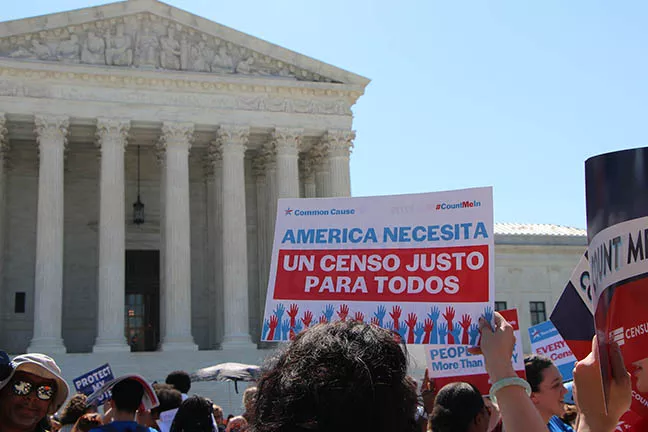
The Supreme Court handed a temporary victory Thursday to opponents of a citizenship question on the 2020 Census, saying the government will have to go back and make a better case in lower courts if it wants to include the question.
That could be difficult for the Census Bureau, which had said that it needed a final ruling by the end of June to have enough time to print the millions of Census forms that must be ready for 2020.
The bureau did not comment on next steps Thursday, saying only that it had taken the court’s ruling under review.
But critics, who said the citizenship question was only meant to “rig the Census against minority communities,” vowed to keep fighting to keep the question off the census form.
“We know that the Trump administration is very persistent and they will continue their attacks on the Latino and immigrant community,” said Karina Martinez, communications director for Mi Familia Vota. But Martinez, who called the census plan an “explicitly motivated” attack on the Hispanic community, expressed confidence that the administration will not be able to justify the citizenship question.
All sides agree that billions of dollars in federal funds ride on an accurate Census count, along with the number of seats each state holds in Congress. They also agree that asking people to declare their citizenship status on the census would reduce the number of people who participate, particularly in minority and immigrant communities.
But Commerce Secretary Wilbur Ross said the projected 5.8 percent drop in census participation that a citizenship question would cause would be outweighed by the benefits of such a question. The results would allow better enforcement of the Voting Rights Act by the Justice Department, which asked for the question to be included, Ross said in 2018.
The Supreme Court said Ross, who oversees the Census Bureau, has the authority to add the question if he has good reason. But Thursday’s ruling said he did no— the reasons he gave were merely a pretext to justify including the question, the court said.
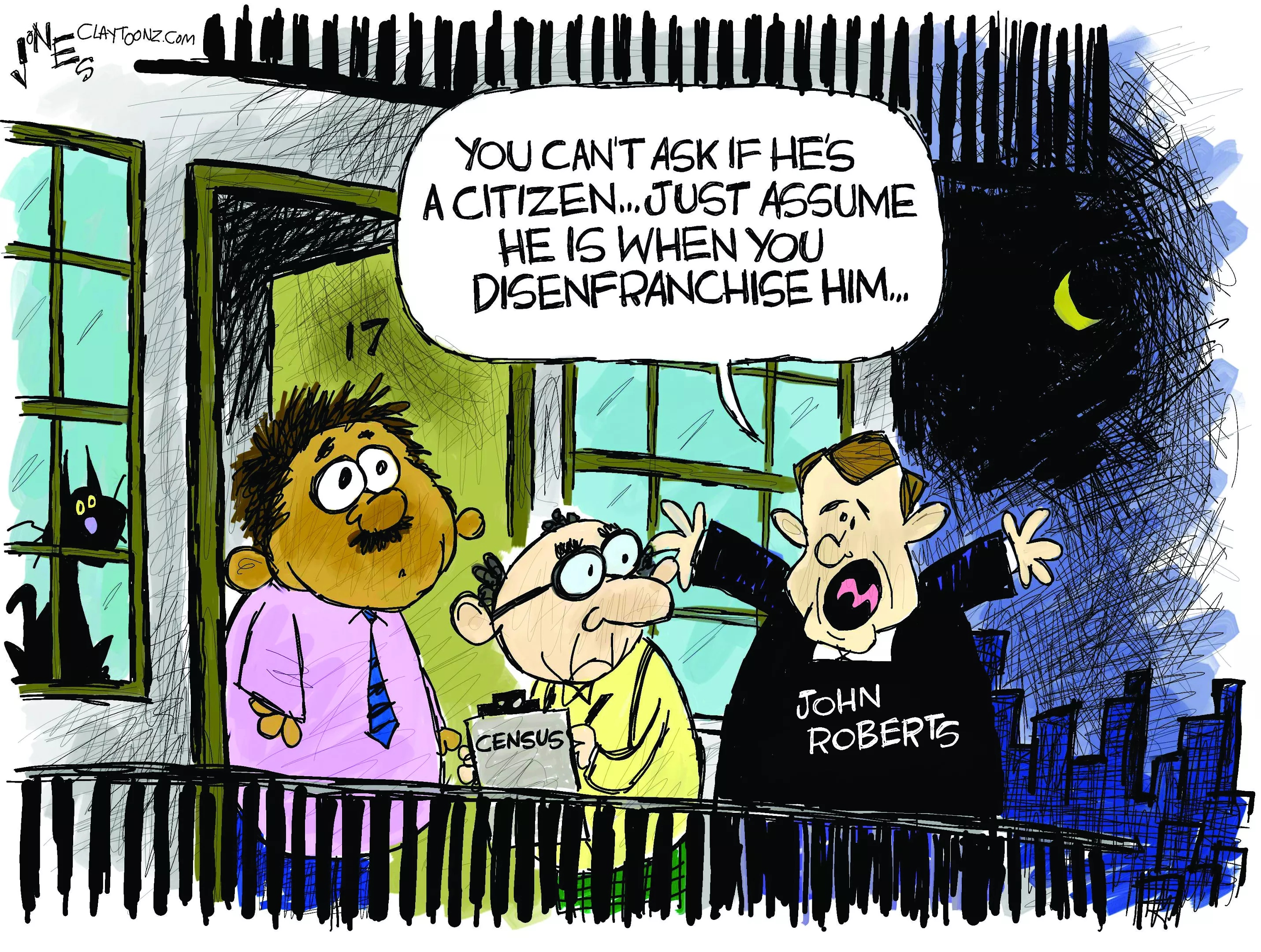
The decision by Chief Justice John Roberts said evidence in the case showed Ross “was determined to reinstate a citizenship question from the time he entered office.”
Ross “instructed his staff to make it happen; waited while Commerce officials explored whether another agency would request census-based citizenship data; subsequently contacted the Attorney General himself to ask if DOJ would make the request; and adopted the Voting Rights Act rationale late in the process,” Roberts wrote for the court.
Roberts called the bureau’s defense of the question “more of a distraction” than an explanation, and ordered the case back to lower court if it wanted to try to explain itself.
In a partial dissent, Justice Clarence Thomas said the court has never invalidated “an agency action solely because it questions the sincerity of the agency’s otherwise adequate rationale.” He predicted that the ruling will lead “political opponents of executive actions to generate controversy with accusations of pretext, deceit, and illicit motives” to win future cases.
Among the scores of protesters who rallied outside the court Thursday, chanting, “Si, se puede,” was Gustavo Torres, executive director of CASA, an immigrant advocacy group based in Maryland. He said states like Arizona could be at risk of actually losing seats in the House if the census undercounts their population next year.
“Arizona is going to lose a lot of people (in an undercount)… That means they can lose up to two Congress people. So that is the reason why it is so very important that everybody be counted,” Torres said.
But some outside the court Thursday said the Census should be able to ask people about their citizenship, as it did in almost every census until 1960.
“If you are legal, you should be on the census. If you are illegal, you should not be counted because you really should not have a say in our government until you become legal,” said Cammy Koeber, a Florida resident who was visiting the court Thursday.
Promise Arizona Executive Director Petra Falcon said a citizenship question would interfere with an accurate count, which is crucial for a growing state like Arizona to get the congressional representation and resources it deserves.
“People need to understand that this isn’t just about figuring out who’s a citizen and who’s not a citizen, it’s about getting resources to the communities that need it,” Falcon said. “This is something that isn’t new, the U.S. Constitution put this in place so that our tax dollars could come back to our states through the federal government.”
Falcon said that, even with the ruling, advocacy groups like hers will have to work hard to ensure that everyone participates in the 2020 Census.
“The threat of deportation and ICE agents knocking on the doors is going to hurt census workers as they go door to door,” Falcon said Thursday, adding that her group will work to help undocumented families get past those fears and fill out the form.
For more stories from Cronkite News, visit cronkitenews.azpbs.org.
Tags: citizenship , question , census , Supreme Court , politics , Image