
Thursday, June 27, 2019

Wednesday, June 26, 2019

Last week I wrote that Arizona's open enrollment policy is one of the three major factors leading to the decline in TUSD enrollment since 2000, the others being charters schools and a slowdown in Tucson's population growth. I estimated somewhere between 1,500 and 3,000 students living inside district boundaries attend schools in other districts.
It looks like I low-balled my estimate. The actual figure appears to be at least double what I came up with, meaning the impact of open enrollment on TUSD's loss of students, and on Arizona's education landscape, is more significant than I realized.
Since Arizona's new open enrollment policy was put into operation in 1995, students can attend any public school that has an empty desk. In district, out of district, it doesn't matter so long as parents can find a way to transport their children to the schoolhouse door. Students inside a school's attendance area and inside the district get first shot at going to a school, but after that, it's open to everyone.
So how many students living in the TUSD attendance area go to schools in other districts? In my post I arrived at a range of students by the back door. I looked at the number of open enrollment students in the Catalina Foothills School District — a whopping 3,000 out of a total student population of 5,200 — along with anecdotal information from Vail School District and used that to arrive at an estimate of 1,500 to 3,000 students. I was pretty sure that was low, but I wanted to stay on the conservative side.
A few days after I finished the post, by one of those odd coincidences which happen all the time, an Arizona Charter Schools Association piece came across my desktop with figures about how many students participate in open enrollment. In the study it cited, 31 percent of students in 9 Maricopa County school districts went to public, non-charter schools which weren't their neighborhood schools. That's twice the 16 percent who attend charter schools.
Tags: Open enrollment , TUSD , Charter schools , Arizona legislature , Arizona Charter Schools Association , Image
Monday, June 24, 2019

Friday, June 21, 2019

Tags: comics , politics , cartoons , Claytoonz , descent , 2020 , Trump , Image
Thursday, June 20, 2019

Zona Politics airs at 4 p.m. Sundays on KXCI community radio, 91.3 FM.
Tags: ZonaPolitics , radio , show , Jim Nintzel , Editor , Calexico , Iron and Wine , The Loft , Audio , Image
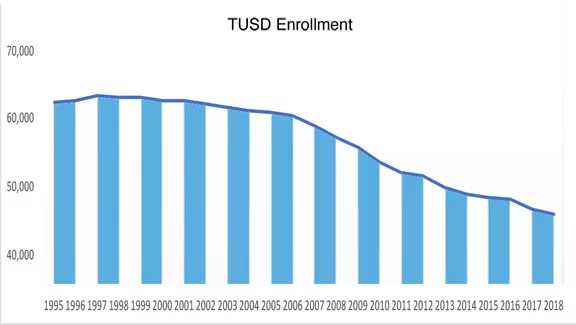
Tucson Unified School District has been losing students steadily since 2000. Lots of students. At its turn-of-the-millenium high point, the district had 62,500 students. This school year, the number was 46,000. That's a loss of 16,500 students, over 900 a year.
Why is TUSD losing students year after year? The answer you're most likely to hear is, the district is the problem. It's the administration. It's the teachers. It's the curriculum. It's "D," all of the above. Fix the administration, fix the teachers, fix the curriculum, and the numbers will climb.
But the standard answer is far too simple. The district may deserve part of the blame for declining enrollment, but most of the drop was inevitable, created by changes in Arizona's educational landscape and a slowing of Tucson's population growth.
For the sake of argument, let's start with the assumption that TUSD is no better or worse now than it was at its 2000 high water mark of 62,500 students and see what else is causing the district to lose students.
I see three factors beyond the control of the district as the major reasons for the enrollment decline.
Two of the factors were created by the Arizona legislature's push for "school choice." The first is the emergence of charter schools. The competition for a limited pool of students means that every student inside the TUSD boundaries who attends a charter is one less student in the district. The second is the state's open enrollment policy, which lets parents send their children to schools in nearby districts. Open enrollment gets far less attention than charter schools, but it is a significant force pulling students living inside the TUSD boundaries to suburban school districts with more affluent, whiter populations.
The third important factor is the slowdown of Tucson's population growth. Students lost to charter schools and open enrollment haven't been replaced by an influx of new students.
Let's look at the factors one by one.
Charter Schools
Arizona's first charter schools opened their doors in 1995. They grew steadily, but since they started from zero, it took awhile for them to have an impact on school districts' enrollment numbers.
In 2000, 50,000 Arizona students were enrolled in charters. I don't have any direct data on how many of those charter students lived inside the TUSD boundaries, but a reasonable estimate is about 3,500. TUSD students made up about 7 percent of the state's public school population in 2000, and 3,500 is 7 percent of the state's charter school population.
Tags: TUSD , Charter schools , Open enrollment , Population growth , Arizona legislature , Image

Tags: comics , politics , cartoons , Claytoonz , ICE , Dominican Republic , immigration , tourist deaths , Image
Wednesday, June 19, 2019
Tags: comics , politics , cartoons , Claytoonz , top secret , Trump , classified , Image
Tuesday, June 18, 2019

Tags: comics , politics , cartoons , Claytoonz , president , polls , off with your head , Image
Monday, June 17, 2019

Tags: comics , politics , cartoons , Claytoonz , Nixon , Trump , politicians , presidents , democrats , republicans , comparison , Image