Tuesday, November 6, 2018
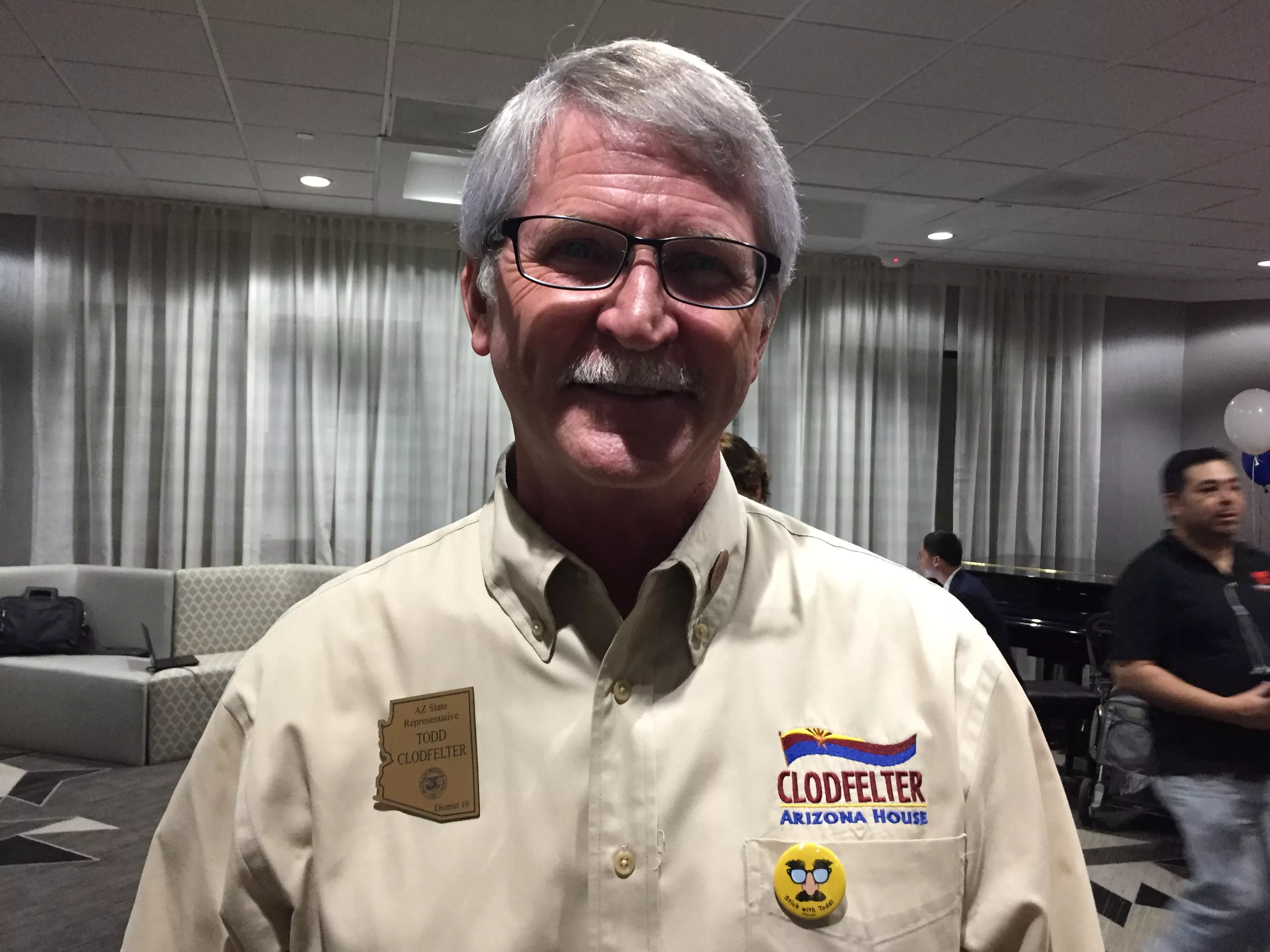
He said he made "Dems for Clodfelter" signs because he has a lot of Democratic supporters and can name a couple.
He says he's fiscally conservative and socially moderate: He didn't support school voucher expansion (Prop 305) and does support the legislature passing a bill to legalize recreational.
In the race for two Arizona House of Representatives Legislative District 10, Republican state Rep. Todd Clodfelter is falling behind Democratic state Rep. Kirsten Engel and Democratic challenger Domingo DeGrazia. Engel has 36 percent of the vote; DeGrazia has 31 percent; and Clodfelter has 27 percent.
In the Senate race in LD10, Democratic incumbent Dave Bradley is up over Republican challenger Marilyn Wiles, 59 percent to 41 percent.
In the race for two Arizona House of Representative seats in Legislative District 9, Democratic Reps. Randy Friese and Pamela Powers-Hannley ahead of Republican challenger Ana Henderson. Friese has 38 percent of the vote; Powers Hannley has 37 percent; and Henderson has 26 percent.
In the LD9 Senate race, Democrat Victoria has 64 percent of the vote, compared to Republican Randy Fleenor’s 36 percent.
In Legislative District 2, Democratic incumbent Sen. Andrea Dalessandro has a lead over Republican challenger Shelley Kais, 58 percent to 42 percent.
In the Democrat-leaning LD2 House race, incumbent Democratic Reps. Daniel Hernandez and Rosanna Galbadon are leading Republican challengers Chris Ackerley and Anthony Sizer.
In heavily Republican Legislative District 11, State Rep. Vince Leach looks like he’s headed for a promotion to the state Senate. He’s got 54 percent of the vote, compared to Democrat Ralph Atchue’s 45 percent.
In the LD11 House of Representatives race, the two Republicans—incumbent Rep. Mark Finchem and Bret Roberts—have a lead over the Democratic candidates, Hollace Lyon and Marcela Quiroz. Finchem has 28 percent; Roberts has 28 percent; Lyon has 23 percent; and Quiroz has 22 percent.
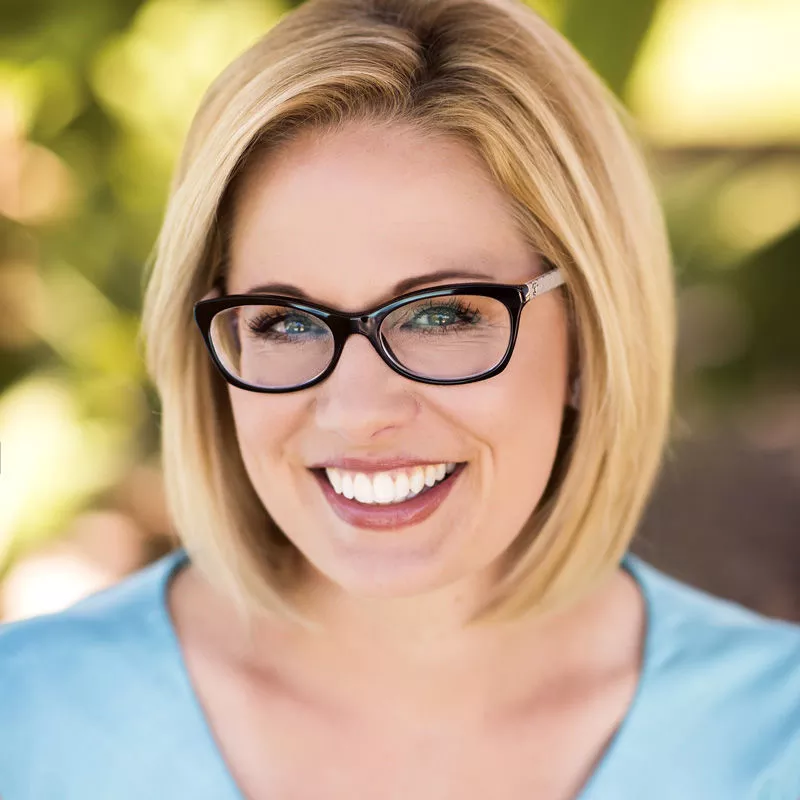
In the marquee race of the night that will decide Arizona’s next U.S. senator, Republican Martha McSally has retaken the lead over Democrat Krysten Sinema, 49.24 percent to 48.47 percent.
In Southern Arizona’s highly competitive Congressional District 2, we're still awaiting results in the race between Democrat Ann Kirkpatrick is crushing Republican Lea Marquez Peterson, 58 percent to 42 percent.
Meanwhile, in Congressional District 1, incumbent Democrat Tom O’Halleran has a tighter lead over Republican Wendy Rogers. O'Halleran has nearly 51 percent of the vote to Rogers' 49 percent
In the heavily Democratic Congressional District 3, Democratic U.S. Rep. Raul Grijalva is crushing Republican challenger Nick Pierson, 60 percent to 40 percent.
Meanwhile, Tucson voters are supporting a $225 million bond package for parks, 55 percent to 45 percent.
Prop 408, which would move the city of Tucson’s elections to even years in line with presidential and midterms elections, is being rejected by 56 percent of the voters.
Pima County officials still need to count the ballots cast at polling places today, as well as early ballots that arrived in recent days or were dropped off at polling places and remain to be processed.
Two thirds of voters are approving Prop 126, which would ban sales taxes on services in Arizona.
Nearly seven out of 10 voters are rejecting the clean energy Prop 127.
Prop 306, which would give the governor’s office more control of the Arizona Clean Election Commission, is passing with 57 percent of the voters approving the measure.
Prop 125, which would bring slight reforms to some of Arizona’s public pensions, is easily passing with was 85 percent of the vote.
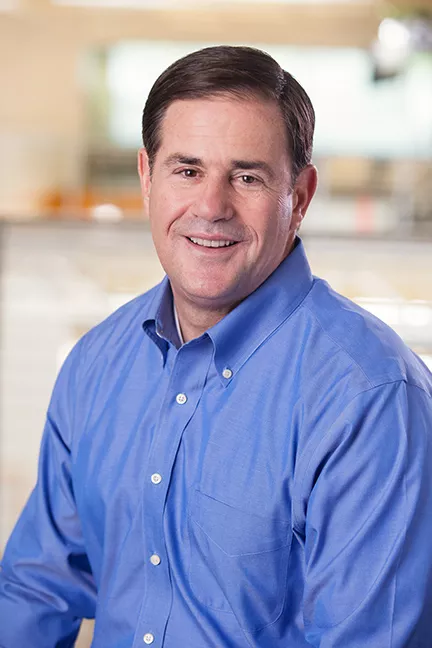
In the governor’s race, Republican incumbent Doug Ducey has a commanding lead over Democrat David Garcia. The first results show Ducey with 58 percent of the vote and Garcia with 39 percent, with Green Party candidate Torres Angel capturing 1.9 percent.
In the Attorney General’s race, incumbent Republican Mark Brnovich has 53 percent of the vote, compared to Democratic challenger January Contreras’ 46 percent.
In the race for Secretary of State, Republican Steve Gaynor has the edge over Democrat Katie Hobbs, 51 to 48 percent.
Republican Frank Riggs is barely ahead of Democrat Kathy Hoffman in the race for State Superintendent of Public Instruction. Riggs has 50 percent of the vote, compared to 49.
In the race for two seats on the Arizona Corporation Commission, Republicans Rodney Glassman and Justin Olson are leading Democrats Sandra Kennedy and Kiana Sears.
In the race for Arizona Treasurer, Republican Kimberly Yee has the lead on Democrat Mark Manoil, with Yee capturing 55 percent of the vote.
This story will update as new results are released.
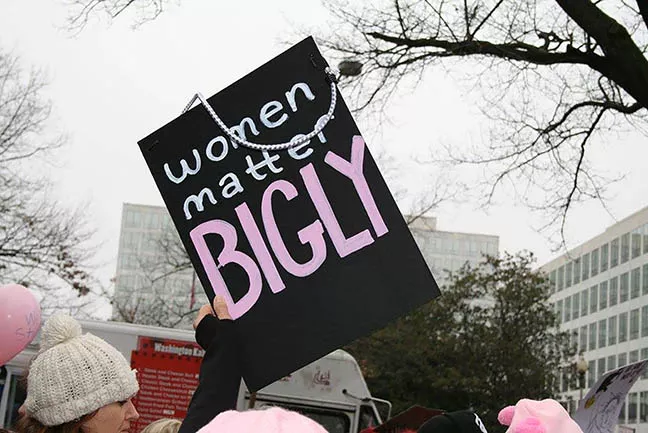
Anita Malik had never run for political office before, but the aftershock of the 2016 election – including the #MeToo movement and the Brett Kavanaugh hearings – pushed her to get her name on the ballot.
“Everything that was going on just made me want to step in and take that on,” said Malik, a Democrat, of her decision to challenge four-term Rep. David Schweikert, R-Fountain Hills, in a district where registered Republicans outnumber Democrats by almost 70,000.
Malik is one of 90 women on the ballot for state or federal office in Arizona this year, accounting for a record-setting 39 percent of the candidates in the state.
That mirrored a national trend in what many national organizations have said would be the Year of the Woman in elections. Cronkite News was able to review ballots in 44 states and found that the number of women running for office ranged from 20 percent in West Virginia to 42 percent in Hawaii.
Most were above 30 percent and Arizona trailed only Hawaii, Oregon, Nevada and Rhode Island for the prevalence of women on the ballot.
In Arizona, the numbers have been steadily rising from 1974, when women made up just 14 percent of the candidates on the ballot. The change is most easily seen in the race to replace Sen. Jeff Flake, R-Arizona, where Democrat Kyrsten Sinema and Republican Martha McSally are vying to become the state’s first female U.S. senator.
Arizona political analyst Jason Rose said more women taking a seat at the political table is “a great thing for American history and American democracy.”
“For too long, the American government has largely been ruled by old white men,” Rose said. “And old white men can tend to take a country club approach, a business as usual approach, and not appreciate or address issues of import to more than half the public.”
Rose said the influx of women would bring more moderate policies and a shift in priorities that could potentially bridge the gap between some more divisive political groups.
League of Women Voters CEO Virginia Kase said that the number of women on the ballot this year shows a clear trend of women “starting to realize that they can have it all.”
“They can be a mom, they can be a wife, they can be all of those things that they want to be, and be a great political candidate,” Kase said. “I think that that’s something that we’re starting to see more than ever before.”
But for Meghan Kelly, a Democrat running her first race against a Republican incumbent in the Delaware House of Representatives, the inspiration to run came when a male colleague tried to make a pass at her at work. She said she asked for professional help and he tried to initiate an intimate relationship with her.
“This is not a man’s world,” she said. “It’s our world to share, and men need to learn to respect and honor women too.”
Malik, likewise, said she ran to stand up for women’s rights.
“Really, women have almost become ‘the other’ again for this administration,” she said. “The idea of attacking women’s rights all across the board and just attacking women as a different class is unacceptable, and it put women in a place of, you know, ‘This is not OK.'”
Kase said the increased number of women on the ballot is likely to lead to more female office holders after Election Day. She sees that as a step in the right direction for the women’s movement as a whole, and the beginning of an exciting trend.
“There are always these little anthills … but sometimes those anthills feel like mountains for women,” Kase said. “But what we’re realizing is that we can overcome any obstacle that gets in our way, and we can move those mountains aside.”
Malik said that whether she wins or loses Tuesday, she does not think this will be “just a blip” in her life. She plans to stay involved in politics, whether that means running for office again or just getting more involved politically, and she expects the same in the rest of the country.
“I think 2016 really woke women up and fuelled that flame of, ‘You know what, if you’re not going to represent me, then I’m going to go ahead and do it,'” Malik said. “So this was the starting point, but it’s definitely not the ending point.”
For more stories from Cronkite News, visit cronkitenews.azpbs.org.
Tags: politics , women , voices , elections , election day , women on ballots , women in politics , Image
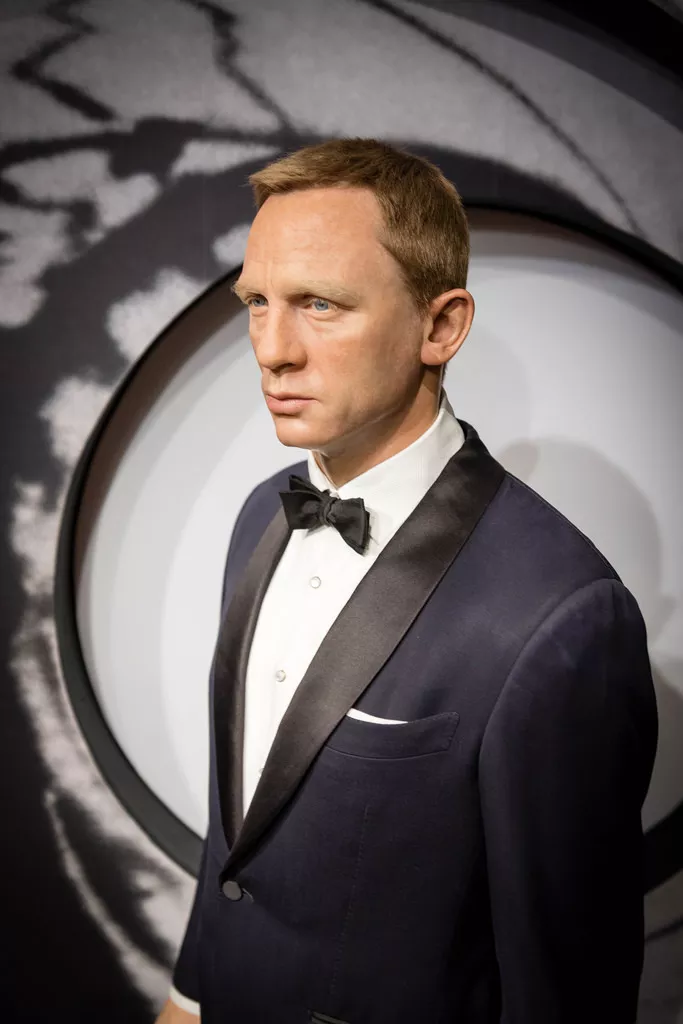
Bond, a property manager and first-time candidate for Congress, and Chavez, who is running for re-election to the Arizona House of Representatives, are just two of the many candidates around the country whose names may make voters do a double-take.
Along with Elvis Presley and John F. Kennedy, a look at ballots across the country this Election Day shows that Chuck Norris, Tom Sawyer, Will Smith, Michael Jackson and more have thrown their hats in the ring.
Rodd McLeod, a Democratic strategist in Arizona, said a candidate’s name is not likely to be the make-or-break factor in their success at the ballot box. But for some candidates, he said, the notoriety can’t hurt.
He said a name can make a difference for candidates who are not well known or are running in races people are typically less informed about, like the superintendent of education or the mine inspector. No voter really thinks they’re voting for JFK, he said, but the name may make the candidate stand out.
“The further down the ballot you go, people are less likely to know who you are and what you stand for, so any kind of leg up is helpful,” McLeod said.
“You don’t want to be named Count Chocula, but I don’t think anyone right now would complain about being named Ariana Grande,” he said.
The candidates with more-famous namesakes take it in stride.
The Cesar Chavez on Arizona’s ballot said he tries not to play up his name, even though he was named for the civil rights leader and founder of the United Farm Workers.
Rep. Cesar Chavez said his grandfather was a farm worker from Mexico who met the original Chavez in California in the ’80s and told his daughter that if she ever had a son, she should name him Cesar.
Chavez calls it an honor to share a name with a man he always admired. Though he doesn’t intentionally mirror his politics after the original Chavez, he said there are lessons all politicians can learn from his legacy.
“He looked at others before looking at himself, and I think that that’s something we in politics need to look at and partake in,” Chavez said. “What can we do for others before we do for ourselves?”
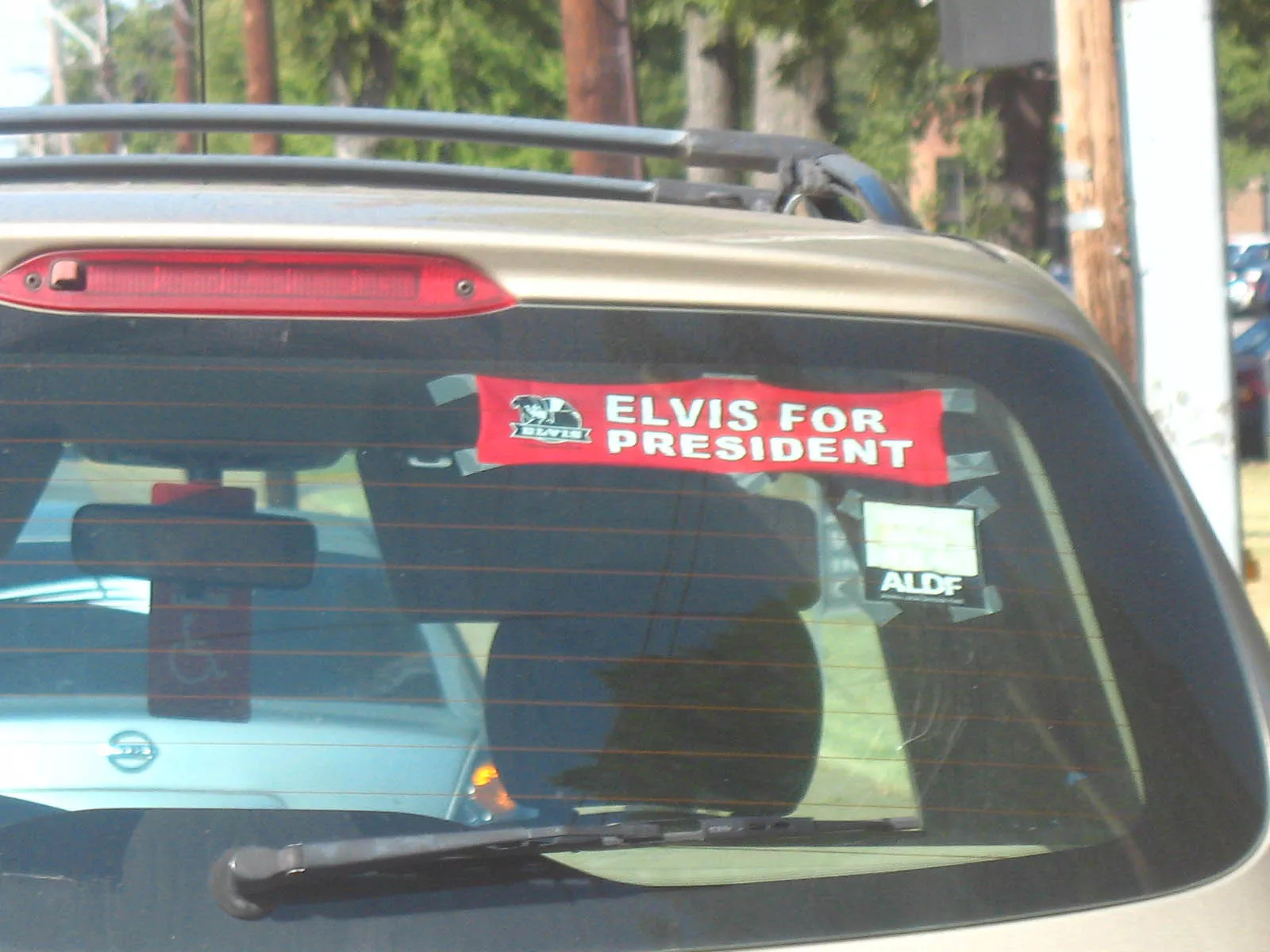
The first-time candidate said he decided to run for Congress when he realized that no one had filed to challenge Rep. Ruben Gallego, D-Phoenix. He concedes he has “virtually no chance” of winning, but got entered the race because it was important to give voters an option.
“I was disappointed in myself because I didn’t know that he was running unopposed,” Bond said of Gallego. “I only realized it when I went to cast my vote in the primary and there was no Republican, or Green Party at that time.”
Bond said the name has been in his family since long before the books and movie franchise made it famous – he’s the fourth. He often tried to downplay the name when he was younger, but “as I got older I was like, ‘Why am I not using it?'”
The name may have to carry him – Bond said he has not put any money into his campaign this year. But, win or lose, he said the experience has made him consider a future run.
“I just noticed that nobody else was running against the incumbent so I just went ahead and registered for the right,” he said. “Though now it’s piqued my curiosity – I’m thinking about making a serious run in the next cycle.”
For more stories from Cronkite News, visit cronkitenews.azpbs.org.
Tags: politics , names , elections , election day , Image
Tags: comics , cartoons , politics , Claytoonz , voting , elections , Image
Monday, November 5, 2018
This is my final pitch, as the emails I got asking for more money the day before the election say. (More money? Really?)
Vote! I don't have to pitch that. If you've voted, great, if you haven't, do it Tuesday. However, voting for education can use some pitching, so let me give you a pitch based on personal experience.
I taught for over 30 years, high school English and a few other things (Photography, Yearbook). That means well over 3,000 students passed through my classroom doors. So I've been there, done that. I've been out of the game for quite some time, so I no longer have a dog in the hunt. I reap no personal rewards from your education-related vote.
Here are a few things I learned over the years beyond techniques and strategies that helped me become a better teacher. Money matters. Morale matters. Both will be improved by electing people who support public education.
Money Matters
Salaries matter. Salaries need to be in line with teachers' educational attainment and their importance to the community, and at least high enough teachers aren't frantic a week before the next payday. Nuff said.
Class size matters. My experience is, I can take in an entire class of 25 students, treat each student as an individual, pay attention to them and help them along when I think they need it. I can even remember the essence of what they wrote on their last few essays well enough to talk with them about their work without looking at their papers or my grade book. Add one more student above 25, and someone gets lost. Add 5 to 10 more, and students' individual outlines grow blurry. I start thinking, "I'm really glad those 3 [5, 10] kids are so quiet and don't need my attention so I can focus on everyone else," instead of, "I've got to make sure to get around to those quiet kids, make regular contact so they know I'm thinking about them and ready when they need something." As class size climbed beyond a reasonable number, my effectiveness diminished.
Lowering class sizes takes money. In a high school like the one where I taught with over 100 teachers, you need to add three teachers to lower everyone's class size by one student.
Tags: Public education , Funding , Morale , vote , election , Image