Wednesday, October 3, 2018
Tags: comics , cartoons , politics , reporter , president , women hater , media , Image
Tuesday, October 2, 2018
It's been the number one issue in the state for years. It's on everyone's minds and most candidates' lips. The decision voters make, whether to continue with the Republican-majority status quo or shift more power to Democrats, will be a major factor in deciding our children's present and future.
If you have patience enough and time, by all means look beyond education when you choose who to vote for. The more you know when you cast your ballot, the better. But after you take a deep dive into the candidates' positions, you're likely to find their approach to education is a reliable a indicator of where they stand on other important issues. Vote their positions on education, and you won't go far wrong.
Candidates who support a robust, fully funded system of public education are making a statement of principle which goes beyond schooling. "Public" is the key word. They want to provide a quality education for all the state's children, the whole K-through-college public, and probably pre-K as well, to give them the best shot at a bright future.
"Public" is also the key word when it comes to the same candidates' approach to the rest of government. They want state government to contribute to the well being of the general public, in the present and into the future. That means, among other things, supporting a well funded social services system, building and maintaining infrastructure and tending to the environment.
Candidates who are OK with education funding at levels low enough that the courts say they're unconstitutional aren't so keen on public education. Lots of them like to use the term "government schools" (FYI, that's supposed to be a bad thing) along with "failing schools" and "failing teachers" to describe our public education system. They heap praise on charter and private schools which educate 20 percent of the school-aged population and treat the schools educating 80 percent of children as an afterthought.
Candidates who disparage "government schools" think of the rest of government the same way, as a public irritant, not a public good. They want government to get out of the way so the free market can do what as it pleases. The less taxes, the less spending, the less meddling by the government in Arizona's affairs, the better.
Tags: Elections , Public education , Charter schools , Vouchers , Image
Monday, October 1, 2018
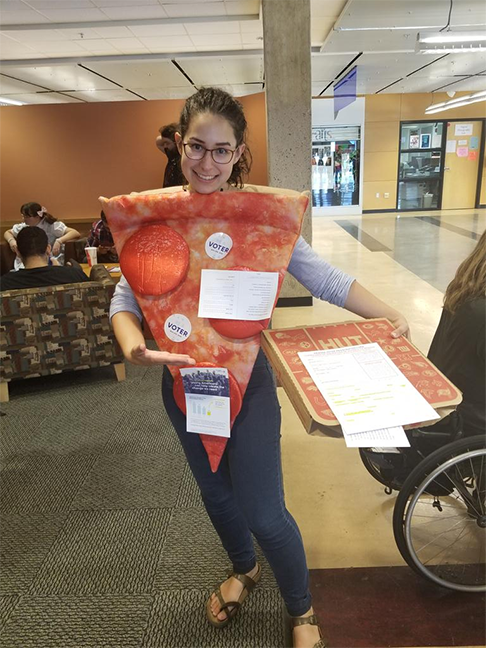
“I wore a pizza costume to get people’s attention. We’ve been stopping anyone and everyone so that I’d have a reputation on campus for being, ‘Oh, you’re that voting person,’” she said with a laugh. She hands out free pizza and snaps polaroids of students while talking to them about registering.
NextGen America was on 20 Arizona college campuses registering young people to vote on Sept. 25, National Voter Registration Day.
NextGen AZ, the Arizona branch, registered 31 people across all five PCC campuses along with gathering 40 pledges to vote, which mostly came from previously registered voters. The group also registered 50 people and got 20 pledges to vote on the University of Arizona campus.
Eller shares the organization’s passion for spreading political awareness and inspiring young people, age 18 to 35, to participate.
“This age group is the largest eligible voting block and the next generation of voters who are going to hold their elected officials accountable,” she said. “Our job here is to ensure students and young people know their votes and opinions matter.”
Eller said a good number of students approached them to ask questions about registering to vote and what they need to do come election day.

NextGen recently invested $3 million on their youth vote program, throughout Arizona, spending $480,000 on their digital ad campaign. Belen Sisa, a media manager for NextGen, helped organize an ad campaign focused on social media, in preparation for National Voter Registration Day.
“Andrew Gillum's huge victory in Florida, which was backed by NextGen America, proved that a good digital strategy can make all the difference in empowering young people and winning elections,” Sisa said. Gillum is the Democratic candidate for governor of Florida.
NextGen America Director Heather Hargreaves said young people often don’t realize that they have the power to “reshape the American political landscape.”

Sisa said NextGen registered 322 people and gathered 326 pledge to vote cards from those aged 18 to 35 across the state.
NextGen AZ does not have any official events planned for the near future, but Sisa said they are going to be canvassing and maintaining their presence on college campuses to keep getting young people registered before the voter registration deadline on Oct. 9.
Tags: vote , register , NextGen AZ , students , education , Pima Community College , Image

Special Collections at the University of Arizona Libraries will hold a panel titled ‘1968: A Closer Look at Its Impact’ on Tuesday, October 2 from 6 p.m. to 8 p.m.
This event will be a panel discussion where activists, musicians, teachers and writers explore the art, conflicts and everyday life of 1968. The discussion will include stories about what life was like in Tucson for women and people of color, some of the popular protest music and the impact that Edward Abbey’s autobiographic work published in 1968, “Desert Solitaire: A Season in the Wilderness” had on this country.
The panel members include Guadalupe Castillo, retired educator and community organizer, Gregory McNamee, author and adjunct lecturer for Eller College of Management, Ted Warmbrand, folk singer and storyteller and Barbea Williams, Artistic Director of Barbea Williams Performing Company and adjunct faculty for UA School of Dance.
So, what happened in 1968?
1. On January 23, North Korea captured the USS Pueblo which threatened to worsen Cold War tensions.
2. On January 30, North Vietnam launched the Tet Offensive against the United States and South Vietnam which signified the beginning of the end of U.S. involvement in the Vietnam War.
3. On April 4, Dr. Martin Luther King Jr. was assassinated in Memphis, Tennessee.
4. On June 5, Robert F. Kennedy was assassinated at the Ambassador Hotel in Los Angeles.
5. On September 30, Boeing introduced the first 747 “Jumbo Jet” which was the world's largest passenger aircraft.
6. On October 16, two African American athletes took a stand at the Summer Olympics by staging a silent demonstration against racial discrimination in the United States.
7. On November 22, “Star Trek” aired American television's first interracial kiss.
8. On December 24, Apollo 8 became the first manned spacecraft to orbit the moon. Jim Lovell, Bill Anders and Frank Borman became the first human beings to travel to the moon.
Tags: 1968 , history , music , culture , education , politics , science , activists , teachers , panel , discussion , musicians , writers , art , conflict , Image
Tags: comics , politics , Rachel Mitchell , cartoons , Image
Friday, September 28, 2018
LD9 Senate candidate Victoria Steele, LD3 House candidate Andrés Cano, LD10 House candidate Domingo DeGrazia, state Rep. Kirsten Engel (D-LD10)
state Rep. Todd Clodfelter (R-LD10), state Rep. Randy Friese (LD-9), LD11 House candidate Marcela Quiroz, state Sen. David Bradley (LD-10), LD3 House candidate Alma Hernandez and LD11 House candidate Hollace Lyon were in attendance.
Michelle Crow, the Southern Arizona director of the Children’s Action Alliance, began the discussion by laying out a few key trends in the system. She said that in 2016 the number of Arizona children in foster care peaked at around 18,000, but that number has been on a steady decline ever since.
For Arizona organizations that deal with child welfare, Crow said the goal is always to keep children with their parents or family members whenever possible and avoid placing them in the foster care system, unless absolutely necessary. She said that taking kids out of their family circle is an extremely traumatic and disconnecting experience that has lasting effects on their adult lives.
“They are more likely to have a connection and feel a sense of love and feel a sense of permanency and stability if they’re placed with somebody that they already have a relationship with,” Crow said. While the best option is to place children with a family member, it is the most burdensome option for the new caretaker. Crow explained that when the Department of Child Safety intervenes and takes a child out of a home and places them with a licensed foster family, that licensed caretaker receives an average of $681 every month to take care of that child.
If a non-licensed relative intervenes and takes responsibility for a child without DCS getting involved, they receive no financial support. If DCS is able to place the child with a relative instead of in a foster care home, which is ideal, that caretaker receives an average of $45 every month.
This $636 difference puts non-licensed family members at a disadvantage and makes it harder for that ideal familial relationship to be sustainable. Also, many times family members are called upon a moment’s notice to take custody of a child that they are related to, whereas licensed foster care providers are trained and prepared for that event.
“Because the system was built around licensed foster care, the system reflects that still,” Crow said. “What we need to do is get the system to catch up to the new reality today.”
On a national scale, Arizona is above the average for placing kids with a relative as opposed to foster care or a group home. While this is good, Kelly Griffith with the Southwest Center for Economic Integrity believes it is still very important to pay attention to how the financial capabilities of families can affect the children in the long-term.
Griffith explained how in Arizona, rent and child-care costs are constantly increasing. She said that there is a capacity problem, where many child-care centers have either closed or stopped accepting subsidies from the Department of Economic Security, because “you can’t afford to stay in business if you’re subsidizing DES, you just can’t.”
Last month Patty Machelor with the Arizona Daily Star reported that “Arizona families lost 788 providers of subsidized child care between January 2016 and July 31, 2018, including 369 centers and group homes ending their state contracts.”
She explained that these child-care providers lose money by accepting families that qualify for state financial assistance because the government’s reimbursement rates have been static for decades. With limited access to quality child care, children across the state are at risk of falling behind.
“Children who attend high-quality preschool are much less likely to participate in criminal activity, when you start looking at the state budget line item, look at how much it costs to house people in private prison facilities … think about that school-to-prison pipeline,” Griffith said.
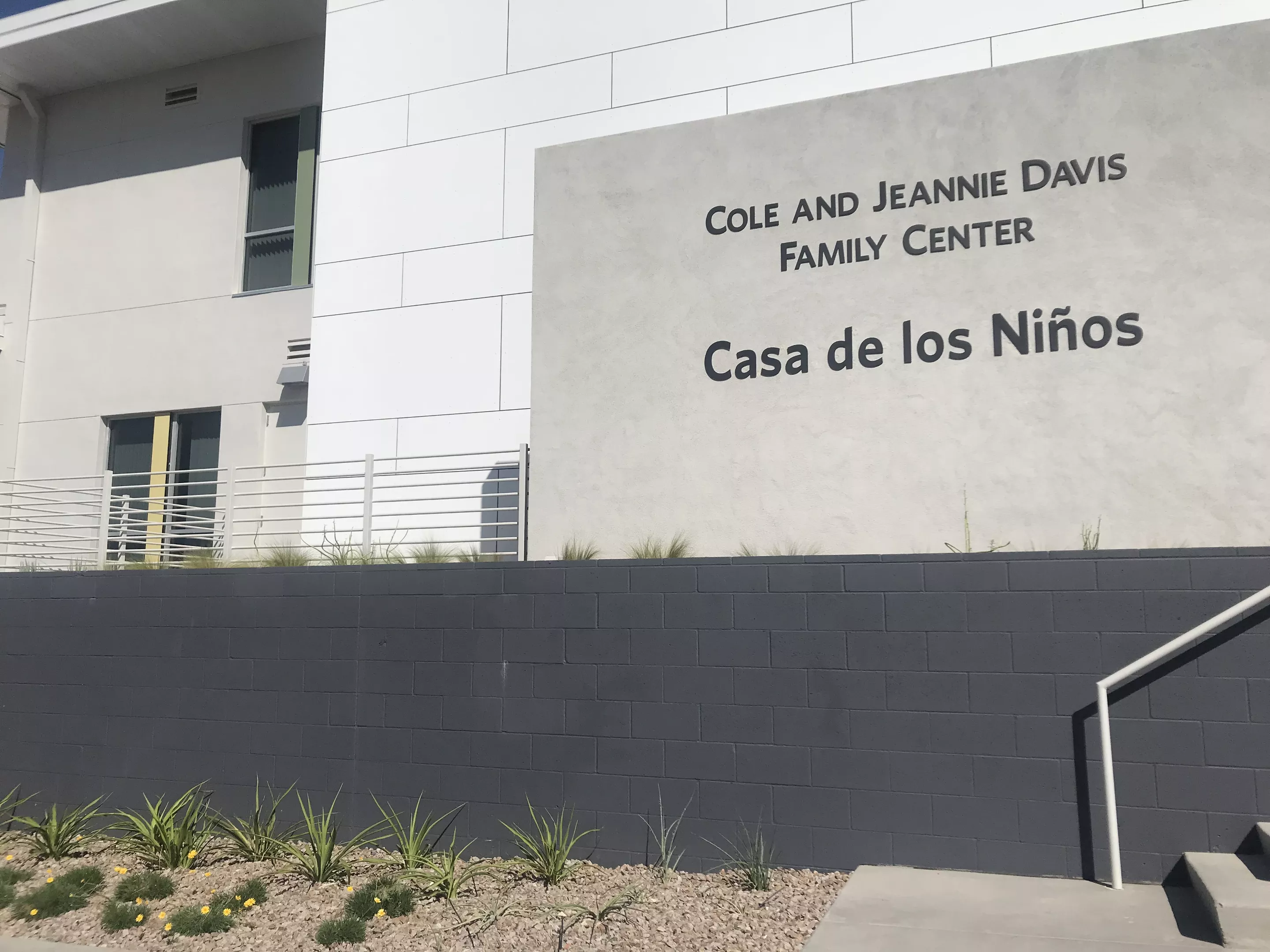
Susan Huhn, executive director of Casa de los Niños, added that the organization will be opening a quality preschool program that will accept DES subsidies in the 85705 zip code, which is significant because there are many high-quality care providers in the area but most don’t take DES subsidies.
So what do these organizations want from the elected officials in the room? They want to see a financial investment in the relatives who take care of these children through eliminating the disparity in funds provided to licensed and non-licensed caretakers, making it easier for non-licensed relatives to become licensed and receive that extra money and making high-quality child care an accessible option.
Tags: casa de los ninos , child welfare , foster care , subsidies , family , children , Image
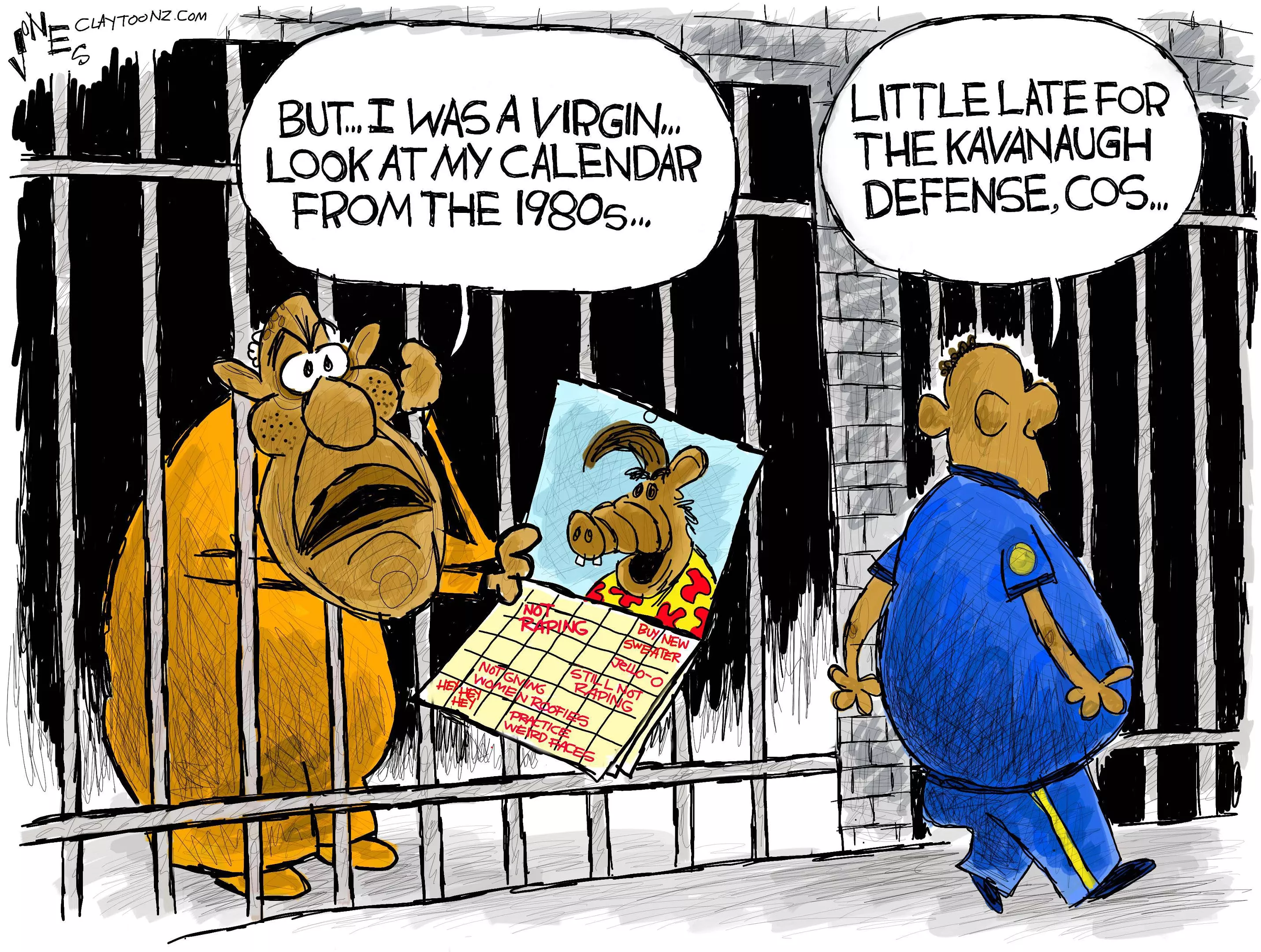
Tags: comics , cartoons , politics , Kavanaugh , baby , diaper change , Image
Thursday, September 27, 2018
Wednesday, September 26, 2018