

Wednesday, June 23, 2021
Tuesday, June 22, 2021
PHOENIX – After months of relaxed COVID-19 precautions, including lifting restrictions on face masks and social distancing, India has suffered a second surge that set records for new infections and deaths.
As the United States begins to ease into a new normal and relaxes its own pandemic restrictions, is there a chance of a similar outbreak here? Dr. Janice Johnston, chief medical director of Redirect Health, told ABC15 multiple factors, including emerging variants and vaccines, ultimately will determine the severity of the spread.
“This is what viruses will do,” Johnston said. “They will start to mutate and vary. And what we think right now is that the vaccines are being quite effective with these variants, but time will tell.”
From a global perspective, health officials are watching the variants closely. The Centers for Disease Control and Prevention says its working with partners around the world to detect, track and respond to new variants.
In this video, Cronkite News reporter Jamie Landers explains where the U.S. stands compared to other countries.
Cronkite News has partnered with ABC15 Arizona to expand the station’s Health Insider series, which provides expert advice and insights into health topics. Cronkite News is experimenting with storytelling tools and techniques to help explain the issues.

Monday, June 21, 2021
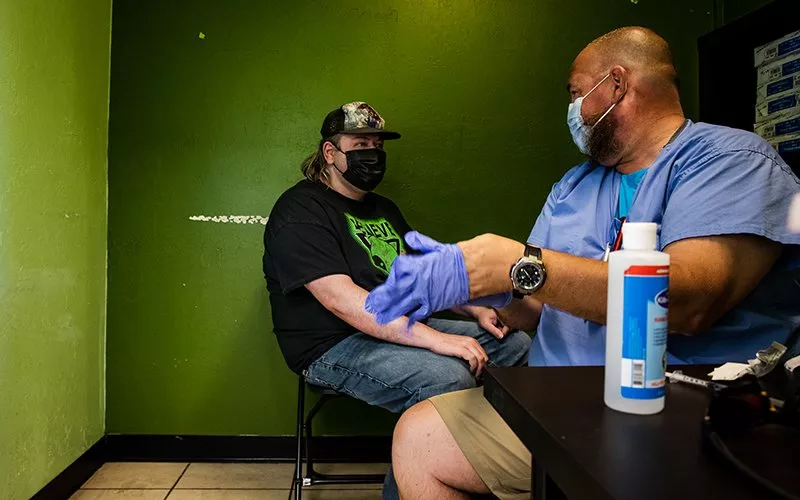
MESA – On a recent weekday morning, Paul Petersen of Florence was one of the first to arrive at Mint Dispensary to get something not usually offered at the cannabis shop: a free COVID-19 vaccine.
The 40-year-old had been holding off on getting vaccinated to see how others responded but was persuaded by an added perk: Mint’s Snax for Vaxx event. Mint gave away one free edible and a pre-rolled joint to anyone 21 or older receiving a Moderna vaccine.
Petersen said he took advantage of the opportunity to acquire “two things at once.”
“I’m comfortable with it now,” he said of the vaccination process, “but I didn’t trust the science before.”
With COVID-19 vaccination rates declining in Arizona and other states, public and private entities are using incentives to reverse the trend and get more shots into more arms.
From free doughnuts at Krispy Kreme shops to cold, hard cash from the state of California, individuals stepping up to get pricked can be rewarded in myriad ways.
In Arizona, Mint joined with Commerce Medical Group to provide vaccinations at pop-up clinics June 1 through 3 at its locations in Mesa, Tempe and Phoenix. Forty doses were brought to each location, and about two-thirds were distributed, said Kristy Jozwiak, a spokesperson for Mint.
Linzy Volm, a medical assistant for Commerce Medical Group who helped at the Mesa location, said more people turned up than she’d expected.
“I think it helps, giving a reward for (the shots),” she said. “But it kind of sucks that it has to come down to people being bribed to get vaccinated.”

Friday, June 18, 2021
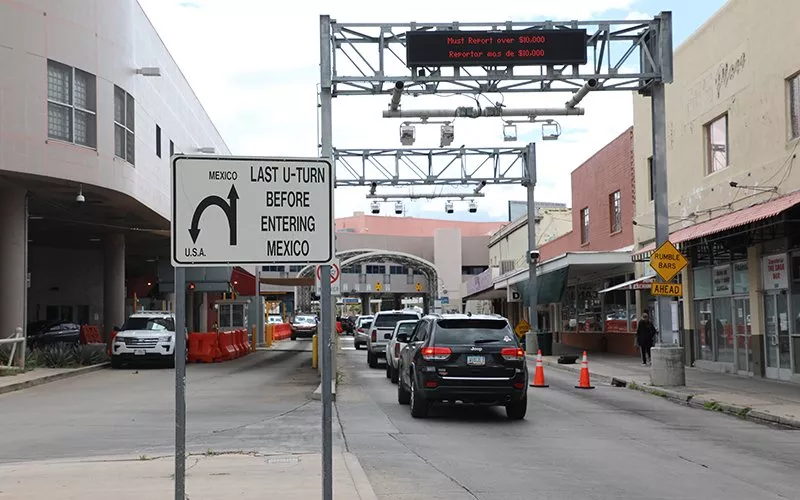
WASHINGTON – Border officials urged lawmakers to stick to a plan to reopen the border to nonessential travel Monday, even as they said more needs to be done to prepare for the expected surge in traffic.
The travel restriction was first imposed in March 2020 because of COVID-19 and has been regularly extended since, with the latest extension through 11:59 p.m. Monday. It was not clear if it will be extended again, but witnesses told a Senate Homeland Security subcommittee Wednesday that border communities cannot afford another delay in the reopening.
“I implore you to work with the White House in lifting border crossing restrictions for nonessential travel,” said Guillermo Valencia, who was testifying on behalf of the Greater Nogales and Santa Cruz County Port Authority.
“While these measures may have served an important role at critical times during the height of the pandemic, the continuation of these provisions are engendering the negative impacts on border economies,” he said.
Valencia testified that border crossings at Nogales are down by more than 46%, a drop that has “decimated” small businesses, restaurants, hotels and stores in the town.
But Valencia and others at the hearing also told senators on the Governmental Operations and Border Management Subcommittee that more workers and better technology will be needed at ports of entry to keep up with any increase in cross-border traffic once restrictions are lifted.
Anthony Reardon, president of the National Treasury Employees Union, said there is a staffing gap of more than 2,000 workers at Customs and Border Protection, which has seen no additional funding for hires since fiscal 2020. Even though border crossings fell during the pandemic, he said workers are stretched thin.
“If these essential travel restrictions are indeed lifted, I have heard from NTEU leaders that the current staffing at land ports will be unable to maintain inspection and processing functions to address the expected increase in traffic flow in a timely manner,” Reardon said.

Thursday, June 17, 2021
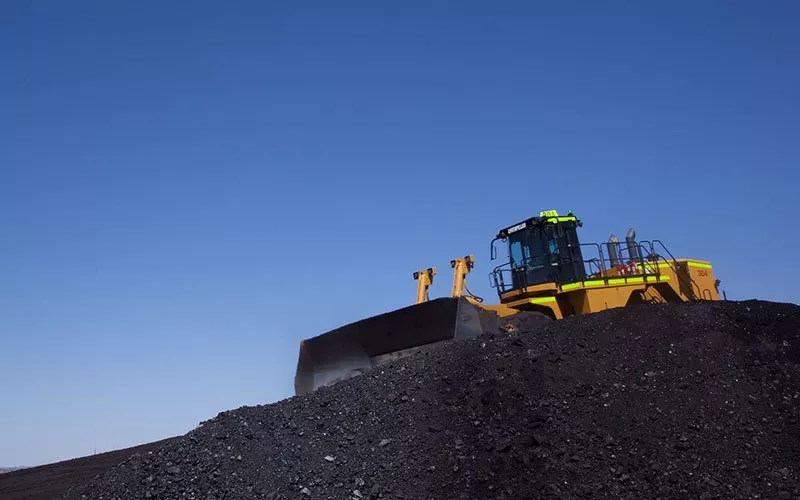
WASHINGTON – Navajo and Hopi witnesses agreed the region needs to move away from its economic dependence on coal, but specific proposals on how to get there remained elusive after a House hearing Tuesday.
The tribal representatives joined witnesses from across coal country at a House hearing on “supporting communities through the energy transition” – a transition that has been particularly hard on northeastern Arizona. The recent closure of mines there has left hundreds unemployed in an area with chronically high jobless rates.
“Our Navajo Nation government’s gross income from coal revenue severely decreased and we still have not found a way to replace the revenue in future fiscal years,” said Navajo Council Member Rickie Nez.
Nez said that while the transition away from coal has been “very painful,” tribal communities such as his are built on “a wealth of natural resources, including the critical minerals and rare earth elements necessary for achieving a renewable energy transition.” The area has the natural resources to rebound if the federal government stops throwing up hurdles to development, he said.
“We believe we have the right and responsibility to develop and manage these resources,” said Nez, who is also chairman of the council’s Resources and Development Committee. “Unfortunately, an estimated 86% of Indian lands that have this mineral wealth potential remain underdeveloped because of the federal government’s often heavy-handed regulation of Indian property.”
But other witnesses said that before moving forward, the government needs to make sure that mining companies clean up what they left behind.
“We Hopi people are very concerned that there is virtually nothing being done to repair and rehabilitate our lands that have been damaged and destroyed by over half a century of coal mining at Black Mesa,” said Ben Nuvamsa, executive director of the KIVA Institute and a former chairman of the Hopi tribe.
Nuvamsa, in joint testimony with Tó Nizhóní Ání Executive Director Nicole Horseherder, said the federal government’s focus should be on repairing the environmental damage that coal mines left behind.
“A half-century of coal mining and water withdrawals by Peabody have left considerable damage across the two mine sites that still remains unaddressed years after closure,” said Horseherder, founder of the grassroots Navajo group.

