

Thursday, June 3, 2021

Wednesday, June 2, 2021

WASHINGTON – Both sides agree on one thing about President Joe Biden’s decision to raise this year’s cap on refugee admissions from a historic low of 15,000 to as many as 62,500.
The U.S. is not going to come close to hitting that new ceiling.
“It’s not realistic, it’s just a kind of virtue signaling,” said Lora Ries, senior research fellow for homeland security at the Heritage Foundation.
Biden had said in April that he planned to keep the historically low 15,000-refugee cap imposed last year by President Donald Trump. That decision was immediately criticized by Biden supporters and sent the administration scrambling to back off, with officials promising within hours that a higher cap would be announced by May 15.
Biden unveiled the new cap on May 3, but even as he announced it he conceded that it was aspirational.
“The sad truth is that we will not achieve 62,500 admissions this year. We are working quickly to undo the damage of the last four years,” Biden said in a White House statement.
At the time of the announcement, the U.S. had admitted just 2,334 refugees, or just over 15% of the original limit of 15,000 refugees for fiscal 2021, according to the most recent refugee admissions report from the Refugee Processing Center. The Arizona Department of Economic Security said 161 refugees had been resettled in the state through May 17.
Numbers for the month of May will not be released until next week, but no one thinks the U.S. will be able to admit 60,000 more refugees in the five months left in the fiscal year.
But just setting a higher target will “very likely result in increased admissions beyond what would have happened, and it lays the groundwork for a bigger expansion next year,” said Mark Greenberg, director of the Human Services Initiative at the Migration Policy Institute.
The limit was set at 85,000 in President Barack Obama’s last year in office, but Trump lowered the ceiling to 50,000 in his first year and cut it every year thereafter until admissions were capped at 15,000 for this fiscal year.
Biden’s new cap “is still below the traditional one before Trump,” said Dany Bahar, senior fellow in the Global Economy and Development program at the Brookings Institution, but he expects the number will increase “very rapidly” because the number of people seeking refuge remains high.
Bahar said the higher cap on refugees was expected and that it should be “further increased because it is definitely not meeting the demand.” When he announced the new fiscal 2021 cap, Biden said he wants to raise the cap to 125,000 next year.
“That goal will still be hard to hit,” Biden said then. “We might not make it the first year. But we are going to use every tool available to help these fully-vetted refugees fleeing horrific conditions in their home countries.”

Tuesday, June 1, 2021
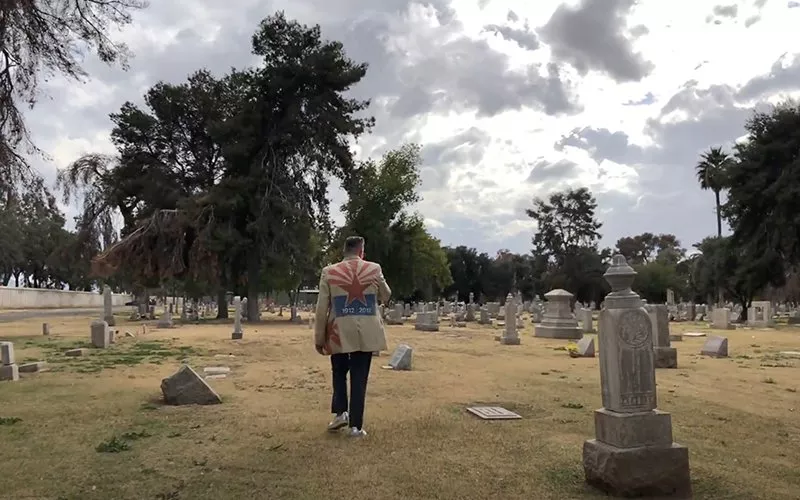
PHOENIX – Arizona’s Hip Historian Marshall Shore is known for his vivid storytelling, a cult-like following and expertise on the state’s history.
From his regular Arizona History Happy Hour to his ghost tours of the Valley, Shore has become a local celebrity. Part of the appeal is his study of under-represented groups and his interest in rewriting history with equity in mind.
Through the support of his followers, Shore was able to raise funds to purchase a headstone for a transgender man who was buried without one in the early 1900s.
The Greenwood Memory Lawn Mortuary & Cemetery in Phoenix opened in 1906 and holds the remains of some of the people who defined Arizona, including John T. Alsap, Phoenix’s first mayor, and William S. Hancock, who laid out the Phoenix townsite, according to the Arizona Republic. It also has been the site of controversy, including a movement to remove a Confederate veterans memorial.
“You can tell a lot about a city by going and visiting a cemetery and seeing its history,” Shore said.
To Shore, each stone in Greenwood cemetery represents a life with a story to share – but in the case of Nicolai De Raylan, the absence of a headstone was much more significant.
“It’s a really amazing story,” he said.
Shore learned about De Raylan in 2016 and said he was curious to learn about the secret life of a “gender pioneer” who died in Arizona in 1906.
Nicolai de Raylan emigrated from Russia to pursue a government job in Chicago. There, he married his first wife. Shore said De Raylan quickly got divorced, reportedly because he was “a little amorous with chorus girls.”
Shortly after, De Raylan married his second wife, Anna Davidson, and became a stepfather to her 10-year-old son.
In 1906, De Raylan was diagnosed with tuberculosis, and he visited Arizona to receive treatment. At the time, Arizona was known for its clean air.
“It didn’t go so well for him, he wound up passing away a few months later,” Shore said.
De Raylan left behind mounds of wealth and his beloved wife.

Monday, May 31, 2021


Friday, May 28, 2021

A University of Arizona economics professor said taxing carbon emissions would help solve the significant challenges that climate change poses to U.S. and world economies.
Dr. Derek Lemoine, associate professor of economics at the UA Eller College of Management, presented his research at the 2021 Breakfast With the Economists on Thursday.
Climate as a distribution of weather, which we “live through and experience,” matters for the economy, Lemoine said.
Lemoine discussed rising carbon emissions, saying “we are really restoring carbon conditions from way before even pre-humans ever existed, like we're really taking the planet pretty far back.” By 2050, carbon dioxide could reach levels unseen in 50 million years, he said.
Increasing carbon emissions increases global temperatures. In the early 1900s, Tucson months were cooler than the 20th-century average, and by the early 21st century, more months were warmer than the 20th-century average, according to data from the National Weather Service of Tucson.
Lemoine connected increases in temperature to things that affect humans: mortality, corn yields, electricity use, labor supply and even math scores.
Data from India and Italy showed that extreme heat correlated with an increase in mortality. Corn yields also suffered in extreme heat, he said, and the data has been replicated for other crops around the world. Although not clear as to why, he said minutes of labor per day fall as temperatures increase.
“I don't entirely understand what the channel is but it does seem to be true that productivity does fall in both extreme cold and extreme heat, and that has important implications for the economy as productivity growth is one of the main sources of economic growth in the medium and long run,” he said.
Truly understanding the impact of climate change on the economy means tracking how people are affected not in the short term by weather, but in the long run by permanent changes in climate.
“This is the economics of it. People react differently when things are happening over and over and when they expect them to happen over and over, and that's what we call adaptation,” said Lemoine.
He explained how Arizona residents install air-conditioning, thus adapting to expected high temperatures or after experiencing hot temperatures over time.
“Both of these are relevant to climate change, and both make climate differ from like the one-off kind of weather shocks we've been looking at, because people are going to live with hot weather over and over and over and over with climate change, and it's going to be hot over and over and over with climate change,” said Lemoine. “It’ll drive longer run investments than what you might see otherwise.”
Lemoine finds adaptation actually increases long‐run costs in U.S. agriculture when farmers adapt by using scarce resources.

Thursday, May 27, 2021

If you get a COVID vaccination this weekend, you could win up to $10,000.
Pima County will give 100 lottery tickets at two vaccination sites from 10 a.m. to 8 p.m. - May 29 at Westgate Shopping Center, 1785 W. Ajo Way, and May 31 at Pima Community College Desert Vista Campus, 5901 S. Calle Santa Cruz.
The 200 tickets, donated by The Arizona Lottery, have about a 1 in 4 chance of being winners, with a maximum prize of $10,000 and assorted smaller prizes.
Tickets will be given to the first 100 people age 21 and older getting the one-dose Johnson & Johnson vaccine, or their first shot of Pfizer or Moderna vaccines, which require two doses.
The University of Arizona's COVID-19 vaccination site will change its operating hours beginning Tuesday. The site will close for good on June 25.
UA campus vaccination site to change hours next week, close for good June 25
The new hours will be 9 a.m. to 3 p.m. After June 6, the site will no longer offer first-dose shots.
Anyone 12 years old and older is eligible for a vaccine. Children must be accompanied by a parent or legal guardian, but no identification is required for either person.
As of Thursday, 442,004 people, about 42%, have received at least one vaccine shot in Pima County. Nearly 378,000 are fully vaccinated.
If you still need to get vaccinated, here are other locations:

