
Wednesday, May 5, 2021
PHOENIX – The ability to attend a sporting event, place a bet on a team and possibly return home a winner will soon be a reality in Arizona.
So, too, could an uptick in gambling addiction, some worry.
Excitement surrounded Gov. Doug Ducey’s decision to sign a bill on April 15 that allows a significant expansion of gambling, including sports betting under licenses issued to tribes and professional sports teams. Gambling on fantasy sports and Keno games at horse race tracks will also be permitted.
But will accessibility increase detrimental behavior?
“Each state needs to take some responsibility and understand that a lot of people don’t gamble socially or don’t gamble like a normal person,” said a recovering gambling addict from Arizona who chose to remain anonymous.
Nearly 2.6% of the U.S. population, almost 10 million people, have an addiction problem because of gambling, according to the North American Foundation for Gambling Addiction Help. In WalletHub’s recent survey of “most gambling-addicted states,” Arizona ranked 41st, a number possibly impacted by the state’s newness to expanded gambling opportunities.
“I know it’s a revenue-making … function for the state but if they’re going to have places where you physically go and gamble like sportsbooks, they need to put right on the front door and visible that if you have a gambling problem, you need to call 1-800,” the recovering addict said, “because this is just going to open up a whole new can of worms for people, especially in today’s world with so many different stressors, so many different pressures on people whether economic, social, marriages, everything.”
Tuesday, May 4, 2021
The University of Arizona plans to decommission its vaccination site as of June 25 and has announced new hours.

With the decline in vaccine demand and “as other avenues for vaccination become more readily available,” the UA POD plans to scale back its hours and on Monday transitioned to fully indoors at the Ina E. Gittings Building, closing the drive-thru as the days get hotter, announced UA President Robert C. Robbins at the university update on Monday morning.
At the start of next week the UA POD will shorten its hours to 10 a.m. to 5 p.m., then on June 1 will continue with new hours only offering second doses.
“We're going to stop taking first dose appointments, relatively soon, just to make sure that the second dose is booked here at the University of Arizona POD, so that we will finish all shots that we started here,” said Vice President of Communications Holly Jensen. More details here.
County launching mobile vax pods
As health officials work to overcome vaccine hesitancy among some members of the public, Pima County and the Federal Emergency Management Agency (FEMA) are teaming up to launch mobile vaccination units to reach vulnerable communities with high risks of COVID-19 exposure and infection.
The operation includes two mobile vaccination units (MVUs), able to administer 250 vaccines per day each, along with administrative staff and federal vaccinators with 70 personnel from FEMA, Health and Human Services, the Environmental Protection Agency and Department of Labor, according to a county press release.
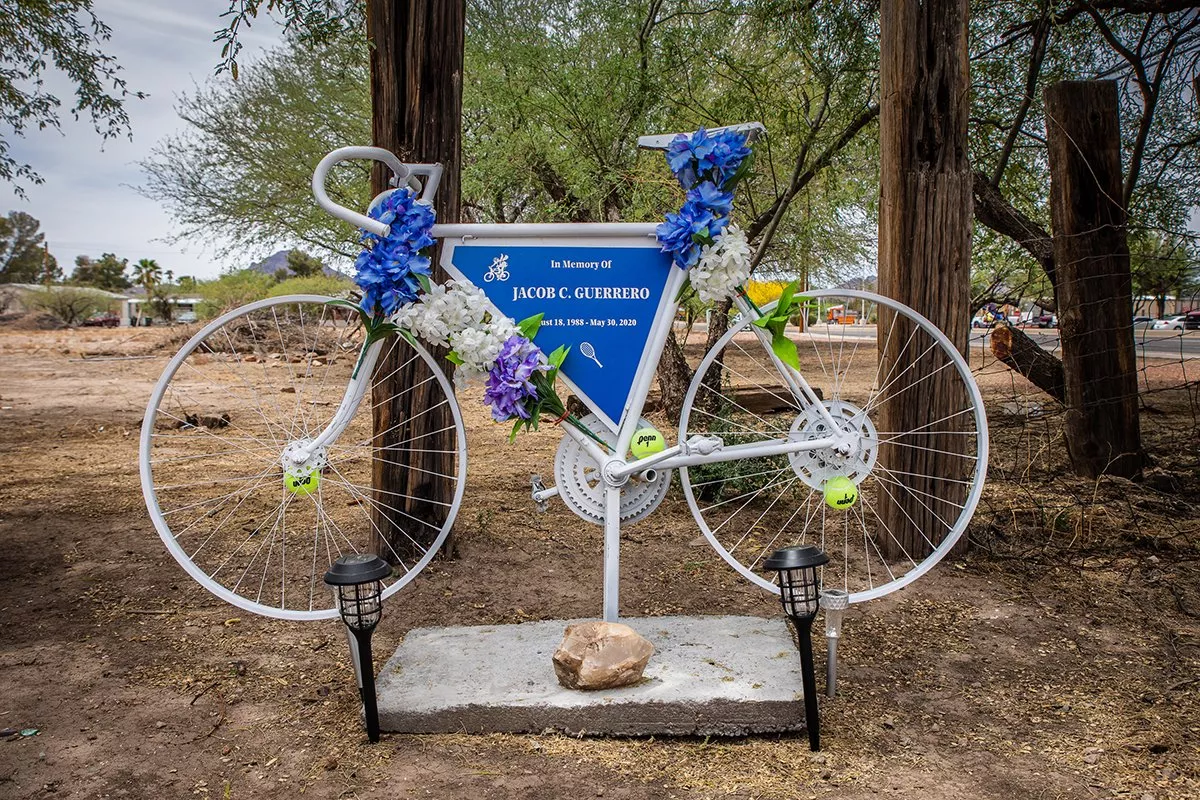
TUCSON – It was a Tuesday afternoon, two months into the pandemic, when Theresa Guerrero got the call from her brother-in-law: Her son, Jacob, had been found unresponsive.
She was standing in the middle of a Ross store in south Tucson picking out a pillow he’d asked for, throwing it to the floor as she raced toward the exit.
Jacob was a cyclist, a tennis player – a trusting, good man – but he’d grown lethargic of late and quit pursuing his active lifestyle. The pandemic only made things worse.
He’d been working as a Postmates driver for a couple of months. One day, his mother saw straws in his car and wondered whether he was using cocaine. But when she confronted Jacob, he brushed her off.
“He was, like so many other people, really lonely, and I remember he would go on drives by himself just to get out of the house,” Guerrero said. “I have to wonder if he had been able to see other people, would they have noticed what he was going through before I did?”
By the time she drove the seven miles to Jacob’s house last May 30, six paramedics hovered over him. Guerrero doesn’t remember a lot about that moment, other than screaming out to strangers as they loaded her only son into an ambulance, assuming their silence meant the inevitable was coming.
She followed the lights and sirens to the hospital, but due to COVID-19 regulations, she had to stay outside and wait.
And wait.
Monday, May 3, 2021

This week, Pima County and the Federal Emergency Management Agency (FEMA) are teaming up to launch mobile vaccination units to reach vulnerable communities with high risks of COVID-19 exposure and infection.
The operation includes two mobile vaccination units (MVUs), able to administer 250 vaccines per day each, along with administrative staff and federal vaccinators with 70 personnel from FEMA, Health and Human Services, the Environmental Protection Agency and Department of Labor, according to a county press release.
The units will run through June 26, operating at two concurrent locations for three days, with one day to tear down and move to the next location. The locations were selected based on census tract data and the Social Vulnerability Index of the area to identify highly vulnerable communities.
“We’re extremely grateful to FEMA for partnering with us on this effort to reach pockets of the community who may not have easy access to this life-saving vaccine,” said Pima County Administrator Chuck Huckelberry. “The ability to offer vaccines during evenings and weekends will enable us to reach folks whose work or school schedules prevent them from getting a vaccine now. With this effort, there’s truly no reason not to roll up your sleeve and get your shot so we can start putting this pandemic behind us.”
The sites will offer walk-up vaccinations of both the Moderna and Johnson & Johnson vaccine for those 18 and older on a first-come, first-served basis. Vaccinators will return to the same mobile site 28 days after their first visit to receive their second dose, following CDC guidance. Help will be available to all who need assistance with mobility, language or other accommodations.
Here are the planned mobile clinics:
May 7-9, 10 a.m. to 8 p.m.
- Casino del Sol, 5655 W. Valencia Road
- Desert Diamond Casino, 7350 S. Nogales Hwy.
May 11-13, 10 a.m. to 8 p.m.
- Greyhound Park, 2601 S. Third Ave.
- Wheeler Taft Library, 7800 N. Schisler Drive
May 15-17, 10 a.m. to 8 p.m.
- Rillito Race Track, 4502 N. First Ave.
- Curtis Park, 2110 W. Curtis Road
The county continues to offer vaccinations at several vaccination centers, mobile pop-up clinics and pharmacies. Visit pima.gov/covid19vaccine for more information.
No appointment necessary for the UA vax POD
You no longer need an appointment to get a shot at the UA vaccination point of distribution. The POD will now accept anyone over the age of 16 who comes in for a shot.
The pod has closed its drive-thru clinic because of rising temperatures, but still offers a sit-down clinic in the Ina E. Gittings Building (1737 E. University Blvd.) from 10 a.m. to 10 p.m. daily.
If you’d rather schedule an appointment, the state is expected to open new first-dose appointments daily at podvaccine.azdhs.gov. Call 602-542-1000 or 844-542-8201 for help in English or Spanish.
If you need help, call the COVID Ambassador Team hotline at 520-848-4045 between 7 a.m. and 7 p.m. daily or email [email protected].
Meanwhile, Pima County officials are shifting to indoor vaccination sites to avoid making staff and volunteers endure long days in triple-degree temperatures.
Tucson Medical Center has shut down its drive-thru vaccination clinics and transferred its operations to the Udall Center, 7200 E. Tanque Verde Road. The site is open 8 a.m. to 5 p.m. Monday, Thursday and Friday and 8 a.m. to 7 p.m. Tuesday and Wednesday. Register at https://vaccine.tmcaz.com/MyChart/OpenScheduling.
Pima County has opened a new indoor vaccine site at the Kino Event Center, where the county had earlier been doing COVID testing. That site is open 9 a.m. to 7 p.m., Monday through Saturday. Register at azdhs.gov.
The county has also opened an indoor vaccination POD at El Pueblo Center, 101 W. Irvington Road, which is open Monday, Wednesday and Friday from 9:30 a.m. to 1:30 p.m. No appointment is necessary.
The drive-through POD at Banner-South Kino Stadium, 2500 E. Ajo Way, is now offering appointments between 7:30 a.m. and 12:30 p.m. and will close permanently on May 14.
As of Sunday, May 2, 402,679 people in Pima County had received at least one shot of the virus, accounting for 38.5% of the population. A total of 322,792 people were fully vaccinated.
For more information or additional mobile clinics, visit pima.gov/covid19vaccineregistration or call 520-222-0119.
Many local pharmacies are now receiving vaccine doses. To find one near you, visit the ADHS website.
Get tested: Pima County has free COVID testing
Pima County is continuing to offer a number of testing centers and pop-up testing sites around town, including the northside Ellie Towne Flowing Wells Community Center, 1660 W. Ruthrauff Road. Schedule an appointment at pima.gov/covid19testing.
The University of Arizona’s antibody testing can determine if you have had COVID and now have antibodies. To sign up for testing, visit https://covid19antibodytesting.arizona.edu/home.
Today’s numbers
With 652 new cases reported today, the total number of Arizona’s confirmed novel coronavirus cases rose past 864,000 as of Monday, May 3, according to the Arizona Department of Health Services.
Pima County, which reported 72 new cases today, has seen 115,361 of the state’s 864,579 confirmed cases.
With no new deaths reported this morning, a total of 17,344 Arizonans have died after contracting COVID-19, including 2,395 deaths in Pima County, according to the May 3 report.
A total of 607 coronavirus patients were in the hospital as of May 2. That’s roughly 12% of the number hospitalized at the peak of the winter surge, which reached 5,082 on Jan. 12. The summer peak was 3,517, which was set on July 13, 2020. The subsequent lowest number of hospitalized COVID patients was 468, set on Sept. 27, 2020.
A total of 833 people visited emergency rooms with COVID-like symptoms on May 2. That number represents 35.5% of the record high of 2,341 set on Tuesday, Dec. 29, 2020. That number had peaked during the summer wave at 2,008 on July 7, 2020; it hit a subsequent low of 653 on Sept. 28, 2020.
A total of 189 COVID-19 patients were in intensive care unit beds on May 2, which roughly 16% of the record 1,183 ICU patients set on Jan. 11. The summer’s record number of patients in ICU beds was 970, set on July 13, 2020. The subsequent low was 114 on Sept. 22, 2020.
—with additional reporting from Austin Counts, Christina Duran, Jeff Gardner and Mike Truelsen

Friday, April 30, 2021
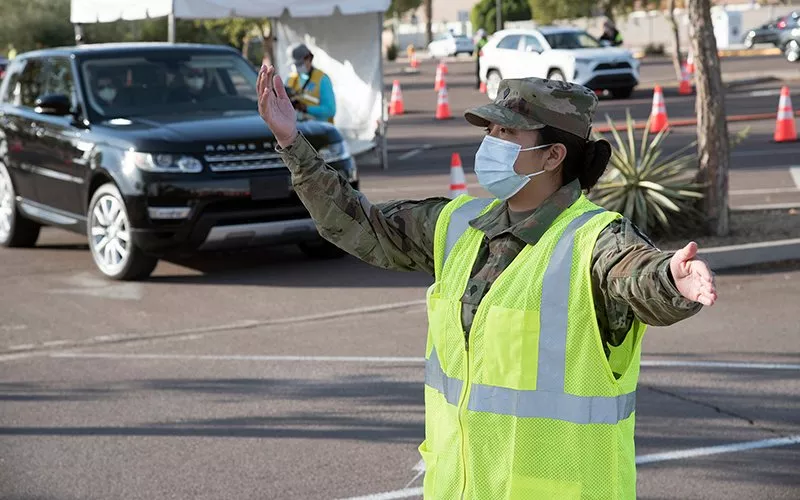
WASHINGTON – When Gov. Doug Ducey sent hundreds of National Guard members to help at the border last week, the move may have been unexpected – but it was not unusual for the troops that have spent a year shuttling from one crisis to another.
From stocking pandemic-depleted grocery shelves to fighting wildfires, from setting up vaccination sites to providing support in cities hit by civil unrest, the nearly 8,300 members of the Arizona National Guard have been constantly pulled in different directions.
“I haven’t been bored one day since we started this,” said Col. Tom Leeper, who was charged with running the Arizona National Guard’s Task Force Medical last year.
Maj. Gen. Michael McGuire, who was adjutant general of the state guard until retiring earlier this month, said the last time the guard was this busy was in the days following Sept. 11, 2001. The outbreak of COVID-19 was the first time since then that Arizona had a major statewide declaration of emergency, he said.
“Kind of interesting bookends to my career, in the years from 2002 to 2020,” McGuire said recently.
Arizona Guard members were not alone. According to the National Guard Bureau, Guard units nationwide spent more than 10.3 million days in the field last year, four times more than they did in 2019, said Nahaku McFadden, media operations chief of the National Guard public affairs bureau.
Nationally, McFadden said in an email, Guard units last year “provided nearly 550 million meals to families in need; delivered nearly 37 million masks to frontline workers; tested nearly 13 million people; and disinfected over 9,600 nursing homes and long-term care facilities.”
McGuire said Arizona has not had “that level of mobilization and participation since World War II.”