Friday, April 16, 2021
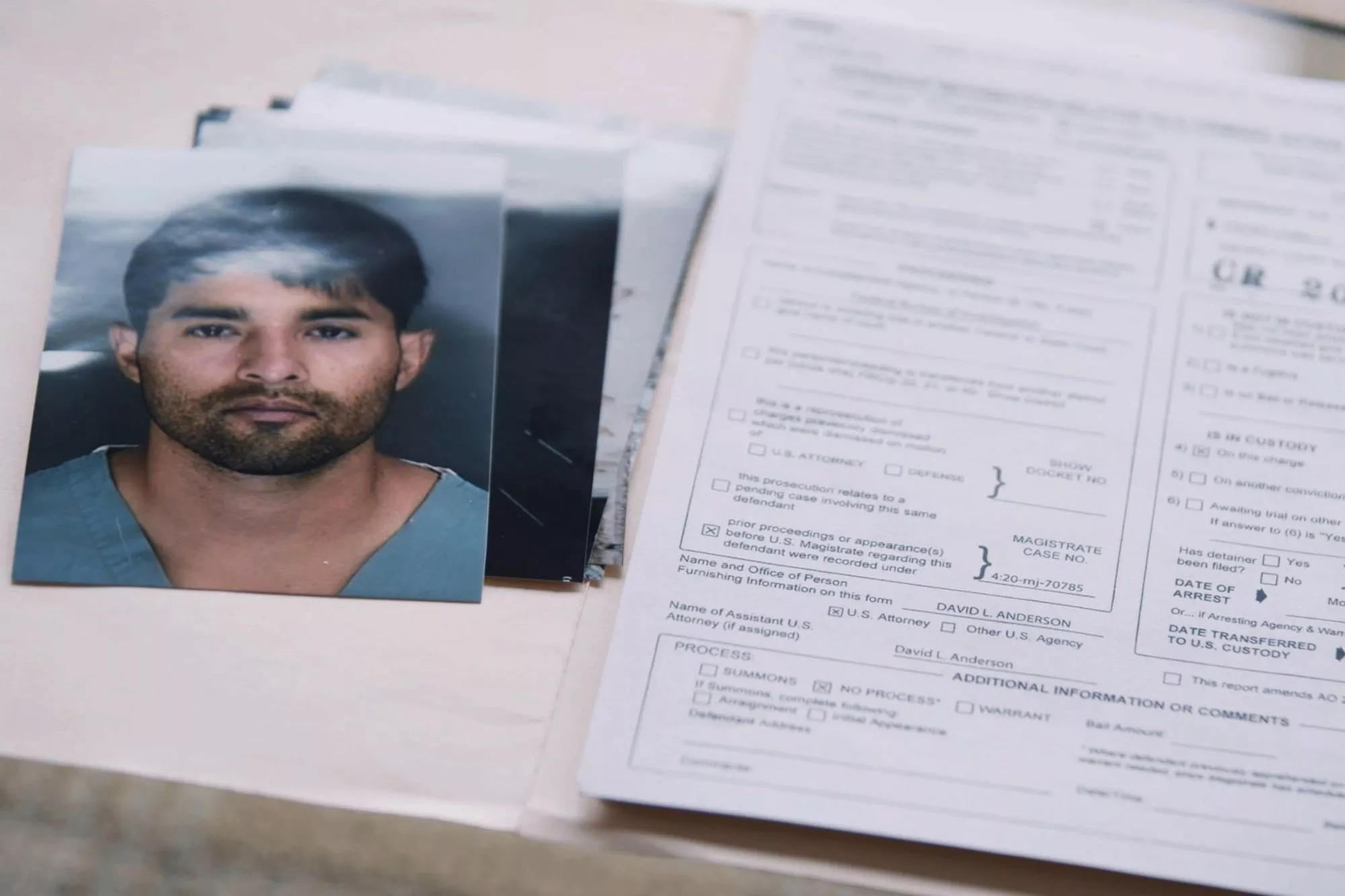
Steven Carrillo’s path to the Boogaloo Bois shows the hate group is far more organized and dangerous than previously known.
This story is part of a collaboration between ProPublica, Berkeley Journalism’s Investigative Reporting Program and FRONTLINE that includes the documentary American Insurrection. Watch the documentary.
It was 2:20 p.m. on June 6, 2020, and Steven Carrillo, a 32-year-old Air Force sergeant who belonged to the anti-government Boogaloo Bois movement, was on the run in the tiny mountain town of Ben Lomond, California.
With deputy sheriffs closing in, Carrillo texted his brother, Evan, asking him to tell his children he loved them and instructing him to give $50,000 to his fiancée. “I love you bro,” Carrillo signed off. Thinking the text message was a suicide note from a brother with a history of mental health troubles, Evan Carrillo quickly texted back: “Think about the ones you love.”
In fact, Steven Carrillo had a different objective, a goal he had written about on Facebook, discussed with other Boogaloo Bois and even scrawled out in his own blood as he hid from police that day. He wanted to incite a second Civil War in the United States by killing police officers he viewed as enforcers of a corrupt and tyrannical political order — officers he described as “domestic enemies” of the Constitution he professed to revere.

Now, as he texted with his brother and watched deputies assemble so close to him that he could hear their conversations, Carrillo sent an urgent appeal to his fellow Boogaloo Bois. “Kit up and get here,” he wrote in a WhatsApp message that prosecutors say he sent to members of a heavily armed Boogaloo militia faction he had recently joined. The police, he texted, were after him.
“Take them out when theyre coming in,” the text read, according to court documents.
Minutes later, prosecutors allege, Carrillo ambushed three deputy sheriffs, opening fire with a silenced automatic rifle and hurling a homemade pipe bomb from a concealed position on a steep embankment some 40 feet from the deputies. One deputy was shot dead, and a second was badly wounded by bomb shrapnel to his face and neck. When two California Highway Patrol officers arrived, Carrillo opened fire on them, too, police say, wounding one.
“The police are the guard dogs, ready to attack whenever the owner says, ‘Hey, sic ’em boy,’” Carrillo said in an interview, the first time he has spoken publicly since he was charged with murdering both the deputy sheriff in Ben Lomond and, a week earlier, a federal protective security officer at the Ronald V. Dellums Federal Building and U.S. Courthouse in Oakland.

Experts say we should investigate “breakthrough infections” to look out for variants and understand who’s vulnerable. In many cases, that’s not happening. Crucial pieces of the puzzle are being tossed in the trash.
Dr. Carey Washington was eager to be vaccinated. The psychologist, who was still working at 80 years old, got his first coronavirus shot on Jan. 12 and followed up with the second Pfizer dose on Feb. 4. With both shots done, he let his guard down at the office he shared with another doctor, sometimes leaving his mask off.
Then he woke up on March 7 with aches and fatigue, feeling as though he might have a cold. When he started experiencing chest pain and finding it hard to breathe, he booked an appointment with his primary care physician, who sent him on to his cardiologist. Both thought that his symptoms must be related to his past heart issues. But Washington’s symptoms got worse. He was so tired he could barely get out of bed. His cardiologist reassured him that the fatigue was likely due to the irregular heartbeat he was experiencing, and that the medications prescribed for that would take a while to kick in. But on March 12, Washington’s son took him to the emergency room anyway. A test revealed Washington was positive for COVID-19.
A week later, he was transferred to the intensive care unit. On March 25, he died.
Washington’s daughter, Tanya Washington, says that after her father was admitted to the Prisma Health Richland Hospital, she was determined to understand why. Why had Washington gotten sick despite being fully vaccinated? “Doctors said that because he was vaccinated, we think this may be a variant,” a strain of the coronavirus that could be more contagious or dangerous, Tanya recalls. She said they originally thought it might be a variant found in South Africa.
WASHINGTON – Backed by a field of flowers that represent the thousands killed by gun violence each year, former Arizona Rep. Gabrielle Giffords said Wednesday that Congress can act on gun reform or “can let the shooting continue.”
Giffords, who was severely wounded by a gunman in a 2011 mass shooting, joined congressional Democrats to call for Senate action on the Bipartisan Background Checks Act, a House bill that would stiffen checks on gun buyers.
The bill has yet to get a hearing in the Senate since it passed the House in March – a period during which 80 people were killed in mass shootings in the U.S., according to the Gun Violence Archive.
“We are at a crossroads,” Giffords said. “We can let the shooting continue, or we can act.”
The news conference came almost a week after President Joe Biden unveiled a series of steps aimed at curbing gun violence, by making it easier for states to adopt “red flag” laws, which keep guns out of the hands of those who are a danger to themselves or others, and by stiffening restrictions on “ghost guns” – those assembled from kits which are almost impossible to trace.
Biden also proposed new restrictions on gun modifications that allow a pistol to fire like a semi-automatic gun – a modification that was used by the shooter in the March 22 attack that killed 10 at a King Soopers grocery in Boulder, Colorado.
“We want to treat pistols modified with stabilizing braces with the seriousness they deserve,” Biden said. “Essentially, it makes that pistol a hell of a lot more accurate and a mini-rifle.”
But whatever changes the federal government makes could hit a wall in Arizona, where Gov. Doug Ducey last week signed the 2nd Amendment Firearm Freedom Act into law. It preempts federal law by making it illegal to use state funds or personnel to “enforce, administer or cooperate with any act” that is more restrictive than current state laws.
The bill, sponsored by Rep. Leo Biasiucci, R-Lake Havasu, passed both chambers of the Legislature on largely party-line votes. In a series of tweets after Ducey signed it into law, Biasiucci, called the law an “extra layer of protection” that makes Arizona a “2nd Amendment Sanctuary.”
The vote on HR 8, the federal background check bill, also fell mostly along party lines, with just eight Republicans supporting it and only one Democrat voting against it. Critics, like Rep. Debbie Lesko, R-Peoria, call the bill an “assault on our Second Amendment right to keep and bear arms.”
“The bill turns law-abiding citizens into criminals by subjecting them to criminal penalties for simply lending a friend or a neighbor a gun on a temporary basis,” Lesko said on the House floor before the March 10 vote.
Since that vote, there have been a series of unrelated mass shootings across the country that have grabbed headlines.
Before the King Soopers shooting there was the March 16 shootings at several Atlanta-area spas that killed eight people, including six Asian-American women, and an apparent family dispute the same day in Phoenix that left four dead. On April 8, a former NFL player killed five people in Rock Hill, South Carolina, before killing himself.
The shooter in Atlanta bought his gun the day of the attack, as Georgia – like Colorado and Arizona – does not have a waiting period between a gun purchase and delivery.
Speakers at the Giffords event included House Speaker Nancy Pelosi, who noted the toll of gun violence by pointing to the 40,000 flowers on the National Mall behind her, about the number of firearm deaths in a year, according to the Centers for Disease Control and Prevention.
“It takes your breath away to see the beauty of this art installation, but gun violence takes away the breath of so many people,” Pelosi said.
The Bipartisan Background Checks Act of 2021 would close a loophole that lets someone buy a firearm at a gun show or online without undergoing a background check.
It also targets the “Charleston loophole” that let an individual flagged for investigation by the FBI still get a gun, because the background check on him had not been finished within three days of his purchase. Dylann Roof used that gun to kill nine worshipers in 2015 after a Bible study at the Emanuel African Methodist Episcopal Church, a historic Black church in Charleston.
Rep. James Clyburn, D-S.C., said that extending the waiting period beyond three days could have saved the lives of those victims.
“I don’t know why the system did not catch the perpetrator,” Clyburn said Wednesday. “It may have been an error unintentional, or it may have been an error intentional.”
Giffords survived a Jan. 8, 2011, assassination attempt at a constituent event outside a Tucson supermarket that killed six people and left 13 injured, including Giffords. She has since worked for gun reform, starting Giffords.org to work toward tighter gun laws. And she said Wednesday she plans to keep fighting.
“I’ve known the darkest of days, days of pain and uncertain recovery, but confronted by despair I’ve summoned hope,” Giffords said. “I put one foot in front of the other, I found one word and then I found another.”
With 845 new cases reported today, the total number of Arizona’s confirmed novel coronavirus cases rose past 852,000 as of Friday, April 16, according to the Arizona Department of Health Services.

Pima County, which reduced the total number of cases by 31 today, has seen 113,998 of the state’s 852,570 confirmed cases.
With 30 new deaths reported this morning, a total of 17,153 Arizonans have died after contracting COVID-19, including 2,378 deaths in Pima County, according to the April 16 report.
A total of 569 coronavirus patients were in the hospital as of April 15. That’s roughly 11% of the number hospitalized at the peak of the winter surge, which reached 5,082 on Jan. 12. The summer peak was 3,517, which was set on July 13, 2020. The subsequent lowest number of hospitalized COVID patients was 468, set on Sept. 27, 2020.
A total of 893 people visited emergency rooms with COVID-like symptoms on April 15. That number represents 38% of the record high of 2,341 set on Tuesday, Dec. 29, 2020. That number had peaked during the summer wave at 2,008 on July 7, 2020; it hit a subsequent low of 653 on Sept. 28, 2020.
A total of 154 COVID-19 patients were in intensive care unit beds on April 15, which roughly 13% of the record 1,183 ICU patients set on Jan. 11. The summer’s record number of patients in ICU beds was 970, set on July 13, 2020. The subsequent low was 114 on Sept. 22, 2020.
Pima County resumes jury trials
Pima County courts resumed jury trials this week after nearly a year-long hiatus, county officials announced Thursday.
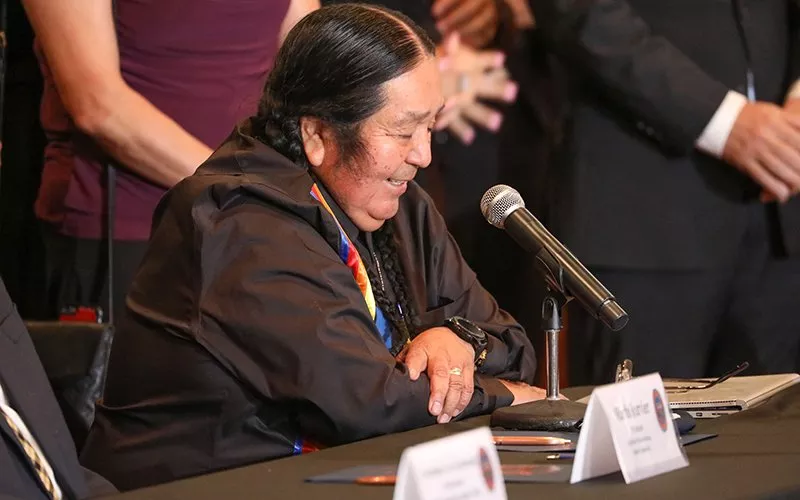
PHOENIX – After years of resistance from tribes around the state, Gov. Doug Ducey signed House Bill 2772 on Thursday, legalizing daily sports fantasy and sports betting in Arizona. The development comes on the heels of ratification of a revised Tribal-State Gaming Compact.
“Today’s signing is the culmination of years of discussion and engagement among many diverse stakeholders, tribal communities, both rural and urban, gaming industry partners and more,” Ducey said at a news conference to finalize the legislation.
“We did it by bringing everyone to the table, pushing individual agendas aside and putting Arizona first. The legislation associated with this compact amendment is a historic bipartisan achievement.”
Senate Bill 1797, a mirror bill to HB 2772, was ratified by a bipartisan majority earlier this week by the state Senate. These amendments to the existing compact grant specific organizations and groups sports betting permits to create sportsbooks in their particular venue. Ten licenses will be granted to sports organizations to open these books in or near their sporting facilities. An additional 10 licenses will be given to tribal nations to open sportsbooks at their respective casinos.
Thursday, April 15, 2021

For 2021, the tax deadline for individuals was extended to May 17. This list highlights the most common tax forms and which ones you might need, depending on your circumstances.
Over the years, the IRS has created a vast network of forms. To file your taxes, you’ve got to navigate a lot of paperwork. Get a regular salary? There’s a form for that. Unemployment benefits? There’s a form for that, too. Social Security? You get the idea.
Why Is It Important to Understand Tax Forms?
Nowadays, most people file their taxes using websites or other products that do the work of figuring out which forms you need to file and filling them out. But it’s not always cheap. Many of those services and software — like TuroTax or H&R Block — charge users depending on which forms they need to use.
For 2020 tax filings (the ones due on May 17, 2021), anyone who made less than $72,000 a year is able to file for free as part of the IRS Free File program. Companies including Intuit, which makes TurboTax, H&R Block and others spent millions lobbying to bar the IRS from making its own free filing option while promising to create their own free products. But then, as ProPublica reported, they systematically undermined the truly free options by hiding search results and calling their products “free” even though for many, they’re anything but.
If you haven’t filed yet, we recommend checking out our guide to filing your state and federal taxes completely for free, looking to see if you qualify for the Earned Income Tax Credit (EITC) or learning how to track your refund. Though the IRS offers the option of paper filing, with the current COVID-19 state of affairs — and a massive backlog of paper returns and documents — the agency is encouraging taxpayers to file electronically to ensure prompt payment of refunds and avoid filing errors. Most paid and free tax prep services will tell you which forms you need to file, but if you’re still confused, see below for a list of the most commonly used tax forms.
Where Can I Get Tax Forms?
The IRS keeps all of its forms in a database online that offers each form in several languages, and it has a page that specifically highlights the most common forms filers use during tax season. These pages include the forms themselves and documents that instruct users on how to use them.
Which Tax Forms Do I Need?
Everybody’s tax situation is unique and might require different forms. The list below will explain what the most common forms are for and whom they might serve best.
With 460 new cases reported today, the total number of Arizona’s confirmed novel coronavirus neared 852,000 as of Thursday, April 15, according to the Arizona Department of Health Services.

Pima County, which reported 126 new cases today, has seen 114,029 of the state’s 851,725 confirmed cases.
With 14 new deaths reported this morning, a total of 17,123 Arizonans have died after contracting COVID-19, including 2,376 deaths in Pima County, according to the April 15 report.
A total of 584 coronavirus patients were in the hospital as of April 14. That’s roughly 11.5% of the number hospitalized at the peak of the winter surge, which reached 5,082 on Jan. 12. The summer peak was 3,517, which was set on July 13, 2020. The subsequent lowest number of hospitalized COVID patients was 468, set on Sept. 27, 2020.
A total of 968 people visited emergency rooms with COVID-like symptoms on April 14. That number represents 41% of the record high of 2,341 set on Tuesday, Dec. 29, 2020. That number had peaked during the summer wave at 2,008 on July 7, 2020; it hit a subsequent low of 653 on Sept. 28, 2020.
A total of 162 COVID-19 patients were in intensive care unit beds on April 14, which roughly 13.5% of the record 1,183 ICU patients set on Jan. 11. The summer’s record number of patients in ICU beds was 970, set on July 13, 2020. The subsequent low was 114 on Sept. 22, 2020.
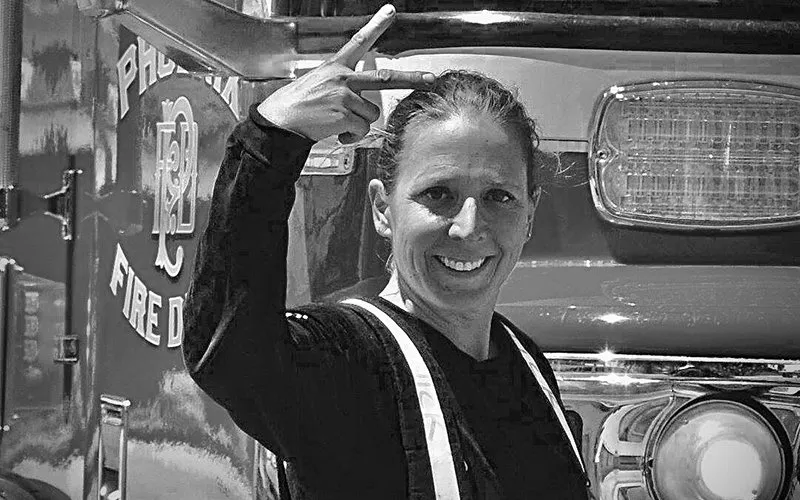
PHOENIX – Nicole Minnick had been a firefighter for seven years when she gave birth in 2008 to her first child, a girl named Kyndal. A few months later, when she returned to work, one thought was foremost in her mind: Would it be safe to breastfeed?
“My second or third shift back to work, we had a fire – and my baby’s 3 months old. I was like, ‘Well I probably shouldn’t nurse her. How long do I need to pump and dump?’” Minnick recalled. “I called the fire department, and they had no idea.”
Turns out extensive research to determine how long carcinogens remain in the breast milk of female firefighters had never been conducted, prompting Minnick to take part in a University of Arizona study.
“This was my baby,” she said. “I wanted to know.”
Now a new UA study aims to build on that body of work and further understand the occupational risks unique to women in the fire service.
The three-year study, funded by a $1.5 million grant from the Federal Emergency Management Agency, will explore stress, cancer risks and the effect of toxins on reproductive health. Researchers hope to enlist 200 women – 100 incumbent firefighters and 100 new recruits – from departments across the U.S., including some from the Tucson Fire Department.
Comparing new recruits with those who’ve served for some years will help identify potential differences in stress and markers in blood associated with increased cancer risk.
“The women and men of the fire service are keeping those of us in the public safe, and therefore it’s really important that we help them by providing information that they can use to keep themselves safe,” said Dr. Jeff Burgess, associate dean for research at the University of Arizona’s College of Public Health.
The project includes a “virtual kitchen table” to provide mentorship for female firefighters with a goal of building resilience and reducing stress. The idea, researcher Sara Jahnke said, is to form an official research question around “What do you need to be supported?”
Wednesday, April 14, 2021
PHOENIX – Red for Ed, the teachers group that spearheaded Proposition 208 – which increases some taxes to hire teachers and bolster teacher salaries – returned to the political battlefield to fight a bill it says undermines the will of Arizona voters in November.
Education advocates oppose Senate Bill 1783, which would allow some business owners to avoid paying the higher taxes Proposition 208 levies on Arizona’s wealthiest residents. Proposition 208, approved by voters 52% to 48%, was spawned by the Red for Ed movement, which formed in 2018 to demand additional funds for education. Arizona ranks 50th in teacher pay, according to Expect More Arizona, an education group.
“This is about the kids and making sure that they have the brightest future possible,” Rebecca Gau, executive director of Stand for Children, said at a rally at the state Capitol last week.
Proposition 208 levies a 3.5% surcharge on the current rate of 4.5% on income exceeding $250,000 for single earners or $500,000 for couples. But SB 1783, sponsored by Sen. J.D. Mesnard, R-Chandler, would circumvent the surcharge by creating an alternate tax category, according to Capitol Media Services.
Mesnard told Capitol Media that the measure would help small businesses.
“We heard time and time again this will not or is not meant to impact small businesses,” he said. “And so what this is doing is ensuring that’s the case.”
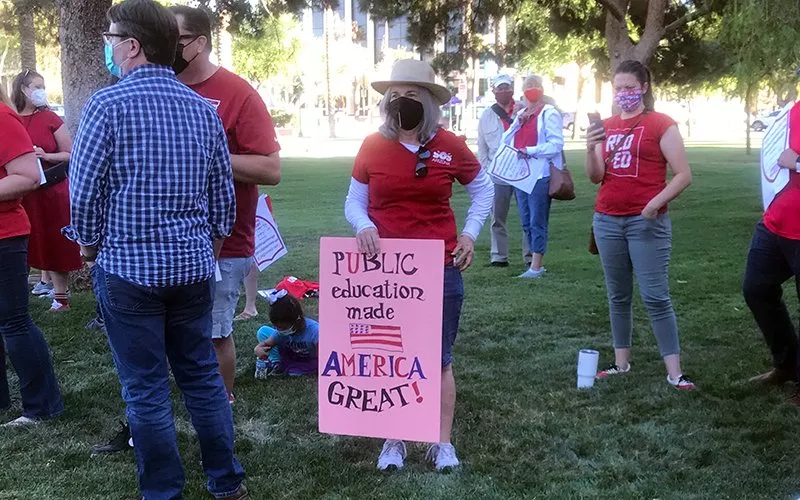
About a dozen teachers, parents and students came to the Capitol to show their support for schools. Dressed in red or blue T-shirts, several carried signs. “Education made America great,” one said. “Seriously, do we really need to do this again?” said another.