

Tuesday, February 9, 2021
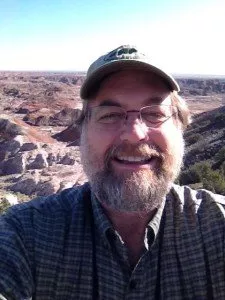
Kevin Dahl, the senior program manager for the National Parks Conservation Association, filed paperwork today to run for the seat.
“Paul has been an excellent Council representative for the residents of Ward 3,” Dahl said. “I supported him when he sought the seat, and now I am supporting him in the difficult decision that he has made to step down.”
Dahl, who has also headed up the Tucson Audubon Society and Native Seeds/SEARCH, has already lined up endorsement from Congressman Raul Grijalva and local environmental queenpin Carolyn Campbell, who is chairing Dahl's campaign.
He said he’d also be interested in appointment to the seat, but he understands that council members may be looking for someone who isn’t going to run for the seat and if that’s the case, he’s more interested in campaigning for a full term.
Meanwhile, Juan Padres, who ran against Pima County Supervisor Sharon Bronson in the 2020 primary, announced on Facebook last week that he’s launching a campaign the job.
“I fully understand the problems and challenges that Ward 3 faces, and look forward to working tirelessly to address them,” Padres said. “My campaign platform will be very similar to the one I ran on last time, making poverty the number one issue that needs to be addressed in our community, especially in the wake of this devastating pandemic.”
A primary election for the Ward 3 seat—along with Ward 6 and Ward 5—is set for Aug. 3, with the general election to follow on Nov. 2.
But we’re still waiting to see if that election is going to happen. State lawmakers are still trying to force the city of Tucson to move its election on onto the same even-year cycle that most elections in Arizona take place. If that happens, city elections would take place the same years as presidential and midterm elections.
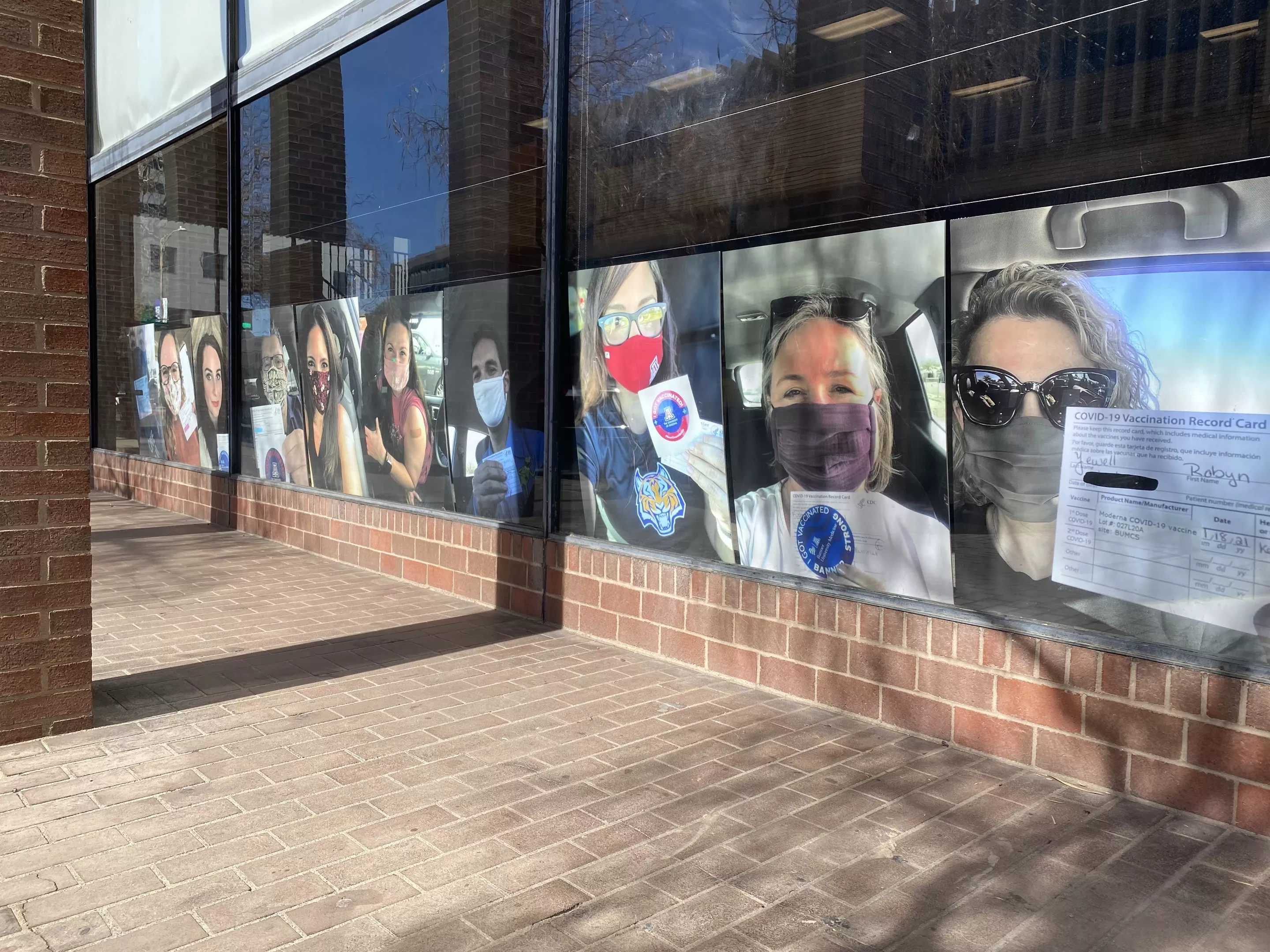
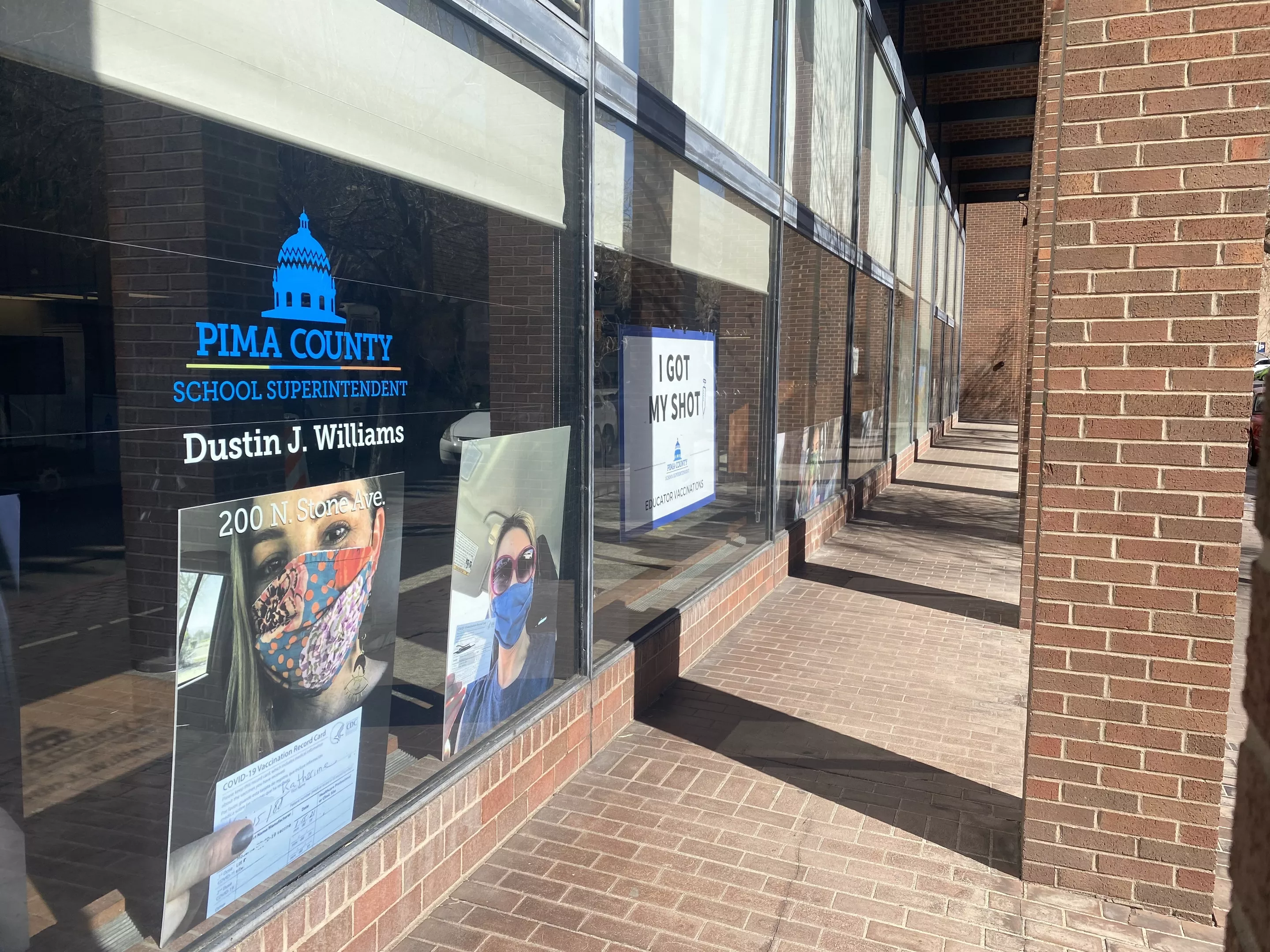
At the Pima County superintendent’s office, the windows that once revealed ordinary office space are now adorned with photos of educators bearing cheerful eyes behind their masks and holding up paper cards showing one of the first signs of hope in a year-long pandemic.
Matt Stamp, the communications director for the superintendent’s office, came up with the idea for teachers to submit photos showing their COVID-19 vaccination cards and to publicly display them on the office windows.
“There were a lot of eager teachers ready to get vaccinated, and so we were seeing a lot of frustration. Then across my own personal timelines on social media, I was starting to see educator friends post their vaccine photos, and just the smiles on their faces,” Stamp said. “You could just tell how proud they were, and something just flipped in my brain and said, this is important. We need to change the narrative here of the frustration, change it from frustration to a message of hope, which is really what this is.”
While Pima County is receiving a limited vaccine supply that falls short of the demand for them, the county superintendent’s office wanted to celebrate the thousands of educators who have taken the first step in quelling the transmission of the virus that’s changed every facet of their work lives.
Nearly 9,000 K-12 educators have received their first dose of the COVID-19 vaccine, according to Pima County Health Department Director Dr. Theresa Cullen. In the county, about 25,000 educators currently qualify to receive their shot in the county's priority 1B group of vaccine rollout, said Pima County Superintendent Dustin Williams.
While educators have successfully registered for vaccines across Pima County’s five PODs, or points of distribution, the county encourages them to go to the University of Arizona or the Tucson Convention Center.
According to the University of Arizona, which only provides vaccines to educators, the POD has administered 9,866 doses as of Monday.
While some local school districts debate whether to return to classrooms and others have already done so, receiving a COVID-19 vaccine is giving many educators hope that instruction will return to normal sooner rather than later.
“We know that schools, when they have face-to-face contact with students, that's the best type of strategy for their cognitive ability, and also their social-emotional,” Williams said. “If we want schools to open in any type of method, whether it be a remote, hybrid or in person, we really want to encourage mitigation strategies. This is just another layer of making sure that the staff at these schools are going to be protected from this deadly virus.”
Ben Collinsworth, a first-grade teacher for Flowing Wells’ digital campus, received his first COVID-19 shot on Jan. 18 at Banner South’s Kino Stadium site. He said it took less time than a standard admissions test would.
“It really hit me when I was waiting in that line of cars that this is the first thing after a whole year that we were doing that was actually part of a solution,” Collinsworth said. “Since March, it's all been about what can we do to prevent the spread? As teachers, as educators, what can we do to teach through the pandemic, or make sure that kids are getting what they need? Here I was sitting in the car, about to finally do something that's like, okay, we're gonna end it. Together, we are going to end it.”
Frannie Neal, a counselor at Tucson Unified School District’s Grijalva Elementary School, received her vaccine on Jan. 19 at Tucson Medical Center.
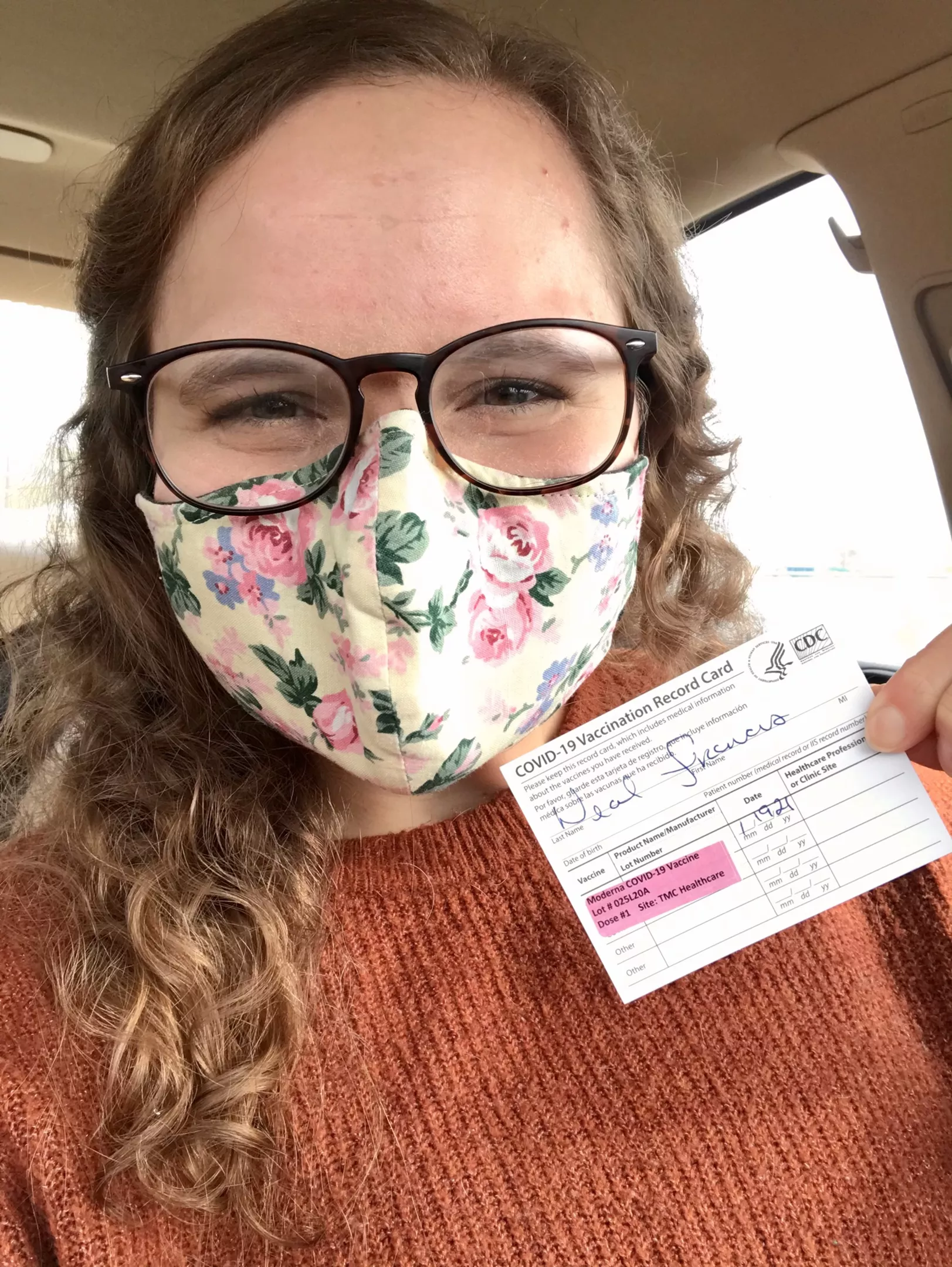
“It was the best day of the year. It just felt like such a relief. You know, after having to quarantine for so long, it's been really quite difficult,” Neal said. “So it was such a joy to be able to register. It was such a relief that day just knowing that this end is hopefully in sight, and we can go back to school soon safely.”
After hearing stories like Collinsworth’s and Neal’s, Stamp decided to publicly display the photos taken by proud educators. He made a Facebook post requesting educators’ vaccine pictures.
Educators: Share your vaccine photos with us! We are looking for any and all educator vaccination pictures. We want to...
Posted by Pima County School Superintendent's Office on Tuesday, January 19, 2021
“The teachers and the educators who saw it and shared their picture were so ecstatic to share, they just had this sense of pride and this sense of hope that they got their vaccine and you could see it in their faces, just how happy they were to get it,” Stamp said. “I really wanted that story to be told, I wanted to just show that this is happening, this is real, and we're gonna get back into the classroom sooner than later.”
But the step in a return to pre-pandemic classroom settings comes after a year of changes that drastically impacted educators’ careers.
“There are so many components of a school, and school counseling is such a crucial one, especially right now. It's been quite difficult trying to reach certain students or families,” Neal said. “Attendance has been hard, some technology issues or the internet's down or device issues—just a myriad of issues. But I know, especially at our school, everybody's working harder than ever to solve those issues.”
The pandemic is affecting students’ school lives, too.
“I think a lot of students are just feeling disengaged,” Neal said. “I know teachers are working—and counselors, of course—harder than ever to get them engaged and to do movement activities and different things to kind of get them involved.”
At a governing board meeting Tuesday night, TUSD will discuss the results of a parent survey assessing whether to return to a hybrid learning model or remain remote.
“I hope that we can return safely as soon as it's possible to return safely. I think that looks like having as many people as possible vaccinated. Continuing the mask-wearing, continuing all of our mitigation strategies that we've been doing,” Neal said. “I'm very cautious about returning to school unless it is safe.”
Neal and Collinsworth have appointments scheduled in the next two weeks to receive the second vaccine dose needed to be fully immunized.
Grateful for the opportunity to receive the vaccine, Collinsworth encourages persistence for those still trying to schedule an appointment.
“I'm excited for everybody to get a chance to get the vaccine. I know that the rollout has been difficult, finding an appointment has been difficult for a lot of people,” he said. “My message is, keep at it, because every shot is one step closer.”
Correction: The original headline on this story was incorrect. Organizers still want to allow customers to tip service workers, in addition to an increase in the minimum wage to $15 an hour.
PHOENIX – Blanca Collazo started working as soon as she could.
She was approved for Deferred Action for Childhood Arrivals, or DACA, at 16. She then was hired as a hostess at the Old Spaghetti Factory restaurant to help her family with bills and to save for college tuition.
She worked long shifts after school for $10 an hour. She saved enough to attend college after she graduated, but the pandemic forced Collazo, 19, to step back from school so she could earn enough to survive.
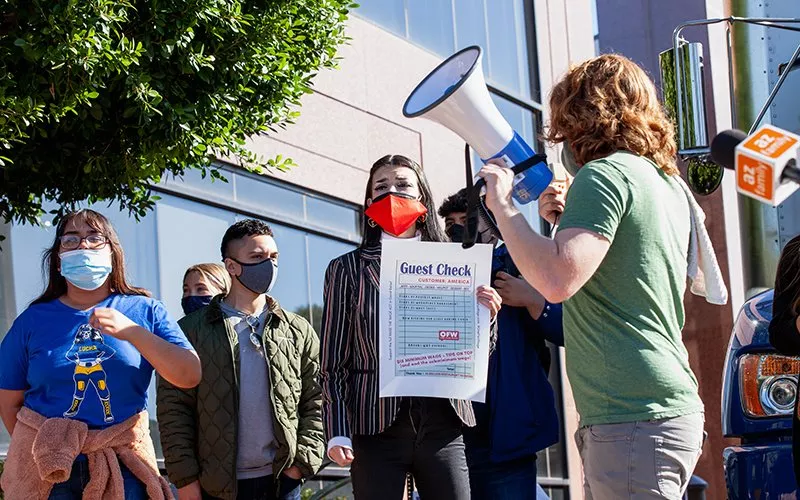
On Monday, Collazo and a handful of fellow organizers in Phoenix joined like-minded activists around the country who rallied to raise the minimum wage and lower the reliance on tips. More than 1.6 million workers, mainly in the restaurant industry, are paid a minimum wage in the U.S. as low as $7.25 on the federal level and, more recently in Arizona, $12.15 an hour.
Collazo told her story in support of the Raise the Wage Act – a provision that would eventually raise the federally required minimum wage to $15 an hour – included in President Joe Biden’s $1.9 trillion COVID-19 relief package.
Collazo now works as an organizer for LUCHA (Living United for Change in Arizona), a nonprofit organization dedicated to working families.
“I’m fighting for future generations because I don’t want them to go through what I went through,” she said. “Being out here today, we’re not asking, we’re demanding.”
With 4,381 new cases reported today, the total number of Arizona’s confirmed novel coronavirus cases topped 787,000 as of Tuesday, Feb. 9, according to the Arizona Department of Health Services.
Pima County, which reported 685 new cases today, has seen 105,606 of the state’s 787,268 confirmed cases.
With 231 new deaths reported today, a total number of 14,286 Arizonans have died after contracting COVID-19, including 1,958 deaths in Pima County, according to the Feb. 9 report.
The number of hospitalized COVID cases statewide has declined in recent weeks, with 2,744 coronavirus patients in the hospital as of Feb. 8. That number peaked at 5,082 on Jan. 11. The summer peak was 3,517, which was set on July 13, 2020. The subsequent lowest number of hospitalized COVID patients was 468, set on Sept. 27, 2020.
A total of 1,307 people visited emergency rooms on Feb. 8 with COVID symptoms, down from the record high of 2,341 set on Tuesday, Dec. 29, 2020. That number had peaked during the summer wave at 2,008 on July 7, 2020; it hit a subsequent low of 653 on Sept. 28, 2020.
A total of 797 COVID-19 patients were in intensive care unit beds on Feb. 7, down from a peak of 1,183 set on Jan. 11. The summer’s record number of patients in ICU beds was 970, set on July 13, 2020. The subsequent low was 114 on Sept. 22, 2020.
How to get a vaccine
Currently, Pima County is providing vaccination shots to people 70 and older as well as educators, first responders and healthcare workers. Those who currently qualify in Pima County’s 1B priority group of eligible vaccine recipients can register for a vaccine at www.pima.gov/covid19vaccineregistration or by calling 520-222-0119.
Cases decline but virus remains widespread
While Pima County lacks the vaccine supply to vaccinate enough of the population to reach herd immunity, COVID-19 cases are decreasing across the state. Health experts warn, however, that continued mitigation is needed to maintain the downward trend.
According to the latest report by Dr. Joe Gerald, a University of Arizona professor who creates weekly coronavirus epidemiology reports based on Arizona Department of Health Services data, the week ending Jan. 31 saw a 31% decrease in total COVID-19 cases from the week prior.
In Pima County, coronavirus cases saw a 27% decrease the week ending Jan. 17 from the week before, Gerald reports.
Data from the Pima County Health Department reflects a similar trend. The first week of January saw Pima County’s highest weekly number of COVID-19 cases at 8,860, while the following week dropped to 7,052 and the third week to 5,260. Week four reported 2,916 cases, but data from the last 4-7 days are still trickling in.
“I'm cautiously optimistic. So we have 130,000 plus vaccinated. We have over 103,000 cases, which confers some immunity, at least for that particular 90 days. We do seem to be seeing a decrease in our cases day by day,” said Dr. Theresa Cullen, Pima County’s health department director. “Overall, if we look at what we call the epi curve, we do see that epi curve seems to have hit its peak and is coming down. That is also consistent with what we're seeing with our hospitalizations. We have more ICU bed availability than we have had for the past eight weeks.”
However, Cullen said the county’s test positivity of 12.5% is still high, and while COVID-19 testing has decreased, it hasn’t corresponded with a decreased positivity rate.
“That means that we still have a lot of COVID transmission occurring in the county,” Cullen said.
While the week ending Jan. 17 remains Arizona’s deadliest at 913 reported COVID-19 deaths, Gerald said deaths will remain high for the next four to eight weeks.
The county health department reports 134 COVID-19 deaths for January’s first week, 125 for the second, 85 for the third and six deaths for the last week of the month. More details here.
After state cuts in vaccine doses, county officials warn that it’s going to take longer for Pima residents to get shots
While Pima County widens vaccine eligibility, it’s receiving a reduced vaccine supply that makes it difficult to keep up with demand.
Last week, the Pima County Health Department announced those over 70 are now eligible to receive COVID-19 vaccines by signing up for appointments beginning Monday.
While only the 75+ age group, protective service workers and educators were previously eligible, the health department is expanding its 1B priority group of vaccine recipients to include individuals over 70 after vaccinating more than 130,000 residents over the past six weeks, according to county health department Director Dr. Theresa Cullen.
However, this week’s vaccine allocation has been truncated. Last week, the state allocated Pima County 29,000 doses. This week, the county will only receive 17,800—a 39% decrease in an already strained vaccine supply.
“Weekly allocations to local jurisdictions are based on population size, which phase a county is currently vaccinating, and the number of doses available for allocation. While Pima County’s allocation this week is lower than in the recent past, in total to date, Pima County has received approximately 14% of the state's overall allocation,” Holly Poynter, the Arizona Department of Health Services’ public information officer, explained in an email. “We have asked the federal government for an increased vaccine allocation, but this has not yet occurred. We are hopeful that the allocation will grow in the coming weeks.”
As of Saturday, Pima County administered 147,229 vaccines out of a total state allocation of 165,950 doses. According to ADHS data, the county has given 26,104 sets of the two doses needed for one to be considered fully immunized.
While doses are taken from the state’s total vaccine allocation from the federal government to send to assisted living facilities, Walgreens, CVS and other store-based pharmacies, Cullen says the health department believes some doses are “taken off the top for other things that we may or may not have insight into.”
As the county expands vaccine eligibility to a wider swath of the population, it still has to ensure second doses are available for individuals who already received their first dose.
“We have worked really closely with our PODs, and we are planning for that inevitable time when we need to expand so people can get their second shot,” Cullen said. “But if the immunization numbers are decreased, we're in a situation where we're going to decide whether to do the first or the second shot. The CDC has given institutions the latitude to go to six weeks for a second shot, but not beyond that right now.”
The health director said she has confidence that all those who wish to receive vaccines in Pima County will get a shot when it’s their time to do so. However, the wait times may be elongated if the county continues to receive a limited vaccine supply. More details here.
UA continues vax program for educators, hoping to allow larger classes soon
The University of Arizona has delivered 9,866 COVID-19 vaccines at a rate of 800 shots per day, according to President Dr. Robert C. Robbins.
The UA point of distribution, or POD, is targeted toward educators and childcare providers and has two vaccination sites: a drive-through location at the University of Arizona Mall and a walk-through clinic at the Ina E. Gittings building.
While operating as a vaccine distribution center, UA is basing its learning structures for students on the prevalence of coronavirus in the community.
Robbins lauded the state for its improvement in COVID-19 transmission. While Arizona held the highest rate of transmission in the country throughout most of January, it now ranks at No. 8 yesterday.
If conditions continue to improve, the university will enter stage two of its reentry plan on Feb. 22 with up to 50 students attending classes in person. For now, it remains in stage one with in-person instruction for essential courses only.
From Jan. 28 to Feb. 6, UA administered 18,767 COVID-19 tests and found 127 positive cases for a positivity rating of 0.7%, down from last week’s percent positivity of 1.3%.
The university began the semester requiring on-campus dorm residents to take two COVID-19 tests a week with at least 48 hours between tests. Due to improving COVID-19 data, dorm residents or students who attend classes in-person will only have to take one test a week, Robbins announced.
The university’s CART team, a collaboration with the UA and Tucson police departments that looks for noncompliance to COVID-19 precautions, found 12 total incidents the week of Feb. 1. They responded to six events with under 20 attendees, one event with 20-49 people and five events with an unknown number of participants.
“Remember, we've tried to shoot for under 5%, and we've been significantly under 5% for a long time now. This last number is very, very encouraging,” Robbins said. “These are good signs, however, remain vigilant, continue to cover your face, wash your hands and keep distance from as many people as possible.”
“The people that are demonstrated in these numbers here are people that are taking risks, not only to themselves, but they're becoming potential vectors of disease. 40 or 50% of people carry this virus and don't know it,” said Dr. Richard Carmona, UA’s reentry task force director and former U.S. surgeon general. “You may feel well, but you may be spreading it to others. So it's extraordinarily important that you keep that social distance, stay away from big groups, until such time that we can do that safely again.”
UA Immunobiologist discusses coronavirus variants
UA Immunobiologist Deepta Bhattacharya joined the university’s press conference yesterday to discuss the efficacy of the current COVID-19 vaccines against growing mutations of COVID-19 throughout the country.
Coronavirus variants from the UK, South Africa and Brazil have been discovered in the U.S. In Arizona, at least three test samples have come back positive for the presence of the UK variant, according to the Arizona Department of Health Services.
Bhattacharya also discussed a new variant identified in California.
The immunobiologist said the UK variant, or the B.1.1.7 virus, is of the greatest concern. While all the mutated viruses have a probable chance of increased transmissibility, the UK virus has a 20-50% greater likelihood of transmitting.
Bhattacharya said the UK virus could become the dominant variant in the coming months.
“The key is to actually make sure that the total number of cases is low enough so that even if it does become the dominant variant, it doesn't cause the levels of problems that it has in the United Kingdom and in Israel,” Bhattacharya said.
In early studies, the vaccines are showing promising protection against the UK variant, Bhattacharya said.
The variants from South Africa and Brazil, however, only show partial effectiveness against the vaccines, while the immunity vaccines provide against the California variant is still unknown.
The immunobiologist said the South African variant is showing a nearly six-fold loss against the protective antibodies the vaccines provide.
“This is just a little bit of evidence that we're going to need some things besides just the vaccines to keep the virus under control,” Bhattacharya said. More details here.
Vaccine available now in Marana and Oro Valley area
MHC Healthcare is currently scheduling COVID-19 vaccine appointments for those older than 75 in the Marana and Oro Valley areas.
On Mondays, Tuesdays and Wednesdays, appointments will take place at MHC Healthcare Marana Main Health Center at 13395 N. Marana Main St.
Vaccinations will take place every Thursday at the James D. Kriegh Park at 23 W Calle Concordia in Oro Valley.
Appointments will run from 9 a.m. to 1 p.m., and residents of Oro Valley, Marana, Dove Mountain, Catalina, Avra Valley, Picture Rocks and Summer Haven can register at mhchealthcare.org.
Vaccinations at both locations will be administered in a drive-thru setting using the Moderna vaccine.
As of last Monday, MHC had received 2,300 vaccines from the Pima County Health Department and administered 1,714.
Get tested: Pima County has free COVID testing
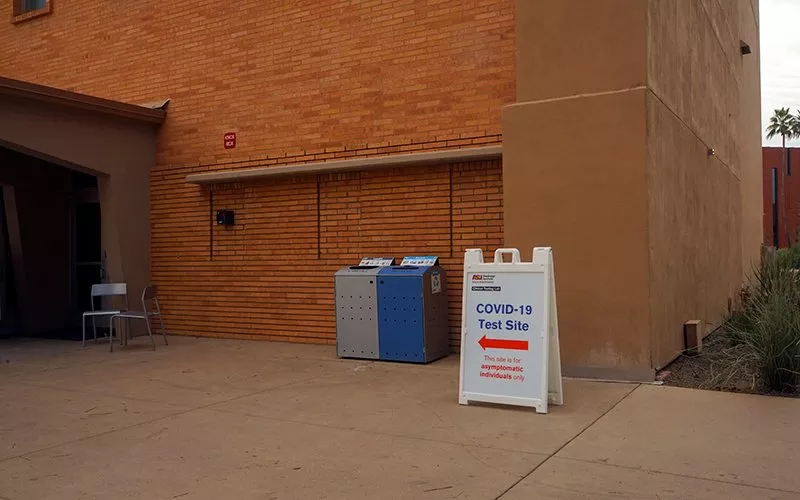
Pima County offers a number of testing centers around town.
You’ll have a nasal swab test at the Kino Event Center (2805 E. Ajo Way) the Udall Center (7200 E. Tanque Verde Road) and downtown (88 E. Broadway).
The center at the northside Ellie Towne Flowing Wells Community Center, 1660 W. Ruthrauff Road, involves a saliva test designed by ASU.
In addition, the Pima County Health Department, Pima Community College and Arizona State University have partnered to create new drive-thru COVID-19 testing sites at three Pima Community College locations. At the drive-thru sites, COVID-19 testing will be offered through spit samples instead of nasal canal swabs. Each site will conduct testing from 9 a.m. to noon, and registration is required in advance. Only patients 5 years or older can be tested.
Schedule an appointment at these or other pop-up sites at pima.gov/covid19testing.
The University of Arizona’s antibody testing has been opened to all Arizonans as the state attempts to get a handle on how many people have been exposed to COVID-19 but were asymptomatic or otherwise did not get a test while they were ill. To sign up for testing, visit https://covid19antibodytesting.arizona.edu/home.
—with additional reporting from Austin Counts, Jeff Gardner, Nicole Ludden and Mike Truelsen

Monday, February 8, 2021
PHOENIX – From the importance of personal protective equipment to dealing with the harsh isolation of quarantined patients, the medical community learned countless lessons during the first year of COVID-19, a pandemic unprecedented in modern times.
“Limiting it to one (lesson), it is how profound it is that social inequity kills people,” said Dr. Andrew Badley, infectious diseases specialist and head of the COVID-19 Research Task Force at Mayo Clinic in Rochester, Minn.
Badley was joined virtually by a panel of Mayo specialists, to reflect on the first year of the COVID-19 pandemic and the medical community and their hospitals’ response, sharing lessons they learned along the way.
Badley said disadvantaged populations are at risk because they work jobs deemed essential, which increases their potential for exposure to the coronavirus that causes COVID-19, and have less access to health care resources.
In Arizona, Mayo Clinic hospital medical director Dr. Alyssa Chapital said people who need care for ailments and conditions other than COVID-19 are not seeking treatment.
“Patients requiring hospitalization and, to some extent ICU, are dropping down,” the Phoenix-based physician said. “What we are seeing right now is delayed care that we have to address. We have a backlog of surgical procedures, and we are going to have to meet the need of that in hospitals, as well as the acute-care needs that will come along.”
The Arizona Department of Health Services reports more than 13,000 Arizonians have died since the first case was reported in the state in January 2020.
Friday, February 5, 2021
WASHINGTON – The Supreme Court postponed upcoming hearings on two Trump administration immigration policies after both had been reversed on the first day of President Joe Biden’s term.
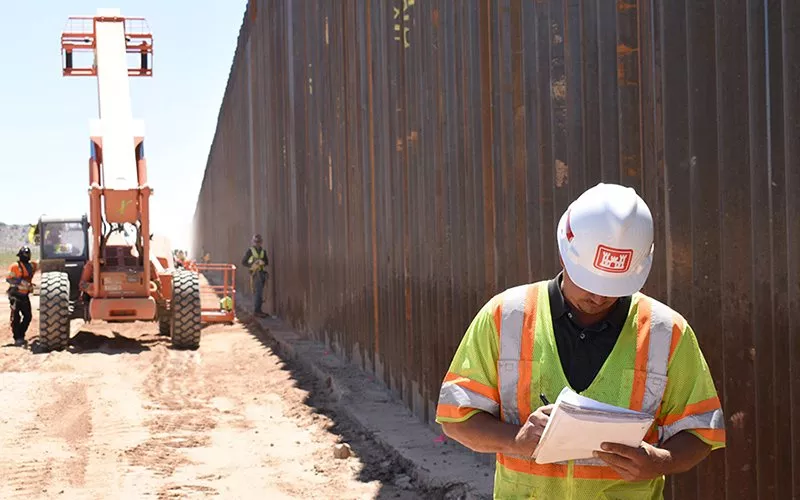
The court was scheduled to hear arguments in the coming weeks challenging then-President Donald Trump’s ability to divert Defense Department funds to border wall construction and on the administration’s Migration Protection Protocol. The so-called “remain in Mexico” policy required asylum seekers to wait in Mexico while their cases were processed in the U.S.
But Biden halted border wall construction on Inauguration Day, and his acting Homeland Security secretary stopped the MPP a day later.
That would have left government lawyers in the position of defending policies the president opposed, leading Acting U.S. Solicitor General Elizabeth Prelogar to ask the court Monday to take the cases off the calendar for now as moot. The court did so without comment.
In a tweet, the American Civil Liberties Union said it was a “good sign that the Biden administration doesn’t want to see us in court to defend these illegal policies.” It went on to call on the president to “rescind the forced return to Mexico policy, give those subjected to it a fair and safe asylum process, and tear down the wall.”
The remain-in-Mexico policy was enacted in January 2019, reversing previous Obama administration guidance that let migrants enter the country and begin living in the U.S. while they were seeking asylum.

