

Monday, January 25, 2021
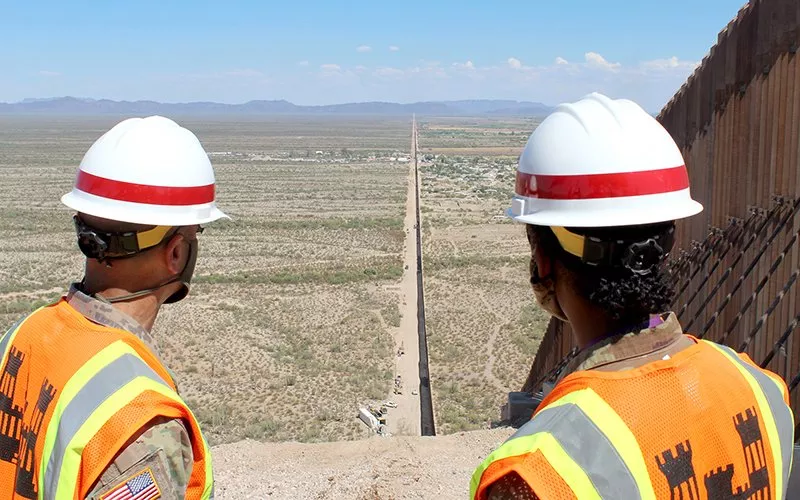
WASHINGTON – President Joe Biden made good on a campaign promise within hours of his swearing-in this week, ordering a pause in construction of the border wall and a plan for how to redirect wall funding.
Opponents of the wall called the executive order “a huge win.” But they also said it is not the end of the fight, noting that Biden’s order allows a week for construction to actually come to a halt and directs agencies to evaluate contractual and legal obligations for the wall.
“For the short-term, foreseeable amount of time, we’re just going to be in a status quo,” said Brett Hartl, government affairs director for the Center for Biological Diversity. “They won’t build anymore, they won’t necessarily take any down, and they’ll look at the problem seriously.”
Tricia Cortez, founding member of the #NoBorderWall coalition, called Biden’s move “a significant first step, but we also know that there is more work to be done.”
Friday, January 22, 2021
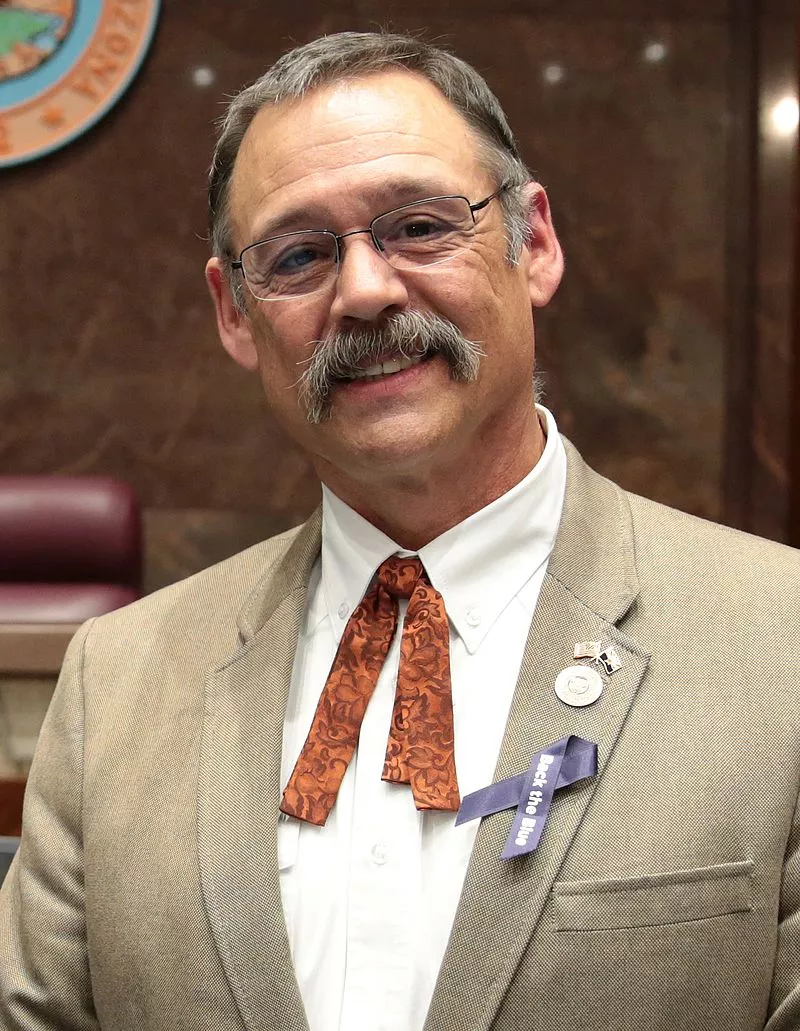
State lawmaker and weird-uncle-you-desperately-avoid-at-family-gatherings Mark Finchem has always been one of the nuttier lawmakers at the Capitol since his election to the Arizona House of Representatives in 2014, what with his bills to make gold legal tender, his links to far-right organizations like the Oath Keepers and the Coalition of Western States, and his peculiar fashion choices.
But Donald Trump’s loss in the presidential race last November has led the Oro Valley Republican to buy a first-class ticket on the crazy train. He led the day-long meeting at a hotel near the Capitol in December that featured Trump attorney Rudy Giuliani laying out numerous crazy theories that were unsuitable for actual courtrooms, including the notion that Biden’s win was illegitimate because Arizona is home to 5 million undocumented immigrants (which would mean 5 out of 7 Arizonans are undocumented, but OK).
Finchem, who was on hand for the Jan. 6 “Stop the Steal” rally in D.C., cheered on the storming of the U.S. Capitol. He tweeted a photo of the rampage with the comment: “What happens when the People feel they have been ignored, and Congress refuses to acknowledge rampant fraud.” Of course, it didn't take long for Finchem to blame Antifa for the disgraceful display of his fellow "patriots" during the D.C. rampage.
Finchem’s D.C. adventures have led to an ethics complaint at the House (which probably won’t go anywhere).
But you won’t read any more tweets from Finchem. As reported by the gang at Arizona Capitol Times, this week, in solidarity with the now-banned Trump, Finchem deleted his Twitter account after tweeting a promise to boycott Lowe’s after the Loew’s hotel chain canceled a fundraising event for Sen. Josh Hawley. “This is what Hitler and Stalin did, what next camps? Ovens?” Yes, we all know it’s a slippery slope from canceling an event reservation to the Holocaust.
Giving up his 55K or so followers, Finchem has moved over to the right-wing Twitter knock-off Gab, where his new handle is AZHoneyBadger, presumably because he considers the fierce creature a spirit totem or something. (In case you’re not familiar, a hysterical YouTube clip of a narrator goofing on honey badger footage with lines about how “honey badger doesn’t give a shit” went viral a few years back.)

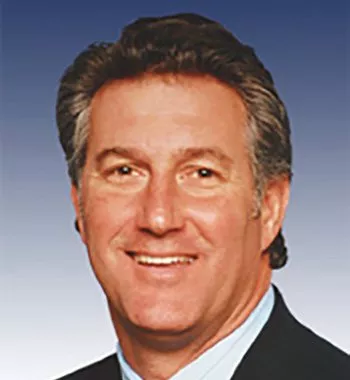
WASHINGTON – In one of his last acts as president, Donald Trump on Wednesday pardoned two Arizonans, including former Rep. Rick Renzi who was convicted of extortion, racketeering and other charges while representing the 1st District in Congress.
The pardons – including one for Scott Connor Crosby, a one-time bank robber who supporters say has turned his life around – were among 73 pardons and 70 sentence commutations Trump issued Wednesday morning.
Renzi’s pardon was called for by Rep. Paul Gosar, R-Prescott, and a slew of former House members who cited Renzi’s family and his service to constituents while in office in urging clemency.
Gosar did not respond to a request for comment on Renzi’s pardon Wednesday. But others criticized the flurry of pardons, which included former Trump associates, as “offensive, but not surprising.”

Thursday, January 21, 2021

As Arizona health officials scramble to speed up rollout of the life-saving COVID-19 vaccine, the deadly virus is still spreading rapidly. Over 12,500 Arizonans have died, and we are seeing more than 9,000 new infections daily. The outbreak in Arizona is the worst in the nation, with one in every 147 residents being infected as of 1/21/2021. The clock is ticking and the time for action is now.
Even under the best circumstances, it will take a year or more for a vaccine to be fully effective. In the meantime, we can save lives with aggressive public health measures. No arena is more important than Arizona workplaces, a dangerous source of COVID hotspots which then spread to our neighborhoods and communities.
We need enforceable emergency workplace standards and worker safety committees to monitor and implement worksite COVID protection plans. Workplaces can play a significant role in turning the economy around to create a safe environment for everyone. Unfortunately, many workplaces remain unsafe, endangering frontline workers and the public they serve.
Our government offices have been impacted by this disease: A top county health official, unemployment staffers and county employees have contracted COVID-19 in their workplaces. Healthcare workers and their support staff are stretched thin and exhausted, grocery, retail and postal workers are exposed to risk of infection on a daily basis. All of us rely on these workers, who don’t have the option to stay at home, and we all need to be involved in demanding that employers and the government do more to keep them safe.
If we want to flatten the curve of new virus cases, employers must take every step possible to implement safety controls to reduce contact with the public and co-workers. Companies like Amazon, with a deplorable record of putting workers in unsafe environments, must involve workers in safety plans, instead of fighting worker efforts to have a voice in the workplace. Every job can be protected, if management develops a plan with input from workers, who know their own jobs and can come up with solutions to reduce exposure.
Innovative approaches to reducing contact between workers and the public include remote working whenever possible, barriers for cashiers, staggering service hours, and reducing the number of shoppers to allow for social distancing. In-person work requires detailed planning and implementation of COVID protection programs. These controls have been adopted in some workplaces, frequently only because workers took the initiative to protest unsafe conditions.
Gov. Ducey recently chose to protect himself from the risk of infection by delivering his state of the state address from inside his own office, instead of in front of the legislature. But instead of protecting frontline workers who can’t work in isolation, his backwards response has focused on protecting business at the expense of workers and community health. This will not preserve jobs and actually makes it more difficult to rebound to a healthy business climate.
Fourteen states and local communities around the country have enacted new protections to assist both workers and employers in implementing COVID protection programs. The Arizona Department of Occupational Safety and Health [ADOSH] has the legal authority to enforce compliance if there is a new standard. We can’t wait any longer to take positive steps to make workplaces safe for everyone. Workers have been the engine driving our efforts to control the virus and deserve to be protected. Protecting them helps protect our communities.
Mr. Valencia is chair of Tucson Jobs with Justice. Mr. Dooley, a certified industrial hygienist (CIH), is safety and health senior project coordinator for the National Council of Occupational Safety and Health (National COSH). Shannon Foley is with IATSE Local Union 415
Arizona COSH is a new worker safety advocacy organization to promote safe jobs for all workers in Arizona. Visit nationalcosh.org for more information or contact [email protected]
WASHINGTON – President Joe Biden unveiled a sweeping immigration reform bill Wednesday that would create a pathway to citizenship for millions of undocumented immigrants, preserve DACA and end the ban on travel from Muslim-majority countries, among other changes.
The proposal, released on the first day of his presidency, is a sharp reversal from former President Donald Trump’s policies and was hailed by advocates for righting “the cruelty that was the cornerstone” of Trump’s immigration actions.
But other experts warned that while there are many good elements in the bill, it has little chance of passing the Senate without revisions.
“The big thing is the legalization of illegal immigrants, that’s a non-starter for a majority of Republicans,” said Alex Nowrasteh, director of immigration studies at the Cato Institute. In its current form, Nowrasteh, “has no chance of passing.”
Supporters would need to get 60 votes to overcome any likely filibuster attempts in the Senate, which is now evenly divided between Democrats and Republicans with Vice President Kamala Harris, a Democrat, holding the potential tie-breaking vote.

Wednesday, January 20, 2021
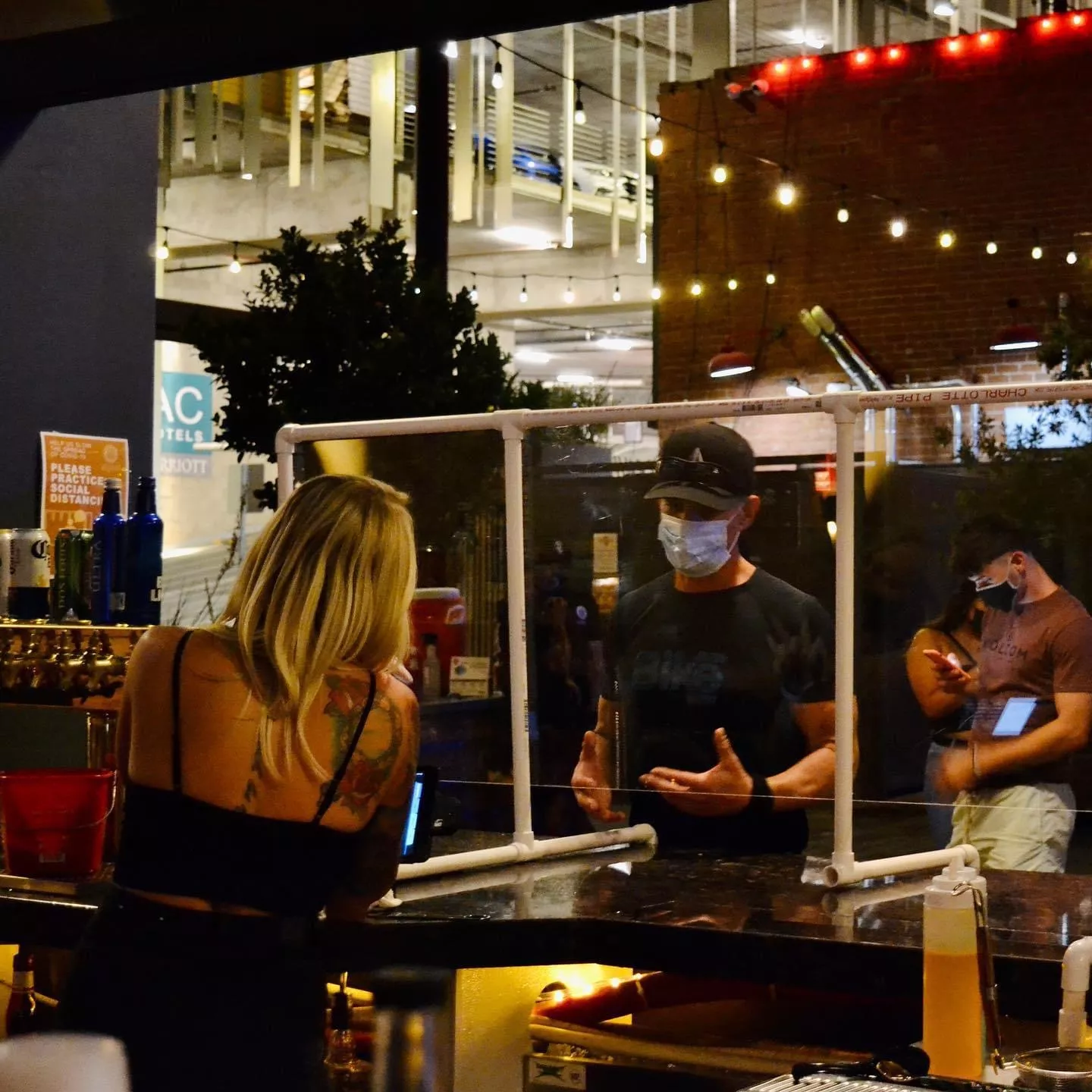
Pima County’s mandatory 10 p.m. to 5 a.m. curfew has been temporarily halted after a group of Tucson bars were granted a preliminary injunction barring the county from enforcing the curfew.
Owners of Cobra Arcade Bar, HighWire Lounge and The Maverick filed a joint lawsuit on Jan. 5 contending the county overextended their legal authority to mandate a curfew.
The owner of The Maverick, Grant Krueger, included other Tucson restaurants he owns in the lawsuit: Union Public House, Reforma Modern Mexican and Proof Artisanal Pizza & Pasta.
After considering the evidence at a Jan. 15 hearing, Pima County Superior Court Judge Kellie Johnson ordered Pima County to cease enforcing the curfew in a ruling filed Jan. 19.
“The Court finds the hardships imposed on the Plaintiffs by the curfew are severe. Additionally, the hardships are arguably unfair because the Court finds Plaintiffs can adhere to the ADHS required safety measures both before and after 10 p.m.,” Johnson wrote in the ruling, echoing the defendant’s arguments. “Moreover, the virus is spread just as easily late at night as it is during the day. Bar patrons can drink excessively during the day just as easily as they can at night.”
While the judge acknowledged the challenges Pima County has managing the COVID-19 pandemic, she held the parties’ legal arguments tipped in the restaurant owners’ favor.
“The County could not demonstrate in testimony or other evidence that more cases are contracted after 10 p.m. Nor has it demonstrated specifically that its current hardships are worsened by people and businesses engaging in conduct after 10 p.m.,” Johnson wrote of the county’s defense. “To the contrary, the burden the County faces in managing this pandemic will continue until the pandemic is under control. The County has simply failed to demonstrate how the curfew not being enforced would cause it additional hardship.”
Pima County County Chief Medical Officer Dr. Francisco Garcia said the 10 p.m. curfew was based on evidence gathered when the county sent 46 inspectors to observe nearly 400 establishments for compliance to the curfew and found 15% of them didn’t comply.
“We have to draw a line in the sand in terms of when you would ask a business like a bar or a restaurant to stop operating. That line in the sand needs to not be entirely arbitrary,” Garcia said. “We know that, based on the surveillance that our county inspection team did, that bars that were operating after 10 o'clock, that there was a substantial amount of non-compliance with the kinds of measures that we've recommended all along. So yes, 10 may seem like a rather odd and very specific time to select, but this is based on actually our observations of what people are doing in those kinds of establishments.”
Grant Krueger, a plaintiff in the case, said he plans to keep both The Maverick and Union Public House open until 2 a.m. beginning tonight.
“We feel that we've been doing it safely since before 10 p.m. and we can do it safely as well after 10 p.m.,” Krueger said. “We've made a lot of really, really good people really happy today by calling back all kinds of staff members who have had to have their hours reduced, limited or even completely eliminated.”
Chuckie Duff, a plaintiff and owner of Cobra Arcade Bar, said he plans on keeping the bar open until midnight tonight and returning to normal business hours of 4 p.m. to 2 a.m. this weekend.
“We're very happy with the ruling and we're glad that we can go back to our normal business hours and continue to follow the rules as we were before and keep everybody safe,” Duff said. “If we have more hours we can be open, it's definitely more hours for our existing employees and hopefully more employees that we'll be bringing back.”
Judge Johnson wrote she’s granting the injunction on the grounds that the curfew is not “statutorily authorized,” the plaintiffs demonstrated the harm it causes them and it violates Gov. Doug Ducey’s executive order.
The governor’s May 12 executive order states: “...no county, city or town may make or issue any order, rule or regulation that conflicts with or is in addition to the policy, directives or intent of this Executive Order, including but not limited to any order restricting persons from leaving their home due to the COVID-19 public health emergency.”

The Pima County Board of Supervisors authorized the county attorney to appeal the ruling, according to a press release.
“It is the County’s firm belief that state law empowers the Health Department to take specific actions such as the curfew to mitigate and halt the spread of infectious diseases,” the release said. “In the meantime, Pima County Chief Medical Officer Dr. Francisco Garcia urges all businesses to continue to voluntarily adhere to the curfew and limit gatherings.”
The curfew was originally set to end when the county reached a rate of 100 COVID-19 cases per 100,000 people. Its current rate is 8,856 cases per 100,000, according to state data.
The curfew will be halted until the resolution of the case. A trial date has yet to be set.
This post has been updated to include comments from bar owners and county officials.
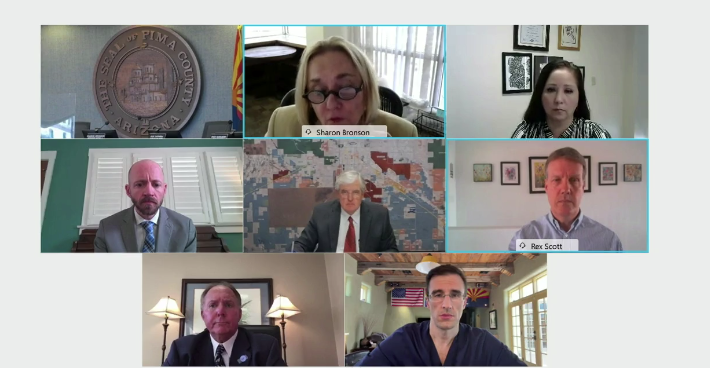
The Pima County Board of Supervisors voted 4-1 yesterday to renew County Administrator Chuck Huckelberry’s contract for another four years and reduce his salary.
With only District 4 Supervisor Steve Christy opposing, the board voted along party lines to extend Huckelberry’s contract to Jan. 7, 2025, and cut his yearly pay to $292,000.
The discussion of the new contract’s renewal was held in an hours-long executive session out of public view.
The county’s top administrator originally asked for a $13,000 raise to $315,000 per year, but the board instead cut his pay by $10,000.
Serving as county administrator since 1993, Huckelberry oversees more than 7,300 county employees and operates under the direction of the Pima County Board of Supervisors.
While the contract Huckelberry originally proposed held that any salary raises would be based on “adjustments that may be accorded Pima County employees generally,” any pay increases will now be based on an evaluation process to be determined by the board.
If the county administrator is terminated without cause, severance pay will now be three months salary instead of six months.

