

Wednesday, December 16, 2020
Tuesday, December 15, 2020
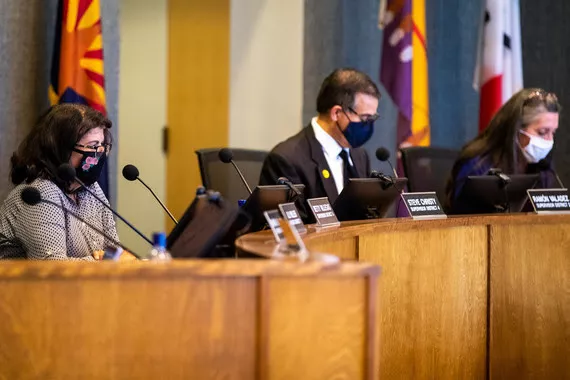
The Pima County Board of Supervisors voted 3-2 to instate a mandatory 10 p.m. to 5 a.m. curfew throughout the county in an attempt to combat Southern Arizona's rising number of coronavirus cases.
Supervisor Steve Christy and outgoing Supervisor Ally Miller, who attended her last board meeting today, voted against the proposal.
Penalties for a nonessential business found violating curfew range from having their business permit suspended or revoked.
The mandatory curfew will stay in place until coronavirus infection rates drop below 100 per 100,000 people, according to county officials.
The transmission rate in Pima County was 357 people per 100,000 people in the two-week period ending Nov. 29, but Pima County Health Department Director Dr. Theresa Cullen expects that number to be significantly higher for the period ending Dec. 13.
The mandatory curfew comes as in December alone, COVID-19 cases in the county have reached 13,589—2,554 more cases than reported in all of November. Last week saw 70 coronavirus deaths, according to a memorandum from County Administrator Chuck Huckelberry.
According to the memo, county personnel observed facilities for compliance to safety mitigations, including the previously voluntary curfew, on Dec. 11 and 12.
Of the nearly 400 locations observed, 15% were "seriously noncompliant," the memo says.
While businesses will now face losing their operating permits if they don't comply with the curfew, it "carries no penalty associated with the individual, as it would be difficult to enforce a curfew against individuals without the cooperation of law enforcement," Huckelberry writes in the memo.
Exceptions include:
Emergency response personnel
Traveling to and from work
Attending religious services
Caring for a family member
Seeking medical care
Fleeing dangerous circumstances
Traveling to perform or receive essential functions
This article has been updated with contributions from Nicole Ludden.
Ajo, Arizona, is an unincorporated community 110 miles south of Phoenix. It borders the Tohono O’odham Indian Nation, serving as a hub for supplies for some of the 7,500 people who live on the reservation. The Ajo Center for Sustainable Agriculture is a nonprofit working in agricultural education, culturally appropriate food and economic development. When the coronavirus pandemic hit Ajo, the shelves of its one grocery story were cleaned out. The organization’s all Native American board stepped up to feed its community.
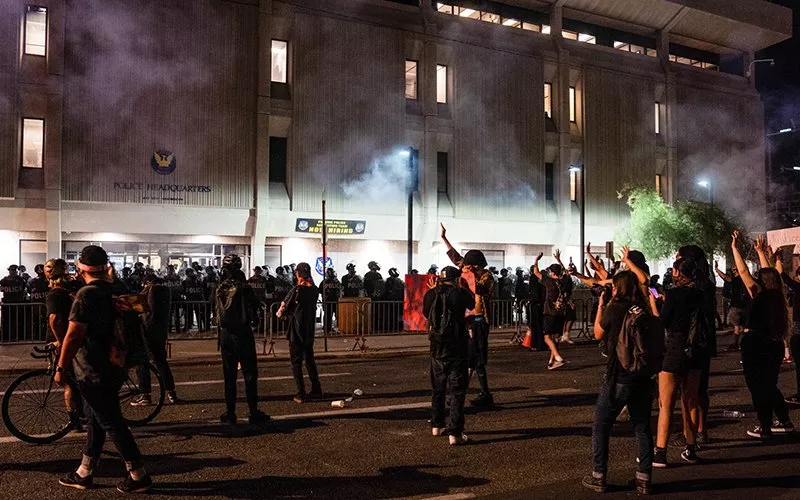
PHOENIX – Three nights after George Floyd suffocated when a white police officer in Minneapolis knelt on his neck for nearly nine minutes, Black Lives Matter supporters rallied in downtown Phoenix. From 7 p.m. to 2 a.m., hundreds of people were on the streets chanting, “What’s his name? George Floyd!” and “Hands up, don’t shoot!” Many held signs that read “Black Lives Matter” and “Silence is violence.”
Tensions rose that night, May 28, between protesters and the Phoenix Police Department, whose use of force made it the deadliest in the country in 2018, according to an analysis by the National Police Foundation.
Ashley Cuber, 25, a law student at Arizona State University, was there in a show of solidarity. About 11:30 p.m., after police declared the protest an illegal gathering, she said, she saw a police officer’s rubber bullet hit the skull of a teenage girl.
Cuber, a short woman who normally wears a black T-shirt with the words Desert Action Medical Network and a baseball cap with a red cross duct-taped in the front, immediately put to use the EMT license she earned while living in Alaska, where she trained in wilderness first aid because help might not arrive in time if she were injured. As she and the wounded teenager ran from police wearing riot gear, Cuber tossed the teenager an ice pack and told her to go to the emergency room immediately. She suspected the girl’s skull was fractured.
“That’s all I could do. That’s probably the worst injury I’ve seen all summer,” said Cuber, adding that she didn’t see any street medics in the crowd of hundreds to treat protesters.
Monday, December 14, 2020
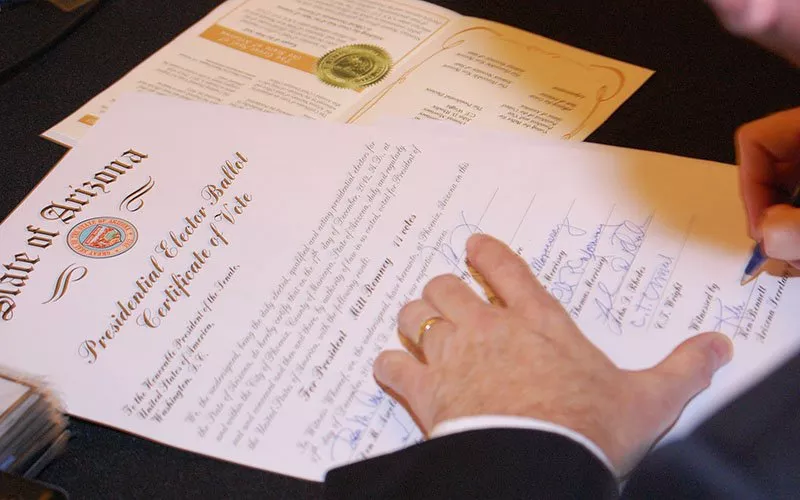
WASHINGTON – Add one more thing to the list of normal activities that have been upended in 2020 – the job of the state’s presidential electors.
What is normally a mundane and largely ceremonial task, often handed out as a reward for loyal party service, has been thrust into the spotlight this year by ongoing Republican challenges seeking to upend the election of President-elect Joe Biden.
“This is a very unusual election cycle in that the Electoral College members have never been challenged like this before,” said Felecia Rotellini, the chair of the Arizona Democratic Party and one of 11 electors scheduled to meet Monday in Phoenix and cast the state’s votes for Biden.
Despite those challenges – the latest of which were rejected by the Arizona Supreme Court and a U.S. District Court in separate rulings last week – Rotellini said she is “confident that our electors will be able to vote on Dec. 14.”
“The process is sound, the selection process is sound. And I believe that we will move forward,” she said. “I have every confidence in our government’s systems of election and so far it is moving smoothly.”
Smooth is how the process works in most years with presidential electors.
When voters cast a ballot for president, they are actually voting for the slate of presidential electors who pledge to vote for that candidate in the Electoral College. Each state gets one Electoral College vote for each of its U.S. senators and House members, and the District of Columbia gets three, for a total of 538 votes – the candidate who gets 270 or more of those votes becomes the next president.
Electors across the country will meet Monday in their state capitals to cast separate votes for president and vice president, which have to be delivered to the Senate by Dec. 23. The next Congress will meet in joint session on Jan. 6 to count the ballots and the winner will be inaugurated on Jan. 20.
Typically, the only excitement is whether an elector will go rogue and not vote for the party’s candidate – an issue that flared up in 2016, when a handful of so-called “faithless electors” for both President Donald Trump and Democratic nominee Hillary Clinton voted for someone else.
Friday, December 11, 2020
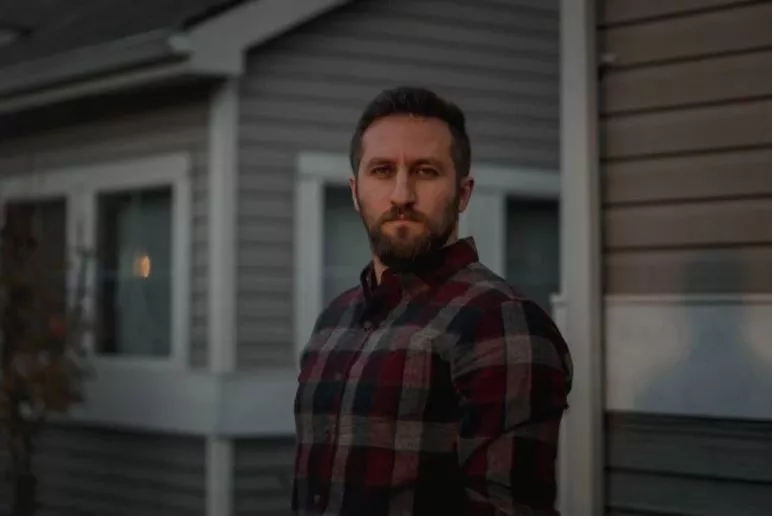
State unemployment agencies have been demanding recipients repay thousands of dollars, even if the agency made the mistake and the money’s already been spent. After ProPublica investigated the practice, legislators are trying to end it.
Rep. Jaime Herrera Beutler, R-Wash. and Rep. Stephanie Murphy, D-Fla., have introduced a bill that would shield unemployed workers from having to return federal pandemic unemployment assistance benefits when agencies have mistakenly paid them these funds. The legislation, submitted on Dec. 2, came in the wake of an article by ProPublica in October that exposed the debts and anguish faced by workers who have been overpaid by state unemployment agencies (which administer both state and federal payments), sometimes as a result of the state’s mistakes. The agencies, the article showed, have variously garnished paychecks or taxed refunds to obtain repayment, while others charged interest on the debt.“I’m grateful to ProPublica for investigating the fallout of poorly managed unemployment benefit programs,” Herrera Beutler said. “I realize state unemployment agencies have been given a tall task, but that’s no excuse for the level of incompetence and unresponsiveness they’ve demonstrated in delivering congressionally approved unemployment benefits.”
As ProPublica reported, states are allowed to grant hardship waivers to individuals who mistakenly receive an overpayment of state unemployment benefits. But the law is different when it comes to benefits paid by the federal government. The Pandemic Unemployment Assistance program, created by the CARES Act in March, bans debt forgiveness. This means that millions of American workers who are self-employed or hold nontraditional work schedules — categories that were not eligible for unemployment benefits until the PUA was established — can be held liable for a mistake made by an unemployment agency.
HR 8812, the Relief for Working Families Act, would change that, allowing states to extend waivers to PUA overpayments in cases where the individual receiving the jobless benefits is not at fault and such repayment would create further financial hardship.
The legislation would ease the plight of people like Ahmad Ghabboun, who was the focus of ProPublica’s article. Ghabboun was a freelance driver for Amazon Flex and Uber in Washington state, and he lost work during the pandemic. He was deemed eligible for aid under PUA and the CARES Act but was told, months later, to repay the state’s Employment Security Department $14,990 after accidentally stating that he could work from home — as a driver, he clearly could not — in one of his weekly online applications for benefits.

