Friday, December 11, 2020
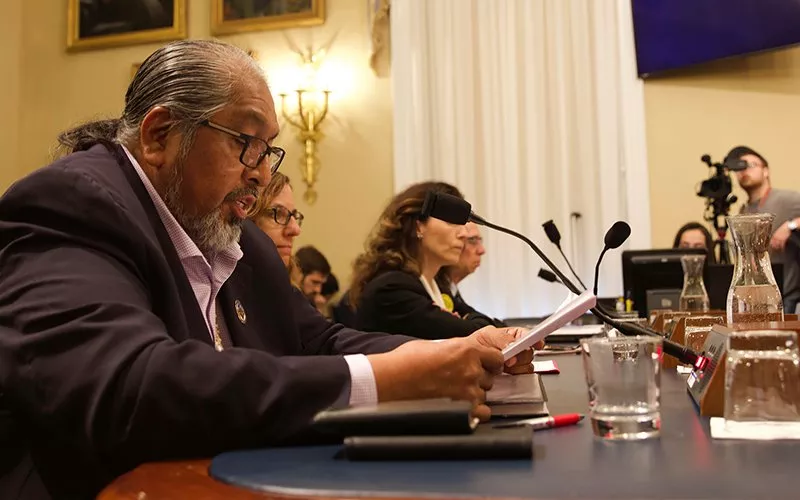
WASHINGTON – In what a former Arizona elector called “a sweet irony,” the slate of 11 Democratic presidential electors who will cast Arizona’s Electoral College votes Monday includes three tribal leaders.
Gila River Indian Community Gov. Stephen Roe Lewis, Navajo Nation President Jonathan Nez and Tohono O’odham Nation Chairman Ned Norris Jr. will join eight other Democrats to cast the state’s votes for President-elect Joe Biden and Vice President-elect Kamala Harris.
While it may have been a sweet irony, however, it was no accident.
Arizona Democratic Party Chair Felecia Rotellini said she wanted to choose electors who would “represent the diversity of Arizona, and the diversity of Arizona voters, as well as Arizona Democratic voters.” That included the three tribal leaders with “deep roots to our state.”
“The three leaders of the tribes that we selected are also great partners with the Arizona Democratic Party in terms of helping us to promote candidates that reflect the values that we all believe in – the values that were on the ballot in this election,” Rotellini said. “Without their leadership, we wouldn’t be where we are today.”
Norris did not respond to requests for comment and Lewis declined. But Nez called being chosen an elector is “a big honor.”
“I’m overjoyed and happy to cast the Navajo electorate vote for Joe Biden and Kamala Harris,” he said.
Thursday, December 10, 2020
WASHINGTON – Rep. Debbie Lesko, R-Peoria, said it can be hard to be socially distant when a large part of your job requires being social.
From interacting with constituents to boarding planes between D.C. and Arizona to voting on the House floor, Lesko said it’s challenging for members of Congress to limit possible exposure to the coronavirus.
“My job is one where I have to meet with people, where I have to go out in public,” Lesko said in a virtual interview. “They’re usually right in my face, so I can’t really control if people are going to wear masks or not.”
So Lesko home-quarantined in November after she was exposed to someone who later tested positive for COVID-19, even though she did not display any symptoms of the virus. And she is not alone.
Four of Arizona’s nine House members have quarantined since the start of the outbreak, either because they were exposed or because they tested positive themselves. Except for states with just one House member, Arizona has the highest percentage of delegation members who have quarantined.
Overall, at least 71 House members have quarantined because they tested positive for COVID-19 or may have been exposed to the virus, according to GovTrack.us. That’s about one House member in six.

Wednesday, December 9, 2020
PHOENIX – Arizona has some of the least restrictive gun laws in the U.S., one of three countries that consider gun ownership a constitutional right.
Consider this data: Americans own more than 390 million guns – with 120.5 civilian firearms per 100 people, according to a study by the World Population Review.
In February, Arizona ranked seventh for the number of registered guns per state, at 204,000, according to a telephone survey conducted by CBS News and ranked by ThoughtCo. That number is far from complete, however, because Arizona is one of 44 states that do not require registration of firearms.
During the contentious 2020 election, armed protesters outside Maricopa County’s tabulating center put a spotlight on Arizona’s open carry practice, which allows those 18 or older to openly carry firearms in most places.
A prohibited possessor is an exception to the law, defined as someone who is a convicted felon and has not had their rights to own a firearm restored, an undocumented immigrant, anyone who is detained in a correctional or detention facility, has been found to be a danger to themselves or others, or serving probation for a domestic violence felony or felony offense.
Residents can’t openly carry guns into certain places. They cannot be brought within 1,000 feet of K-12 school campuses, Native American reservations, businesses that serve alcohol or polling locations on Election Day, in addition to several other restrictions that can be found here.
A gun permit allows owners to carry a concealed firearm into a business that serves alcohol if there is not a sign prohibiting them and they don’t drink alcohol, according to Arizona Concealed Carry.
Restrictions have been implemented on how a gun can be transported in a car. For residents under 21, it is illegal to carry a concealed firearm within the immediate control of anyone in the vehicle. Firearms must be transported in a case, holster, storage compartment, trunk or glove compartment. If the gun is in a holster, then it can be concealed anywhere in the car.
“Arizona is considerably more permissive than most states when it comes to concealed carry,” said Adam Winkler, a professor at the UCLA School of Law and an expert on gun rights and civil liberties.
Residents who are at least 21 can legally own or purchase a firearm, can carry a gun loaded and concealed without any type of permit in their vehicle and around the state, according to Arizona’s concealed carry law. The measure, which was established in July 2010, also eliminated the need for a permit for those 21 or older to carry a concealed firearm.
That means residents do not have to go through a background check if they buy the weapon from a private seller and do not have to take a firearms training course, according to the organization Arizona Concealed Carry. But a gun permit may be needed for people who want to conceal their weapon on their person. Without a permit, owners can’t conceal and carry in any other states. Arizona has a reciprocity agreement with 37 states that allows concealed firearms with an Arizona permit. The states vary depending on if you are an Arizona resident or not.
Arizona’s history of ‘open carry’ and ‘concealed carry’ gun laws are intertwined.
When Arizona was still a territory, some cities had stricter gun laws than those now in place. “A place like Tombstone, back in the 1880s, prohibited open carry of firearms,” Winkler said.
During that time, travelers had to leave their guns with local law enforcement or the Grand Hotel, and could only retrieve it when they were leaving town, according to an article by attorneys Mesch Clark Rothschild.
By 1994, Arizona passed its first law allowing state-permitted gun owners to carry concealed weapons, according to the same article. In 2009, the state Legislature allowed Arizona residents to carry concealed weapons into bars and restaurants that serve alcohol.
Gun ownership tends to happen earlier for people who grew up with guns.
A 2017 study by Pew Research Center found that 67% of gun owners grew up with guns in their households and 76% first fired a gun before they were 18.
The study shows owners who grew up with firearms received their first gun at age 20 on average, while those who did not got their first guns at age 26.
Gun ownership varies based on demographics. Men are more likely to own a gun than women, with ownership rates at about 40% and 22% respectively, according to the Pew study. Nearly 40% of Caucasians reported owning a gun, while about 25% of African Americans and 15% of Hispanics owned a gun.
Tuesday, December 8, 2020

WASHINGTON – The Trump administration said Monday it will abide by court order – for now – to start accepting new Deferred Action for Childhood Arrivals applications, a move that could affect an estimated 682,000 undocumented immigrants.
The Department of Homeland Security is already looking to appeal the Friday court ruling, but advocates for immigrants were celebrating the decision that they called critical to the lives of DACA recipients, including thousands in Arizona.
“A lot of young people are going to be able to get deferred action so they won’t be eligible for deportation if they follow the rules, they’re going to get work permits and the ability to work and contribute to their household,” said Jose Patiño, a DACA recipient and education director at Aliento, an immigrant advocacy group in Phoenix.
The decision could affect 1.3 million people in the U.S., according to the Migration Policy Institute, which said about 682,000 have yet to apply for DACA protection. In Arizona, the ruling has the potential to almost double the number of DACA recipients, from the current 24,140 to an estimated 47,000 in the state who could be eligible.
The Obama-era policy defers deportation for immigrants who were brought to this country illegally as children and have known no other home, allowing them to get driver’s licenses, work permits and Social Security numbers. It lets them “feel like they’re part of the country,” Patiño said Monday.
Then-candidate Donald Trump targeted the program, which was enacted as a policy change and not by law, as presidential overreach and promised to do away with it if elected. On Sept. 5, 2017, then-Attorney General Jeff Session did just that, announcing plans to “wind down” DACA over a six-month period, during which the administration invited Congress to enact DACA as law.
Congress did not, but the proposal to end DACA was challenged almost immediately in court. It ultimately landed in the Supreme Court, which ruled that the administration had not followed the proper procedures to rescind the program.
Monday, December 7, 2020