Monday, November 30, 2020
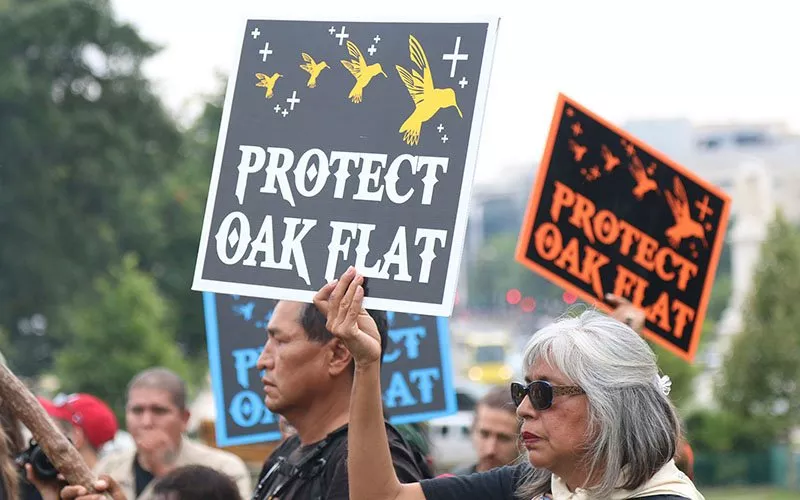
WASHINGTON – Activists worry that the Trump administration has fast-tracked the final environmental impact statement for the massive Resolution Copper mine, a project planned for lands near Superior that are claimed as sacred by the San Carlos Apache.
Opponents became alarmed when the U.S. Forest Service’s schedules of proposed action, which said the environmental statement would be completed by December 2021, suddenly shifted this year to a finishing date of this December, before President Donald Trump leaves office.
“A lot of alarm bells went off when we saw this,” said Randy Serraglio, Southwest conservation advocate at the Center For Biological Diversity. “We realized … they’re just rushing this through to get it done, while Donald Trump is still president.”
But officials with the Forest Service and Resolution Copper mine insist nothing is being fast-tracked.
Ivan Knudsen, a Forest Service spokesman, said more than “30,000 submittals received during the public and tribal comment periods” were cataloged since the last draft of the environmental impact statement was published in August 2019. He stressed that the timeline adjustment from 2021 to 2020 does “not reflect an acceleration of the … process” and that federal and local appraisals are being conducted.
“Once completed, they will be reviewed by the regional appraiser, and after they are accepted, made available to the public for review,” said Knudsen.
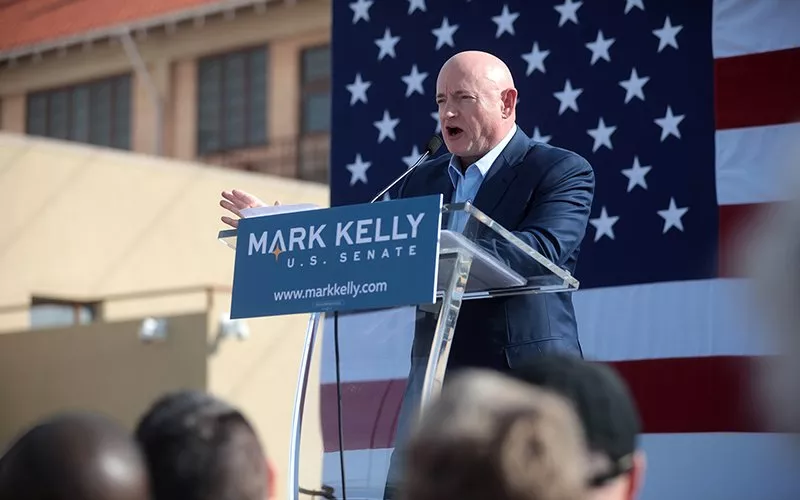
WASHINGTON – He won’t be Arizona’s next U.S. senator for another couple of days, but Sen.-elect Mark Kelly is already acting the part.
Just days after Election Day, the Democrat was on Capitol Hill for new member orientation and conversations with sitting senators from both sides of the aisle, including Republicans Mitt Romney of Utah, Marco Rubio of Florida and Pat Toomey of Pennsylvania, his aides said.
He met with Gov. Doug Ducey, unveiled a 13-member transition team and hosted a public briefing about the impact of COVID-19 on Arizonans and the local economy.
But there’s not a lot of time to waste: Because of unusual circumstances of the Senate election in Arizona this year, Kelly could be sworn a full month before the rest of the Senate.
“It’s probably like falling out of the stars and into a place on planet Earth … It’s very fast,” said Bradford Fitch, president and CEO of the Congressional Management Foundation, about Kelly’s quick transition into the Senate seat.
On Monday, Ducey and Secretary of State Katie Hobbs are required to certify the results of the Nov. 3 election, which gave Kelly a 51.2-48.8% margin over Sen. Martha McSally, R-Arizona. More than 3.3 million votes were cast in the election, which capped the most-expensive Senate race in state history.
Kelly and McSally were facing off in a special election to fill the remainder of late Sen. John McCain’s term, which McSally was appointed to fill temporarily in 2018. Because it’s a special election, Kelly can be sworn as soon as election results are certified.
McSally smoothed the way two weeks ago when she conceded to Kelly, and in her farewell address to the Senate last week when she wished him well.
Friday, November 27, 2020

Six days after President Donald Trump lost his bid for reelection, the U.S. Department of Agriculture notified food safety groups that it was proposing a regulatory change to speed up chicken factory processing lines, a change that would allow companies to sell more birds. An earlier USDA effort had broken down on concerns that it could lead to more worker injuries and make it harder to stop germs like salmonella.
Ordinarily, a change like this would take about two years to go through the cumbersome legal process of making new federal regulations. But the timing has alarmed food and worker safety advocates, who suspect the Trump administration wants to rush through this rule in its waning days.
Even as Trump and his allies officially refuse to concede the Nov. 3 election, the White House and federal agencies are hurrying to finish dozens of regulatory changes before Joe Biden is inaugurated on Jan. 20. The rules range from long-simmering administration priorities to last-minute scrambles and affect everything from creature comforts like showerheads and clothes washers to life-or-death issues like federal executions and international refugees. They impact everyone from the most powerful, such as oil drillers, drugmakers and tech startups, to the most vulnerable, such as families on food stamps, transgender people in homeless shelters, migrant workers and endangered species. ProPublica is tracking those regulations as they move through the rule-making process.
Every administration does some version of last-minute rule-making, known as midnight regulations, especially with a change in parties. It’s too soon to say how the Trump administration’s tally will stack up against predecessors. But these final weeks are solidifying conservative policy objectives that will make it harder for the Biden administration to advance its own agenda, according to people who track rules developed by federal agencies.
“The bottom line is the Trump administration is trying to get things published in the Federal Register, leaving the next administration to sort out the mess,” said Matthew Kent, who tracks regulatory policy for left-leaning advocacy group Public Citizen. “There are some real roadblocks to Biden being able to wave a magic wand on these.”
In some instances, the Trump administration is using shortcuts to get more rules across the finish line, such as taking less time to accept and review public feedback. It’s a risky move. On the one hand, officials want to finalize rules so that the next administration won’t be able to change them without going through the process all over again. On the other, slapdash rules may contain errors, making them more vulnerable to getting struck down in court.
The Trump administration is on pace to finalize 36 major rules in its final three months, similar to the 35 to 40 notched by the previous four presidents, according to Daniel Perez, a policy analyst at the George Washington University Regulatory Studies Center. In 2017, Republican lawmakers struck down more than a dozen Obama-era rules using a fast-track mechanism called the Congressional Review Act. That weapon may be less available for Democrats to overturn Trump’s midnight regulations if Republicans keep control of the Senate, which will be determined by two Georgia runoffs. Still, a few GOP defections could be enough to kill a rule with a simple majority.
Thursday, November 26, 2020
Wednesday, November 25, 2020
Tuesday, November 24, 2020

WASHINGTON – All 15 Arizona counties had submitted official election results by Monday to the secretary of state, who will certify them in the next week or sooner – ending a contentious weeks-long battle over a normally routine process.
That included GOP lawsuits challenging the election, angry rallies outside the Maricopa County Ballot Tabulation Center and even death threats against Secretary of State Katie Hobbs.
But the last of the lawsuits was dismissed Friday and while the Trump campaign is still pressuring other battleground states, Arizona appears to be out of the crosshairs.
Tom Collins, executive director of the Arizona Citizens Clean Elections Commission, said that fighting over the canvass is “a new development” for what is typically only a formality.
“This step in the process is not a partisan political activity, it’s really been more seen as ratification that the processes have been followed and that these are the official results,” Collins said Monday.
If certified, the results will show Democrat Joe Biden with a narrow 10,457 lead over President Donald Trump, out of almost 3.89 million votes cast. That would award Arizona’s 11 Electoral College votes to Biden, who was declared president-elect weeks ago.
The results would also confirm Democrat Mark Kelly’s 78,806-vote lead over Sen. Martha McSally, R-Arizona, out of 3.35 million cast. Because he would be filling the seat of the late Sen. John McCain, which McSally has held for the last two years, Kelly could be sworn in as soon as the votes are certified.

Monday, November 23, 2020