

Friday, November 6, 2020
Thursday, November 5, 2020
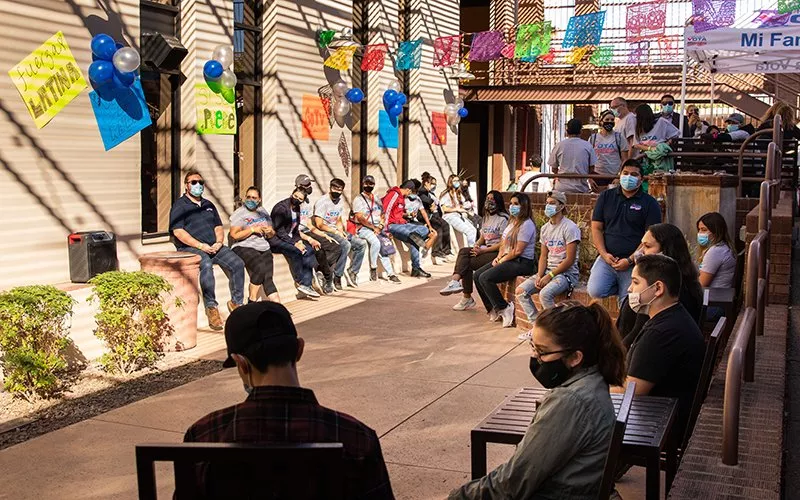
PHOENIX – Latino voters fueled by the Trump administration’s failures to curb COVID-19 and the lingering impact of the anti-immigration law known as SB 1070 helped turn Arizona blue after decades of entrenched Republican rule, according to organizers who have spent years working toward this moment.
“This feels like a victory lap,” said Eduardo Sainz, director of Mi Familia Vota in Arizona. He spoke hours before Wednesday’s early returns indicated that Democrat Joe Biden had likely won Arizona. Democrats celebrated a second Senate seat, and they should hold a majority of the state’s congressional seats, according to unofficial early returns.
Attention in the 2020 election cycle was riveted on Latino voters, who now make up the largest minority ethnic voting bloc in the country. In Arizona, nearly 1 out of 4 eligible voters are Latino, according to the Pew Research Center.
The Biden campaign hoped to capture 70% of those voters in its bid to flip a state that hasn’t voted for a Democratic presidential candidate since Bill Clinton in 1996. According to an early poll by American Election Eve, Biden reached that number.
Sainz, 27, said the victory in Arizona is a long time coming.
“This feels like looking at all of the hard work we’ve been able to do over the past 15 years, looking at real change, looking at real power, looking at our communities holding the keys to the White House,” he said.
Still, activists and other experts caution against the mistaken assumption that Latinos are a huge, unified group that leans to the left politically.
“What we have seen time and again is that our communities are treated as a monolith. And there’s so many cultural nuances, racial differences, ethnic differences,” said Alejandra Gomez, co-executive director of the advocacy group LUCHA.
Martha Figueroa, 46, exemplifies those nuances.
When she voted Tuesday in Laveen, a neighborhood in the southwest corner of Phoenix, she recalled a trope that President Donald Trump famously wields – and then voted for him in spite of it.
“Latinos, we are not rapists and we are not criminals,” said Figueroa, who this year changed her voting registration from Democrat to Republican.
“We need to make a better America and Biden is not the one to lead us. Whoever is here from another country, let’s get them papers, and whoever wants to come needs to come legally. We need to know who is here.”
In Florida, about 55% of the Cuban Latino voting bloc voted to reelect Trump, according to NBC News’ exit polls.
Trump and Biden came to Arizona, a state that shares a border with Mexico, intent on courting Latino voters, but it was Biden who triumphed.
In Nevada, where Latino voters make up 20% of the electorate, the presidential race remains too close to call, but their role is crucial. In 2016, Hillary Clinton won Nevada by just 2 percentage points.
Hector Sanchez Barba, chief executive of Mi Familia Vota, called it irresponsible to assume that Latinos vote as one bloc that shows up at the polls.
“This is the first question the media asks me: ‘When is the sleeping giant going to wake up?’” Sanchez Barba said. “Which is extremely denigrating and lacks the basic understanding of how to work in our democracy – that a democracy that is extremely imperfect – and doesn’t really understand how hard it is for a community to participate in the process.”
In Arizona and other parts of the country, some observers said, COVID-19 – which has disproportionately affected people of color – bent the Latino vote toward Biden.
Polling from American Election Eve and phone banking by Mi Familia Vota suggest the ongoing pandemic was the most important election issue for Latinos. The Centers for Disease Control and Prevention said Latino communities in Arizona were some of the hardest-hit by COVID-19.
But the foundation for the 2020 election flip was likely SB 1070, a decade-old Arizona law that upended immigration policies and drew international attention as one of the toughest anti-immigration laws in the country.
As a teenager, Sainz was galvanized by SB 1070, known as the “Show me your papers” law, which gave law enforcement the legal right to stop people they suspected of being in the country illegally and, as the ACLU and others charged, led to rampant racial profiling. Though the law is still on the books, it has been stripped of some of its controversial parts.
During that time, activists also launched a campaign to oust Maricopa County Sheriff Joe Arpaio, who, in 24 years in office, targeted undocumented immigrants and created what he called his own “concentration camp” to house them.
“I literally was able to see how people were so terrorized, that they packed everything that they own into vehicles and travel back to Mexico or to other states, et cetera,” Sainz said. “And looking at their fear … was something that I knew, I didn’t want communities and other individuals to go through.”
Gomez of LUCHA also was involved in the protests against Arpaio. She said she found herself at a vigil at the Arizona Capitol with just seven people in 2010. But it eventually drew thousands and lasted 103 days.
Yara Marin, 24, is the political director for Mi Familia Vota. Before she was able to vote, she was canvassing and phone banking during the fight against SB 1070. She continues that tradition of activism in Mi Familia Vota’s office.
This time around, the presidential election was just as crucial.
“Everything was on the ballot,” Marin said. “The people you vote for are going to decide whether or not you have access to high quality, affordable health care, whether or not our teachers and our students get good textbooks and good education, small classes. There is so much on the ballot that’s really going to define rights for everyone.”
To make that happen, advocates said they had to fight attempts at voter suppression and intimidation. Mi Familia Vota and advocates nationwide noted a series of robocalls targeting Latinos nationwide, with messages in both English and Spanish claiming that the polls would be open the day after the election, or declaring that a candidate had already won.
That is where groups like LUCHA and Mi Familia Vota step in, Gomez said.
“Communities at the margins are left with the challenges of voter suppression, the challenges of misinformation, and also accessibility for our communities while juggling the pandemic, job loss, childcare, homeschooling,” she said. “Our communities are trying to figure out how to survive, let alone how to find their polling location.”
The final push to get out the vote came Tuesday, Election Day. Many of the people working the get-out-the-vote phone bank were teenagers. Kevin Rosas, 16, said he got involved because he had a lot of family members working with Mi Familia Vota. Felix Cordova, also 16, said he took the job for pay but quickly realized the value of the impact he could make.
According to Marin, Mi Familia Vota registered nearly 15,000 new voters this cycle, and then an additional 35,000 after a lawsuit to extend Arizona’s voter registration deadline. The group made more than 27,000 phone calls. LUCHA said its volunteers knocked on 54,000 doors and made more than 8 million phone calls.
That level of investment, Sanchez Barba said, is what the political parties increasingly targeting Latino voters have been missing. Mi Familia Vota operates in six states, but the chief executive chose to spend the final hours of Election Day in Arizona.
“Looking at political power, and not the transactional one that historically we have seen in the Latino community, politicians come in and out to us last minute to do the work, just for turnout for that particular election,” he said. “But Arizona is showing that we can do it better.”
Still, advocates said, there’s more work to do. Sainz and Marin pointed out health care and education as key issues they’re pushing to reform.
“We continue to organize,” Sainz said. “We’re never going to stop.”
Cronkite News reporter Anthony J. Wallace contributed to this article.

WASHINGTON – Voter intimidation, Russian hacking, stolen ballots and, now, Sharpies.
The popular marker has been cited in social media claims as part of a clever strategy to invalidate ballots by using Sharpies, because their ink reportedly cannot be detected by ballot-scanning machines. That claim has since been picked up by at least two Arizona elected officials calling for answers.
But Arizona Secretary of State Katie Hobbs has a ready answer: It just ain’t so. The pens are used because their ink dries quickly, she said, and any ballot marked with one will be counted.
“IMPORTANT: If you voted a regular ballot in-person, your ballot will be counted, no matter what kind of pen you used (even a Sharpie)!” Hobbs said in a tweet Wednesday.
She was responding to a video that began circulating election night on Facebook. The video – since flagged by Facebook as “false information” – shows a woman describing how Maricopa County poll workers gave voters Sharpies to fill in their ballots, which she claimed tabulation machines were subsequently not able to read.
“Sharpie-gate” began to spread on social media, with people who said they voted in-person and later checked their vote status, had it come in as “canceled.” They blamed the pens.
Arizona election officials quickly began to challenge the claims that Sharpies would invalidate a ballot. Megan Gilbertson, communications officer for Maricopa County Elections Department, said there’s a simple reason Sharpies are used.
“We use Sharpies on Election Day because it is the fastest-drying ink,” Gilbertson said, “As the voter is marking the ballot, we need to make sure that when they put it through that precinct-based tabulator that the ink does not smudge.”
But the social media claims still caught the attention of Arizona’s Attorney General Office.
“We have received hundreds of voter complaints regarding the use of Sharpie brand markers to fill out ballots on Election Day at voting centers in Maricopa County,” Arizona Deputy Solicitor General Michael Catlett wrote Wednesday to the Maricopa County Elections Department.
“Voters are concerned that the use of Sharpies may have caused their ballots to be rejected, spoiled, or cancelled,” Catlett wrote. He asked for information on which polling sites used Sharpies and to what extent were they used.
The story was also picked up by Rep. Paul Gosar, R-Prescott, who, fresh off an election night victory, took to Twitter to push back against fact checkers, like the Associated Press and the Arizona Republic, who he said were missing the point.
“The issue is that hundreds of people who voted with Sharpies have checked online and their votes were not counted,” Gosar wrote. “There may be an issue with the machines reading the Sharpie.”
But Hobbs said there could be other reasons for “canceled” ballots, including someone who asked for a mailed ballot but decided to vote in person. The mail-in vote would be canceled, which would show up in a check of the county’s Ballot-by-Mail/Early Ballot Status update, but the in-person vote would still be counted, Hobbs said.
In past Maricopa County elections, Sharpies were discouraged because they could bleed through the arrow-style ballot used by the county until 2019. That could have shown up as a ballot mark on the backside of the form.
“In 2019, the Maricopa County Elections Department invested in new tabulation equipment and along with that equipment came a new ballot style,” Gilbertson said. “Those ballots have offset columns so if a voter marks the ballot and the ink bleeds through to the backside it would not impact tabulations.”
So Sharpies are OK now for elections officials. But not for Arizona Attorney General Mark Brnovich.
“Confidence in our elections is paramount. Rumors are not helpful,” Brnovich said on Twitter, where he encouraged people with legitimate voter fraud information to report it. “If you have evidence of voter fraud, file an election complaint with our office.”

On
Tuesday night, Arizonans joined four other states to pass some form of cannabis
legalization, when citizens voted in favor of the Smart and Safe Arizona Act, Prop
207, which legalized the use of marijuana for persons over the age of 21.
Citizens
of Arizona joined with voters in New Jersey, Montana and South Dakota to
approve measures legalizing recreational marijuana, while Mississippi approved
the use of medical marijuana for people with “debilitating conditions.”
Smart
and Safe passed, with nearly 60 percent voting in favor. As of Thursday, Nov.
5, the measure was leading In Maricopa County by nearly 360,000 votes and in
Pima County, it was leading by more than 120,000 votes.
“It
appears the vast majority of Arizonans and Americans admit the War on Drugs has
been a complete failure,” said Steve White, founder and CEO of Harvest
Enterprises, Inc., which supported the measure with nearly $1.5 million in
donations. “When you put a significant amount of time and money into the hands
of other people, it’s scary. I’m thankful that 60 percent of Arizonans made the
right choice.”
Once
the final votes are certified, marijuana possession for persons over the age of
21 will be legal, although the rules regulating commercial retail likely won’t
be in place before March and expungement of low-level marijuana-related
convictions will begin in July. A 16 percent excise tax will be imposed the
sale on recreational cannabis, which is expected to generate $250 million in
annual revenues to be dispersed for programs including enforcement, school
funding and administration of the program through the Arizona Department of Health
Services.
AZDHS,
or any successor agency to that department, will oversee the medical marijuana
program and has been given the task of writing policy within the guidelines of
the measure.
Under
the new law, individuals can grow up to six plants for personal use, with
severe penalties for anyone caught selling cannabis on the black market.
Municipalities
will also have control over whether there are recreational retail shops within their
jurisdictions, although they are not allowed to ban sales where a medical
marijuana dispensary exists.
On
Oct. 26, the Town of Sahuarita pre-emptively set restrictions in place, prohibiting
cannabis on public property—which is already part of the law—prohibiting
recreational retail sales with the exception of a “dual licensee” operating out
of a shared location, as well as banning future testing facilities that are
expected in response to a state testing mandate that started on Nov. 1, 2020.
Hana Meds is the sole dispensary in Sahuarita, so the restriction would allow that dispensary to open a recreational retail shop in the same location should it receive a dual license from the state in 2021.
Ballot Counting Continuing in Pima County; Last Night's Count Didn't Change Any of Tuesday's Results

Meanwhile, the County Recorder's Office has verified another 22,000 ballots for tabulation later today, according to a press release from Pima County. The Recorder's Office is continuing to verify early ballots and will ship them over to the Elections Department for counting later today.
The Weekly will update with new numbers as they are posted by county officials.
As of yesterday, county officials estimated between 26,000 and 34,000 ballots remained to be counted in Pima County. Yesterday afternoon, 5,354 of those ballots were counted.
PHOENIX – Health officials Wednesday warned of a “staggering” death toll in Arizona as cases of the novel coronavirus continue to rise unabated, citing fatigue over COVID-19 and crowded holiday gatherings as potential dangers.
Dr. Joshua LaBaer, executive director of Arizona State University’s Biodesign Institute, said its team attributes a resurgence of cases in Arizona and nationwide to a potential new era in the pandemic – one in which Americans weary of eight months of isolation return to pre-COVID-19 routines of work, school and play. That could lead to a rise that surpasses even the state’s spike last summer, when nearly 1 out of 4 tests were positive.
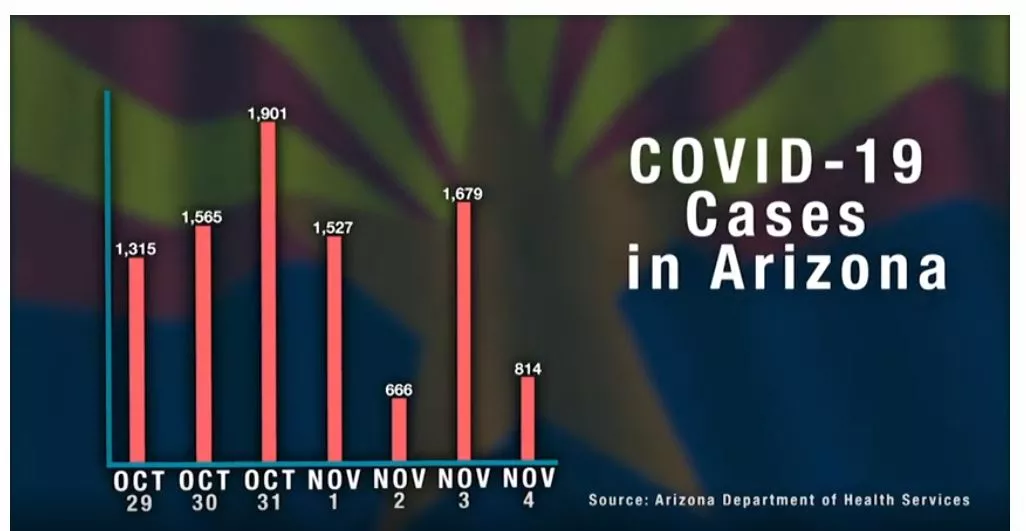
About two weeks ago, LaBaer cautioned that cases were about to reach 1,000 a day. That estimate turned out to be conservative.
“Arizona’s moving average is now around 1,300, almost 1,400, new cases a day,” he said. “It’s not rising quite as rapidly as it did at the end of June, but it is rising consistently day-over-day and that’s a concern.”
He recommended minimal mingling during the holidays and a return to pandemic precautions of wearing masks, social distancing and frequent testing for the disease, which since January has killed more than 6,000 people in Arizona and 230,000 across the nation.
“I would suggest, for the upcoming holidays, that people really limit it to their immediate family this year. I don’t think it’s a great year for big family get-togethers,” LaBaer said.
Nearly 10% of tests in Arizona are positive, according to the Arizona Department of Health website, and half the 250,000 cases of the virus reported in Arizona are in Maricopa County, the state’s most populous.
LaBaer said Arizona has some confusing markers. A number of people have recovered from COVID-19 and appear to be immune for up to six months, which should mean a slowdown in the transmission of the disease. But that hasn’t happened.
“The fact that the transmission rate is as high as it was back then means that people are doing a better job of transmitting it, which is not good,” he said. “People are interacting more, and some of that may be COVID fatigue, some may be that people are back at work more often, but we really need to be attentive to reducing that sort of thing.”
As the global race for an approved COVID-19 vaccine pushes on, more people are getting the coronovirus that causes the disease.
“We’re hitting a milestone here where the seven-day average for new cases is approaching 100,000 new cases a day. To put that in some perspective, the number of new cases we saw yesterday was around 90,000. That is more than the total number of cases in the original Wuhan outbreak,” LaBaer said, referring to the industrial city in central China where COVID-19 emerged late last year.
Herd immunity has never been achieved without a vaccine, he said. Despite the widespread devastation and death toll caused by the virus, Arizona and the rest of the world are nowhere near the necessary 60% level to achieve herd immunity.
ASU has managed to keep the number of new cases low, LaBaer said.
ASU in January drew national attention when an ASU student became one of the nation’s first recorded cases of COVID-19. The student, who had returned from a trip to Wuhan, has recovered.
Regularly aggregated data on ASU’s COVID-19 management website recorded 86 of the 91 total known positive cases, as of Nov. 2, as off-campus students. Sixteen faculty and staff members have tested positive.
“We’re lucky there,” LaBaer said. “I personally believe that part of the reason our numbers are so good is because we do such regular testing.”
ASU has tested more than 106,000 students and employees since Aug. 1, using a saliva-based test the university developed that also is available to the public. The test has since been used at Northern Arizona University.
In previous months, health officials across the country have warned against potential spikes in cases after national holidays, such as the Fourth of July and Labor Day, though LaBaer did not share the same concern over the possibility of a post-Halloween surge among ASU students.
“I think our student population has been pretty well behaved,” LaBaer said, referring to those living on campus. “The harder part, for me, is the off-campus population, because those folks are in the community and it’s clear that our community numbers are rising and hard for them to escape that. I think that’s probably the likely bigger source of the issue.”
Will Humble, executive director for the Arizona Public Health Association, and other health officials also see a similar difference between on-campus and off-campus student behavior.
“The off-campus behavior has a direct impact on the success of the whole reentry program,” said Humble, former director of the state health department. “That’s why it’s so key to have a partnership between ASU and the city of Tempe.”
Humble agreed that ASU’s system of regular mass testing is effective.
“The standard is not perfection, the standard is to do the best you can. ASU had a great plan, and still does have a great plan on campus,” he said, but school officials need to work more closely with community officials and law enforcement to monitor off-campus behavior.
ASU shifted all classes online after Thanksgiving. LaBaer encouraged students to get tested before traveling and again before returning to campus in the spring to avoid the likelihood of spreading the coronavirus.
Wednesday, November 4, 2020
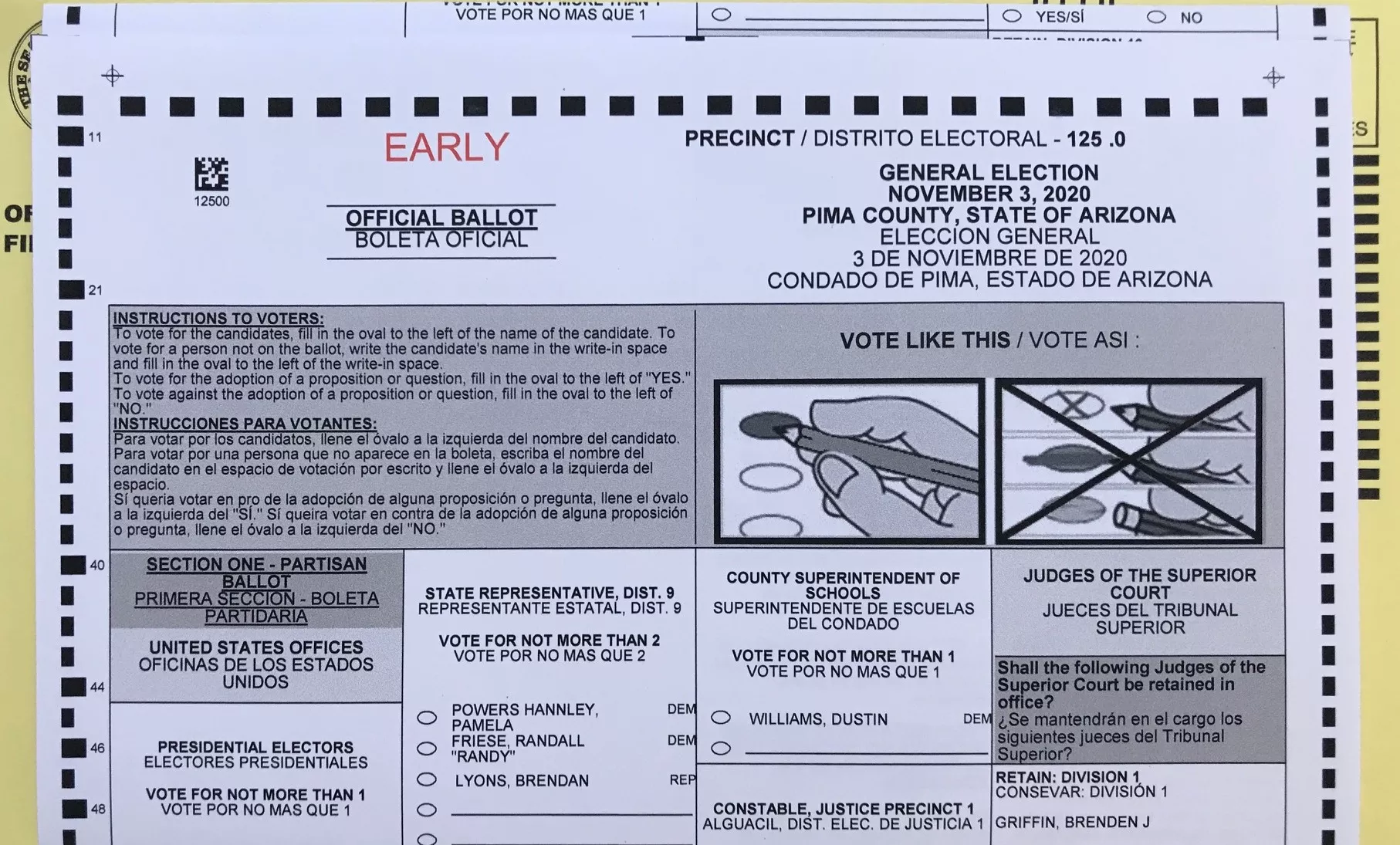
Pima County election officials announced today that somewhere between 26,000 and 34,000 ballots from yesterday's election remained to be counted. Those ballots must have their signatures verified by the County Recorder's Office before they can be sent to the Elections Department for tabulation.
In addition, the county has roughly 18,300 provisional ballots that have to be verified. Provisional ballots come when there's some question about whether someone has already voted early, is possibly voting in the wrong precinct or has run into a different snafu. In most elections, roughly 80 to 85 percent of those ballots get counted, according to a county press release.
The Elections Department will begin counting early ballots this afternoon, with new results expected by the end of the day. Tabulation will continue tomorrow.
This story has been updated to reflect new vote totals.
With an unknown number of early ballots in Pima County and at least 400,000 votes left to count statewide (per the Arizona Republic), the race for to fill three seats on the Arizona Corporation Commission shifted last night as more votes were counted.
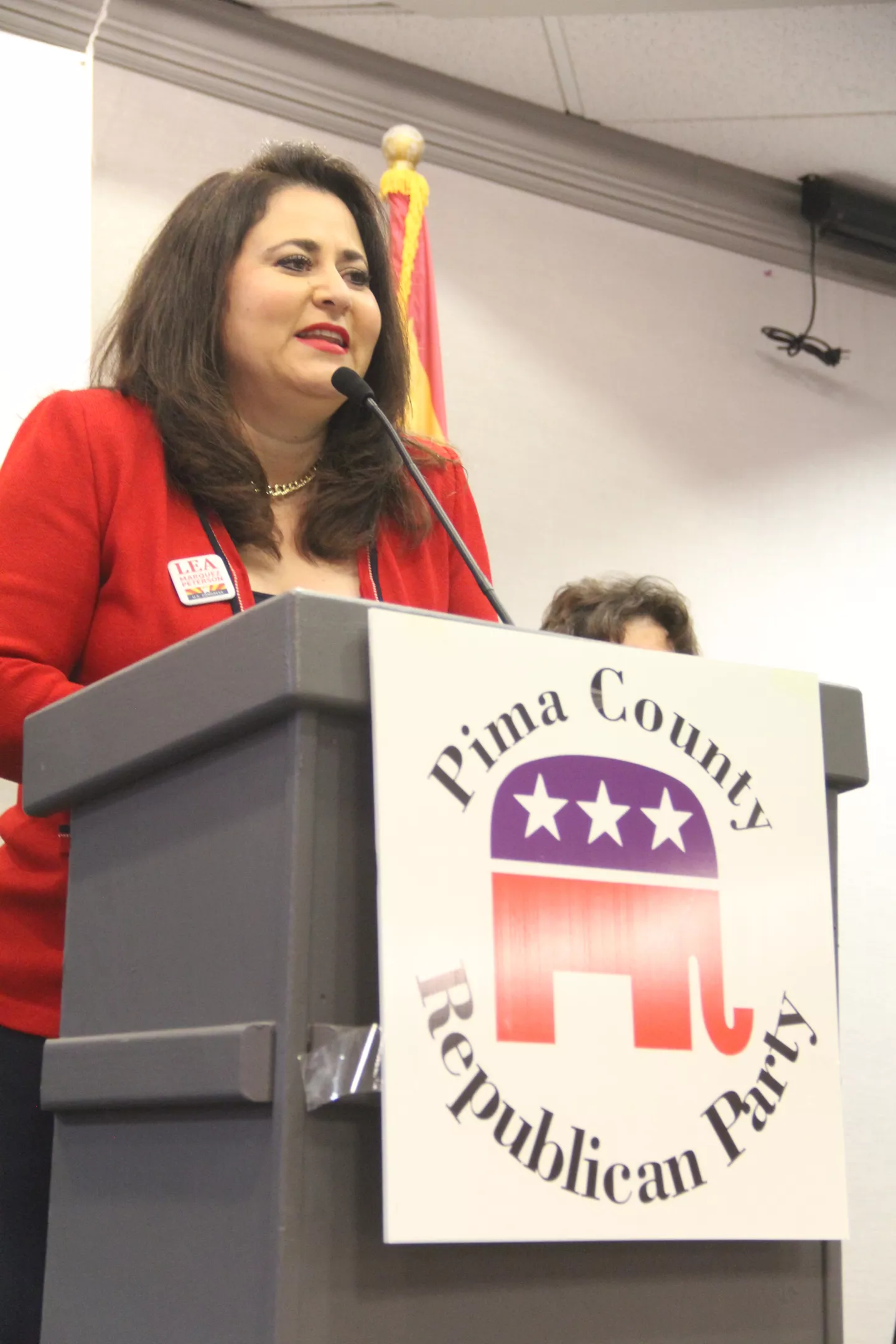
While the top vote-getter remains Democrat Anna Tovar (with 18 percent of the vote), former Tucson Hispanic Chamber of Commerce President and GOP candidate Lea Marquez Peterson has moved into second place (with 17 percent of the vote). Meanwhile, Republican James O’Connor (with 17 percent of the vote) has slid into third place, pushing Democrat Bill Mundell into fourth place (with 16 percent of the vote).
The three top vote-getters will join Democrat Sandra Kennedy and Republican Justin Olson on the five-member panel.
The new commissioners will serve four-year terms on the state’s regulatory body overseeing public service utilities as well as regulating corporations.
In the race to fill three seats on the Arizona Corporation Commission, the Democratic slate of Anna Tovar (with 19 percent of the vote), William Mundell (with 17 percent of the vote) and Shea Stanfield (with 17 percent of the vote) is out ahead of the three Republican candidates, Lea Marquez Peterson (16 percent), James "Jim" O'Connor (16 percent and Eric Sloan (15 percent).

