

Monday, November 2, 2020
Just days before Election Day, elections officials are on alert for voter intimidation – which can range from threatening emails to campaigning too close to a polling location – and working to educate voters about their rights and how to respond.
Intimidation is illegal under state and federal law, and can result in lawsuits, fines or imprisonment.
In Arizona specifically, it is a misdemeanor “to intimidate any person for voting for a candidate, for refraining from voting or to vote against another candidate,” said Amy Marshak, senior counsel at Georgetown Law’s Institute for Constitutional Advocacy and Protection.
Under Arizona law, private citizens are prohibited from bringing a weapon within the 75-foot radius established around the polling location. Even outside the 75-foot limit, the Arizona Secretary of State’s Office website considers an “aggressive or ostentatious display of weapons” to be voter intimidation.
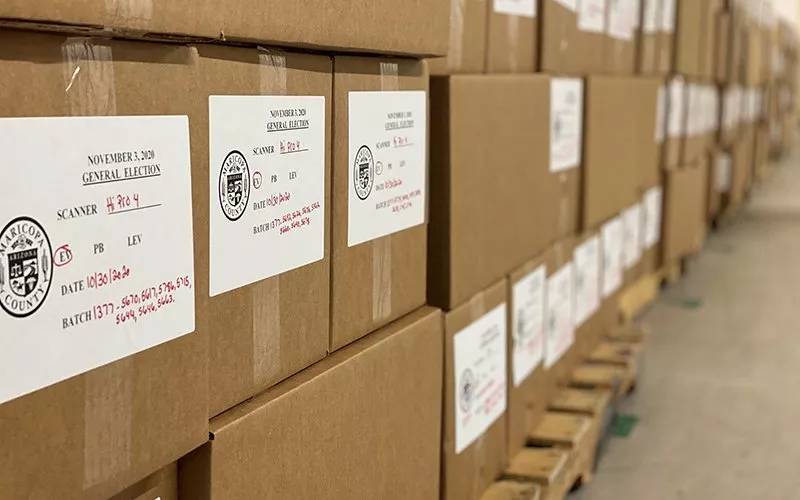
WASHINGTON – Arizonans are already setting voting records this year, driven by a bitterly contested presidential race, a large number of new voters and COVID-19 fears that voting in-person may not be safe.
With four days left until Election Day, state election officials had already received 2.3 million ballots Friday, closing in on the total 2.6 million that were cast in 2016. This year’s turnout is “the most people who have ever voted early in Arizona history,” said Paul Bentz, senior vice president of research and strategy for HighGround Inc.
There are 4.28 million registered voters in Arizona this year, according to the secretary of state’s office, 692,686 more than in 2016.
Maricopa County officials reported processing 1.5 million ballots as of Friday, and increases were being seen in swamped recorders’ offices across the state. Pima County had received 389,876 ballots by Friday, while Greenlee County, which only has 4,866 registered voters, had received early ballots from 2,166 of them by Friday.
Tags: tucker carlson , biden , Image
Friday, October 30, 2020

This year, Pima County voters will decide a new District 1 Supervisor after Republican Ally Miller held the seat for eight years.
Now, Republican Steve Spain and Democrat Rex Scott are vying for the Pima County Board of Supervisors’ seat in District 1, a position that determines a wide range of public policy in the county.
The district, representing Marana, Casa Adobes, Oro Valley, and the Catalina Foothills, has reliably voted for Republicans in recent decades. This year’s Republican candidate, has a history as a political pundit penning right-leaning opinion pieces for the online Arizona Daily Independent.
Spain has been unabashedly critical of the current Pima County Administrator Chuck Huckelberry. In an analysis of Pima County elections results in the 2016 general election, he criticized the election of District 4 Supervisor Steve Christy, calling him “the county establishment’s token quasi-Republican rubber stamp.”
“This, naturally, secures the position and malfeasance of Chuck Huckelberry, the nearly-half-a-million-dollar-a-year puppet of Diamond, Lopez, Click, Mehl, and the other members of the cabal that has this town by its short hairs,” Spain wrote.
But the latest campaign filing reports reveal Spain’s campaign for district supervisor took $12,000 from Humberto Lopez, Jim Click and David Mehl — presumably the same “members of the cabal” Spain mentioned.
The contributions from these individuals comprised 19% of Spain’s total campaign contributions as of Oct. 17.
The Spain campaign’s 2020 pre-general report shows he received $5,000 from Jim Click, the owner of several car dealerships in Tucson and Green Valley, on Oct. 8.
The third-quarter campaign finance report shows a $5,000 contribution from David Mehl, the owner of real estate development company Cottonwood Properties, on Aug. 27. Humberto Lopez, the president of real estate development and investment company HSL Properties, Inc., contributed $2,000 on Sept. 24.
As of Friday, Spain has not responded to Tucson Weekly’s request for comment.
The only entity Spain mentioned in the quoted portion of his 2016 article whom he didn’t receive funds from is “Diamond,” which presumably refers to the late legendary land speculator Don Diamond, who died in 2019.
Rex Scott’s campaign received $1,950 from individuals associated with Diamond Ventures, the company founded by Don Diamond.
The private company’s Vice President Priscilla Storm contributed $500 on Oct. 6. On Sept. 14, Diamond Ventures’ President David Goldstein gave $1,000. The company’s principal who oversees philanthropy, Helaine Levy, gave $200 on Sept. 10, and Chief Financial Officer William Kelley gave $250 on Sept. 9.
Since the last reporting date Oct. 26, Scott’s campaign had received $128,568.82 in total contributions, and Spain’s campaign received $61,842.05.
“There is no Clean Elections option for county elections, so we have to play by the rules that are set in front of us, and that means taking money from folks who are interested in the races,” said Adam Kinsey, a consultant for the Rex Scott campaign. “That's not the problem, the hypocrisy is when you slam these people and say that those contributions will result in actions as an elected official. When you say that they are buying the county administrator, they are buying these politicians, when you make claims like that, and then you take the money yourself, that's where we're got a problem.”
The Democratic candidate in the race for district 1 posted Spain’s comments about “the cabal that has this town by its short hairs,” and the revelations from his latest campaign findings on a website listing the Republican candidate’s past statements as a political pundit.
“We know that Steve Spain is largely unknown to most voters. But we know that he also has an incredible body of work that's out there in the public sphere, because he's been blogging on this sort of alt-right blog, the Arizona Daily Independent, for years,” Kinsey said. “Rex is a career educator, and he does not want to go negative. He does not want to mud sling, he does not want to make any baseless political attacks. So he said, one thing we can do is just share what Steve Spain has put out into the world with the voters and let his words speak for themselves.”
This article has been edited to include an additional quote from political consultant Adam Kinsey as well as the Scott campaign's fundraising totals.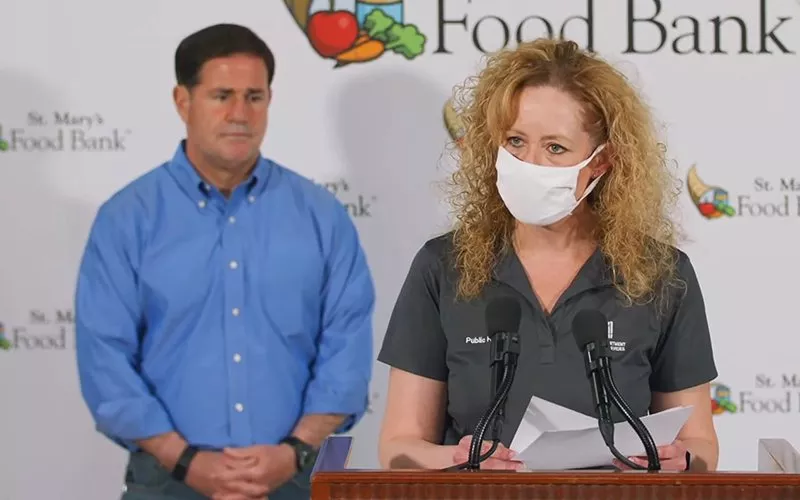
An Oct. 29 Cronkite News story mischaracterized the Arizona Department of Health Services policy on in-person versus virtual schooling during COVID-19. The policy sets recommended guidelines for local schools, which have the ultimate authority on how to proceed.
WASHINGTON – The Ducey administration defended its decision Thursday to make it harder for Arizona schools to revert to virtual education, from in-person or hybrid schooling, in the face of surging COVID-19 cases.
Gov. Doug Ducey said the decision to require that three different criteria are met – the old standard was just one of the three – before schools consider returning to online teaching was made with input from “the superintendent of public instruction and education leaders.”
But in a statement Thursday, a spokesperson for the Arizona Department of Education said that the department “was not part of the decision-making process” on the change.
The back and forth comes as new COVID-19 cases are surging in the state, with more than 5,700 new cases reported this week alone and 49 deaths attributed to the disease.
As of Thursday, the state had confirmed 242,480 cases of COVID-19 since the virus was first discovered in Arizona in January, and had recorded 5,918 deaths from the disease, according to Arizona Department of Health Services data.

WASHINGTON – Phoenix resident Rey Torres is “very happy to have been born into my culture” of a Mexican-American family – just don’t ask him if that means Democrats will be getting his vote this fall.
President Donald Trump has “respect for American jobs and … a laser focus on bringing jobs back to our country” among other positives, said Torres, a member of the Arizona Latino Republican Association.
Torres is not an outlier: A Pew Research poll from June found that 32% of Latino voters said they support Trump. An Equis Research survey released in September put support for the president among registered Latino voters in Arizona at 29%.
But while the polls showed some support for Trump, including growing support among young Latino men, they also reflect the fact that Latinos as a whole are still firmly in the Democrats’ camp.
“Generally speaking, Latinos have leaned towards the Democratic Party more than the Republican Party over the last 30 plus years,” said Mark Lopez, the director of global migration and demography research at Pew Research.
Thursday, October 29, 2020

Gov. Doug Ducey and Arizona Department of Health Services Director Dr. Cara Christ provided a COVID-19 update at a press conference today amid rising cases throughout the state.
On Oct. 29, the Arizona Department of Health Services reported 1,315 new COVID-19 cases throughout the state, with a percent positivity of 9.7%.
Pima County reported 105 new COVID-19 cases today and now has recorded 28,067 of Arizona’s 242,480 total positive cases.
“The recent increase in cases has resulted in an increase in the COVID-19 rates in many counties,” Christ said at the press conference. “At the Arizona Department of Health Services, we remain on high alert. We’ve worked to contain COVID-19 from all angles, and we continue to take further action in light of recent increases.”
Although Ducey acknowledged Arizona’s rising coronavirus numbers, he said in comparison to other states, “we’re not in that zone that we’re seeing in other places.”
“We do see this rising in different parts of the country, our expectation in Arizona has been that cases would continue to go up,” he said.
The governor recognized that the state’s current R naught number, which indicates how contagious a virus is, is currently at 1.16, which means coronavirus is spreading as fast as it did in June.
“Arizona did one of the best jobs in the nation when our time of challenge did come of driving it beneath one, but as we head into influenza season it becomes more challenging,” Ducey said.
Although the current rise in COVID-19 cases is alarming, Ducey said there’s even more to come.
“We know that there is a storm ahead of us, yet it’s not here,” Ducey said. “But those simple guidelines of wearing a mask, washing our hands, being socially distanced and using common sense have served us very well to date.”
However, the governor doesn’t plan on imposing new safety restrictions to prevent further spread of COVID-19.
“The mitigation that we’ve put out, the plan we put into effect remains in effect. I am proud that Arizona is open, that our economy is open, that our educational institutions are open and our tourist destinations are open,” Ducey said. “While at the same time, we do have mitigation steps in place that have allowed us to protect lives while protecting livelihoods, and we’re gonna continue to do that.”
Given the likelihood of travel and large gatherings, Christ says she anticipates seeing a spike 10-14 days after Thanksgiving that could potentially increase over the next 4-6 weeks.
In preparation for the holiday season, she said ADHS will be putting out guidance, working on mitigation strategies and making sure hospitals have enough resources, although she said the biggest barrier for hospitals is not “the beds, but could be the staffing.”
Christ urged citizens to continue mitigation tactics such as wearing a mask, maintaining social distancing and getting an influenza shot.
“We understand that this has been a difficult year, and many have grown tired of the mitigation strategies. But now is not the time to let up,” she said.
When asked about the example he’s setting for Arizonans after repeatedly attending public events sans-mask, including at a Trump rally at the Prescott Regional Airport Oct. 19 and as he spoke at today’s press conference, Ducey called upon the First Amendment.
“We’ve been consistent the entire time through the pandemic to protect people’s rights under the Constitution,” Ducey said. “There are five days left in the election cycle and we’ll continue to protect people’s rights.”
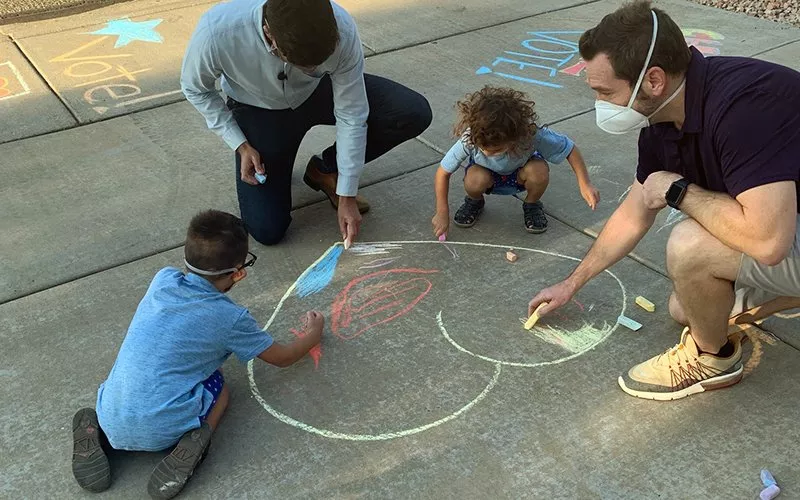
PHOENIX – Divya Yoder and her family were out on the sidewalk in front of their home one recent Sunday, writing chalk messages to encourage their neighbors to vote.
“Vote early,” one read. “United we stand,” read another.
The Yoders weren’t the only family taking chalk to concrete with similar messages in recent days. Hundreds of Arizonans were doing the same, along with thousands of families across the country as part of #ChalkTheVote, which was created by the non-profit organization ParentsTogether to urge families to vote on Nov. 3.
Yoder, the mother of two young boys, wanted them to understand the importance of voting – a right that isn’t available to everyone.
“You know, we live in a community with our loved ones, friends, neighbors, and children, and some of them don’t have the privilege and we make the decisions to vote for ourselves and for the ones around us,” said Yoder, who immigrated to the U.S. from the United Kingdom when she was 5, became a U.S. citizen six years ago and voted for the first time in 2016.
Yoder, who’s of East Indian descent, said her background has informed her views on the right to vote, and what she wants her sons to understand.

WASHINGTON – President Donald Trump and Democratic vice presidential nominee Kamala Harris were back stumping in Arizona Wednesday, evidence of what one report calls the high “voter power” of residents of the swing state.
The WalletHub report, “2020’s States with the Most and Least Powerful Voters,” rated Arizona the state with the fifth-most powerful voters, based largely on Arizona’s relatively newfound status as a toss-up state.
The high ranking “will come as a pleasant surprise to a lot of Arizonans,” said Jason Rose, an Arizona political consultant. “I don’t think most Arizonans really thought of themselves as all that important, because of the history of it being a red state – until now, perhaps.”
Voters may not think of themselves as important, but the presidential campaigns apparently do.
Harris had campaign stops scheduled Wednesday in Phoenix and Tucson, where she took part in “drive-in rallies” of about 100 cars at each event. She was joined in Phoenix by singer Alicia Keys.

