
Thursday, October 29, 2020

Wednesday, October 28, 2020

Democrats agree that Trump’s caused asylum-seekers unacceptable misery. But the goal of deterring people from migrating to the U.S. — which has motivated Trump’s complex web of border policies — has seduced some Democrats, too.
In early October, hundreds of migrants in Honduras set out in a “caravan” with plans to travel through Mexico to the United States.
The timing was similar to a caravan two years ago, which swelled to thousands of people, overwhelmed Guatemalan and Mexican border authorities and became the leading issue for President Donald Trump and Republicans going into the 2018 midterm election.
The latest caravan was stopped hundreds of miles short of the U.S. border, hardly making a blip in the news cycle. Shortly after entering Guatemala, police and migration authorities set up roadblocks and rounded up the group for deportation back to Honduras.
It was so routine that Trump, ill with COVID, didn’t even bother to bang out a celebratory tweet, much less talk about deploying the military to avert an invasion as he did in 2018.
The fate of the caravan is a symbol of a larger success. Over the past year and a half, Trump and his relentlessly focused aide, Stephen Miller, have largely achieved their goal of choking off the flow of unauthorized immigrants into the United States — especially families from Central America, many of whom come with the intention of requesting asylum. They have done so with a combination of policies that Tom Jawetz, a former Democratic aide to the House Judiciary Committee, describes as a “waterproof fabric” to repel migrants.
New U.S. regulations and legal precedents make it harder for someone to be granted asylum once they arrive. But few these days even get the chance to ask. As much as possible, the Trump administration has simply expelled asylum-seekers.


Tuesday, October 27, 2020
The Senate voted 52-48 to confirm Judge Amy Coney Barrett’s appointment to the Supreme Court on Monday, with Sen. Martha McSally casting a vote in favor of the judge receiving a lifetime appointment on the nation’s highest court, which will now hold a 6-3 conservative majority.
The Supreme Court will hear oral arguments in the Trump administration’s lawsuit to overturn the Affordable Care Act (ACA) on Nov. 10, one week after the general election. Protect Our Care, a healthcare advocacy organization, says overturning the Obama-era healthcare law could cause 223,000 Arizonans to lose their coverage.
Many have expressed concerns about Republican-nominated Coney Barrett, who could cast a vote to dismantle the ACA.
After the Supreme Court confirmation, Protect Our Care hosted a virtual press conference Tuesday to discuss the implications of McSally’s vote to approve the judge.
“With just a week left to election day, the confirmation of Amy Coney Barrett to the U.S. Supreme Court makes the situation even more dire. It has been literally shocking to watch the GOP, including Arizona’s Martha McSally, help rush through her nomination,” state Rep. Kelli Butler said at the conference. “With the entire Affordable Care Act set to be heard by the Supreme Court right after the election, we can expect her presence on the court is likely to be devastating to the ACA and for all its protections for your healthcare.”Today I had the honor of casting a historic vote to confirm Judge Amy Coney Barrett to the Supreme Court. She is a brilliant, fair jurist who will bring a stellar judicial temperament to the bench. I look forward to seeing her take her seat on our nation's highest court. pic.twitter.com/y3UKtpMhuv
— Martha McSally (@SenMcSallyAZ) October 27, 2020
Under the ACA, health insurance companies cannot deny coverage based on pre-existing conditions. Butler says if it were overturned, this would put nearly 2.8 million Arizonans with pre-existing conditions at risk, and that despite claims otherwise, there’s not a solid replacement plan to protect pre-existing conditions.
“Republicans like Martha McSally...have tried to basically fool you into thinking they want to protect people with pre-existing conditions,” Butler said. “It’s easy for them to say they want to protect people with pre-existing conditions, but their actions tell the real story, because there is only one set of laws that guarantees people with pre-existing conditions can get insurance coverage for the care they need, and that’s the Affordable Care Act.”
Alicia DeWitt, a Tucsonan survivor of the rare illness Cushing's Disease, shared how a lack of access to healthcare has been detrimental to her livelihood.
At 20 years old, she began developing “concerning medical symptoms,” but without health insurance, she couldn’t afford to see a specialist. Ten years later, doctors diagnosed DeWitt with a brain tumor and she had her pituitary and adrenal glands removed.
This week, doctors found a regrowth of her tumor tissue.
“I can’t help but think back on that if I had been a 20-year-old today and I had been on my parent’s insurance...I would’ve gotten an MRI, I would’ve been diagnosed with a brain tumor and I’d be living a happy and healthy life and I wouldn’t be permanently disabled from something that I shouldn’t be,” DeWitt said.

PHOENIX – The pay gap is confoundingly stubborn: On average across the United States, women make 81 cents for every dollar a man makes, with the size of the gap varying based on a woman’s job, family status and race.
In Arizona, women fare slightly better than the national data, making 84 cents for every dollar a man is paid. That places the state at No. 11 for the smallest gender wage gap, according to a 2020 study by business.org. When the wage gap is broken down by race, many women are making even less.
Asian women overall are paid the most, matching the Arizona average of 84 cents. The gap grows for Black women, who make 65 cents on the dollar, and Hispanic women, who make 55 cents.
The National Committee on Pay Equity, which advocates for the elimination of the race and gender pay gaps, created a formula to determine how far into the following year different demographics of women would have to work to make the same as a man, on average, at the end of the year. They call each of these days “equal-pay day.”
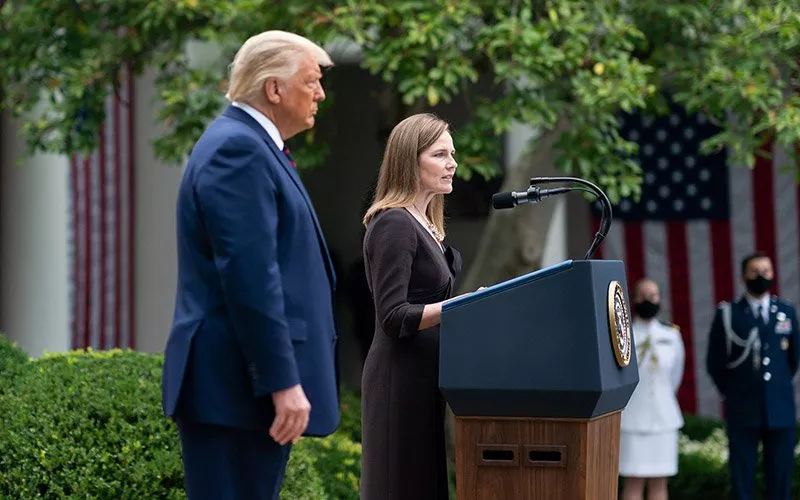
WASHINGTON – Arizona conservative groups hailed the confirmation of “capable, brilliant” Judge Amy Coney Barrett to the Supreme Court, after a rushed vote Monday that split the Senate along party lines.
Barrett’s confirmation comes less than six weeks after the death of Justice Ruth Bader Ginsburg and cements a conservative majority on the high court for years to come – what Senate Minority Leader Chuck Schumer called a “decades-long effort to tilt the judiciary to the far right.”
No Democrats voted for Barrett, who was sworn in Monday night at the White House by Supreme Court Justice Clarence Thomas within hours of the 52-48 Senate vote. Maine Sen. Susan Collins was the only Republican to vote no on the nomination.
Arizona’s senators also split on party lines, with Republican Sen. Martha McSally saying before the vote that she was eager to vote for “this highly qualified pioneering woman.” But Democratic Sen. Kyrsten Sinema, who voted no, expressed concerns over the weekend over what she called Barrett’s “inconsistent views on legal precedent.”

Monday, October 26, 2020
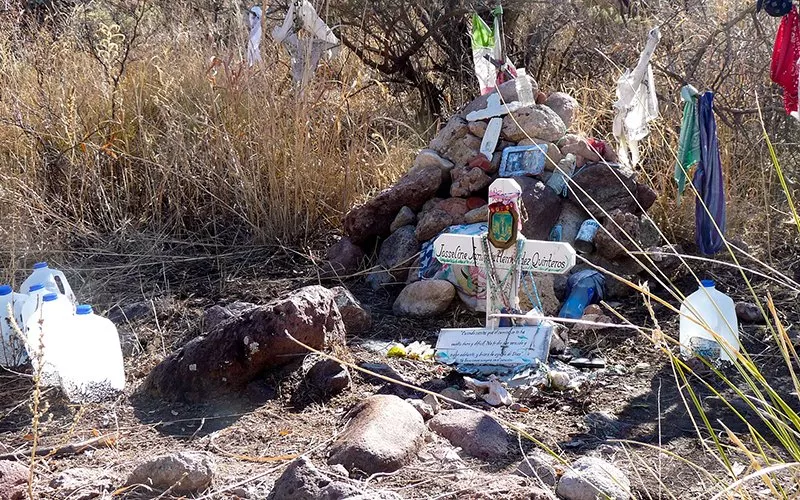
WASHINGTON – Remains of 181 migrants were found in the Arizona desert through the end of September, 37 more than in all of last year and the most since 2013, according to the group Humane Borders.
The rise in migrant deaths comes during a year of intense heat and little precipitation for Arizona – but also at a time when the number of people caught crossing the border has fallen sharply.
Humanitarian groups and county officials along the border blame the rising deaths on years of border security policies that have pushed migrants toward riskier routes into the U.S. – along with this year’s harsh weather, expanded border security and COVID-19 health restrictions.
“It’s kind of like stopping water: If you block it up in one place, it’s going to go somewhere else,” said Pima County Sheriff Mark Napier. “We’re seeing the results of that as an increase in deaths.”
The number of deaths is tracked by the humanitarian group Humane Borders, using data from the Pima County Medical Examiner’s Office and other public sources. The group, which releases numbers quarterly, recovered remains of 181 people in the desert through September, with 85 of those cases coming in the last three months alone.
Tags: immigration , border , Image