

Monday, October 26, 2020
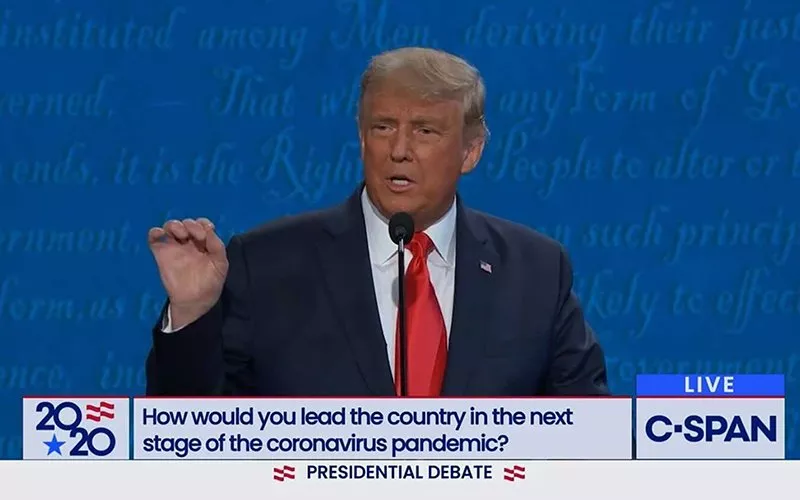
WASHINGTON – President Donald Trump name-dropped Arizona early in Thursday’s presidential debate, claiming the “very big spike” in COVID-19 cases in the state is “now gone.”
Except that it’s not.
New cases are up – twice in the past week they topped 1,000 – the rate of positive tests rose as did hospitalizations – although currently well within the current capacity of hospitals. That led Arizona Department of Health Services director, Dr. Cara Christ, to caution Arizonans on Thursday, “Don’t let down your guard.”
“Over the past few weeks in Arizona, reported cases and percent positivity have been increasing,” Christ wrote in the blog post that went up about an hour before the presidential debate started.
Trump brought up Arizona – and Texas and Florida – early in the debate, when he and Democratic nominee Joe Biden were asked how they would lead the country “during this next stage of the coronavirus.”
Saturday, October 24, 2020
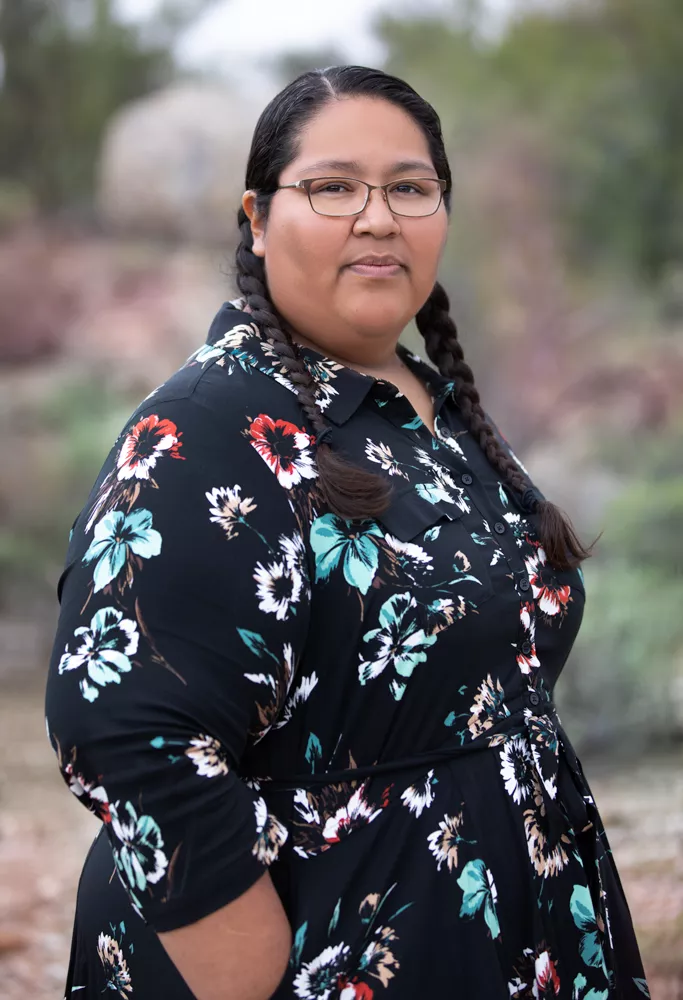
The candidates for Pima County Recorder certainly have different approaches to the office, but one candidate recently criticized the other after third-quarter campaign finance reports were released.
Republican candidate for county recorder Benny White posted a photo of Democratic candidate Gabriella Cázares-Kelly’s cash operating expenses that show she paid herself with campaign funds. The post has since been deleted.
“My opponent pays herself from her campaign account,” the post read. “The saddest part of this in my mind is that she is taking $5 and $10 donations from people who are reported as being unemployed and then taking their money for her own benefit. We just see things differently.”
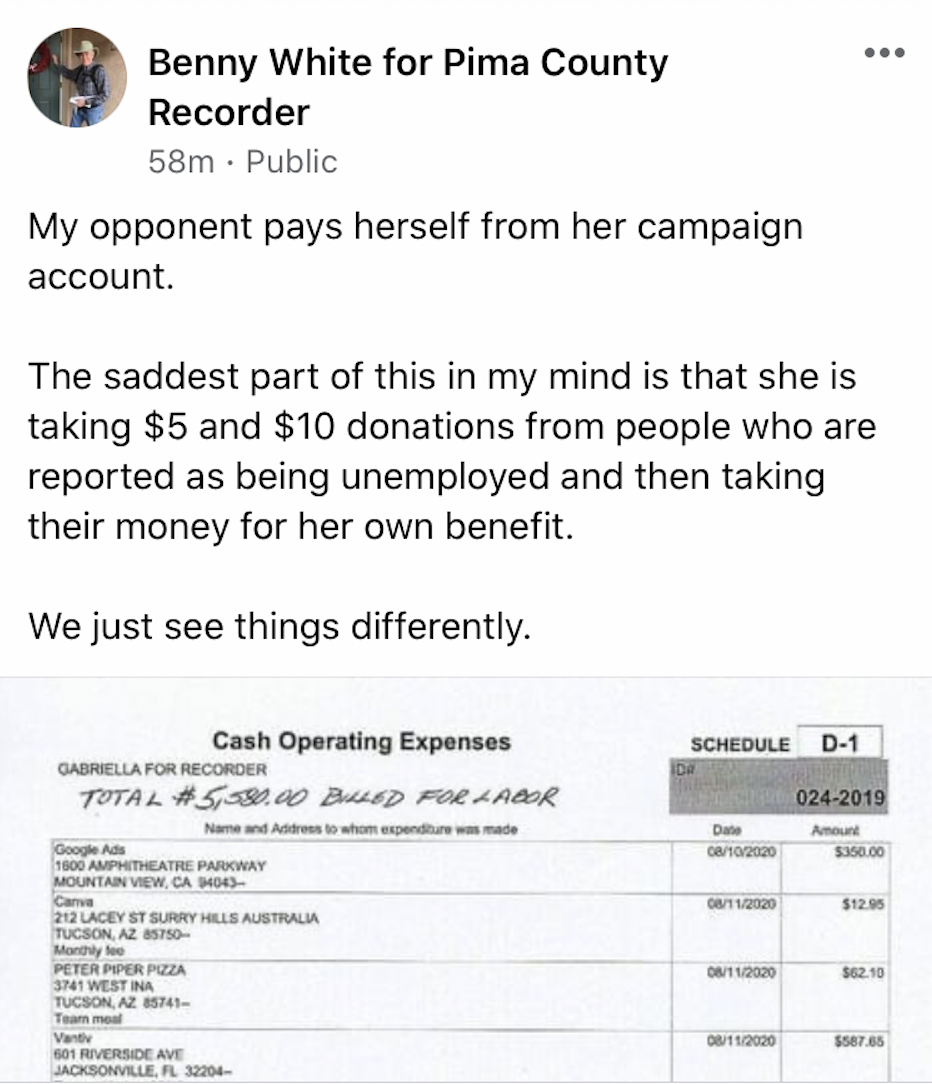
Cázares-Kelly was quick to respond by acknowledging her opponent’s criticism in her own Facebook post and says she pays herself a $1,290 biweekly salary to support herself while she runs for county recorder.
“I do not come from a rich family. I am not independently wealthy, I am not yet retired, and my household cannot survive off of only one income,” she wrote in a Facebook post. “My reality is that I am a working-class candidate bringing my unique perspective and experiences into this leadership role.”
Cázares-Kelly says she paid herself $4,580 in campaign funds from Aug. 19-Sept. 18. One reported expense in the finance report shows a payment of $1,000 on Sept. 2, but her campaign says it was never received, and a later disbursement on Sept. 18 was used in its place.
Her paychecks were set at $1,000 for the first two weeks, and subsequent payments were set at $1,290 a week.
“There is no express prohibition in Arizona on candidates drawing salaries from campaign monies,” Sophia Solis, a spokesperson for the Arizona Secretary of State’s office, wrote in an email.
“Arizona law defines permissible ‘operating expenses’ as ‘staff salaries … and similar items necessary to keep the campaign in operation,’ which could include candidate salaries,” Solis wrote. “While Arizona law applies to local and state candidate campaign finance activities, to the extent that authority from the Federal Election Commission on this issue is persuasive, the FEC permits candidates to draw a limited salary from campaign monies, provided that the salaries do not exceed the lesser of the amount they earned the year prior to running for office, or the minimum salary paid for the office the candidate seeks to hold.”
According to Cázares-Kelly, her salary last year was $54,000 annually. According to Arizona Revised Statutes, the county recorder has a starting salary of $67,800.
“I just found it curious. I've never seen anyone take campaign funds for their personal salary,” county recorder candidate White said. “I don't have any comments on her postings because I've not read them.”
After White made the post on Wednesday, Cázares-Kelly says her campaign has exceeded its fundraising goal.
Within 24 hours of White’s post, Cázares-Kelly says her campaign raised $18,541—the biggest fundraising day of her entire campaign. As of today, the campaign has raised $21,391 online, according to Cázares-Kelly.
“People were very motivated and inspired by the posts that we shared about some of the barriers that I've had being a working-class candidate, and they wanted to show that by donating more money,” Cázares-Kelly said.
Tags: Pima County Recorder , Pima County , Campaign spending , Image
Friday, October 23, 2020
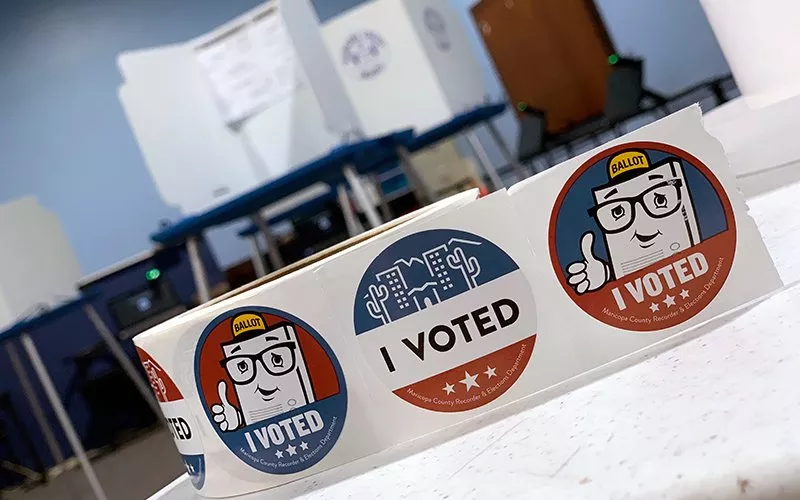
PHOENIX – Time is running out for voters to request mail ballots and for voters in nursing homes and hospitals to get help from a special elections team, state and county election officials said Thursday.
“There is still time to do so for this general election. But you must do it by tomorrow (Friday),” Secretary of State Katie Hobbs said at a news conference at the state Capitol.
The deadline to request a ballot by mail or a special election board from a county recorder is 5 p.m. Friday, she said. Special election boards help Arizonans in hospitals or a long term care facility, and anyone with a severe illness or disability, cast their ballots. Board members make in-person visits and conduct video conferences to ensure the right to vote is respected.
There’s still a chance to request the help of a special election board through Nov. 2 – the day before Election Day – if a voter can show that an emergency prevented them from asking earlier, Maricopa County Recorder Adrian Fontes said. But that help is not guaranteed after Friday, officials warned.
Representatives from AARP and the Arizona Center for Disability Law joined Hobbs and Fontes at the news conference to answer frequently asked questions about the rights of voters living in long term care facilities. The law center is operating a voter hotline through Election Day.
“We’ve moved forward early on as recorder to have a full-time coordinator for special election boards,” Fontes said. “These are authorized by federal law to assist voters with disabilities to make sure that they have their right to vote.”
Fontes described the board as “a two-person board of opposite political parties” that assists voters “who otherwise would not have access to the ballot.”
“For example, if you’re in a long term care facility and under quarantine, you can now have someone come and assist you to administer the ballot,” he said, adding that his office has received 144 such requests.
A Maricopa County Superior Court judge on Oct. 6 ruled that because of visitation restrictions at long term care facilities imposed to slow the spread of COVID-19, Arizonans in those facilities may be eligible to vote via video conference with help from a special election board.
The ruling by Judge Randall H. Warner came after Attorney General Mark Brnovich and Gov. Doug Ducey asked that the court deny plans to allow virtual voting.
At the time, Hobbs argued that voters in hospitals or assisted living arrangements should be allowed to cast their ballot via teleconference.“There are many communities where barriers continue to exist, and in fact the pandemic has exacerbated or highlighted those barriers even more,” she said.
Brnovich and Ducey argued that nothing in Arizona law allows voters to cast ballots via video conference or exempts special election boards from helping voters in person.
Brnovich also argued that the plan poses risk of voter fraud. Warner’s ruling says the chances of that are low because bipartisan special election boards act as a safeguard against voter fraud.
Although state law may not address such virtual voting, the judge wrote, the particular circumstances set forth by COVID-19 require additional procedures to ensure both voter safety and access to voting.
“It makes no difference whether, under Arizona’s COVID-19 guidelines, hospitals or care centers have to allow special election boards to enter,” the ruling says. “The issue is not the legal impediment to in-person contact, it is the health risk. Federal law does not allow Arizona to impose on a disabled voter the choice between voting and protecting their health.”
Fontes outlined key features of voting procedures for Arizonans who can’t physically mark a ballot. Members of the special election board team will go through the ballot with the voter and ask the voter’s selection for each candidate or issue.
They then will hold the ballot up to the camera and ask the voter for confirmation that the correct choice was marked.
After the voter’s confirmation the selections are correct, the special election board will place the ballot in an affidavit envelope, print the voter’s name and write, “Voter unable to sign due to COVID-19 rules” in the signature box.
More information on requesting special election boards, voting via teleconference and mail-in ballots can be found at arizona.vote.
Cronkite News reporter Alexander Gaul contributed to this report.
Thursday, October 22, 2020
Two petitions are currently circulating on change.org, seeking to ban no-knock warrants in Arizona: one aimed at city lawmakers in Phoenix, and one aimed at state lawmakers. Together, the petitions have garnered more than 5,000 signatures.
“If our home is invaded, how are we to differentiate between a home invader and the police if they don’t announce their presence?” said Kenneth Cochran, a Tucson smoke shop owner who started the statewide petition. “With a huge percentage of Arizonans legally carrying firearms, this will almost always lead to tragedy."
These calls for reform are not limited to citizens. In July 2020, Pima County Sheriff Mark Napier issued a document calling for law enforcement reform under the initials ACT: Accountability - Community Engagement - Transparency. Among Napier's calls for reform is a ban on no-knock warrants, unless approved by the Sheriff, which would "only occur under the extreme circumstances."
Click below to read the specifics of the petitions:
Ban No-Knock Warrants In Phoenix
Ban No-Knock Warrants in Arizona
With 994 new cases reported today, the number of Arizona’s confirmed novel coronavirus cases closed in on 235,000 as of Thursday, Oct. 22, according to the Arizona Department of Health Services.
In a worrisome trend, the number of cases statewide has climbed by nearly 3,000 in just three days.
Pima County had seen 27,208 of the state’s 234,906 confirmed cases.
With five new deaths reported yesterday, a total of 5,859 Arizonans had died after contracting COVID-19, including 635 deaths in Pima County, according to the Oct. 22 report.
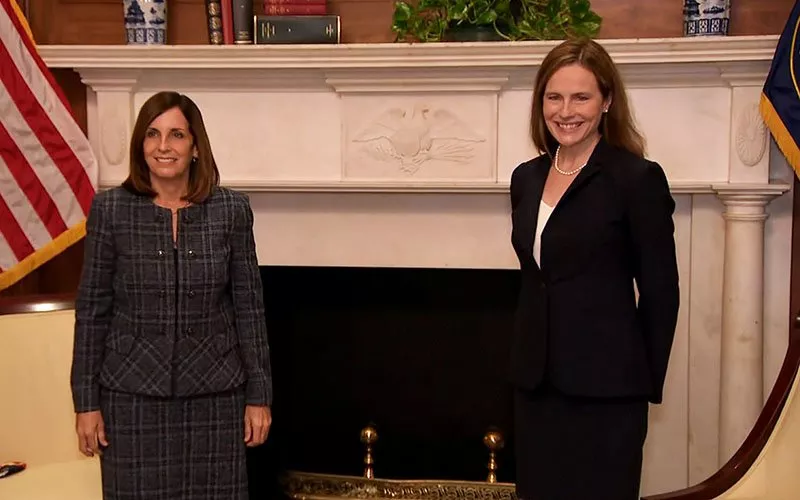
WASHINGTON – Arizona Sen. Martha McSally left little doubt how she plans to vote on Supreme Court Judge Amy Coney Barrett’s nomination, calling Barrett “a gift to America” during a brief meeting Wednesday.
The meeting, one of a series between senators and Barrett, came on the eve of a Senate Judiciary Committee vote on the nomination, which is expected to be before the full Senate for a final vote as early as Monday.
“I am so inspired to meet you,” McSally said to Barrett. “Really looking forward to voting to put you on the Supreme Court.”
Democrats do not appear to have the votes to block the confirmation, but continued to criticize the rushed process, which could put Barrett on the court less than six weeks after the death of Justice Ruth Bader Ginsburg and just days before Election Day.
Tags: mcsally , Amy Coney Barrett , Image
Wednesday, October 21, 2020
The Town of Marana’s mayor and council chose Police Chief Terry Rozema to replace Jamsheed Mehta as town manager in a 6-1 vote during a special council meeting on Tuesday, Oct. 20.
Rozema will begin his new job today.
Council Member Roxanne Ziegler cast the lone dissenting vote.
“I think this was something managed about a week and a half ago by some folks on this council,” Ziegler said during last night’s meeting.
The council member expressed her concern over her colleague’s decision to hire Rozema due to his lack of experience in the position. She preferred the chief serve as interim town manager—as Mehta did when former town manager Gilbert Davidson moved to be chief operating officer for the State of Arizona in 2017—while the council conducts a nationwide search for candidates with five to 10 years of municipality management experience. Rapid development within the town’s limits in recent years and how it will continue to be handled in the future is a driving force behind Zigler’s discontent with the decision.
“What we need is experience. This town is 52,000 plus citizens now. I think you could’ve gotten away with this when we were 35,000, 40,000 people and put someone who has absolutely no town manager experience,” Ziegler said. “I think the town of Marana and the employees of this town deserve something better than that.”
While town officials were tight-lipped as to why they wanted Mehta to go, Ziegler gave a glimpse as to a reason why the former town manager was abruptly dismissed, saying “this was a done deal” before the meeting took place.
“We also need somebody that isn’t handpicked and that’s what’s happened here,” Ziegler said, referring to why the council chose Rozema. “We need somebody with new eyes, a new face and a new perspective and insight to come into our town and take a very open-minded look at what we’ve got on our plates.”
Ziegler later added, “What I am tired of is 16 to 17 years being on this council and I know a few things and here we go again. Handpicking somebody in advance because, I think, mayor and vice mayor, you want somebody you can control. That’s not right. I’ve just about had it with that.”

