

Thursday, May 21, 2020
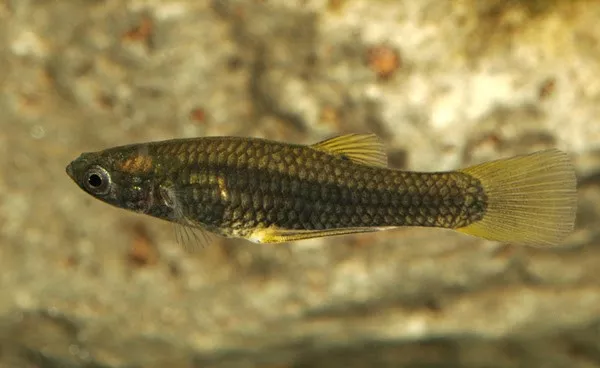
500 Gila topminnows were released into the pond on Wednesday, May 13, by staff from multiple county and state agencies. The fish release, part of the larger Sonoran Desert Conservation Plan, has been years in the making.
The small green and black Gila topminnow once swam throughout Tucson’s water system, but loss of habitat and predation from non-native fish landed them on the endangered species list in 1967. Topminnows survived in sparse populations in the Santa Cruz watershed, such as in Cienega Creek.
“They were in very dire straits in terms of very few natural sites that still had them,” said Karen Simms, Natural Resources division manager for Pima County’s Natural Resources, Parks and Recreation Department. “There’s been a lot of effort in expanding the number of sites that have topminnow in recent years.”
Aside from loss of habitat, one of their greatest threats were the non-native mosquitofish, which outcompete them for food.
“The Gila topminnow actually do just as good of a job at mosquito control, so another one of our goals is to change over the water sources we manage to have topminnow instead of mosquitofish in them,” Simms said.
Monday, May 11, 2020

The scientists who study how diseases emerge in a changing environment knew this moment was coming. Climate change is making outbreaks of disease more common and more dangerous.
Over the past few decades, the number of emerging infectious diseases that spread to people — especially coronaviruses and other respiratory illnesses believed to have come from bats and birds — has skyrocketed. A new emerging disease surfaces five times a year. One study estimates that more than 3,200 strains of coronaviruses already exist among bats, awaiting an opportunity to jump to people.
The diseases may have always been there, buried deep in wild and remote places out of reach of people. But until now, the planet’s natural defense systems were better at fighting them off.
Today, climate warming is demolishing those defense systems, driving a catastrophic loss in biodiversity that, when coupled with reckless deforestation and aggressive conversion of wildland for economic development, pushes farms and people closer to the wild and opens the gates for the spread of disease.
Thursday, May 7, 2020

Technology currently being designed in Tucson may soon help the US send astronauts to the moon for the first time in 50 years. Paragon Space Development Corporation, headquartered in Tucson, is part of a science team that recently secured a NASA contract to design a human landing system to take the first woman and next man to the lunar surface by 2024.
“This is a major endeavor for the US, and we’re so excited to be a part of it,” said Grant Anderson, president and CEO of Paragon. “This is like a jewel in the crown of any environmental control company.”
The team Paragon is on was organized by Dynetics, a subsidiary of Leidos that provides engineering and science solutions for the national security, space and cybersecurity sectors. As part of this team, Paragon will provide the Environmental Control and Life Support System for the human landing system.
“The company was looking at those similar to Dynetics, and knew of Paragon already. They were a natural connection to our team,” said Kristina Hendrix, director of communications for Dynetics.
According to Hendrix, NASA put out requests for proposals for the Artemis Human Landing System last summer, and Dynetics quickly moved into action, assembling a team of subcontractors over three to five months. Other members of the team include the Sierra Nevada Corporation, Tuskegee University, Bionetics Corporation, Oceaneering International and more than a dozen others.
While Anderson says working on a moon lander has an especially inspirational feeling to it, this type of contract is not new for Paragon; the company has supported the development of every human-rated vehicle for NASA since 1999. Founded in 1993, Paragon focuses on creating life support and thermal control systems that would "allow humans to expand beyond their previously believed limits."
Thursday, April 30, 2020
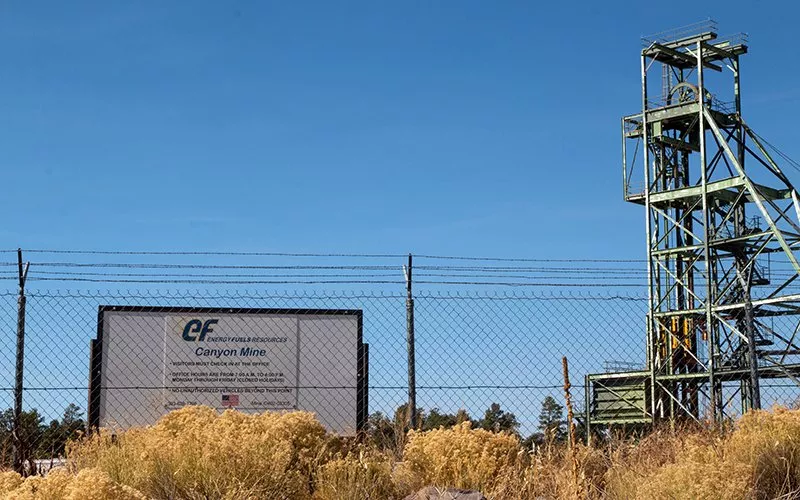
They are responding to a report last week by the Department of Energy’s Nuclear Fuel Working Group, which called for the government to support both uranium mining and nuclear power technology to preserve national security.
The first step in that plan is a proposal for $150 million in next year’s Energy Department’s budget to buy and stockpile U.S.-mined uranium, the report said.
“As a matter of national security, it is critical that we take bold steps to preserve and grow the entire U.S. nuclear energy enterprise,” Energy Secretary Dan Brouillette said in a statement announcing the report. He said a lack of U.S. progress on nuclear energy and technology “has threatened our national interest and national security.”
Environmentalists say there is no need to protect a “sagging” uranium mining industry and fear the report will lead the administration to slash environmental laws and regulations to allow for more mining. That is a particular concern in northern Arizona where there are hundreds of abandoned uranium mines that still pose health risks, they said.
“We cannot turn a blind eye to past mining in the region and incentivize new mining on public lands without even fully remediating environmental and public health hazards already present,” Rep. Tom O’Halleran, D-Sedona, said in a statement responding to the report.
Tuesday, April 21, 2020
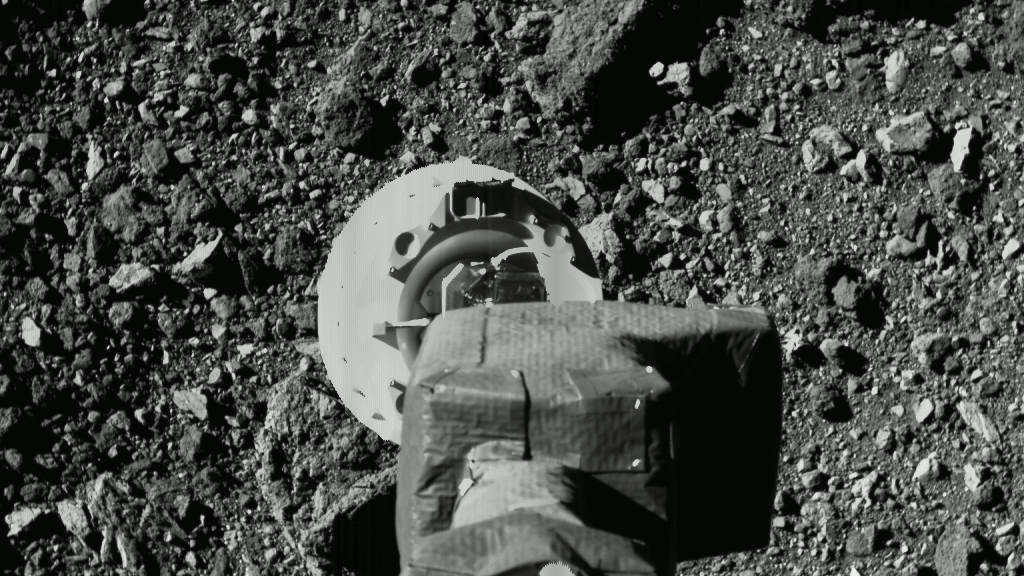
On Tuesday, April 14, the NASA spacecraft captured the closest-ever images of the asteroid Bennu during a sample collection rehearsal. The images, taken only 200 feet from the asteroid's surface, show the rocky terrain that the OSIRIS-REx spacecraft plans to capture a sample of on Aug. 25.
According to UA, the images were recorded over a 10-minute span during sample collection rehearsal. The images show the spacecraft’s sampling arm—called the Touch-And-Go Sample Acquisition Mechanism—and Bennu's "Nightingale" sample site.
The UA/NASA mission launched on Sept. 8, 2016, and is expected to return to Earth with a sample of the asteroid's surface on Sept. 24, 2023. While OSIRIS-REx is anticipated to be the first U.S. space mission to return samples from an asteroid, the spacecraft will not land on Bennu's surface. Instead, it will use the Touch-And-Go Sample Acquisition Mechanism to shoot a jet of nitrogen, dislodging particles from the asteroid. The spacecraft is expected to be able to capture upwards of 60 grams worth of carbonaceous dust and rock ejected from Bennu's surface.
Tags: science , nasa , asteroid , osiris , rex , ua , uarizona , Image
Monday, April 20, 2020

As part of International Dark Sky Week, the star party features live presentations and hosts from multiple time zones, all sharing information and their passion on astronomy.
The star party also features participants from the Prescott Astronomy Club; the Mark Slade Remote Observatory in Spotsylvania, Virginia; and the Feynman Observatory in Bloomington, Indiana; as well as astronomer Brian Cummins of Chantilly, Virginia; and, Michael Keefe, The AstroNerd, of Apex, North Carolina. Several participants are members of the NASA/JPL Solar System Ambassadors volunteer corps.
The livestream begins at 8 p.m. for Arizona on Friday, April 24 at cfa.harvard.edu/flwo/youtube
Tags: astronomy , stars , livestream , observatory , Image
Monday, April 6, 2020

Though the moon will be in its perigee—its closest point to earth—during the daytime, it will be full after the sun has already set.
"At 10:35 p.m. EDT—7:35 p.m. here—the moon will be exactly full as it will be opposite from the sun in its orbit," said Tim Swindle, who heads the University of Arizona Lunar and Planetary Laboratory. "And since it's a full moon, it will rise right around sunset, 6:38 p.m., with sunset occurring at 6:47 p.m., to be exact."
Wednesday, February 26, 2020
Bad news for Elvis impersonators, Civil War reenactors and our bearded brethren across the world...but good news for Gillette.
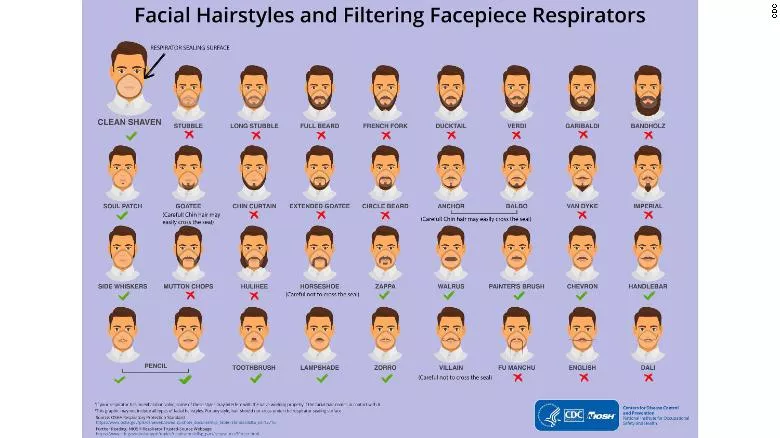
The Centers For Disease Control And Prevention recommends shaving your beard to protect yourself from a potential coronavirus outbreak. Beards and mutton chop side burns can interfere with the seal of a facepiece respirator mask, according to a new CDC infographic.
The circle beard, the fu-manchu and the chinstrap are other facial hair styles recommended for shaving by the CDC.
The bottom line is facial hair should not make any contact with the respirator seal's surface, according to the infographic.
The CDC also urged the American public to start preparing for potential future outbreaks during a press conference on Tuesday.
“As we’ve seen from recent countries with community spread, when it has hit those countries, it has moved quite rapidly," Nancy Messonnier, director of the CDC’s National Center for Immunization and Respiratory Diseases, said at the conference. "We want to make sure the American public is prepared."
Messonnier also noted the increased risk of a domestic outbreak due to travel between countries like Italy, South Korea and Iran, all of which have seen recent coronavirus outbreaks.
“As more and more countries experience community spread, successful containment at our borders becomes harder and harder," Messonnier said.
There are currently 80,000 cases of coronavirus globally, with the majority being in mainland China. Domestically, there has been 53 confirmed cases of U.S. citizens with the virus; 14 cases from people who recently traveled to China, and another 39 Americans who have been affected abroad.
Tags: coronavirus , Center for Disease Control , Nancy Messonnier , illness , facial hair , beards , Image
Friday, September 6, 2019
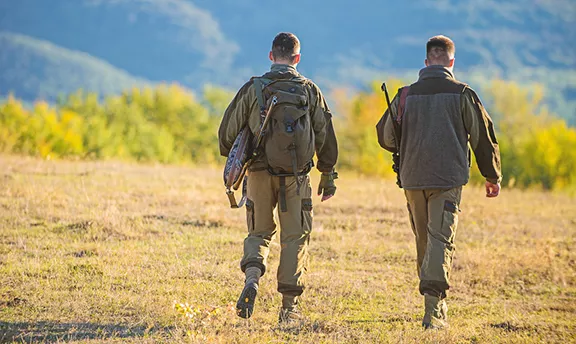
The changes, announced last week by the U.S. Fish and Wildlife Service, affect 1.4 million acres of federal land, more than 800,000 of which are in Arizona where seven of nine national wildlife refuges would be included in the changes.
Zack May, president of Southern Arizona Quail Forever, said the changes reduce contradictions between state and federal hunting rules while making national public land more accessible to sports enthusiasts.
“Anything that improves public access to public land is a good thing,” he said.
While hunters cheered the changes, environmentalists groups greeted them with a shrug. Brett Hartl, government affairs director for the Center for Biological Diversity, called the expansions “relatively minor and somewhat silly,” pointing to Kofa as an example.
“The reality is that there’s not that many hunters that go there,” Hartl said. “It’s hotter than hell 98 percent of the year.”
Kofa, at more than 660,000 acres, is the largest of the wildlife refuges affected by the changes.
The Interior Department said the new rules open hunting and fishing on 77 national wildlife refuges and 15 hatcheries. The rules also remove or revise more than 5,000 hunting regulations “to more closely match state laws,” Interior Secretary David Bernhardt said in a new release announcing the change.
The department says the rules open or expand twice as much land as had been opened in the previous five years, and brings the number of refuges allowing hunting to 381. Affected refuges now have expanded season dates, longer hours or more hunting take methods for several bird and big game species, according to the Fish and Wildlife Service.
The hunting and fishing changes unveiled by the U.S. Fish and Wildlife Service affect 77 national wildlife refuges and 15 fish hatcheries. (Photo by Bureau of Land Management/Creative Commons)
May, who hunts primarily in Buenos Aires and Cibola national wildlife refuges, said he has experienced “minor issues” with conflicting state and federal regulations and credited the new rules to a good working relationship between the two governments.
The final rule specifies that Fish and Wildlife officials will work with the Arizona Game and Fish Department on opening more opportunities in the next three years, including the two refuges not included in this year’s changes.
Hartl questioned the need for further expansion, characterizing the fanfare in the Interior Department’s announcement as a move to appease President Donald Trump’s political base.
“It’s such a modest thing,” Hartl said. “There’s no pent-up demand. It’s not as if this has been a contentious issue.”
A May Fish and Wildlife Service report estimates that only about 3% of Kofa’s 95,404 visitors visited the refuge for hunting during the 2017 fiscal year.
But others see the rules as a sign the federal government is listening to the real owners of the land: the public.
Hunting groups such as Safari Club International contend that people should be able to utilize public space, regardless of its popularity. Benjamin Cassidy, director of government affairs, said giving hunters the opportunity to hunt in places like Kofa “should be commended.”
“I think it continues in the tradition of listening to the American people and seeing how we can improve the experience on public lands,” he said. “Americans own these public lands.”
National wildlife refuges in the Southwest U.S. saw over 7 million visitors in 2017, according to recent Fish and Wildlife Service reports.
Nick Wiley, chief conservation officer for Ducks Unlimited, called the changes a “fresh look” at access to public lands – Arizona included.
“There’s a strong hunting interest from the people in Arizona and the hunting community,” Wiley said.
Tags: hunting , parks , Safari Club , Game and Fish , wildlife , national wildlife refuges , Image
Tuesday, July 23, 2019

PHOENIX – Some of the landscaping at Phoenix Sky Harbor International Airport has changed from front-lawn green to desert tan. The airport recently finished replacing nearly 11 acres of turf with native flora as part of a water conservation project that’s expected to save nearly half a million dollars a year.
The landscaping approach is known as xeriscaping, which uses native, drought-resistant flora arranged in ways that promote efficient water usage. The airport project incorporated 435 water-sipping trees, 75 saguaros, 275 other large cactuses and about 2,900 plants and shrubs for groundcover, according to a release from Sky Harbor.
The xeriscaping project is expected to save the city $400,000 annually, in addition to reducing water usage by more than 5 million gallons per year.
“You see in people’s houses, you see it in other natural landscaping because it fits here,” Sky Harbor public information officer Greg Roybal said. “I think the water services director said it best when she said we honor our environment when we plant things that belong here.”
The redesign, completed in June, is part of the airport’s 2015 Sustainability Management Plan, which aims to reduce water consumption by 10% by 2020. Sky Harbor currently uses an average of 30 million gallons of water per month.
Phoenix’s chief sustainability officer, Mark Hartman, said the converted areas were not near pedestrian spaces.
“You want to be very strategic about where you use your water,” he said. “Like, there’s not that many people who walk to the airport and walk along beside the freeway, so having grass there might not be a good spot for grass.”
The xeriscape project is one of seven initiatives in the airport’s sustainability plan, which also focuses on air quality, energy use and waste management.
Because less maintenance is needed on those 11 acres, the project also falls in line with Phoenix’s pledge to reduce greenhouse gases by 30% by 2025.
“It fits in perfectly with not only our overall goals but with the city’s goals and the community’s goals,” Hartman said. “I think it’s going to be looked at as a prime project to model after.”
This story is part of Elemental: Covering Sustainability, a new multimedia collaboration between Cronkite News, Arizona PBS, KJZZ, KPCC, Rocky Mountain PBS and PBS SoCal.
Tags: cronkite news , Sky Harbor , airport , sustainability , xeriscaping , landscape , redesign , Image

