

Friday, November 30, 2018

UA was ranked No. 23 out of all public universities and No. 38 for all U.S. universities, according to UA News. This also rates them higher than all other Arizona universities, and was discovered through the Higher Education Research and Development survey.
"University of Arizona researchers have had great success over the past year, both in their efforts to attract funding for their work and in the impact that they have in Arizona and globally," said UA President Robert C. Robbins.
This year's research funding was up nearly $20 million. According to UA News this put the university in the top 5% nationwide. The HERD survey also showed that UA was No. 5 in NASA funding, No. 6 in physical sciences and No. 1 in astronomy and astrophysics.
"The quality of our research is recognized around the world and it's because of the dedication and quality of our staff and faculty," said Kimberly Ogden, interim vice president for research at the UA.
For more information on UA research click here.
Tags: UA Research Top 25 , UA Research , UA Top 25 , university of arizona , Image
Thursday, November 29, 2018

Ben Bronselear, a postdoctoral research associate in UA Geosciences and first author of “Change in future climate due to Antarctic meltwater,” (a report published in the journal Nature) said that current climate models do not include the effect of melting ice on a global scale.
"It’s the first new identified feedback on climate in 20 years," said Joellen Russell, a UA associate professor of geosciences and leader of the SOCCOM group focused on improving the Southern Ocean's representation in the computer models of global climate.
Previously, research suggested that the melting of the Antarctic ice sheet would only affect the sea level, but the not the entire climate system. Using a climate model called ESM2M, scientists simulated tests over the time period of 1950 to 2100.
The studies determined the global temperature would increase by 2 degrees Celsius by the year 2065 (and not 2053, as previously estimated). However, they also estimated that by the 2100, the sea level will rise approximately 10 more inches above the previous estimate of 30 inches.
Russell determined that the ocean circulation moves heat from the equator to the poles, where the heat is then released into the atmosphere. However, the team’s new research reveals that the additional freshwater from the melting ice sheet acts like a lid on the waters around Antarctica and decelerates the release of heat.
The research is part of the National Science Foundation-funded Southern Ocean Carbon and Climate Observations and Modeling (SOCCOM) Project, with The National Oceanic and Atmospheric Administration and NASA also funding.
“The melting delays warming—it's still warming but it will warm less steeply and give us another 15-year grace period," Russell said.
Tags: climate change , science , UA , ice melting , ocean levels , global warming , NASA , geoscience , nature , warming , Image
Tuesday, November 27, 2018

Three high school students who were in summer internships with the UA Bioinformatics Laboratory will leave high school being published scientific authors.
Usually only college students and graduates have the opportunity to be co-authors in scientific published work, but Liam Wilson, Wesley Chiu and Minsu Pumarejo each were able to complete a summer data science internship in a bioinformatics lab in the Center for Biomedical Informatics and Biostatistics at the University of Arizona.

Wesley Chiu is a senior at Basis Tucson North High School and initially had an interest in biology. After the internship, Chiu said he learned more about databases, querying and their connection to the real world application.
"We have don't a lot of programing in class, but this has really opened my eyes to the possibility of integrating programming to solving problems affecting humanity right now," Chiu said.
Though the internship, the three students participated in a four year computational biology project that analyzed 'junk DNA,' an area of the DNA that does not produce proteins and where diseases can derive from. These regions of the DNA are still not completely understood and account for 97 percent of the human genome.
UA researchers analyzed the shared molecular mechanisms between diseases and found 398 new links among approximately 16,000 potential combinations.
The continuous work of Dr. Li and Dr. Lussier in this study has the potential to contribute new solutions of preventive and treatment plans for diseases, lowering healthcare costs and can decrease mortality rates for patients.
Tags: science , biology , high school , university , internship , Image
Friday, November 23, 2018

Traveling since Sept. 2016, OSIRIS-REx is arriving at Bennu, the carbonaceous astroid it was sent to collect a sample from two years ago. To laud its mission, the UA College of Humanities is launching with BENNUVAL!, an "out-of-this-world family-friendly variety show."
This show is to celebrate OSIRIS-REx's arrival to Bennu, as well as explore the "spirit of human curiosity" that drives missions like this. The spirit that "extends across human history and also unites different fields of study, from the sciences to the humanities."
“Human cultures have always looked to the stars as they sought answers about the meaning of life,” College of Humanities Dean Alain-Philippe Durand wrote in a UA press release. “The names from those stories and myths are now the names of the planets, stars, asteroids, and the space missions that go to explore them. The study of humanities and human cultures has always been closely intertwined with the scientific search for answers about our world. Dante Lauretta is an inspiring representation of that connection.”
Local musicians, artists, and special guests like Dante Lauretta and other UA professors will delve into stories that will "share the myths and stories that inspired the names of the space missions and asteroids."
Lauretta's “TED-style talk” will explore the origin of life, as well as the importance of asteroids (like Bennu and Ryugu). With the help of a presentation from UA Egyptologist, Lauretta will also distinguish the ties between the mission of OSIRIS REx to the Egyptian god, Osiris and the deity Bennu. Also see the latest images OSIRIS Rex.
Described in the release as "A true variety show, BENNUVAL! will also feature Emmy Award-winning host Geoff Notkin, improv comedy from Unscrewed Theater, readings of space poetry the UA Poetry Center, music from ChamberLab composer Chris Black, and performances by the renowned acrobatic ensemble Flam Chen."
The event will be held at the Fox Theatre, 17 W. Congress St., Dec. 1 at 6pm.
Regular admission is $10 and $6 for students with a CatCard.
Tags: Science , Fox Theatre , Osiris , OSIRIS REx , Bennu , Egyptian gods , UA college of Humanities , BENNUval , BENNUval! , Image
Tuesday, November 13, 2018

The Southwest Climate Adaptation Science Center, SW CASC, at the University of Arizona received a $4.5 million grant from the United States Geological Survey to support research on climate science and adaptation in the Southern Arizona region.
SW CASC was originally established in 2011 and is responsible for researching the adaptation impacts of land, water and wildlife in the southwest.
With the grant, the SW CASC will be able to continue its seven-year research in partnership with the United States Geological Survey, USGS, to assess the southwest's scientific needs.

Researchers at the SW CASC will be able to use the funds to research topics including vegetation conversion, the theory that after destructive natural events such as wildfires and pathogen outbreaks, new species will appear in the landscapes effected.
The center also announced that it will continue research on drought, the steady increase of summer and winter temperatures and flood risks due to increases in rainfall.
Stephen Jackson is the USGS director of the SW CASC and adjunct professor of geoscience and natural resources and environment at UA. Jackson said that the research would also be able to help other parts of the country.
"The entire world is going to be and already is facing impacts of climate change, but in the southwest, we're seeing it faster and more intensely," Jackson said. "Seeing this first puts us in a good position to tell people in other parts of the country what challenges might be coming to them and pass along information about how to adapt."
To read more about the Southwest Climate Adaptation Science Center, click here.
Tags: adaptation , science , UA , wildlife , research , Image
Monday, November 5, 2018
“Meet MCB! is our opportunity to share the scientific research of molecular and cellular biology with Arizona high school students,” said Dr. Joyce Schroeder, Head of the Department of Molecular and Cellular Biology.
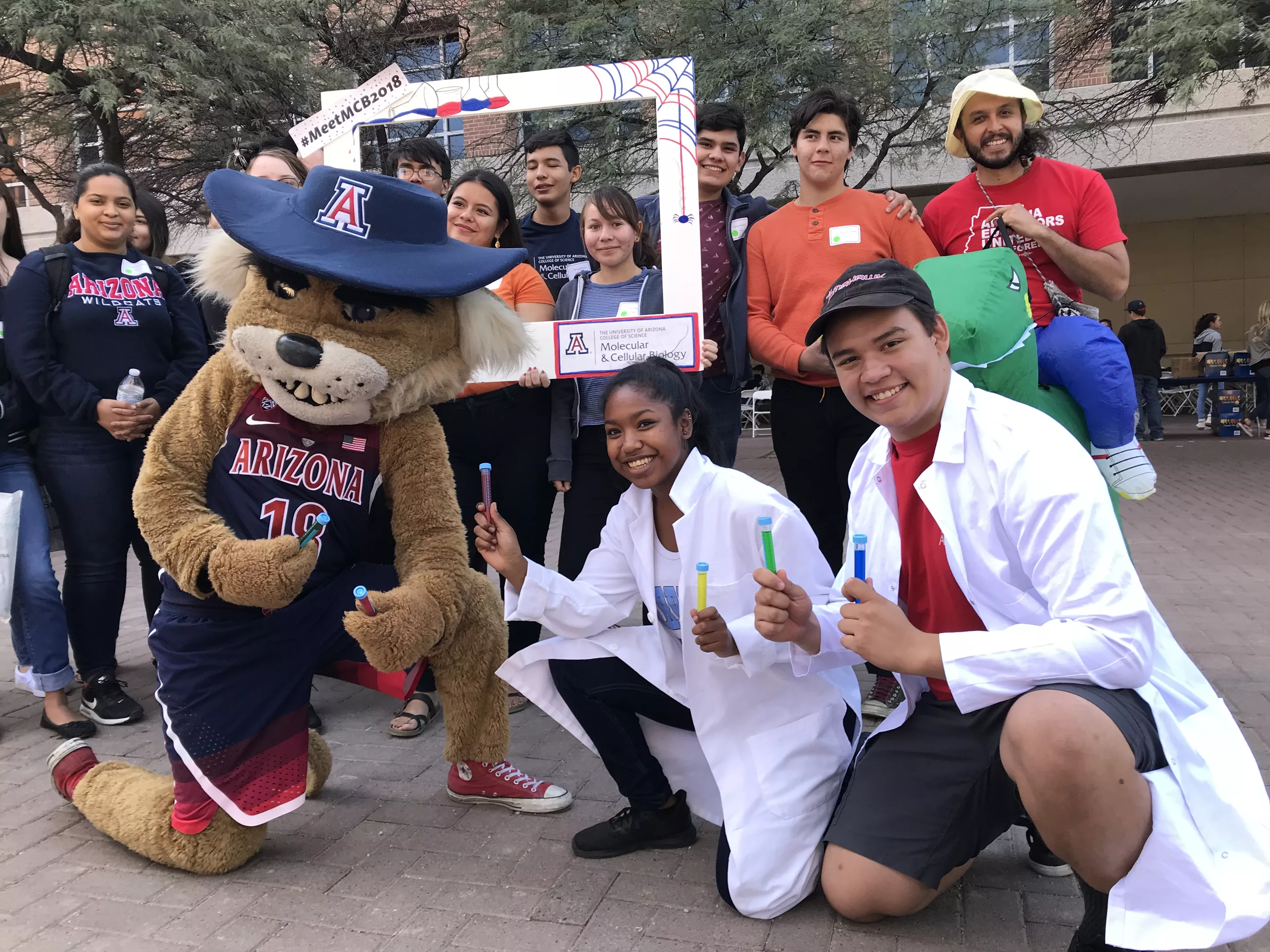
At the event, students toured UA research labs working on cancer research, aging and neurodegenerative disease, while also receiving information on applying to the university and the MCB major.
“Our goal through this event is to showcase the excitement of UA science and give them a glimpse of what life is like as a MCB major at the University of Arizona,” Shroeder said.
All students who attended the event were already linked to the MCB department through the decades-old BIOTECH Project. Through this project, teachers offer high-school students across Arizona hands-on biotechnology experience in professional development workshops, classroom visits, and material and equipment loans.
Dr. Andrew Lettes, biotechnology instructor at Pueblo High School, is heavily involved with the BIOTECH project and attended the Meet MCB! event with his students.
Lettes’ students are currently taking advantage of the BIOTECH project by earning college credit via biotechnology CTE courses at Pueblo High.
This option was first made available in Spring 2013, with the UA MCB department offering three units of credit for two biotechnology courses, MCB101 and MCB102, and for a fraction of the cost: $475 dollars per course. Currently, 12 schools in Pima County offer this opportunity to their students.
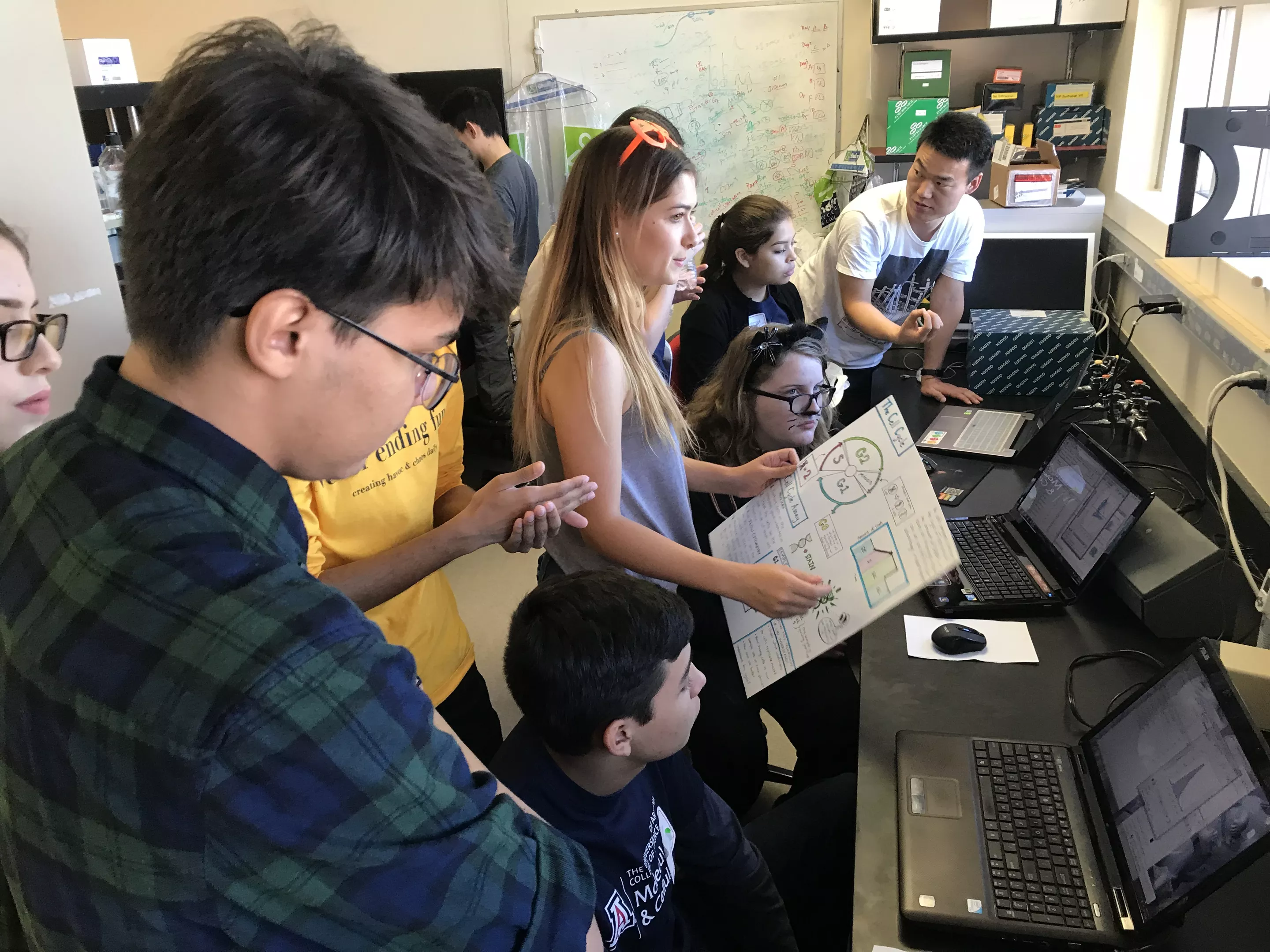
“It’s different than a simple bio course,” Lettes said. “It helps apply the science that they learn to real life.”
During their lab tour with UA associate staff scientist Kimiko Della Croce and her team of university students, the Pueblo High School students walked through a series of large posters explaining why individual cells are studied and how the data is analyzed through cytometry. After, the students saw computers processing data from the cells.
Kara Dyson, the senior academic advisor for the MCB department, said in a press release, “By hosting Meet MCB!, we hope to dispel some of the stigma about big universities and show that our department is a big family of people who truly care for their students.”
The BIOTECH project is supported by the UA BIO5 Institute, the Pima County Joint Technological Education District, the Pima County One Stop Career Center, the UA MCB department and the Marshall Foundation, and continue to use their support to help underrepresented populations of students.
Tags: science , education , BIOTECH , Molecular & Cellular Biology , MCB , UA , Image
Tuesday, October 23, 2018

The grant will allow the College of Nursing to partner with MHC Healthcare in Marana. Together, the collaboration aims at better equipping MHC to treat opioid use disorder.
The overdose rate in Pima County for 2016 was 21.9 per 100,000 people which is much higher than the state average of 16.9 per 100,000. Part of the problem is that rural health care providers don't have the same opportunities to receive training in behavioral health in regards to opioid use.
This grant and partnership will be put to use to train healthcare providers in Pima county on how to better handle opioid misuse.
Learn more here.
Tags: University of Arizona , College of Nursing , MHC Healthcare , Rena Love , Nursing , Health , Hospital , Opioid crisis , rural , Marana , Pima County , Image
Tuesday, October 16, 2018

The area surrounding Tumamoc Hill is the longest continuously inhabited site in the United States, with evidence of maize cultivation from over 4,000 years ago. This was a leading factor in the UNESCO designation of Tucson as an international city of gastronomy.
The site was first studied by scientists from the Carnegie Institution in 1903 with the goal of learning how plants adapt to the arid environment. The area was purchased by the University of Arizona in 1956 and is one of the longest-running scientific observations in the world.
"The people that walk the hill today are only the most recent chapter in that history, the vantage point from this peak looking over the valley of Tucson continues to draw us up Tumamoc’s slopes," Wilder said. "Now, we have 115 years of science that is the baseline of knowledge of the Sonoran Desert.
Wilder described his new position as his dream job, and has come full circle since he began his journey at Tumamoc studying buffelgrass as an undergraduate student in 2004.
Wilder returned to UA in 2015 to work with the Consortium for Arizona and Mexico Arid Environments. In 2016 he was appointed the interim director of Tumamoc Hill. Since then, Wilder has helped create Tumamoc Tour, a free app that tells the history of the Sonoran desert through the hill, rainwater harvesting at the Tumamoc Laboratory and modern storage for important fossils that are kept at Tumamoc.
Now, as director, Wilder said he plans to upgrade old buildings, labs
Wilder is positive about the years to come for the age-old Tucson favorite, saying "the work we do here is our history, but also our future."
Learn more about Wilder here.
Tags: Tumamoc Hill , Benjamin Wilder , University of Arizona , Sonoran Desert , Ecology , gastronomy , culture , anthropology , Desert , Tucson , Santa Cruz Valley , UNESCO , Cactus , Science , Image

Fred Fox Music+Festival. The Fred Fox School of Music will be hosting its eleventh Music+Festival this year to honor late poet Paul Pines. The festival will consist of seven concerts, a symposium and a major conference. Although most events are featured on the weekend, today they will be hosting the Poetry of Paul Pines set by Daniel Asia. 7:00 p.m. Holsclaw Hall, 1017 N. Olive Road. This is a free event. Details Here.
Creative Juice Spooky Starry Night. Get through the week with a little art, sipping on a glass of wine and learning how to paint like Van Gogh. With an instructor to guide you through step-by-step instructions, avoid a disaster with paint and have a great social hour at the same time. Plus, you'll be creating a masterpiece! $35 per person. 6530 E. Tanque Verde Road. Details Here.
Send Us Your Photos:

If you go to any of the events listed above, snap a quick pic and tag us for a chance to be featured on our social media sites! Find us on Twitter, Facebook and Instagram @tucsonweekly.
Events compiled by Brianna Lewis, Emily Dieckman, B.S. Eliot, Zac Ogden and Jeff Gardner.
Tags: Tucson events , UA events , Things to do in Tucson , Image
Monday, October 15, 2018

On Tuesday, Oct. 16 at 6 p.m., the University of Arizona College of Science will be hosting UA Science Café. This installation of the Cafe is titled ‘The Race for Ground Water-A Shrinking Resource’ and is held at Magpies Gourmet Pizza on Fourth Ave.
Presented by Jen McIntosh, associate professor for UA Department of Hydrology and Atmospheric Sciences, the talk will bring the community together to talk about the competition and shrinking supply of the last deep groundwater resources in the United States.
Barbara Sherwood Lollar, a prominent scientist from the University of Toronto who discovered deep, billion-year-old water resources in the earth’s crust and the microbial life that lives there will be highlighted at the talk.
The Science Café at Magpies Gourmet Pizza series features leading female researchers from the University of Arizona who work in a variety of fields. Each presenter will reference a female researcher who came before them in their field, who inspired them at a time when few women were able to pursue a career in scientific research.
Science Cafés teach the latest research that is being conducted and allow all to come and interact with the faces behind the science. There are five different café series at five different locations in Tucson.
Tags: Magpies , pizza , science , hydrology , groundwater , resources , researchers , research , café , water , Image

