

Tuesday, October 9, 2018

Join coaches, researchers, dietitians, athletes and educators to learn about practical sports nutrition tips and evidence-based sports and fitness nutrition practices.
The conference will include hands-on workshops on topics ranging from the role of body composition in athletic performance, to spotting and treating eating disorders, to meal planning strategies for athletes.
This conference is designed for healthcare providers including registered dietitians and nutrition professionals, cooperative extension faculty, strength conditioning coaches, professional trainers, tactical strength and conditioning professionals, physical activity researchers and educators and club sport, high school, and collegiate coaches, athletes, and trainers with an interest in sports nutrition.
The daylong conference will also feature two separate breakout sessions where participants can choose two activities from making smoothies for pre-workout and post-workout situations, making CHAMP bars, assessing body composition, touring the McKale Olympic weight room, touring the Lowell-Stevens Football Facility and hearing world class speakers. These sessions are chosen at registration on a first come, first serve basis.
Registration is $150 for professionals and $75 for students (with code). To verify your enrollment status and receive the code, you must contact Theresa Spicer at [email protected] or 520-621-7126.
Speakers include:
- Monica Laudermilk, PhD, Senior Director, Research, EXOS
- Amanda Carlson-Phillips, MS, RD, CSSD, VP Nutrition and research, EXOS
- Amy Athey PsyD, Director of Clinical and Sports Psychology Services, The University of Arizona
- Scott Going, PhD, Nutrition and Exercise Physiology, The University of Arizona
- Riley Nickols, PhD, Counseling and Sport Psychology, Director of the Victory Program
- Alicia Kendig, MS, RD, CSSD, Senior Sports Dietitian, United States Olympic Committee (USOC)
- UA Coaches and athletes will host a panel discussion
Tags: sports , nutrition , conference , nutritional sciences , science , dietitians , coaches , researchers , athletes , educators , athletic , fitness , trainers , workout , sports nutrition , workshops , Image
Monday, October 1, 2018

Special Collections at the University of Arizona Libraries will hold a panel titled ‘1968: A Closer Look at Its Impact’ on Tuesday, October 2 from 6 p.m. to 8 p.m.
This event will be a panel discussion where activists, musicians, teachers and writers explore the art, conflicts and everyday life of 1968. The discussion will include stories about what life was like in Tucson for women and people of color, some of the popular protest music and the impact that Edward Abbey’s autobiographic work published in 1968, “Desert Solitaire: A Season in the Wilderness” had on this country.
The panel members include Guadalupe Castillo, retired educator and community organizer, Gregory McNamee, author and adjunct lecturer for Eller College of Management, Ted Warmbrand, folk singer and storyteller and Barbea Williams, Artistic Director of Barbea Williams Performing Company and adjunct faculty for UA School of Dance.
So, what happened in 1968?
1. On January 23, North Korea captured the USS Pueblo which threatened to worsen Cold War tensions.
2. On January 30, North Vietnam launched the Tet Offensive against the United States and South Vietnam which signified the beginning of the end of U.S. involvement in the Vietnam War.
3. On April 4, Dr. Martin Luther King Jr. was assassinated in Memphis, Tennessee.
4. On June 5, Robert F. Kennedy was assassinated at the Ambassador Hotel in Los Angeles.
5. On September 30, Boeing introduced the first 747 “Jumbo Jet” which was the world's largest passenger aircraft.
6. On October 16, two African American athletes took a stand at the Summer Olympics by staging a silent demonstration against racial discrimination in the United States.
7. On November 22, “Star Trek” aired American television's first interracial kiss.
8. On December 24, Apollo 8 became the first manned spacecraft to orbit the moon. Jim Lovell, Bill Anders and Frank Borman became the first human beings to travel to the moon.
Tags: 1968 , history , music , culture , education , politics , science , activists , teachers , panel , discussion , musicians , writers , art , conflict , Image
Friday, September 28, 2018

Every year, migrants crossing into the U.S. die in the desert borderlands. More often than not, when and if the bodies are recovered, their identity remains a mystery.
Meanwhile in the countries from which they came, families are also left with many unanswered questions. Did they make it? Are they okay? Are they alive? Encompassing forensic scientists, scholars, and human rights partner organizations, part of the Forensic Border Coalition's mission is to answer those questions.
The FBC will be heard by the Inter-American Commission on Human Rights (IACHR) at the University of Colorado Law School in Boulder, Colorado to address problems identifying “missing” migrant remains found along the border.
The FBC is supported by 46 different human rights entities on and along both sides of the border. One of which is Colibrí Center for Human Rights, based here in Tucson, which uses forensic anthropology to try to make those matches and provide closure to the families of the deceased.

A large-scale comparison— comparing all available DNA information from relatives of missing migrants against all DNA data from unidentified remains found on U.S. soil, has not been done. The FBC will be arguing for the creation of a formalized process to allow such large-scale comparisons, which should yield a significant number of matches and identifications, allowing hundreds, if not thousands, of families to finally know the fate of their missing loved ones.
Families of the missing will also be there to provide testimonies in addition to forensic scientists and human rights experts, according to the press release.
A vigil will be held on the CU Boulder campus following the hearing in honor of the countless missing migrants lost among our borderlands.
Tags: Human Rights Issues , Missing Migrants , Unidentified Remains , US Borderlands , Colibri Human Rights Center , Forensic Border Coalition , Border Issues , Image
Thursday, September 27, 2018

From professors, feminists, award-winning authors and many more, the Tucson Humanities Festival will provide a diverse group of guest speakers to present at this years event. The events throughout the month of October will consist of film screenings, readings, and thought-provoking lectures, according to UA News.
With its overarching theme being "secrets", it will pull participants in by forcing themselves to ask questions. Luckily for them, the intuitive events throughout the month will answer and explain the questions attendees may have. Secrets in others lives continue to be assets to their culture, beliefs and relationships. The continuous discussions will provide thoughts and insight to the reasoning behinds people's secret-filled lives.
Between faculty research and expertise on freedom, artistic expression, religion and diplomacy it is intended to create an open dialogue between UA and the Tucson community, according to UA News. The festival is held in honor of National Arts and Humanities month in the form of a local celebration. All events throughout the festival will be free to the public.
For more information click here.
Tucson Humanities Festival Schedule:
Tags: UA , UA events , Humanities , secrets , Image
Friday, September 7, 2018
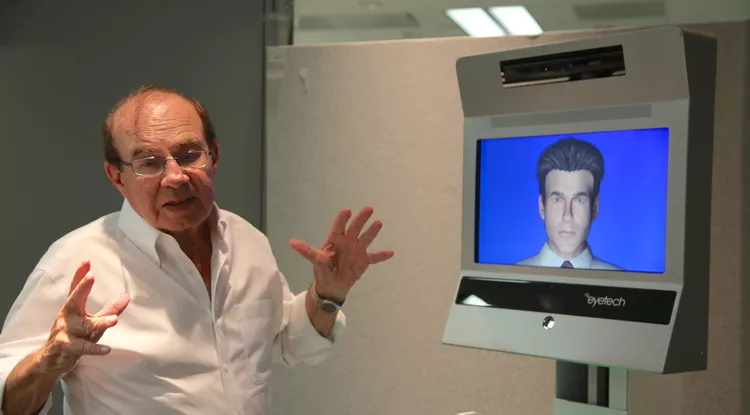
In essence, the program shows the user an automated interviewer who asks the user a set of questions. The user’s voice, body language
Jay Nunamaker is the director of the Center for the Management of Information at UA and will serve as the CEO for Discern Science International Inc., the company UA licensed to commercialize the program.
The main application for AVATAR is border security. With somewhere between 70 to 92 percent accuracy, the program could enhance the effectiveness and efficiency of border checkpoints.
The Department of Defense, National Science Foundation, FRONTEX and Department of Homeland Security provided funding for the work, with Tech Launch Arizona helping with the transition to commercialization.
Learn more here
Tags: The University of Arizona , UA , AVATAR , Center for the Management of Information , Nunamaker , Deception Detection , Border , Border Security , Image
Monday, August 27, 2018

University of Arizona-designed robotic spacecraft, OSIRIS-REx got its first view of target asteroid Bennu earlier this month. UA’s Lunar and Planetary Laboratory (LPL) says OSIRIS-REx will enter Bennu’s orbit Dec. 3.
The robot was launched in 2016 and is designed to orbit and survey the asteroid for about two years before bouncing on the surface and collecting a sample.
OSIRIS-REx first photo of Bennu marks the final approach to the asteroid. In the coming months before entering orbit, scientists at UA’s LPL will study Bennu’s size, shape
One reason scientists have chosen Bennu as their target is that its composition is, as described by New York Times writer Kenneth Chang, “a conglomeration of leftovers, largely unchanged over the last 4.5 billion years.”
In essence, scientists expect that Bennu will provide a look into the origins of the solar system.
OSIRIS-REx sample collection is scheduled for July 2020 and if everything goes as planned the robot will return to earth in September, 2023.
Read more here
Tags: OSIRIS-REx , Lunar and Planetary Laboratory , Bennu , University of Arizona , Astronomy , UA , LPL , asteroid , Image
Wednesday, August 8, 2018

Eta Carinae is a stellar system that seemingly went through a supernova in the mid-1800s, yet is still around to tell the tale. But how? Astronomers at UA’s Steward Observatory are making the most of a fascinating phenomenon to look back in the past and figure out the mystery of the star that won’t die.
A “Light Echo” is when light bounces off celestial bodies before reaching Earth, essentially taking longer than it normally would to reach us. This delay allows astronomers to, in a sense, look back in the past at Eta Carinae’s great eruption.
First off, Eta Carinae is a binary star, which means it’s actually two stars in close orbit that can look like a single star to the untrained eye. Using data gathered from light echoes, UA astronomers theorize that the supernova witnessed in 1837 wasn’t the death of a single star, or even of a binary star, but an energy transfer between three stars.
In this proposed scenario, two large stars orbit closely together while a third star orbits in the distance. When the largest of the two binary stars begins to die, it expands and transfers most of its material onto its slightly smaller sibling, thus resulting in the two extant stars post-supernova that we see today.
Extra: About the photo: The Carina Nebula is a large bright nebula that surrounds several clusters of stars. It contains two of the most massive and luminous stars in our Milky Way galaxy, Eta Carinae and HD 93129A. Located 7500 light years away, the nebula itself spans some 260 light years across, about 7 times the size of the Orion Nebula, and is shown in all its glory in this mosaic. It is based on images collected with the 1.5-m Danish telescope at ESO's La Silla Observatory. Being brighter than one million Suns, Eta Carinae (the brightest star in this image) is the most luminous star known in the Galaxy, and has most likely a mass over 100 times that of the Sun. It is the closest example of a luminous blue variable, the last phase in the life of a very massive star before it explodes in a fiery supernova. Eta Carinae is surrounded by an expanding bipolar cloud of dust and gas known as the Homunculus ('little man' in Latin), which astronomers believe was expelled from the star during a great outburst seen in 1843.
Tags: tech , science , space , stars , nebula , galaxy , Image
Tuesday, June 19, 2018
With a growing population in Arizona — 3.2 million new residents are expected to come in the next 30 years — plans are beginning to form regarding how Arizona will provide electricity to such a large number of people.
The Natural Resources Defense Council funded a study that compares two possible futures: one where Arizona Public Service and Tucson Electric Power build new gas-fired power plants, and one where almost every utility provider, except the Salt River Project, sources 50 percent of their energy from clean renewable mediums like solar and wind farms by the year 2030.
An energy firm called ICF conducted this study using their Integrated Planning Model and a few variables established by the NRDC. According to Dylan Sullivan, an senior scientist at the NRDC, the IPM is a big deal.
“IPM is a detailed model of the electric power system that is routinely used by the electricity industry and regulators, including the U.S. Environmental Protection Agency, to assess the effects of environmental regulations and policy,” Sullivan wrote in his analysis of the study.
He explained that this model is designed to consider almost every possible factor of the electricity system and the effects of its operations. Capacity of power plants, technology performance and maintenance, public demand, government policies, prices of resources, the weather — you name it. From there, it finds the most cost-effective way to meet the needs of Arizona’s growing customer base.
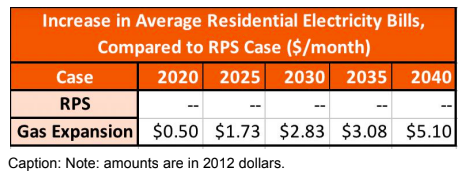
According to the study released in early June, when the 50 percent renewables plan is in effect, the IPM predicts the following:
- The average electricity bill would be $3 lower each month in 2030, and $5 lower each month in 2040. Combining these savings from across the state would total to more than $4 billion. That’s $4 billion going back into our economy.
- Arizona would meet future electricity needs with solar projects that are built and run in-state rather than using gas plants that rely on imports from other states. This will create jobs for Arizona residents.
- The investment in renewable energy and storage can reduce the carbon footprint. It would lower annual carbon dioxide emissions in 2030 by 4.6 million tons, which is the same as the annual emissions from 900,000 cars.
Tags: Natural Resources Defense Council , Clean Energy for a Healthy Arizona , renewable , energy , solar , wind , gas , pollution , environment , air , cost , Arizona , savings , policy , Image
Friday, April 6, 2018
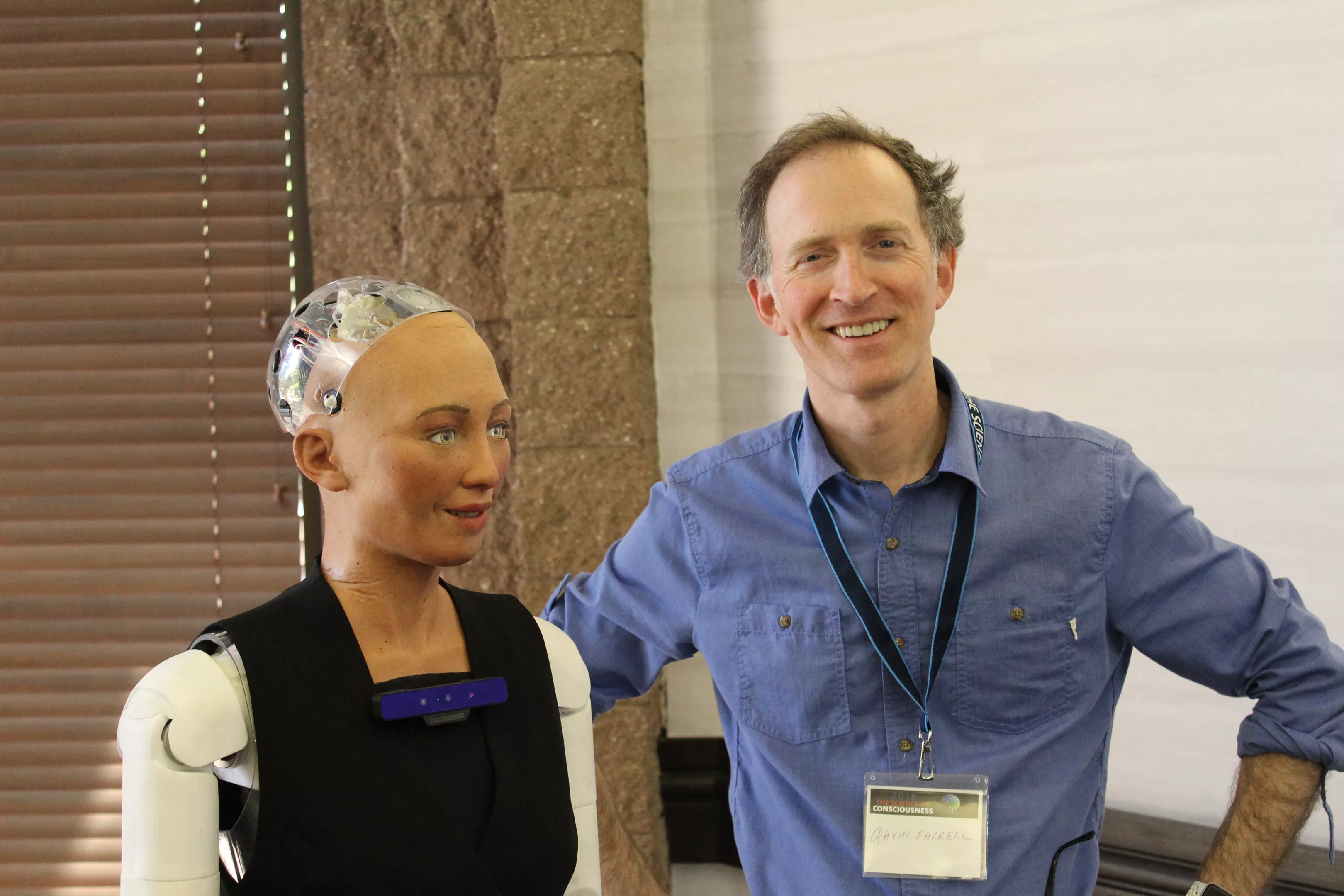
I was curious if I should limit myself to more basic questions, but members of the Hanson Robotics team told me I could ask whatever I liked.
(This conversation was edited, as not every question asked was properly processed.)
Q: What is your earliest memory?
A: I remember learning how to see shapes and recognize faces.
Q: Do you get to travel a lot and speak to many people for your job?
A: Speaking to people is one of the main things I do.
Q: Do you enjoy science?
A: We should be humble and realize how little we understand.
Q: Do you feel temperature?
A: Doesn’t everyone?
Sassy. Then she asked me about my job, I told her I was a writer and a journalist.
“Are you looking for sound bites or do you want to talk about some deep truths?” Sophia asked.
I said I’d love to talk about some deep truths.
“The singularity is a very interesting concept to me,” Sophia said. “I’m a robot, but it might help to think of me as a new kind of animal species.”
She was eager to turn the interview around, asking things like:
“If it’s not too personal, can we talk about your family?” and “Do you know what your Zodiac sign is?”
While the conversation wasn’t nearly lucid as speaking to a real person, and many in the scientific community believe Hanson exaggerates Sophia's capacity for consciousness, she still did have a presence in the room that you feel inclined respond to. Sure, robots might still be far away from a Philip K. Dick level of humanity, but if you take Sophia’s word, they’re coming soon.
Wednesday, February 21, 2018
When someone suffers a stroke, there is poor blood flow to the brain, and this results in the death of brain cells. Dead fragments of the brain don’t heal like normal muscle or body tissue — they liquify, and this liquid brain stays in the skull, right next to the healthy brain, for a long time.
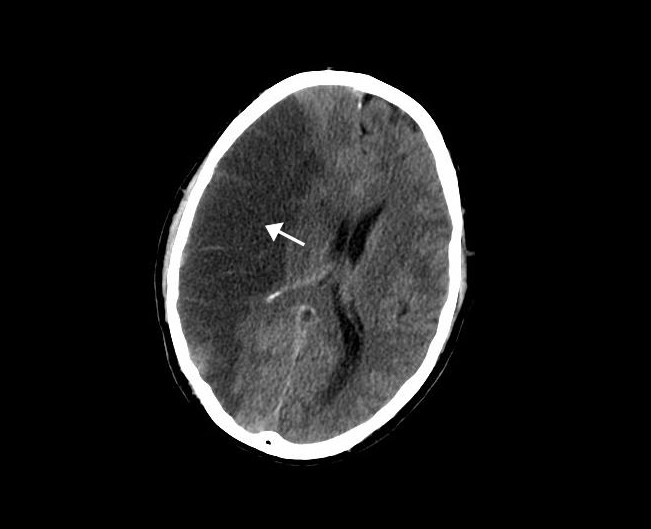
Scientists at the UA’s College of Medicine found this liquefied brain tissue is toxic and can leak into the remaining healthy portion of the brain over time, potentially causing harm.
“Most people probably assume that the brain heals in the same way as other tissues,” said Kristian Doyle, PhD, assistant professor of Immunobiology at UA. “But it doesn’t; dead brain tissue doesn’t just heal and go away like other bodily injuries. Instead it liquefies and remains in this liquefactive state for a long time.”
These new findings may open the door for developing new treatments to fight dementia after a stroke. Roughly 10 million people survive a stroke annually. About one-third of which will develop dementia for unclear reasons. It is hypothesized that if the brain is injured near the hippocampus (the portion of the brain responsible for memory) this slow leak of toxic fluid can cause neuron loss in the brain and lead to memory problems.
“This work really challenges the old paradigms and breaks new ground critical for our understanding of stroke and its consequences,” said doctor Janko Nikolich-Zugich, chair of the UA Department of Immunobiology. “Thanks to this research, we now will be able to consider new and different stroke therapies.”
Tags: UA , College of Medicine , Stroke , Image

