

Thursday, October 25, 2012
The first step, of course, is to rip the head off.
At least, from what paleontologists from Montana's Museum of the Rockies gather, that's how Tyrannosaurus Rex did it.
From Nature:
As [Denver Fowler] and his colleagues examined the various types of bite mark on the skulls, they were intrigued by the extensive puncture and pull marks on the neck frills on some of the specimens. At first, this seemed to make no sense. “The frill would have been mostly bone and keratin,” says Fowler. “Not much to eat there.” The pulling action and the presence of deep parallel grooves led the team to realise that these marks were probably not indicative of actual eating, but repositioning of the prey. The scientists suggest that the frills were in the way of Tyrannosaurus as it was trying to get at the nutrient-rich neck muscles.“It's gruesome, but the easiest way to do this was to pull the head off,” explains Fowler with a grin. The researchers found further evidence to support this idea when they examined the Triceratops occipital condyles — the ball-socket head—neck joint — and found tooth marks there too. Such marks could only have been made if the animal had been decapitated.
Awesome. For the rest of that article, check out Nature.com.
And now, people in rubber dinosaur suits fighting:
Tags: tyrannosaurus rex , triceratops , nature , denver fowler , museum of the rockies , dinosaurs! , "How do you eat a triceratops? One bite at a time!" , Video
Monday, October 22, 2012
This is proof positive that everything old is new again. From New Scientist, it turns out that hard disks are on their way out as mediums for high-density information storage, as a result of the physical limitations of hard disk technology. The solution, interestingly, is related to what's currently sitting in my nearly-old-enough-to-buy-beer pickup truck: the cassette tape.
From NewScientist:
Researchers at Fuji Film in Japan and IBM in Zurich, Switzerland, have already built prototypes that can store 35 terabytes of data - or about 35 million books' worth of information - on a cartridge that measures just 10 centimetres by 10 cm by 2 cm. This is achieved using magnetic tape coated in particles of barium ferrite.But the real debut for this technology is likely to be the Square Kilometre Array (SKA), the world's largest radio telescope, whose thousands of antennas will be strewn across the southern hemisphere (New Scientist, 2 June, p 4). Once it's up and running in 2024, the SKA is expected to pump out 1 petabyte (1 million gigabytes) of compressed data per day.
Current projections by the trade body Information Storage Industry Consortium show that although hard drives will be able to store 3 terabytes a piece in a decade's time, that still amounts to at least 120,000 drives a year.
Using tapes should cut down drastically on energy use, too. Data centres based on disc drive arrays use over 200 times more power than would a tape library of similar size, according to a 2010 study by The Clipper Group, a technology consultancy based in Rye, New Hampshire. That's because disc drives in large arrays tend to remain powered-up, so their platters spin continuously, in case data is required, says Jon Hiles of Spectra Logic, a digital archiving firm in Boulder, Colorado. But tape drives only use power when they are being read or recorded on, he says.
So there it is, folks. They're more energy-saving, able to store more data, and likely to make my dad's old Clapton tape to feel less alone in this world.
For more, check out New Scientist.
Tags: newscientist , cassette tapes , hard disk drives , information storage , square kilometre array
Monday, September 17, 2012
Filmmakers have been cleaning up the video of the Curiosity Mars Science Laboratory's landing on Mars last month. Slate explains:
In the weeks since we first saw the both dazzling and disappointing video of the Curiosity rover landing on Mars, space- and video-enthusiasts have spent hours upon hours trying to make it better. The original video featured a herky-jerky 4 frames-per-second frame rate that made it look as much like a slide show as history in motion. In August, Dominic Muller smoothed out the frame rate by adding in new frames in between the old ones, and the results were awe-inspiring.For this breathtaking new version, filmmaker Bard Canning spent over a month not only boosting the video’s frame rate, but steadying the camera movement, cleaning up the image, and rendering it in 1080p. As Wired explained, “The result provides the best possible video accuracy while really enhancing the footage.” (You can also watch a before-and-after comparison.)
Since landing, Curiosity has been making sure everything is in working order and has been driving around Gale Crater. Find out the latest here.
Tuesday, September 11, 2012

On Sept. 11, 2001, mechanical engineer Steve Gorevan was biking from his home in Manhattan to the offices of his company, Honeybee Robotics, where they were developing tools for the Spirit and Opportunity rovers to use during their mission on Mars. As usual, Gorevan took his typical route, one which included a ride through the World Trade Center plaza.
From discovery.com:
On the morning of Sept. 11, he heard jet engines on his ride. Not the sound of a regular approach to LaGuardia or JFK Airports, either, but the out-of place sound of engines accelerating and flying too low to the ground. Then he heard a crash. He stopped and got off his bike. Standing in the street with a dozen or so others, he stared at the flames spewing out of the North tower. After a minute, he hopped back on his bike and pedaled the mile north to Honeybee.Honeybee employees watched the morning’s events unfold from their building’s rooftop. They saw the towers fall and watched as masses migrated away from the site, ghostlike from a layer of soot. But work at Honeybee couldn’t stop; employees couldn't put their work on hold to help the city recover. They had to go to Mars.
So the company did the next best thing they could: Include pieces of the World Trade Center itself on the rovers, which were designed to stay on Mars, as a lasting tribute to the Twin Towers. After a few months of communication with the office of the-Mayor Rudy Giuliani, the Honeybee team was given a box of debris, including a "twisted aluminum plate."
The [Robotic Abrasion Tools] had a lot of aluminum parts, including cable shields designed to protect the electric cables that ran the instrument from possible damage if it bumped into a rock. The aluminum from the World Trade Center was the perfect piece to cut and shape into cable shields.Honeybee made four — two for the flight rovers and two as spares — and vacuum sealed an American flag on each to ensure they wouldn’t peel off.
The tributes remain there to this day — and they should be there for millions of years.
[9/11 Monuments On Mars]
[9/11 Mars Tributes Could Last 'Millions of Years']
Tags: September 11 , Mars tribute , Spirit , Opportunity , discovery.com , Mars rovers
Wednesday, August 29, 2012
We interrupt your post-election coverage to bring you this:
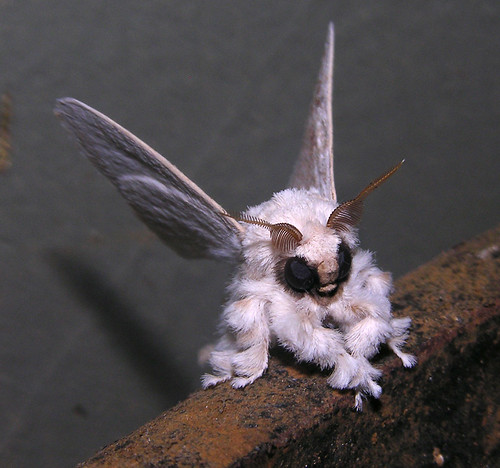
Holy crap.
The Venezuelan Poodle Moth has the distinction of being both something that I would run away in terror from, as well as something that I want to capture and train to battle other frightening creatures with inexplicable elemental powers.
Below the jump, the story behind the moth's Internet fame.
Tags: Giant Poodle Moth , pokemon , things that are terrifying , things that might be huggable
Tuesday, August 28, 2012

- NASA/JPL-Caltech/MSSS
- A chapter of the layered geological history of Mars is laid bare in this postcard from NASA's Curiosity rover. The image shows the base of Mount Sharp, the rover's eventual science destination.
NASA has released new photos from the Curiosity mission on Mars and announced that a human voice has been heard on the surface of the planet.
Rapper Will.i.am is also broadcasting from Mars.
Tags: Mars , curiosity , will.i.am , photos , Tucson news , Arizona news , Video
Wednesday, August 22, 2012

NASA's Curiosity rover has done a test drive around its landing site in Gale Crater, which has been named Bradbury Landing in honor of the late Ray Bradbury, author of The Martian Chronicles.
Here's an update from the Mars Science Laboratory website:
This 360-degree panorama shows evidence of a successful first test drive for NASA's Curiosity rover. On Aug. 22, 2012, the rover made its first move, going forward about 15 feet (4.5 meters), rotating 120 degrees and then reversing about 8 feet (2.5 meters). Curiosity is about 20 feet (6 meters) from its landing site, now named Bradbury Landing.Visible in the image are the rover's first track marks. A small 3.5-inch (9-centimeter) rock can be seen where the drive began, which engineers say was partially under one of the rear wheels. Scour marks left by the rover's descent stage during landing can be seen to the left and right of the wheel tracks. The lower slopes of Mount Sharp are visible at the top of the picture, near the center.
This mosaic from the rover's Navigation camera is made up of 23 full-resolution frames, displayed in a cylindrical projection.
In other mission news: The lander has successfully deployed its laser against a Martian rock and the Huffington Post looks into whether there are UFOs on Mars. (My guess: No, but it works as click bait.)
Tags: Curiosity , Mars , rover , NASA , laser , rock , test drive , UFO on mars , Huffington Post , Tucson news , Arizona news
Friday, August 17, 2012
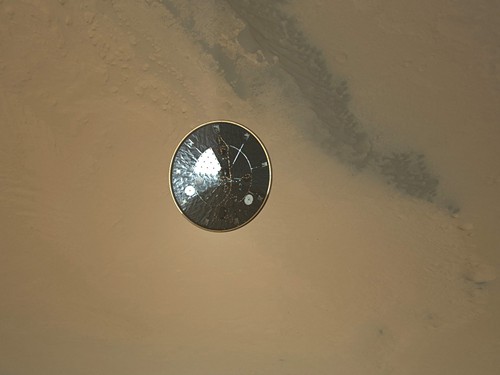
- NASA/JPL-Caltech/MSSS
- Curiosity snapped this shot of its separated heat shield during its descent onto Mars
The Mars Curiosity team took to Reddit to discuss the latest on the mission yesterday. Talking Points Memo has the takeaways:
NASA scientists have been understandably proud of performing the most accurate landing of an unmanned robotic spacecraft yet, with the Mars Curiosity Rover touching down just one-and-a-half miles away from its precise landing target, an amazing feat given the sheer complexity and unaccountable factors involved in descent, such as Martian weather.The pride makes even more sense now, given the Curiosity team’s admission on Reddit that the rover is unlikely to ever leave the area immediately surrounding its landing site, a 96-mile-wide depression known as Gale Crater, which scientists believe could have retained liquid water — and thus, offered increased chances of supporting life — on ancient Mars.
As Steve Collins, the rover’s cruise altitude and control systems engineer, wrote in response to a user question: “Probably won’t leave Gale crater. It’s huge! and there is plenty of interesting science to do there.”
Specifically, NASA is aiming to drive the rover from its current position on the edge of the crater over to one of the major features of its interior, a 3.4-mile high mountain known as Mount Sharp, where the Curiosity team wants to sample rocks and soil for clues as to the history of Mars’ climate and geology.
Meanwhile, Slate has assembled a gallery of some of the coolest pics from the Curiosity mission. After the jump, you'll find a Martian landscape photo, as well as a spectacular pic of Curiosity's landing spot taken by the UA's HiRISE camera aboard the Mars Reconnaissance Orbiter.
Tags: Curiosity , Mars , News , pictures , Arizona news , Tucson news , HiIRISE
Monday, August 6, 2012

- NASA/JPL-Caltech/University of Arizona
- During its descent, Curiosity was able to shoot a photo of its own heat shield shortly after it had been jettisoned.
NASA released a new batch of photos from the Curiosity rover following the Mars Science Laboratory's landing in Gale Crater yesterday. The above photo was taken as the robotic lab was rushing toward the Martian surface and had jettisoned its heat shield.
Meanwhile, Dan Stolte of UA News brings us more details about the astonishing work that the UA Lunar and Planetary Lab's HiRISE team did in capturing a picture of Curiosity's descent:
Dangling from its parachute, Mars rover Curiosity was photographed by the UA-led HiRISE camera aboard NASA's Mars Reconnaissance Orbiter. HiRISE images will serve as road maps once the rover sets out to explore Gale Crater.In a carefully choreographed maneuver high in the sky above Mars, two man-made spacecraft zipped past each other as NASA scientists and engineers stared at screens inside Mission Control at NASA's Jet Propulsion Laboratory, anxiously enduring the "7 minutes of terror"—the time it would take the Curiosity rover to plunge into Mars' atmosphere and touch down on the bottom of Gale Crater near the Martian equator.
While Curiosity—the centerpiece of the Mars Science Laboratory Mission, or MSL—hurtled toward the ground at twice the speed of sound, another spacecraft, NASA's Mars Reconnaissance Orbiter, or MRO, pointed its HiRISE camera at Curiosity and snapped a photo of the spacecraft with the rover tucked inside, suspended from its 50-foot-diameter parachute. HiRISE stands for High-Resolution Imaging Science Experiment.
"We have been planning this for some time," said Alfred McEwen, a professor in the University of Arizona Lunar and Planetary Laboratory and principal investigator of the HiRISE mission. "We gradually adjusted MRO's orbit to make sure it would be right over Curiosity as it landed, and that put us in a great position for this image. It came back exactly as we expected in terms of brightness and contrast. The parachute looked beautiful, nice and sharp, fully inflated and working perfectly."
The snap shot required months of preparations to make sure the two spacecraft, traveling in directions perpendicular to each other and at several miles per second in the case of MRO, wouldn't miss each other. McEwen said it would have been great to have the descent image in color, but because HiRISE's color channel has a narrower field of view than the black and white channels, that wasn't possible under the circumstances. "It's a good thing our field of view wasn¹t very much narrower or we could have missed it entirety," McEwen said.
Tags: Arizona news , Tucson news , Curiosity , HiRISE , NASA , descent , UA Lunar and Planetary Lab

- NASA/JPL-Caltech/University of Arizona
- NASA's Curiosity rover and its parachute were spotted by NASA's Mars Reconnaissance Orbiter as Curiosity descended to the surface on Aug. 5
A huge congrats to the UA team running the Lunar and Planetary Lab's HiIRSE camera: They got the timing just right to get a shot of Curiosity as it dropped through the Martian atmosphere. (HiRISE managed to do a similar feat with the landing of Phoenix in 2008.)
The Range made it out last night to Fourth Avenue's Sky Bar, where a cheering crowd watched the NASA feed of Curiosity's entry and descent to Mars' Gale Crater on the bar's big-screen TVs. We have admit that we were a little stunned to see that the Mars Science Laboratory team was able to post the first photo from the Mars Science Laboratory within minutes of the landing. Mind-blowing stuff—and the two-year mission is just getting started. More on that here.
Here's the press release about the HiRISE photo:
An image from the High Resolution Imaging Science Experiment (HiRISE) camera aboard NASA's Mars Reconnaissance Orbiter captured the Curiosity rover still connected to its 51-foot-wide (almost 16 meter) parachute as it descended towards its landing site at Gale Crater."If HiRISE took the image one second before or one second after, we probably would be looking at an empty Martian landscape," said Sarah Milkovich, HiRISE investigation scientist at NASA's Jet Propulsion Laboratory in Pasadena, Calif. "When you consider that we have been working on this sequence since March and had to upload commands to the spacecraft about 72 hours prior to the image being taken, you begin to realize how challenging this picture was to obtain."
The image of Curiosity on its parachute can be found at: http://www.nasa.gov/mission_pages/msl/multimedia/pia15978b.html
The image was taken while MRO was 211 miles (340 kilometers) away from the parachuting rover. Curiosity and its rocket-propelled backpack, contained within the conical-shaped back shell, had yet to be deployed. At the time, Curiosity was about two miles (three kilometers) above the Martian surface.
"Guess you could consider us the closest thing to paparazzi on Mars," said Milkovich. "We definitely caught NASA's newest celebrity in the act."
Tags: UA Lunar and Planetary Lab , HiRISE , NASA , curiosity , photo , descent , arizona news , Tucson news

