

Monday, July 18, 2011
Not really. Just wanted to get you to look at another picture of Mars! So many angles. So many colors. So many formations.
Here's another shot courtesy of the UA Lunar and Planetary Lab's HiRISE camera aboard the Mars Reconnaissance Orbiter. This week, we have a shot of Small Mounds in Chryse Planitia.

The suggested area in this observation is characterized by a group of cones, shield-like features, and round mounds. They are a few hundred meters to kilometers in diameter but their heights are unknown.Possible explanations for their formation include sedimentary (mud) volcanism and magmatic volcanism. HiRISE data would be essential for distinguishing these hypotheses.
This caption is based on the original science rationale.
Written by: HiRISE Science Team (6 July 2011)
For more information about the HiRISE, click here.
Tags: Mars , HiRISE , University of Arizona , Pictures of Mars , life on Mars , Small Mounds , Chryse Planitia
Wednesday, July 13, 2011
...I'm packing my suitcase. I'm heading to Mars!!! Not really, but courtesy of the UA Lunar and Planetary Lab's HiRISE camera aboard the Mars Reconnaissance Orbiter, I can pretend. Here's a shot of the Terraced Eastern Wall along the Middle Reach of Ma'adim Vallis.

Tags: Mars , HiRISE , University of Arizona , Pictures of Mars , life on Mars , Terraced Eastern Wall , Ma'adim Vallis , Tracy Morgan , Astronaut Jones , SNL , Video
Friday, July 8, 2011
From now through August, you can check out one of the most fascinating places in town, The Arizona-Sonora Desert Museum, at night! Wait until the temperature cools down and enjoy all the evening activities they have to offer. Admission after 4:00 p.m. is $7; $3 for ages 6-12; FREE for kids 5 and younger. The museum is located at 2021 North Kinney Road. For more information, call 883-2702 or check out visit their website.
Tags: Summer Saturday Evenings at Arizona-Sonora Desert Museum , Arizona-Sonora Desert Museum , Tucson Desert Museum , Video
Thursday, July 7, 2011
Let's rocket to Mars, courtesy of the UA Lunar and Planetary Lab's HiRISE camera aboard the Mars Reconnaissance Orbiter. Here's a shot of Active Gullies in Crater Dune Field, Southern Polar Region. Mmmm, polar. Makes me wish I was eating Klondike bar on Mars right now.

These dune gullies are located in an unnamed crater just north of the Richardson Crater, which also contain dune gullies.HiRISE is monitoring the seasonal activity of gullies in this location and in other dune fields in the southern midlatitudes and northern polar region.
Written by: HiRISE Science Team (29 June 2011)
For more information about the HiRISE, click here.
Tags: Mars , HiRISE , University of Arizona , Pictures of Mars , life on Mars , Active Gullies in Crater Dune Field , Southern Polar Region , Klondike bar
Listen, University of Arizona: We run photos from your fancy Mars camera all the time and that's cool, I guess. But you know what's cooler than pictures of another planet? A printer that makes chocolates in any shape you want. Score one for the University of Exeter. You can't eat pictures of Mars.
Step up your game, Wildcat engineers. Maybe a printer that makes customized Gummi shapes? Next level candy visionaries, that's what Tucson needs.
Tags: university of exeter , 3d chocolate printer , university of arizona engineers , custom candy , Video
Wednesday, July 6, 2011

Sure we see saguaros just about every day, but how much do we really know about these majestic, green-armed creatures? This Saturday, July 9th, go check out the Ha:San Bak Saguaro Harvest Celebration at La Posta Quemada Ranch facility in Colossal Cave Mountain Park! Learn more about the saguaro fruit summer harvest with saguaro facts and hands-on workshops, including Tohono O'odham basket-weaving. Also, check out the critter displays, the saguaro syrup at the Desert Spoon Cafe, and the Tohono O'odham Rain Dancers. Admission is $5/car (up to six people). This event runs twice on Saturday July 9 from 7 to 11 a.m. and from 4 to 9 p.m. The park is located at 16721 E. Old Spanish Trail. For more information, call 647-7121 or visit their website.
Tags: Ha:San Bak Saguaro Harvest Celebration , La Posta Quemada , Colossal Cave Mountain Park , saguaros , saguaro fruit harvest , Desert spoon cafe , Tohono O'odham basket-weaving , Tohono O'odham rain dancers , Old Spanish Trail
Sunday, July 3, 2011

- Michael Van Woert, NOAA NESDIS, ORA. National Oceanic and Atmospheric Administration/Department of Commerce
- This view of the seaward edge of Antarctica’s floating Ross Ice Shelf shows a region where the ice is cracking and may produce an iceberg.
UA scientists are part of a team that suggests that the Greenland and Antarctic ice sheets are going to melt faster than anticipated because of warming oceans. Mari Jensen of UA News brings us details from a paper that's being published today in Nature Geoscience:
Warming of the ocean's subsurface layers will melt underwater portions of the Greenland and Antarctic ice sheets faster than previously thought, according to new University of Arizona-led research. Such melting would increase the sea level more than already projected.The research, based on 19 state-of-the-art climate models, proposes a new mechanism by which global warming will accelerate the melting of the great ice sheets during this century and the next.
The subsurface ocean layers surrounding the polar ice sheets will warm substantially as global warming progresses, the scientists found. In addition to being exposed to warming air, underwater portions of the polar ice sheets and glaciers will be bathed in warming seawater.
The subsurface ocean along the Greenland coast could increase as much as 3.6 F (2 C) by 2100.
"To my knowledge, this study is the first to quantify and compare future ocean warming around the Greenland and the Antarctic ice sheets using an ensemble of models," said lead author Jianjun Yin, a UA assistant professor of geosciences.
Most previous research has focused on how increases in atmospheric temperatures would affect the ice sheets, he said.
"Ocean warming is very important compared to atmospheric warming because water has a much larger heat capacity than air," Yin said. "If you put an ice cube in a warm room, it will melt in several hours. But if you put an ice cube in a cup of warm water, it will disappear in just minutes."
Tags: Tucson news , Arizona news , UA College of Science , global warming , climate change , rising sea levels , Jonathan Overpeck , melting ice sheets
Tuesday, June 28, 2011

Let's take a virtual trip to Mars courtesy of the UA Lunar and Planetary Lab's HiRISE camera aboard the Mars Reconnaissance Orbiter. Here's a shot of Opal Deposits near the Valle Martineris. The marble swirls on this thing remind me of Rocky Road ice cream, and suddenly I'm hungry:
Tags: Mars , HiRISE , Opal Deposits , Valle Martineris , University of Arizona , Pictures of Mars , life on Mars , Rocky Road ice cream
Saturday, June 25, 2011

Twenty years after the first crew was sealed inside its glass walls, the University of Arizona is set to be the new owner of Biosphere 2.
The UA will announce Monday that the giant terrarium, located on Oracle Road north of Catalina, will be given to the College of Science, which has been managing the facility for several years to conduct climate-change research.
Biosphere 2—which features different “biomes,” including a tropical rainforest, a grassland savannah, a mangrove wetland, a desert, and a small saltwater ocean and beach—was originally built as an experiment to keep a sealed environment for a century, but the effort was abandoned after the first two-year stint by a crew that entered the facility in 1991 came to an end.
Since then, Biosphere 2—which is owned by Texas billionaire Ed Bass—has had several managers, including Columbia University, which gave up its interest in the facility in 2003.
While it’s hard to pin a precise value on Biosphere 2 (there isn’t a comparable facility anywhere in the world), it cost more than $200 million to build. UA officials are estimating the facility is worth $100 million today.
The UA College of Science will receive 40 acres around Biosphere 2, including a conference center and a collection of casitas.
Bass’ Philecology Foundation will also give the UA a $20 million grant to cover the cost of running the facility in future years, according to UA sources.
TW covered the UA's work at Biosphere 2 in 2009:
Researchers are now planning their first large-scale experiment. They've cleared out the biome where Biospherians once grew their crops, and the now-bare concrete floor will soon be covered by experimental hillsides to better understand how water moves through the earth from mountains to rivers, says John Adams, Biosphere 2's assistant director for planning and facilities.
Tags: Biosphere 2 , UA College of Science , University of Arizona , Ed Bass , gift
Wednesday, June 22, 2011
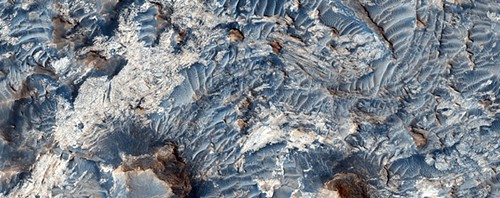
We wish we could blast off and visit Mars right now, but we'll have to settle for a glimpse of the Red Planet, courtesy of the UA Lunar and Planetary Lab's HiRISE camera aboard the Mars Reconnaissance Orbiter. Here's a shot of light-toned dunes on the Meridiani Planum:
Tags: Mars , HiRISE , Dunes on Mars , Meridiani Planum , University of Arizona , Pictures of Mars , life on Mars

