

Monday, May 16, 2011
Source SPACE.com: All about our solar system, outer space and exploration
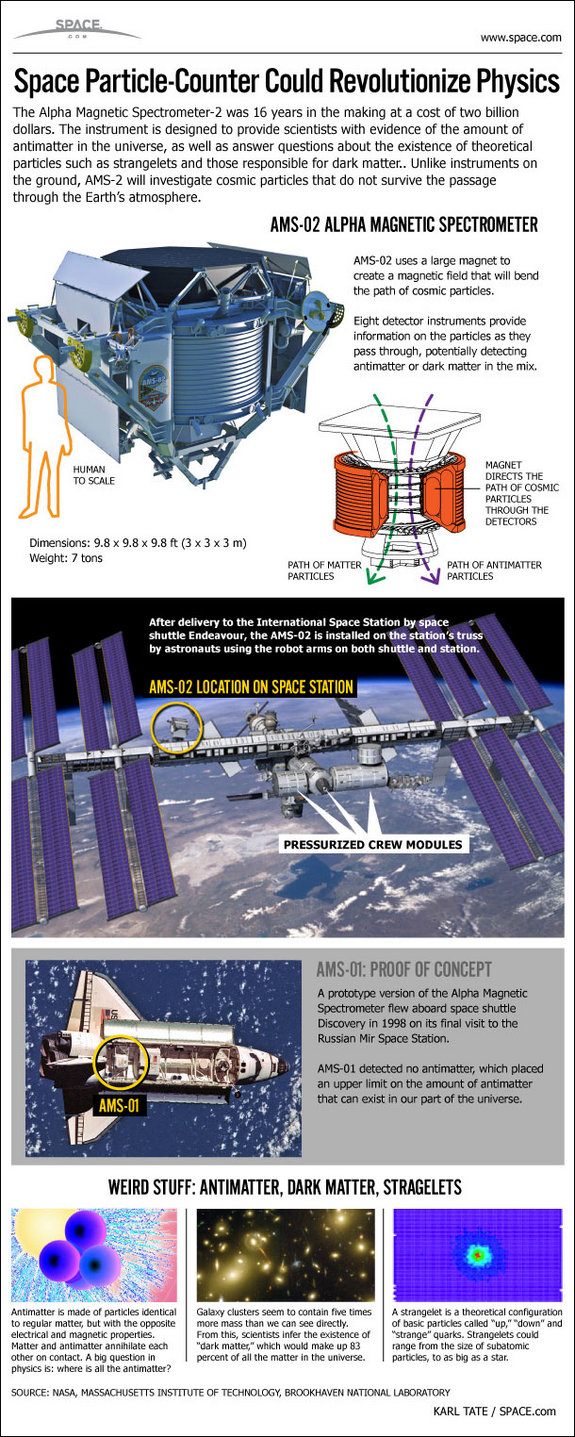
The Space Shuttle Endeavour is delivering an Alpha Magnetic Spectrometer to the International Space Station. What does it do, exactly?
You might think you learned in high school that the universe is made of atoms and molecules, protons and electrons, stars and galaxies, but over the last few decades astronomers have concluded — not happily — that all this is just a scrim overlying a much vaster shadowy realm of invisible “dark matter” whose gravity determines the architecture of the cosmos.
If they are lucky, scientists say, the Alpha spectrometer could confirm that mysterious signals recorded by other satellites and balloons in recent years are emanations from that dark matter, revealing evidence of particles and forces that have only been theoretical dreams until now.
Even if dark matter won’t ever become the ultimate diet — eat it and disappear — knowing what nature is made of could be useful someday in ways nobody can dream. Einstein’s curved spacetime, equally elusive to the senses, proved crucial to the function of GPS devices that were invented decades after Einstein’s death.
Or the device could find even something weirder.
Tags: Alpha Magnetic Spectrometer , space shuttle Endeavour , Mark Kelly , Gabrielle Giffords , Tucson news
Sunday, May 15, 2011

All systems are go for the launch of Space Shuttle Endeavour tomorrow, although skies are a little stormy.
Wired has a roundup of where you can watch from home.
Tuesday, April 12, 2011
5.6k Saturn Cassini Photographic Animation from stephen v2 on Vimeo.
A gorgeous look at what it would be like to approach Saturn, using actual images from the Cassini spacecraft:
What would it look like to approach Saturn in a spaceship? One doesn't have to just imagine — the Cassini spacecraft did just this in 2004, recording thousands of images along the way, and thousands more since entering orbit. Recently, some of these images have been digitally tweaked, cropped, and compiled into the above inspiring video which is part of a larger developing IMAX movie project named Outside In. In the last sequence, Saturn looms increasingly large on approach as cloudy Titan swoops below. With Saturn whirling around in the background, Cassini is next depicted flying over Mimas, with large Herschel Crater clearly visible. Saturn's majestic rings then take over the show as Cassini crosses Saturn's thin ring plane. Dark shadows of the ring appear on Saturn itself. Finally, the enigmatic ice-geyser moon Enceladus appears in the distance and then is approached just as the video clip ends.
Tags: Cassini spacecraft , NASA , saturn , Video
Wednesday, April 6, 2011
The Jet Propulsion Laboratory uses photos from the UA's HiRISE camera aboard the Mars Reconnaissance Orbiter to show how NASA's Mars Science Lab will land in August 2012. Nancy Atkinson of Universe Today notes:
Entry, descent and landing is the big moment for any Mars lander mission, and the big honkin’ Mars Science Lab and its sky-crane landing system will truly be unique. This brand new video from the Jet Propulsion Lab shows how MSL, a.k.a Curiosoity will land on the Red Planet in August of 2012. Doug Ellison, part of the team who worked on this computer generated video told Universe Today that the scenes from Mars shown here were created from real elevation data from the HiRISE camera on the Mars Reconnaissance Orbiter, and the outcrop of rock that Curiosity visits is based on Burns Cliff, visited by Opportunity in 2004.When they started working on the video, the real rover wasn’t as close to completion as it is now. “The oddity is that we had to finish our virtual rover ahead of the real rover!” Ellison said. “The rover and other major components were derived from simplified CAD drawings, combined with lots of photographs of the actual hardware under construction.”
Tuesday, March 29, 2011
From NASA:
Early this morning, at 5:20 am EDT, MESSENGER captured this historic image of Mercury. This image is the first ever obtained from a spacecraft in orbit about the Solar System's innermost planet. Over the subsequent six hours, MESSENGER acquired an additional 363 images before downlinking some of the data to Earth. The MESSENGER team is currently looking over the newly returned data, which are still continuing to come down.

Tags: nasa , messenger , mercury , space photos
Tuesday, March 15, 2011

Robert Strom, professor emeritus in the UA's Lunar and Planetary Laboratory, said: "Once in orbit, MESSENGER will image the surface at 250 meters per pixel. At its closest approach, it will even get to a resolution of six meters per pixel. Of course, you can't image a whole planet at this fine resolution. This will be reserved for targets of opportunity — features that MESSENGER images during its surveys and that catch our attention."Strom pointed out that the MESSENGER mission is unusual because its main payload is not the instruments, but the fuel needed to slow the spacecraft down.
"Because the journey from Earth to Mercury goes toward the sun, we need a lot of energy to counteract the sun's gravitational pull," he explained.
To save fuel, the engineers devised a carefully choreographed dance that MESSENGER performs around selected planets: the Earth, the moon and Mercury.
"By having the probe dance around planets, it can take advantage of their gravitational fields to slow its speed," Strom added. "Even once in orbit around Mercury, the spacecraft will need to burn fuel every few hours or so to prevent the sun's gravitational field from pulling it out of orbit."
Another great challenge MESSENGER has to cope with is the intense heat due to Mercury's proximity to the sun. At the equator, surface temperatures become hot enough to melt lead. The heat reflected from the planet's surface is so intense that the spacecraft's instruments need to be shielded against the glare.
"The spacecraft is going to go very fast, traveling around the planet every 12 hours," Sprague explained. "The orbit is highly elliptical to allow the spacecraft to cool down. We couldn't do this with a circular orbit, like around Mars. Everything would just overheat. MESSENGER must swoop in, keeping its sunshade pointed toward the sun, and then it has to swing out far into space so it can cool down."
Strom added: "The strategy is to have MESSENGER gather data during its close approach and then read the data out and send them back to Earth while the probe is at a safe distance from the scorching planet."
Monday, March 7, 2011
The UA Science gang presents an informal talk on the future of the Colorado River on at 6 p.m. Tuesday, March 8, at downtown's Cushing Street Bar. Warning: The water that Tucson depends on is drying up.
Press release after the jump:
Tuesday, March 1, 2011

Details from the Cosmic Origins web site:
Origins of Black Holes: Gravity at Its ExtremeFeryal Özel, Associate Professor, Astronomy/Steward Observatory, University of Arizona
Gravity is the most important force in the universe, holding together planetary systems, stars, and galaxies. It is what makes the stars hot enough to shine and what keeps the Earth close enough to the Sun for life to form. It is also what ends the life of every massive star with a spectacular collapse and the formation of a black hole. Finding and studying hundreds of black holes within the Milky Way and in other galaxies brings us closer to understanding gravity at its extreme.
Friday, February 25, 2011

The UA Lunar and Planetary Lab's Alfred McEwen talks about a HiRISE photo from Mars:
Some of the largest landslides known in the Solar System have happened on Mars. These are interesting phenomena, but they also sometimes produce excellent exposures of the bedrock geology, in cross-sectional views. The purpose of this image was to view bedrock exposures at a deep level in Valles Marineris.We have only a vague idea how old these rocks are. Crater counts date landscapes, and clearly this is a young landscape with very few impact craters due to the continual mass wasting (landslides) of the steep slopes. The rocks are much older—probably older than the plateaus surrounding Valles Marineris (2 to 3 billion years based on the large craters), unless these are intrusive rocks emplaced later from migrating magma. We need radiometric age dating, either on Mars or from returned samples, to measure the age of igneous (volcanic or plutonic) rock layers within the strata.
The age of sedimentary layers such as river or lake deposits can be bracketed by the ages of overlying and underlying igneous layers. Not knowing the absolute ages of bedrock units on Mars is a huge limitation to our understanding of the geologic history.
Lots more here.
Wednesday, February 16, 2011
Dear Dr. Gerba:
I understand your latest study makes the bachelor pad look like a breeding ground for the plague, while comparatively, bachelorettes have tidy, practically germ-free abodes. I almost cried, thinking back to the days before husbands and children, when my life was practically germ-free.
Have you considered another place where germs are breaking new ground ... the homes of working families, like mine? My family consists of two working parents with an equally busy 9-year-old son. It's an all-American home, really, with two dogs, two cats and a structure that barely passed inspection when it was bought three years ago.
Just in time for Valentine's Day, MSNBC looked at a new study by you (blog voyeurs should know that Dr. Gerba, also cheerfully called Dr. Germ, is UA microbiologist Charles Gerba known for studying germs, the nastier the better).
From the story:
New research has just confirmed the old suspicion that the residences of single men are among the most foul in the land. But things are far grungier than random socks dangling from lampshades or towers of crusty dishes teetering in sinks. After testing for germs on four common surfaces — TV remotes, coffee tables, nightstands and doorknobs — scientists learned that bachelor pads contain 15 times the amount of bacteria than do the homes of bachelorettes.Ready to really get down and dirty in the singles scene? Seven of every 10 coffee tables checked at the guys’ places harbored coliforms — a variety of bacteria abundant in the feces of warm-blooded animals. Yes, feces. To help put this filthy finding in true laboratory lingo, we turn to the study’s leader, Dr. Charles Gerba.
“They have poop on the coffee table,” Gerba said.
Um, why?
“I would suspect the guys probably put their feet up on the coffee table. About 90 percent of shoes have fecal bacteria on the bottom after you wear them for three months,” said Gerba, professor of microbiology at the University of Arizona. “My wife never puts her feet on the table. I do, and I keep getting told to take them off.”
Dr. Gerba, to back up your latest study, you point to your own childhood home, and specifically your mother, whom you described as "a general when it came to cleaning and disinfecting."
Most likely, Dr. Gerba, your mother was a housewife. If not, I'm guessing her haste to clean up after you may have sparked your interest in all things germ-related.
Now days, most working parents work hard to run egalitarian households (OK, I know in some cases, that may be a stretch), but in my house, we really try, which means the mopping and such has to fit around work schedules and kid schedules, and my job is a bit more 24-hour-ish ... so, yeah, sometimes a homemaker's nightmare occurs, and I guarantee there are germs that exist in my house that no bachelor has seen before.
So consider another study: the study of the working middle-class family. (Quick, before the middle class disappears! I guarantee the germs will remain.) My home is available, but I may insist on a life-time housekeeping service as payment ... or at least a visit from your mother.
Sincerely,
Mari Herreras
Tags: Dr. Gerba , germs , bachelors , bachelorette , UA , crazy working mothers

