

Monday, June 21, 2010

- NASA/JPL/University of Arizona
The UA Lunar and Planetary Lab has posted new photos from the HiRISE camera in orbit around Mars. See them here.
HiRISE team member Nathan Bridges tells us about the above photo:
This observation shows dark dunes and light polygonal terrain in Olympia Undae, also known as the North Polar Erg.Two sets of dunes are obvious. The major set trends North-South, indicating winds from the East or West. Between the crests of these dunes is a second set oriented mostly East-West.
Zooming in on the dunes, a rippled texture is apparent, probably due to
Thursday, June 10, 2010

- NASA/JPL/University of Arizona
A new batch of HiRISE images has been posted by the UA Lunar and Planetary Lab. See ’em here.
HiRISE team member Patrick Russell tells us about the above photo:
This observation shows the intersection of several geologic features at the edge of the huge Valles Marineris system of canyons on Mars.The circular feature is an impact crater, roughly 4 kilometers (2.5 miles) across. To the south, terrain slopes downward over 4000 meters (13000 feet). Thinking of the crater like a huge drill hole and the canyon wall like a towering road-cut, both features provide a glimpse into the subsurface of the surrounding terrain.
In the curved north wall of the impact crater, and in the East-West trending, upper walls of the canyon (center of the scene), individual layers of rock can be traced
Friday, May 28, 2010

- NASA/Caltech/JPL/E. DeJong/J. Craig/M. Stetson
A bulletin from Daniel Stolte of UA Communications:
A team of planetary scientists has used radar and a high-resolution camera to reveal the subsurface geology of Mars' northern ice cap.The findings — based on data from SHARAD (the surface-penetrating radar) and HiRISE (the high-resolution camera) on the Mars Reconnaissance Orbiter — were published May 27 in two papers in the journal Nature.
The group studying a canyon feature called Chasma Boreale included Shane Byrne from the University of Arizona's Lunar and Planetary Laboratory. Jack Holt and Isaac Smith of The University of Texas at Austin's Institute for Geophysics are the papers' lead authors.
"The ice sheet on Mars' northern polar region is about the size and thickness of the Greenland ice sheet," said Byrne. "Just like Greenland, the layers of ice on Mars preserve a climate record that reaches back probably a few million years. Studying this ice sheet and its internal layers tells us about Martian climate and how it has varied in the past."
On Earth, large ice sheets are shaped mainly by ice flow. But on Mars,
Wednesday, May 26, 2010

- NASA/JPL/University of Arizona
NASA has given up hope that the Phoenix Mars Lander will transmit any new signals after being buried under Martian ice. Daniel Stolte of University Communications tells us:
NASA's Phoenix Mars Lander has ended operations after repeated attempts to contact the spacecraft were unsuccessful. A new image transmitted by NASA's Mars Reconnaissance Orbiter, or MRO, shows signs of severe ice damage to the lander's solar panels.An image of Phoenix taken this month by the High Resolution Imaging Science Experiment, or HiRISE, camera on MRO suggests the lander no longer casts shadows the way it did during its working lifetime.
"The latest HiRISE image appears to show that a solar panel of the Phoenix lander has collapsed," said University of Arizona planetary scientist Alfred McEwen, who is the principal investigator of the HiRISE camera project.
According to McEwen, it gets so cold during the Martian winter that carbon dioxide, which accounts for 95 percent of the planet's atmosphere, forms a frost blanket up to one or more feet thick
Friday, May 14, 2010

- NASA/JPL/University of Arizona
You've only got a few hours left to reserve a spot on Mount Lemmon to meet the UA Lunar and Planetary Lab crew on Saturday, May 22. Details from LPL:
On Saturday, May 22, 2010, the University of Arizona's Lunar and Planetary Laboratory (LPL) is hosting a public open-day at the Catalina Observatories, located on the summit of Mt. Lemmon, from noon to 6 p.m. This is one of several special events held throughout this year
Thursday, May 13, 2010
Can't find your duodenum, dural sac or deep peroneal nerve? Try looking for them at the Rialto Building downtown, 300 W. Congress St, starting this Saturday at Bodies: The Exhibition. The show features a literal inside look at what makes us tick as well as showing what effects cancer and other diseases can wrack on our organs. Tickets can be found at www.bodiestucson.com or by calling (888) 263-4379.
It's the only place in the state where you'll see stiff, unresponsive human bodies (besides the Legislature).
Tags: bodies , the exhibition , tucson , Video
Wednesday, May 5, 2010

- NASA/JPL/University of Arizona
The UA Lunar and Planetary Lab has released a particularly beautiful new batch of HiRISE photos of the Martian surface this week. See them here.
Don't forget: The LPL is having a picnic on Mount Lemmon on Saturday, May 22. Details on how to make your reservations before the May 14 deadline here.
HiRISE team member Ken Herkenhoff tells us about the photograph:
Like Earth, Mars has seasonal polar caps that grow in the winter and retreat in the spring, but on Mars the seasonal caps are composed primarily of carbon dioxide (dry ice). Carbon dioxide is the major component of the Martian atmosphere, and a significant fraction
Tuesday, May 4, 2010

- NASA/JPL/University of Arizona
Another spectacular shot of a dune field from the UA Lunar and Planetary Lab's HiRISE aboard the Mars Reconnaissance Orbiter. Find the latest images here.
Speaking of the Lunar and Planetary Lab: You can join the LPL gang for an open house up on Mount Lemmon later this month where you'll be able to meet the scientists, see HiRISE images and check out the Catalina Observatories.
Details from LPL:
On Saturday, May 22, 2010, the University of Arizona's Lunar and Planetary Laboratory (LPL) is hosting a public open-day
Saturday, May 1, 2010
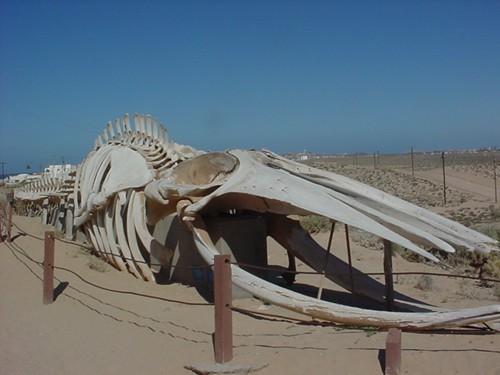
- Jim Nintzel
Our friends at Rocky Point's CEDO are celebrating their 30th anniversary of protecting the Gulf of California today at Hotel Congress. Will Ferguson has the details here.
Monday, April 26, 2010

- Timothy Archibald
Friend of the Range Timothy Archibald photographs robots being built by David Hanson for this month's Discover magazine. Discover photo director Rebecca Horne notes on her blog:
David Hanson’s robots are by now somewhat familiar faces, including his Einstein robot currently being used as a research tool at Javier Movellan’s Machine Perception Lab at UCSD, and the punk rock conversationalist Joey Chaos. A less familiar face is that of Bina Rothblatt, the blonde at the end of the table in the above photograph. Bina is a robot commissioned by Sirius Satellite Radio inventor Martine Rothblatt to look like her beloved wife. Take that, uncanny valley!

