

Tuesday, March 30, 2010
Sizzle comes to the Loft Cinema at 7 p.m. this Wednesday, March 31. Details here.
Randy Olson, a marine biologist who became a filmmaker with Sizzle, will be at the Loft for the screening and a subsequent Q&A that will include UA professors Julia Cole of geosciences, Diana Liverman of the Institute of the Environment, Brian McGill of the School of Natural Resources and the Environment and Jacqueline Sharkey of the School of Journalism. (BTW: Sharkey is also my boss over at UA School of Journalism.)
Olson is also in town to help celebrate EarthWeek, "a showcase of research by undergraduate and graduate students in the School of Earth and Environmental Sciences," according to Mari Jensen of the UA College of Science. Olson will deliver a lively plenary lecture that encourages future scientists to go a little more gonzo. You can catch "Don't be Such a Scientist: Talking Substance in an Age of Style," at

- CARL PHILABAUM
How do we pull up all that data in our head? Alfred W. Kaszniak of the UA Psych Departmentl, explains it all as the UA College of Science continues its Tuesday night lecture series with Metamemory: How Does the Brain Predict Itself? Details here.
The gist:
Our brains recreate past experience, monitor recall efforts, and predict our chances of remembering things in the future. The knowledge we each possess about our own memory, and strategies to aid memory, form what is called metamemory. Studies of persons with impaired metamemory due to neurological illness, along with brain imaging studies of healthy adults making judgments about memory, indicate that the brain systems active in retrieving information are distinct from those that self-monitor memory. Metamemory research is helping build an understanding of a wide range of experiences from tip-of-the-tongue forgetfulness to the symptoms of Alzheimer's disease.
Tags: UA College of Science , Mind and Brain
Monday, March 29, 2010
Good news for astronomy fans! Here's part of a press release we got today:
FLANDRAU PLANETARIUM AND EXHIBITS REOPEN TO THE PUBLIC APRIL 3RD
Planetarium shows, special exhibits, and expanded hours to reconnect the community with scienceTucson, Arizona — UA Science: Flandrau, on the campus of The University of Arizona, will celebrate the reopening of its planetarium and the start of its new expanded schedule on Saturday, April 3, 2010. As of the 3rd, the center will be open to the public seven days a week offering scheduled planetarium shows, science demonstrations, hands-on exhibits, an extensive mineral collection on display, a special exhibit of Bisbee minerals (Treasures of the Queen), telescope viewing in the observatory, and storytelling and exhibits from the Miners’ Story Project.
A Tucson tradition since 1972, Flandrau reopens under the guidance of The University of Arizona College of Science. It is this new partnership that makes it possible for Flandrau to reopen to the public and showcase other UA Science: departments and programs such as Biosphere 2 in Oracle and the UA Science SkyCenter, at the summit of Mt. Lemmon just north of Tucson.
Friday, March 26, 2010

- NASA/JPL/University of Arizona
The latest batch of pics from the UA Lunar and Planetary Lab's HiRISE camera in orbit around Mars can be found here, including this shot of Melas Chasma.
HiRISE team member Cathy Weitz tells us:
This subimage shows layering in a light-toned deposit in Melas Chasma.The layers are sedimentary in origin, but there are many processes that could have deposited them, such as volcanic airfall from explosive eruptions, or dust-size particles settling out of the atmosphere due to cyclic changes, and deposition in standing bodies of water.
By looking at the slopes in the layers and how the
Tuesday, March 23, 2010
The UA College of Science "Mind and Brain" lecture series that's been filling up Centennial Hall continues this evening with "The Making of a Mind," presented by LouAnn Gerken, a professor of psychology.
Here's a brief description:
We're all born with a brain, but when does our brain begin to construct a model of the world — a mind? Research now suggests that infants not only absorb a remarkable amount of information about the physical and social world, they also use this information much like scientists to make guesses about the structure of that world. By creating tentative models of different aspects of the world based on very small amounts of data, infants use their developing models to predict the behavior of objects, people and the world around them.
More info on the Mind and Brain series can be found here.
The above video is from the third lecture in the series, by Anna Dornhaus, an assistant professor of
Friday, March 19, 2010

- NASA/JPL/University of Arizona
This week's batch of HiRISE images includes this salty spot that might one day be make for a home for a future Mars mission. HiRISE honcho Alfred McEwen tells us:
There is an intriguing surface unit in parts of the ancient Martian highlands that may consist of chloride salts (like NaCl—table salt) which precipitated out of shallow lakes as in desert regions of Earth.It has unusual thermal properties and distinctive morphologies, but lacks spectral absorption bands. All of these characteristics and the geologic settings are consistent with salt deposits. These deposits are often associated with clay minerals that do have distinctive absorption bands.
This particular location has been selected as a candidate landing site for the Mars Science Laboratory or another future rover. Hopefully the HiRISE images won't reveal too many boulders or steep slopes that would be hazardous. A stereo anaglyph is also available.
Thursday, March 18, 2010
We've regularly featured images of Mars from the HiRISE camera on The Range, but now here's video of what some guy did with all those pictures: He created a fly-by using the topographical data taken by the camera.
The video (showing the Candor Chasma region) is being billed the most accurate video of the surface of the Red Planet.
Here's more from Discovery News:
Tags: Phoenix Mars Lander , HiRISE Camera , UA College of Science , Video
Tuesday, March 16, 2010
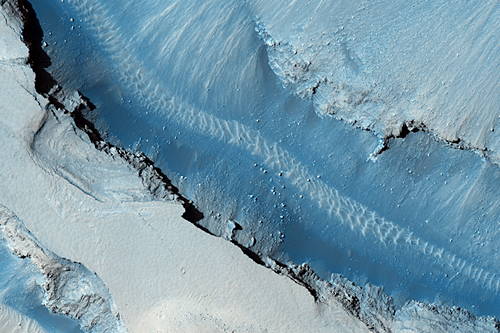
- NASA/JPL/University of Arizona
One more Mars snapshot from the latest batch released by the HiRISE team at the UA Lunar and Planetary Lab.
HiRISE team member Anjani Polit tells us:
This image shows part of Cerberus Fossae, a long system of extensional (normal) faults arranged in trough-bounding (graben-bounding) pairs. Cerberus Fossae served as the source of a large volcanic eruption that draped Athabasca Valles in lava.Large boulders that have been dislodged from the graben walls are visible on
Tags: Mars , HiRISE , UA Lunar and Planetary Lab
Friday, March 12, 2010
Here's the second lecture from the UA College of Science's Tuesday night lecture series on "Mind and Brain," presented by Regents Professor Leslie Tolbert, vice president for Research, Graduate Studies, and Economic Development and professor of Neuroscience, and Cell Biology & Anatomy.
This week's lecture about the relative advantages and disadvantages of having a brain and learning was fascinating. Anna Dornhaus, an assistant professor of ecology and evolutionary biology, told the audience that when you can separate smart fruit flies from dumb fruit flies and breed several generations worth until you have really smart fruit flies and really dumb fruit flies. But when you put them into a single community, the dumb fruit flies breed more effectively than the smart ones. Dornhaus noted: "Idiocracy in a petri dish."
No lecture next week because it's spring break. Here are more details on the series.
Here's a brief description of what you'll see if you watch Tolbert's lecture above:
The human brain is the most complex object known to us. It contains roughly
Tags: UA College of Science , mind and brain lecture series , Video

- Photo courtesy of Craig Stillwell
- Sexual size dimorphism: Female hawk moths (left) are larger than their male counterparts
So you like big butts and you cannot lie? UA researchers have a new theory about sexual dimorphism.
Daniel Stolte from the UA has some details:
Take a look around in the animal world and you will find that, in most organisms, individuals of one sex are larger than the other of the species.Even though evolutionary biologists have long recognized this discrepancy, called sexual dimorphism, they have struggled for decades to solve a major paradox: How can males and females of one species be of different sizes, given that they share the same genetic blueprints dictating their development and growth?
Researchers from the University of Arizona have discovered that the key to unraveling this mystery lies in

