

Wednesday, March 10, 2010

- NASA/JPL/University of Arizona
Nearly 700 new images of Mars have been released to the Planetary Data System.
Among this week's featured new images: a snapshot of spring emerging on Mars.
HiRISE team member Candy Hansen tells us:
In the winter a layer of carbon dioxide ice (dry ice) covers the north polar sand dunes. In the spring the sublimation of the ice (going directly from ice to gas) causes a host of uniquely Martian phenomena.In this subimage streaks of dark basaltic sand have been carried from below the ice layer to form fan-shaped deposits on top of the seasonal ice. The similarity in the directions of the fans suggests that they formed at the same time, when the wind direction and speed was the same. They often form along the boundary between the dune and the surface below the dunes.
The audio slideshows are a fun watch for anyone who enjoys taking a walk onto any outdoorsy landscape.
(Photographs by John deDios)
Tags: Border , Borderbeat.net , open wound , bleeding , first aid , Lauren Adams , Amanda Portillo , John deDios , Video
Monday, March 8, 2010
The UA College of Science's Tuesday night lecture series, "Mind and Brain," is drawing near-capacity crowds at UA's Centennial Hall, which is no small accomplishment.
Here's a video of the first lecture by Dr. Lynn Nadel, who talked about "Building Brains, Making Minds."
This week in the free series: Anna Dornhaus, assistant professor of ecology and evolutionary biology, talks about the evolution of mind and brain. Here's what you have to look forward to:
What does anybody need a brain for? Brains are energetically expensive to make and to use, and susceptible to making mistakes. Accordingly, not learning, i.e. sticking to an innate or random strategy, is often the best thing to do. Still, humans and other animals display sophisticated learning and cognition. Recent research shows that each animal has specific learning abilities and lacks others according to its environment and evolutionary history. Understanding what different brains are used for can help us understand why they evolved.
Also happening tomorrow night: A Science Cafe talk focusing on Biosphere 2, which is now under the management of the College of Science, at 6 p.m. at Cushing Street Bar & Restaurant. Details here.
More on the Mind and Brain series here.
If you'd like to listen to podcasts of the series, you can get them from iTunes by starting here.
Thursday, March 4, 2010

- NASA/JPL/University of Arizona
A new batch of Mars photos has been uploaded at the HiRISE Web site.
The above pic shows sand dunes and inverted craters in Arabia Terra.
HiRISE team member Nathan Bridges tells us:
This image shows dark sand dunes and inverted craters in the Arabia Terra region of Mars.The sand is dark because it was probably derived from
Tags: Mars , HiRISE , UA Lunar and Planetary Lab
Wednesday, March 3, 2010
UA scientists have been tapped to help with the hunt for what exactly all that dark energy in the universe is. The contracts are bringing in a total of $6 million to the university.
Daniel Stolte of University Communications has the details:
Two University of Arizona research and development groups were selected to develop and manufacture key technology for the first major undertaking to investigate the mystery of dark energy in the universe.UA's Imaging Technology Laboratory, a research group within Steward Observatory, and the Optical Fabrication and Engineering Facility at the College of Optical Sciences will provide image recording devices and the heart of the optical system used for imaging, respectively, for the Hobby-Eberly Telescope at the McDonald Observatory, which is operated by the University of Texas, Austin.
The additions are part of outfitting the world's fourth largest optical telescope with an array of new instruments to analyze the light from distant galaxies in an effort to understand the nature of dark energy. Scientists have known for a while that dark energy exists, but so far, nobody has been able to come up with
Tags: UA , dark matter , Hobby-Eberly Telescope
Tuesday, March 2, 2010
- NASA/JPL-Caltech/University of Arizona/Texas A&M University
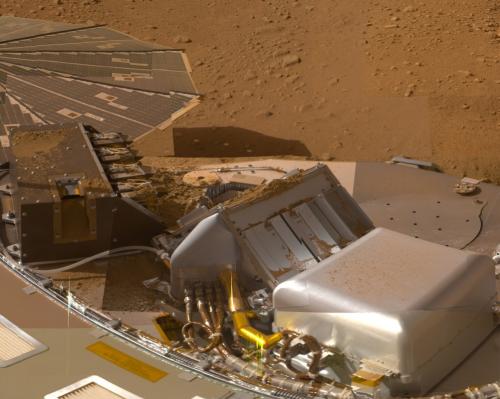
Our friends at KUAT-TV present another Arizona Public Media production this evening: Phoenix Mars Mission: Onto The Ice shows how Peter Smith and his team at the UA Lunar and Planetary Lab dropped a robot lab onto the Martian north pole and sent back photos, weather reports and soil and air samples. The special will be airing nationally on PBS World channel on Thursday, March 4.
They're still listening to see if Phoenix can send a signal, but after a year under that ice, it's a long shot.
Bonus for space nuts: Tonight's Nova will feature The Pluto Files at 8 p.m.
Monday, March 1, 2010
- CARL PHILABAUM
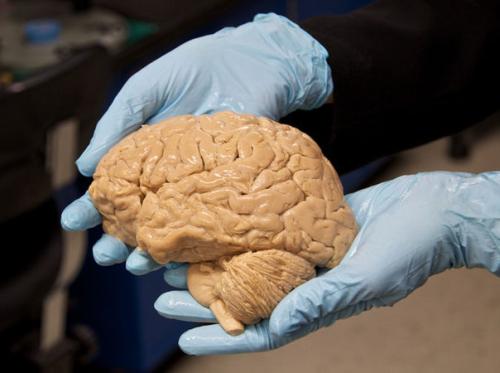
Leslie Tolbert, regents' professor in neuroscience and vice president for research, is the speaker tomorrow in the latest free talk in the UA's Mind and Brain Tuesday night lecture series at 7 p.m. at Centennial Hall.
The human brain is the most complex object known to us. It contains billions of nerve cells, each of which may make thousands of connections, in immense networks of circuitry that control our sense of self and our appreciation of—and interaction with—the world around us. In the last half century we learned that we are born with raw circuitry that quickly tunes itself to the environment we encounter. Now we are learning that the properties that allow nerve cells to achieve this "plasticity" in response to the early environment are controlled by the very same genes that drive learning and memory in adults.
Friday, February 26, 2010
A fascinating clip exploring "temporal discounting" from last Tuesday's lecture on "Building Brains, Making Minds" by Lynn Nadel, a Regents' Professor in Psychology. The The UA College of Science continues its spring lecture series, focusing on the mind and the brain, next month.
Thursday, February 25, 2010

- NASA/JPL/University of Arizona
A new batch of photos from the HiRISE camera aboard the Mars Reconnaissance Orbiter are up.
HiRISE team member Colin Dundas tells us:
This observation shows a portion of the central sedimentary deposits in Pasteur Crater.The deposits in this image now being eroded into knobs and ridges. The erosion is probably dominated by wind, as most of the ridges are parallel. This is common in wind-eroded features, with the ridges generally aligned with
Monday, February 22, 2010
The UA College of Science is launching its spring lecture series, focusing on the mind and the brain, tomorrow night. The talks start at 7 p.m. at UA's Centennial Hall.
Lynn Nadel, a Regents' Professor in Psychology, will discuss "Building Brains, Making Minds":
What does the brain do? The ancients thought it was a radiator, cooling the blood. Modern views see it as an activator, using inputs from the environment in combination with prior knowledge to generate behaviors (walking, talking, eating and drinking) and mental states (feelings, desires and beliefs). Recently the idea has emerged that the brain acts as a predictor, using inputs and stored knowledge to generate models of the world, and of the consequences of possible actions we and others might pursue. These models can predict what will happen in the next minute, hour or decade, and allow us to behave in the most adaptive way.
Tags: UA College of Science

