

Saturday, February 20, 2010
- NASA/JPL/University of Arizona
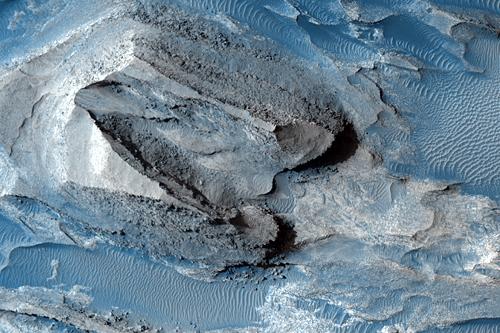
One more Mars photo from this week's batch of photos from the UA's HiRISE camera.
HiRISE team member Maria Banks tells us:
This observation shows a northwestern portion of the floor of a crater in the Arabia Terra region of Mars.In the subimage, several light-toned layered outcrops are
Tags: HiRISE camera , Mars
Thursday, February 18, 2010

- NASA/JPL/University of Arizona
A new twist on the images snapped by the UA's HiRISE camera aboard the Mars Reconnaissance Orbiter: An enhanced 3-D image of the Mojave Crater on Mars:
The vertical dimension is exaggerated three-fold compared with horizontal dimensions in the synthesized images of a portion of the crater's wall. The resulting images look like the view from a low-altitude aircraft. They reflect one use of digital modeling derived from two observations by the orbiter's High Resolution Imaging Science Experiment camera.This enhanced view shows material that has ponded and is backed up behind massive blocks of bedrock in the crater's terrace walls. Hundreds of Martian impact craters have similar ponding with pitted surfaces. Scientists believe these "pitted ponds" are created when material melted by the crater-causing impacts is captured behind the wall terraces.
Wednesday, February 17, 2010

- NASA/JPL/University of Arizona
Gorgeous new HiRISE shots from the UA's Lunar and Planetary Lab are up, including this shot of gullies in a crater in Terra Sirenum.
HiRISE team member Kelly Kolb tells us:
This observation shows gullies in a crater in Terra Sirenum. The gullies unusually emanate from different elevations along the crater wall. Several of the gullies are extremely developed and incised, while others have very narrow, shallow channels.Many of the gullies appear to have extensive debris aprons, but that could be deceiving. Based on
Friday, February 12, 2010
A galactic mystery solved by UA astronomers?
Daniel Stolte of University Communications tells us:

- Viewed through the Hubble Space Telescope at visible light (left), a galaxy does not reveal its full secret underlying star formation. Only when observed using a combination of radio emission and infrared wavelengths, the galaxy reveals a massive, rotating disc measuring about 60,000 light years across (right). This disc consists of cold molecular gas and dust, the raw materials from which stars are born. UA astronomers help explain why fewer stars are born today than in the early universe.
University of Arizona astronomers have helped solve a mystery surrounding the birth of stars in galaxies that has long puzzled scientists. Their results are published in the Feb. 11 issue of Nature."We have known for more than a decade that in the early universe — three to five billion years after the Big Bang or nine to eleven billion years before today — galaxies churned out new stars at a much faster rate than they do now," said Michael Cooper, a postdoctoral Spitzer fellow at the UA's Steward Observatory.
"What we haven't known is whether this was because they somehow formed stars more efficiently or because more raw material — molecular gas and dust — was available," said his colleague Benjamin Weiner, an assistant astronomer at Steward Observatory and one of the co-authors on the paper.
Compared to the average galaxy today, which produces stars at ratesequaling about 10 times the mass of our sun per year, the rate of star formation in those same galaxies appears to have been up to 10 times higher when they were younger.
In its efforts to find an answer, the scientific community has tended to turn telescopes toward few, rare, very bright objects, mostly because the instruments available did not allow for the study of less extreme, more typical galaxies. By focusing on the rare, bright objects, the results
Wednesday, February 10, 2010

- NASA/JPL/University of Arizona
Now up for your viewing pleasure: A fresh batch of Mars images from the UA Lunar and Planetary Lab's HiRISE camera
Speaking of Mars: We ran into Peter Smith, the principal investigator of the LPL's Phoenix Mars Mission, last week. He said they were still listening to see if their plucky robot survived the harsh winter on the Arctic plains of Mars, but they hadn't heard anything yet.
He also mentioned a recent story we missed: The LPL is one of three finalists in a competition for a NASA space mission. The plan: Drop a robotic spacecraft named OSIRIS-REx onto an asteroid, take same samples and snapshots, and come back home to earth. How cool is that?
Here's the UA's release on the project:
OSIRIS-REx will usher in a new era of planetary exploration. For the first time in space-exploration history, a mission will return a pristine sample of a carbonaceous asteroid.The mission executes precise spacecraft navigation to the surface of the asteroid, thoroughly characterizes the asteroid and the sample site, acquires a significant quantity of
Tuesday, February 9, 2010
Worried that the Large Hadron Collider may open up a black hole here on earth and swallow the planet? You can get the straight story tonight at tonight's Science Café. Details here:
Flandrau: The UA Science Center is holding its next “Science Café” at Cushing Street Bar & Restaurant in downtown Tucson on Tuesday, Feb. 9 at 6:00 p.m. A science café is a casual forum for people to meet and discuss a particular science topic with a UA scientist in the relaxed atmosphere of a local restaurant.Michael A. Shupe, a University of Arizona professor of physics, will give a short talk entitled, “Simply Smashing: The Large Hadron Collider Ramps Up.” Shupe, a member of the UA’s Large Hadron Collider team, is part of the LHC’s worldwide scientific effort to answer fundamental questions of the universe.
The Large Hadron Collider, the world’s biggest scientific experiment, will zip beams of sub-atomic particles around a 17-mile underground tunnel beneath the border of France and Switzerland. The machine, shut down for the winter, is scheduled to resume operations in March.
Friday, February 5, 2010

- NASA/JPL/University of Arizona
A new batch of Mars photos from the UA Lunar and Planetary Lab's HiRISE camera are up this week.
The above shot features Martian dunes on the northern plains.
Here's a note from Ken Herkenhoff, a HiRISE science team member at the USGS in Flagstaff:
This image shows dunes on the northern plains of Mars, and appears similar to images taken when the surface was covered by frost.However, CRISM spectra taken at the same time do not show
Tags: HiRISE , Mars , UA Lunar and Planetary Lab
Monday, January 25, 2010

- NASA/JPL/University of Arizona
The HiRISE gang at the UA Lunar and Planetary Lab have a beautiful new batch of Mars photos.
They're also introducing a new feature: HiWish, which lets you suggest areas you'd like the HiRISE camera aboard the Mars Reconnaissance Orbiter to target.
If you're interested in learning more about our sister planet, the University of Arizona College of Science will be offering three different talks about Mars this Friday, Jan. 29. Details:
Every few years the Earth passes Mars in their journeys around the Sun and we are given a front row seat to view our Martian neighbor up close and personal.On Jan. 29, the Red Planet will rise in the eastern sky around 8 p.m.
While Mars will only look like a bright orange star with unaided eyes, telescopes will zoom in on details such as the polar ice caps and large
Tuesday, January 19, 2010

- NASA/JPL/University of Arizona

- NASA/JPL/University of Arizona
More images from UA's Lunar and Planetary Lab's HiRISE camera in orbit above Mars. That's sand spilling across dry ice on on the floor a crater in the lower image. Cindy Hansen fills us in:
Dunes are often found on crater floors. In the winter time at high northern latitudes the terrain is covered by carbon dioxide ice (dry ice). In the spring
Tags: HiRISE , Mars , UA Lunar and Planetary Lab
Thursday, January 7, 2010

- NASA/JPL/University of Arizona
LPL's Candy Hansen tells us:
There is a vast region of sand dunes at high northern latitudes on Mars. In the winter, a layer of carbon dioxide ice covers the dunes, and in the spring as the sun warms the ice it evaporates. This is a very active process, and sand dislodged from the crests of the dunes cascades down, forming dark streaks.In the subimage falling material has kicked up a small cloud of dust. The color of the ice surrounding adjacent streaks of material suggests that dust has settled on the ice at the bottom after similar events.
Also discernible in this subimage are polygonal cracks in the ice on the dunes (the cracks disappear when the ice is gone).

