

Wednesday, January 6, 2010
UA electrical engineering senior Matt Bunting has gotten some attention for a robot he built as a class project last year.
Alan D. Fischer brings us this bulletin from the UA:
A six-legged robot designed to use cognitive reinforcement learning to most efficiently walk straight forward seems to be opening professional doors for UA electrical engineering senior Matt Bunting.The success of the as-yet-unnamed hexapod, built as a spring 2009 class project for UA cognitive robotics class ECE 596C, includes Intel Corp. ordering two of the robots and Bunting agreeing to develop software for a robotics company’s products.
“One of the things I wanted to explore was the idea of reinforcement learning. What I wanted to do was not preprogram any of those walking algorithms, I wanted it to figure out how to walk straight forward on its own,” Bunting said. “It has the ability to figure it out itself.”
The robot features a camera and uses successively taken images to determine if
Tags: Robots , University of Arizona , First Step Toward Enslavement of Mankind , Video
Friday, January 1, 2010
A few new HiRISE images of Mars from the UA's Lunar and Planetary Lab to start the new year:

- NASA/JPL/University of Arizona

- NASA/JPL/University of Arizona
The upper shot shows dark sand covering bright bedrock in the Terra Meridiani region of Mars.
Nathan Bridges of the LPL tells us:
The MER Opportunity rover is currently exploring Meridiani, but is located about 500 kilometers to the west-southwest from here (as of 2007).There are three broad classes of terrain in this image. The regular spacing of the dark ridges, with one side of the ridges (in this case generally on the northwest) shallower than the other, indicates that the material is windblown sand deposited in the form of dunes or large ripples.
On the slopes of and in between the dunes/ripples are smaller-scale ripples. The dark tone
Sunday, December 13, 2009
We got some good news about the HiRISE camera aboard the Mars Reconnaissance Orbiter from the morning daily this weekend: The UA Lunar and Planetary Lab says the MRO should be working fine again after some repairs.
We're delighted to hear that we're going to continue to get images like these:

- NASA/JPL/University of Arizona

- NASA/JPL/University of Arizona
The top image shows bright layered deposits near the junction of Coprates Chasma and Melas Chasma, part of Valles Marineris.
The lower is image is of barchan dunes. The LPL's Andrea Philippoff tells us:
Barchan dunes are common on both Earth and Mars. These dunes are very distinctive in shape, and are important because they can tell scientists about the environment in which they formed.Barchans form in wind regimes that blow
Wednesday, December 9, 2009
I talk about the robots that work at the Human Origins Genotyping Story in this week's cover story, but you need to see them in action to really appreciate what's going on there.
Our Web producer, Nick Smith, shot a short video where Matt Kaplan, the lab's director, explains how the robots do their thing.
Tags: Human Origins Genotyping Laboratory , Matt Kaplan , Genographic Project , Video
Wednesday, December 2, 2009
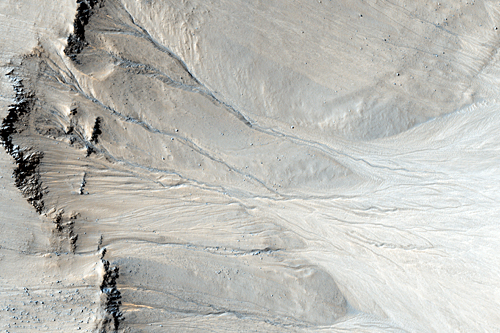
- NASA/JPL/University of Arizona
- Different types of gullies
Here's one of the latest photos released by the HiRISE team at the UA Lunar and Planetary Laboratory. This week's theme is gullies. Ingrid Daubar Spitale tells us:
This image covers parts of two different craters, both with gullies in the inner walls. Gullies are a popular target because their formation is still being debated.The powerful HiRISE camera reveals many details of gullies that have never been seen before. (Searching our catalog for "gully" or "gully" will bring up many, many more images of gullies!) Some hypotheses about the formation of gullies involve the flow of some amount of liquid (water, brine, or some other substance), and others postulate that gullies could be formed by the downhill movement of dry material such as dust or sand. To further complicate things, different gullies could have formed by different methods.
The many gullies visible in this image look quite different from each other. This subimage
Tags: HiRISE camera , UA Lunar and Planetary Lab , Mars
Tuesday, November 10, 2009

- NASA/JPL/University of Arizona
- Pitted Layers Northeast of Hellas Region
Red Star is complaining that we didn't share a postcard from Mars last week. (Actually, we think we did.)
Nonetheless, we'll take any excuse to share these gorgeous snapshots, so this one is for him. More from the UA's awesome HiRISE here.
Thursday, November 5, 2009

- NASA/JPL/University of Arizona
Here's one I missed in all the election excitement: The HiRISE camera aboard Mars Reconnaissance Orbiter has spotted the Phoenix Mars Lander on the frosty northern plains of Mars.
Lori Stiles of University Communications tells us:
The HiRISE camera aboard NASA's Mars Reconnaissance Orbiter captured one image of the Phoenix lander on July 30, 2009, and the other on Aug. 22, 2009. That's when the sun began rising over the northern polar plains at the end of the northern hemisphere winter, the imaging team said.The new images are available at the HiRISE Web site.
"We decided to try imaging the site despite the low light levels," said. HiRISE team members Ingrid Spitale of the UA Lunar and Planetary Laboratory.
Now if only Phoenix still works after all that time under Martian ice...
Tags: Phoenix Mars Lander , HiRISE Camera , UA College of Science

- Omar Tonsi Eldakar
- The water strider on the right, identified by the blue-red-white dot sequence, is a highly aggressive male who is trying to break up a mating pair. The male water strider with the white-yellow-blue dots is on top of a female who had green dots on her head.
UA scientist Omar Tonsi Eldakar reveals that the female water strider is more attracted to geeks than jocks.
Eldakar notes:
Nice guys don't always finish last. In this study we've shown that it's possible for non-aggressive males to have the advantage.
Mari N. Jensen of the UA College of Science delivers a dispatch after the jump.
Tags: Science , water striders , pickup artists , UA College of Science
Wednesday, October 28, 2009

- NASA/JPL/University of Arizona
Otto Ross at the morning daily reports that the Mars Reconnaissance Orbiter, which has the UA's HiRISE camera aboard, is having some computer problems:
The Mars Reconnaissance Orbiter carrying UA's HiRISE camera is entering its ninth week in a precautionary safe-mode, facing its greatest challenge since it launched in 2005.Engineers are busily working to safeguard the orbiter against an unlikely but potentially fatal scenario that was discovered when the orbiter unexpectedly put itself into safe-mode for the fourth time this year.
"It's very unlikely but (the MRO) is a precious asset for the American people and we take it very seriously to make sure we protect it," said MRO Project Manager Jim Erickson.
Let's hope it's nothing serious. The HiRISE team is one of Tucson's finest assets. Check out some of the new photos from Mars here.
Wednesday, October 14, 2009

Ten, nine, eight, seven, six, five—that bottle's kicked, too?—four, three, two, one... CRASH!
They crashed a rocket on the moon the other day, on purpose. NASA was out of vodka, and a spokeswoman said, "This is the most cost-effective way to find out if the moon has any vodka."
Taxpayers remain skeptical, mostly because the crash was a dud: no photogenic fire, no photogenic heroes, no plume shaped like Bat Boy, and, worst of all, no vodka.
Folks tend to get more exited when things crash accidentally, like the Titanic, Evel Knievel and various television hosts.
If NASA had better PR people, they'd have pretended that the moon mission was manned. The spokeswoman would say, "This is the critical juncture for Astronauts X, Y and Z --all of whom have beautiful and anxious families. (Roll the stock photos.) We can only pray to Vodka that their retrorockets won't fail."
They'd place propaganda in all the important newspapers (both of them) informing the public that, for scientific reasons beyond our comprehension, this particular mission also carried a very fluffy bunny rabbit, whom the astronauts named "Cinderella," and who does backflips whenever their spacecraft is in trouble.
That way, when Cinderella started doing backflips, it would make the front page, and, when the craft finally crashed, taxpayers would cry into their Dunkin' Donuts coffee, tie ribbons around their trees, and call in sick at work. Even NASA might forget for a moment that they were still out of vodka.

