

Thursday, September 24, 2009

- NASA/JPL/University of Arizona

- NASA/JPL/University of Arizona
More beautiful photos of Mars from the UA's HiRISE camera aboard the Mars Reconnaissance Orbiter.
The latest news: HIRISE has helped scientists spot ice below the surface of Mars halfway between the north pole and the equator, thanks to photos of craters that had been recently created by meteor collisions.
Lori Stiles of UA News tells us:
Scientists are seeing sub-surface water ice that may be 99 percent pure
halfway between the north pole and the equator on Mars, thanks to
quick-turnaround observations from orbit of fresh meteorite impact
craters on the planet."We knew there was ice below the surface at high latitudes of Mars, but
we find that it extends far closer to the equator than you would think,
based on Mars' climate today," said Shane Byrne of the University of
Arizona, a member of the High Resolution Imaging Science Experiment, or
HiRISE, which runs the high-resolution camera on NASA's Mars
Reconnaissance Orbiter."The other surprising discovery is that ice exposed at the bottom of
these meteorite impact craters is so pure," Byrne said. "The thinking
before was that ice
Thursday, September 17, 2009
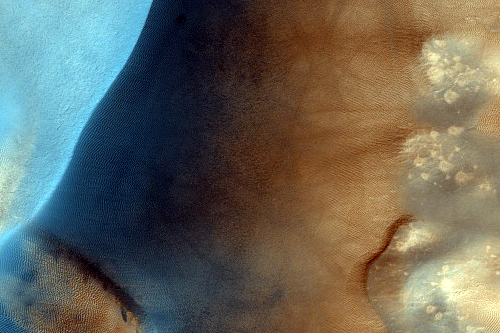
- NASA/JPL/University of Arizona
The latest snapshots of Mars taken by the UA Lunar and Planetary Lab's HiRISE camera aboard the Mars Reconnaissance Orbiter.
Wednesday, September 9, 2009

- NASA, ESA, and the Hubble SM4 ERO Team
Thanks to some nifty—and dangerous—repair work, the Hubble Space Telescope is working again. Here's a press release from NASA:
Astronomers declared NASA's Hubble Space Telescope a fully rejuvenated observatory with the release Wednesday of observations from four of its six operating science instruments. Sen. Barbara A. Mikulski, D-Md., unveiled the images at NASA Headquarters in Washington.Topping the list of new views are colorful, multi-wavelength pictures of far-flung galaxies, a densely packed star cluster, an eerie "pillar of creation," and a "butterfly" nebula. Hubble's suite of new instruments allows it to study the universe across a wide swath of the light spectrum, from ultraviolet all the way to near-infrared. In addition, scientists released spectroscopic observations that slice across billions of light-years to probe the cosmic-web structure of the universe and map the distribution of elements that are fundamental to life as we know it.
"This marks a new beginning for Hubble," said Ed Weiler, associate administrator for NASA's Science Mission Directorate
Wednesday, September 2, 2009

- NASA/JPL/University of Arizona

- NASA/JPL/University of Arizona

- NASA/JPL/University of Arizona
More great snapshots of Mars taken by the UA Lunar and Planetary Lab's HiRISE camera aboard the Mars Reconnaissance Orbiter. Zilair Crater? The dunes of Aonia Terra? Who names these places, Edgar Rice Burroughs?
The first shot features gullies at the edge of Hale Crater. Shane Byrne explains:
Several years ago gullies carved into hill-slopes and the walls of impact craters like the ones pictured here were discovered. Scientists are excited to study these features because, on Earth, they usually form through the action of liquid water - long thought to be absent on the Martian surface. Whether gullies form under today's cold dry conditions is a major question that planetary scientists are trying to answer.The gullies pictured here are great examples of what a typical Martian gully looks like. You can see wide V-shaped channels running downhill
Friday, August 28, 2009

- NASA/JPL/University of Arizona

- NASA/JPL/University of Arizona
Here are some of the latest photos of Mars taken by the UA Lunar and Planetary Lab's HiRISE camera aboard the Mars Reconnaissance Orbiter.
The upper image features dunes near the Martian north pole. Shane Byrne explains:
Multiple levels within the north polar layered deposits are visible in this HiRISE image.The north polar layered deposits (NPLD) are a stack of dusty water-ice layers that are thought to record information about past Martian climates in the same way that ice-caps on the Earth record variations in our climate. These Martian layers are visible in the walls of troughs and scarps eroded into the stack. One such scarp-face is visible on the far left of the full image and decreases in height from left to right.
Scientists continue to debate the length of time required to
Wednesday, August 12, 2009

- NASA/JPL/University of Arizona
- An Oblique View of Victoria Crater

- NASA/JPL/University of Arizona
- Interesting Crater in Meridiani Planum
It's been a while since we shared new photos of Mars taken by the UA Lunar and Planetary Lab's HiRISE camera aboard the Mars Reconnaissance Orbiter.
The upper photo is an oblique view of Victoria Crater. Dr. Alfred McEwen of the LPL tells us:
Victoria Crater was explored by Opportunity rover for more than a Mars year; HiRISE images have supported surface exploration and contributed to joint scientific studies.HiRISE stereo data were used to measure slopes and help select safe paths for the intrepid rover. The most interesting exposures of geologic strata are in the steep walls of the crater, difficult to image from the overhead perspective of orbiting spacecraft like MRO. However, MRO can point to the sides, and did so in this case to get a better view of layers in the west-facing and sunlit slopes of the crater.
Especially prominent is a bright band near the top of the crater wall, interpreted by some MER scientists as
Tuesday, July 21, 2009

Press release of the day:
POMPANO BEACH, Fla.— In response to rumors circulating the internet on sites such as FoxNews.com, FastCompany.com and CNET News about a “flesh eating” robot project, Cyclone Power Technologies Inc. (Pink Sheets:CYPW) and Robotic Technology Inc. (RTI) would like to set the record straight: This robot is strictly vegetarian.On July 7, Cyclone announced that it had completed the first stage of development for a beta biomass engine system used to power RTI’s Energetically Autonomous Tactical Robot (EATR™), a Phase II SBIR project sponsored by the Defense Advanced Research Projects Agency (DARPA), Defense Sciences Office. RTI’s EATR is an autonomous robotic platform able to perform long-range, long-endurance missions without the need for manual or conventional re-fueling.
RTI’s patent pending robotic system will be able to find, ingest and extract energy from biomass in the environment. Despite the far-reaching reports that this includes “human bodies,” the public can be assured that the engine Cyclone has developed to power the EATR runs on fuel no scarier than twigs, grass clippings and wood chips — small, plant-based items for which RTI’s robotic technology is designed to forage. Desecration of the dead is a war crime under Article 15 of the Geneva Conventions, and is certainly not something sanctioned by DARPA, Cyclone or RTI.
“We completely understand the public’s concern about futuristic robots feeding on the human population, but that is not our mission,” stated Harry Schoell, Cyclone’s CEO. “We are focused on demonstrating that our engines can create usable, green power from plentiful, renewable plant matter. The commercial applications alone for this earth-friendly energy solution are enormous.”
Thursday, June 18, 2009
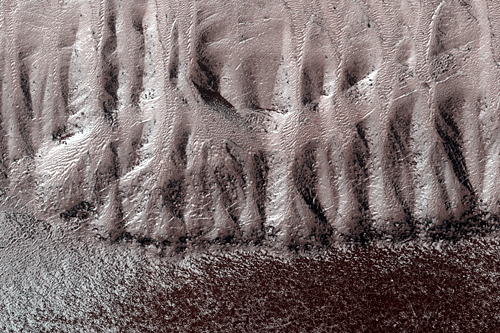
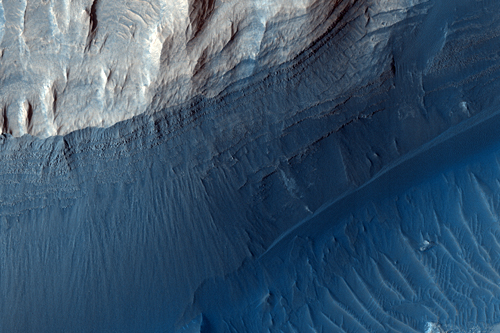
From the most recent batch of Mars photos taken by the UA Lunar and Planetary Lab's HiRISE camera aboard the Mars Reconnaissance Orbiter. The upper photo features "the north wall and floor of a polar pit in the southern hemisphere," while the lower shot shows us the Grand Canyon of Gale Crater.
Photos by NASA/JPL/University of Arizona
Monday, June 15, 2009

We reported last month on The Range about the unfortunate cloure of the UA's Flandrau Science Center, which was to cease operations on Monday, June 1, because of budget cuts.
Well, it appears that a number of extraordinarily dedicated astronomy volunteers have taken it upon themselves to keep one key activity alive at the observatory: viewings through the 16-inch telescope.
The telescope is open for viewings from 7 to 10 p.m., Wednesday through Saturday, year-round, according to a press release released by the folks at Flandrau. Poor weather will botch viewing attempts, so check with your local weatherman before heading down to the observatory, which is located on the UA campus on the northeast corner of University Boulevard and Cherry Avenue.
You can even find out about significant heavenly events to look for during your visit at http://www.uasciencecenter.org/astronomy/skywatchers-guide/. Expert astronomers will also be on hand to help guide you through your heavenly tour.
Visit www.UAsciencecenter.org for more info.
And make sure to say thanks to those volunteers for keeping this local treasure alive.
Friday, June 5, 2009
UA astronomer Chris Impey, who says he's traveled over 5 million miles by air, shared his perspective on the recent Air France tragedy in an opinion piece published in the Los Angeles Times.

