

Monday, May 10, 2021
Pima County is teaming up with the Northwest YMCA, 7770 N. Shannon Road, to offer a vaccination clinic from 4 to 8 p.m. today, Monday, May 10.
Meanwhile, Pima County and the Federal Emergency Management Agency (FEMA) have launched mobile vaccination units to reach vulnerable communities with high risks of COVID-19 exposure and infection.
The operation includes two mobile vaccination units that are able to administer 250 vaccines per day each, according to a county press release.
The units will run through June 26, operating at two concurrent locations for three days, with one day to tear down and move to the next location. The locations were selected based on census tract data and the Social Vulnerability Index of the area to identify highly vulnerable communities.
The sites will offer walk-up vaccinations of both the Moderna and Johnson & Johnson vaccine for those 18 and older on a first-come, first-served basis. Vaccinators will return to the same mobile site 28 days after their first visit to receive their second dose, following CDC guidance. Help will be available to all who need assistance with mobility, language or other accommodations.
Here are the planned mobile clinics:
Monday, May 10
- 2900 N. Columbus Blvd, Tucson, 9 a.m. – noon
Northwest YMCA, 7770 N. Shannon Road, Tucson, 4 – 8 p.m.
Tuesday, May 11 - Thursday, May 13
- Greyhound Park, 2601 S. 3rd Ave., 10 a.m. – 8 p.m.
- Wheeler Taft Library, 7800 N. Schisler Drive, 10 a.m. – 8 p.m.,
Rillito Race Track, 4502 N. 1st Ave., 10 a.m. – 8 p.m.
Wednesday, May 12
- Ott Family YMCA, 401 S. Prudence Road, 8 a.m. – noon
- Sun City Oro Valley, 1565 E. Rancho Vistoso Blvd., 1 p.m. - 4 p.m.
At other vaccination sites, Pima County officials are shifting to indoor vaccination sites to avoid making staff and volunteers endure long days in triple-degree temperatures.
Tucson Medical Center has transferred its operations to the Udall Center, 7200 E. Tanque Verde Road. The site is open 8 a.m. to 5 p.m. Monday, Thursday and Friday and 8 a.m. to 7 p.m. Tuesday and Wednesday. Register at https://vaccine.tmcaz.com/MyChart/OpenScheduling.
Pima County has opened a new indoor vaccine site at the Kino Event Center, where the county had earlier been doing COVID testing. That site is open 9 a.m. to 7 p.m., Monday through Saturday. Register at azdhs.gov.
The county has also opened an indoor vaccination POD at El Pueblo Center, 101 W. Irvington Road, which is open Monday, Wednesday and Friday from 9:30 a.m. to 1:30 p.m. No appointment is necessary.
The drive-through POD at Banner-South Kino Stadium, 2500 E. Ajo Way, is now offering appointments between 7:30 a.m. and 12:30 p.m. but will close permanently on May 14.
Visit pima.gov/covid19vaccine for more details.
The UA vaccination point of distribution is now accepting anyone over the age of 16 who comes in for a shot.
The POD, which is scheduled to close at the end of June, offers a sit-down clinic in the Ina E. Gittings Building (1737 E. University Blvd.) from 10 a.m. to 10 p.m. daily.
If you’d rather schedule an appointment, the state is expected to open new first-dose appointments daily at podvaccine.azdhs.gov. Call 602-542-1000 or 844-542-8201 for help in English or Spanish.
If you need help, call the COVID Ambassador Team hotline at 520-848-4045 between 7 a.m. and 7 p.m. daily or email [email protected].
CVS pharmacies are now accepting same-day COVID-19 vaccination appointments, and at some locations no appointment is necessary.
About 190 locations in Arizona are taking walk-ins, but appointments are also available within an hour of scheduling.
Walgreens announced it would offer same-day appointments at locations across the country as of this week. Patients can schedule appointments up to 30 minutes before the desired appointment time.
While Walgreens continues to encourage appointments, a Walgreens corporate spokesperson said, walk-ins have and continue to be accepted “if a time slot is available,” across all 8,800 Walgreens stores offering vaccinations.
As of Sunday, May 9, 414,850 people in Pima County had received at least one shot of the virus, accounting for 39.7% of the population. A total of 349,067 people were fully vaccinated.
Get tested: Pima County has free COVID testing
Pima County is continuing to offer a number of testing centers and pop-up testing sites around town, including the northside Ellie Towne Flowing Wells Community Center, 1660 W. Ruthrauff Road. Schedule an appointment at pima.gov/covid19testing.
The University of Arizona’s antibody testing can determine if you have had COVID and now have antibodies. To sign up for testing, visit https://covid19antibodytesting.arizona.edu/home.
Today’s numbers
With 642 new cases reported today, the total number of Arizona’s confirmed novel coronavirus continues to climb to 870,000 as of Monday, May 10, according to the Arizona Department of Health Services.
Pima County, which reported 61 new cases today, has seen 115,805 of the state’s 869,472 confirmed cases.
With no new deaths reported this morning, a total of 17,409Arizonans have died after contracting COVID-19, including 2,403 deaths in Pima County, according to the May 10 report.
A total of 565 coronavirus patients were in the hospital as of May 9. That’s roughly 16% of the number hospitalized at the peak of the winter surge, which reached 5,082 on Jan. 12. The summer peak was 3,517, which was set on July 13, 2020. The subsequent lowest number of hospitalized COVID patients was 468, set on Sept. 27, 2020.
A total of 828 people visited emergency rooms with COVID-like symptoms on May 9. That number represents 35% of the record high of 2,341 set on Tuesday, Dec. 29, 2020. That number had peaked during the summer wave at 2,008 on July 7, 2020; it hit a subsequent low of 653 on Sept. 28, 2020.
A total of 182 COVID-19 patients were in intensive care unit beds on May 9, which roughly 15% of the record 1,183 ICU patients set on Jan. 11. The summer’s record number of patients in ICU beds was 970, set on July 13, 2020. The subsequent low was 114 on Sept. 22, 2020.
—with additional reporting from Christina Duran, Jeff Gardner and Mike Truelsen
Friday, May 7, 2021
Pima County officials are hoping they get lucky enough to overcome vaccine hesitancy by setting up mobile vaccination sites at the Desert Diamond and Casino del Sol this weekend.

Pima County and the Federal Emergency Management Agency are teaming up to launch mobile vaccination units this weekend to reach vulnerable communities with high risks of COVID-19 exposure and infection.
The operation includes two mobile vaccination units, able to administer 250 vaccines per day each, along with administrative staff and federal vaccinators with 70 personnel from FEMA, Health and Human Services, the Environmental Protection Agency and Department of Labor, according to a county press release.
The units will run through June 26, operating at two concurrent locations for three days, with one day to tear down and move to the next location. The locations were selected based on census tract data and the Social Vulnerability Index of the area to identify highly vulnerable communities.
The sites will offer walk-up vaccinations of both the Moderna and Johnson & Johnson vaccine for those 18 and older on a first-come, first-served basis. Vaccinators will return to the same mobile site 28 days after their first visit to receive their second dose, following CDC guidance. Help will be available to all who need assistance with mobility, language or other accommodations.
Here are the planned mobile clinics:
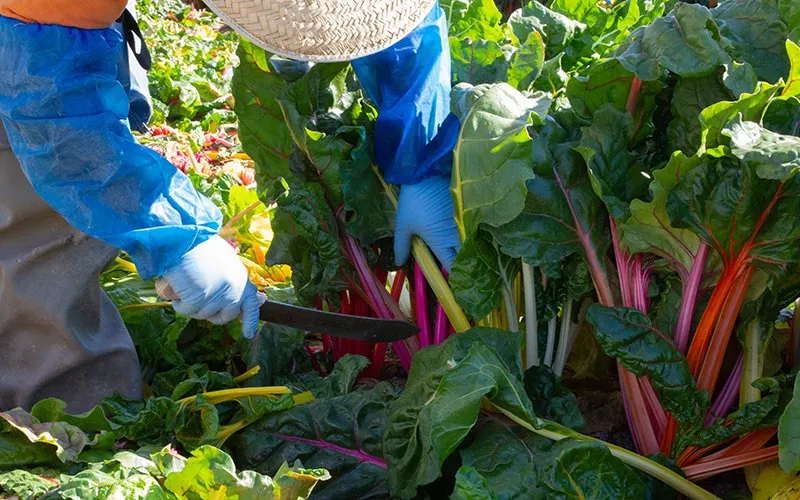
YUMA – The workers swing their machetes, chopping vegetables under the heat of a midmorning sun.
When the migrant workers take a moment to swipe the sweat from their masked faces, they can see the wall along the Mexican border, not a half-mile distant. But before long, they turn their attention back to a rainbow-colored field of Swiss chard.
It takes more time to clear a field since the COVID-19 pandemic began a year ago. Where there had been 25 workers in the field, there are now 15, to create social distance.
More buses are used to drive workers to the fields, and plexiglass guards were placed on farming equipment, according to the Yuma Chamber of Commerce. Some farms have added masks, daily temperature and blood-pressure checks and contact tracing after outbreaks.
The protocols were necessary to protect Yuma’s top industry, which depends on migrant workers – whom Gov. Doug Ducey declared essential when the pandemic began more than a year ago. Yuma is one of the nation’s major producers of vegetables, with the produce ending up in kitchens across the U.S.
Now, attention is turning to getting farmworkers vaccinated, but advocates for migrant workers say that effort trails the need.
Migrant workers – close to 9,000 temporary agricultural worker visas were issued in Arizona during 2020, mostly in Yuma – travel across the border every day from Mexico.
The Yuma Chamber of Commerce website says agriculture brings in an estimated $2.5 billion a year into the local economy.
Still, some farmworkers are nervous.
More than half a million agricultural workers had tested positive for COVID-19 in the U.S. as of March 10, according to Purdue University’s Food and Agriculture Vulnerability Index. It estimated that just under 7,200 of those cases were in Arizona, about 1,000 of which were in Yuma County.
“When our work partner sneezes, we all turn around,” Teresa De Jesús Rodríguez, a migrant worker in Yuma, said in Spanish. “Outside of work, we ask that person how they feel and make sure we always isolate the person.
Thursday, May 6, 2021
CVS pharmacies are now accepting same-day COVID-19 vaccination appointments, and at some locations no appointment is necessary.

About 190 locations in Arizona are taking walk-ins, but appointments are also available within an hour of scheduling.
“We continue to orchestrate an all-out effort to vaccinate the nation against COVID-19,” said CVS Health President and CEO Karen S. Lynch. “Thanks to the dedication and effort of our colleagues, I am proud to say we helped achieve the President’s accelerated 100-day goal of 200 million vaccines and have administered over 17 million COVID-19 vaccine doses to date. Our customers continue to give us high satisfaction scores based on their interactions with colleagues and our customer-centric digital approach for scheduling appointments.”
CVS has administered more than 17 million COVID-19 vaccine doses nationwide through the Pharmacy Partnership for Long-Term Care Program and Federal Retail Pharmacy Program as of May 5. CVS locations boast a more than 90% second-dose compliance rate.
Walgreens announced it would offer same-day appointments at locations across the country as of yesterday. Patients can schedule appointments up to 30 minutes before the desired appointment time.
While Walgreens continues to encourage appointments, a Walgreens corporate spokesperson said, walk-ins have and continue to be accepted “if a time slot is available,” across all 8,800 Walgreens stores offering vaccinations.
The announcement by CVS comes after the state announced on April 27 that it would allow no-appointment walk-ins at state PODs. Pima County offers no-appointment walk-ins at its mobile clinics and some large vaccination sites, including El Pueblo Center on Irvington Road.

WASHINGTON – Open it, and they will come.
A special open enrollment period for Affordable Care Act coverage drew 528,005 new enrollees nationwide in its first six weeks, with 9,569 of those consumers in Arizona, according to a report from the Centers for Medicare and Medicaid Services.
Enrollment from Feb. 15 to March 31 was two to three times higher than the same period in previous years, although spring enrollment then was available only to those with qualifying life events like a birth or job change. But advocates were encouraged by the numbers from this spring, which they said show the underlying demand for coverage.
“I think that largely shows that people need coverage, and having a special enrollment period extended during a pandemic is exactly the kind of policies that we need,” said Sarah Coombs, director for health system transformation at the National Partnership for Women and Families.
President Joe Biden ordered a special open enrollment period just days after his inauguration in January, to counter what the White House called “four years of attempts to strip health care from millions of Americans” during the Trump administration. Biden originally called for the open enrollment to run from Feb. 15 to March 15, but that was later extended to Aug. 15 by Health and Human Services Secretary Xavier Becerra.
Since the special enrollment period started, Congress approved the administration’s $1.9 trillion American Rescue Plan, which includes funding that will lower health insurance premiums through tax credits for people who buy their insurance through the ACA’s federal marketplace. That includes consumers who enrolled in 2020, but can use the open enrollment period to see if they can get a lower premium.
Effective April 1, the American Rescue Plan provides “major improvements in access to and affordability of health coverage through the Marketplace by increasing eligibility for financial assistance to help pay for Marketplace coverage,” according to CMS. It estimates that four in five people who enroll through healthcare.gov will end up paying less than $10 a month in premiums after their tax credits are applied.
Coombs said the subsidies “will make a huge difference to people’s pockets, and in people’s decision-making in getting coverage.”
Wednesday, May 5, 2021
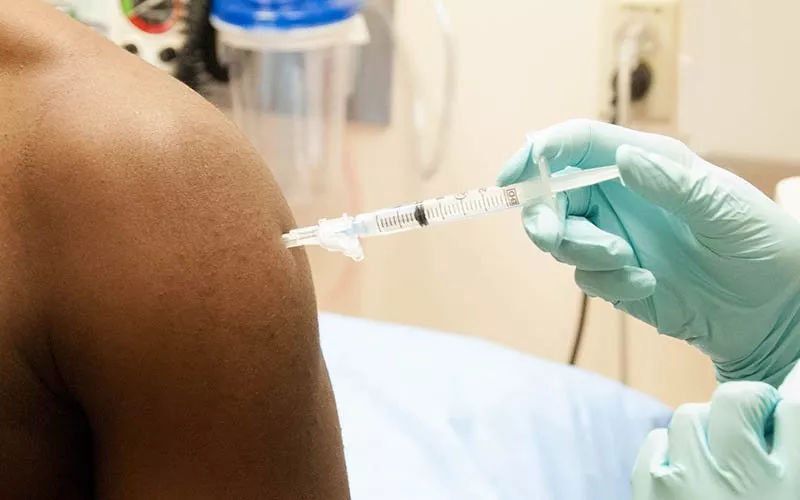
CVS pharmacies are now accepting same-day COVID-19 vaccination appointments, and at some locations no appointment is necessary.
About 190 locations in Arizona are taking walk-ins, but appointments are also available within an hour of scheduling.
“We continue to orchestrate an all-out effort to vaccinate the nation against COVID-19,” said CVS Health President and CEO Karen S. Lynch. “Thanks to the dedication and effort of our colleagues, I am proud to say we helped achieve the President’s accelerated 100-day goal of 200 million vaccines and have administered over 17 million COVID-19 vaccine doses to date. Our customers continue to give us high satisfaction scores based on their interactions with colleagues and our customer-centric digital approach for scheduling appointments.”
CVS has administered more than 17 million COVID-19 vaccine doses nationwide through the Pharmacy Partnership for Long-Term Care Program and Federal Retail Pharmacy Program as of May 5. CVS locations boast a more than 90% second-dose compliance rate.
Walgreens announced it would offer same-day appointments at locations across the country as of today. Patients can schedule appointments up to 30 minutes before the desired appointment time.
While Walgreens continues to encourage appointments, a Walgreens corporate spokesperson said, walk-ins have and continue to be accepted “if a time slot is available,” across all 8,800 Walgreens stores offering vaccinations.
Tuesday, May 4, 2021
The University of Arizona plans to decommission its vaccination site as of June 25 and has announced new hours.

With the decline in vaccine demand and “as other avenues for vaccination become more readily available,” the UA POD plans to scale back its hours and on Monday transitioned to fully indoors at the Ina E. Gittings Building, closing the drive-thru as the days get hotter, announced UA President Robert C. Robbins at the university update on Monday morning.
At the start of next week the UA POD will shorten its hours to 10 a.m. to 5 p.m., then on June 1 will continue with new hours only offering second doses.
“We're going to stop taking first dose appointments, relatively soon, just to make sure that the second dose is booked here at the University of Arizona POD, so that we will finish all shots that we started here,” said Vice President of Communications Holly Jensen. More details here.
County launching mobile vax pods
As health officials work to overcome vaccine hesitancy among some members of the public, Pima County and the Federal Emergency Management Agency (FEMA) are teaming up to launch mobile vaccination units to reach vulnerable communities with high risks of COVID-19 exposure and infection.
The operation includes two mobile vaccination units (MVUs), able to administer 250 vaccines per day each, along with administrative staff and federal vaccinators with 70 personnel from FEMA, Health and Human Services, the Environmental Protection Agency and Department of Labor, according to a county press release.
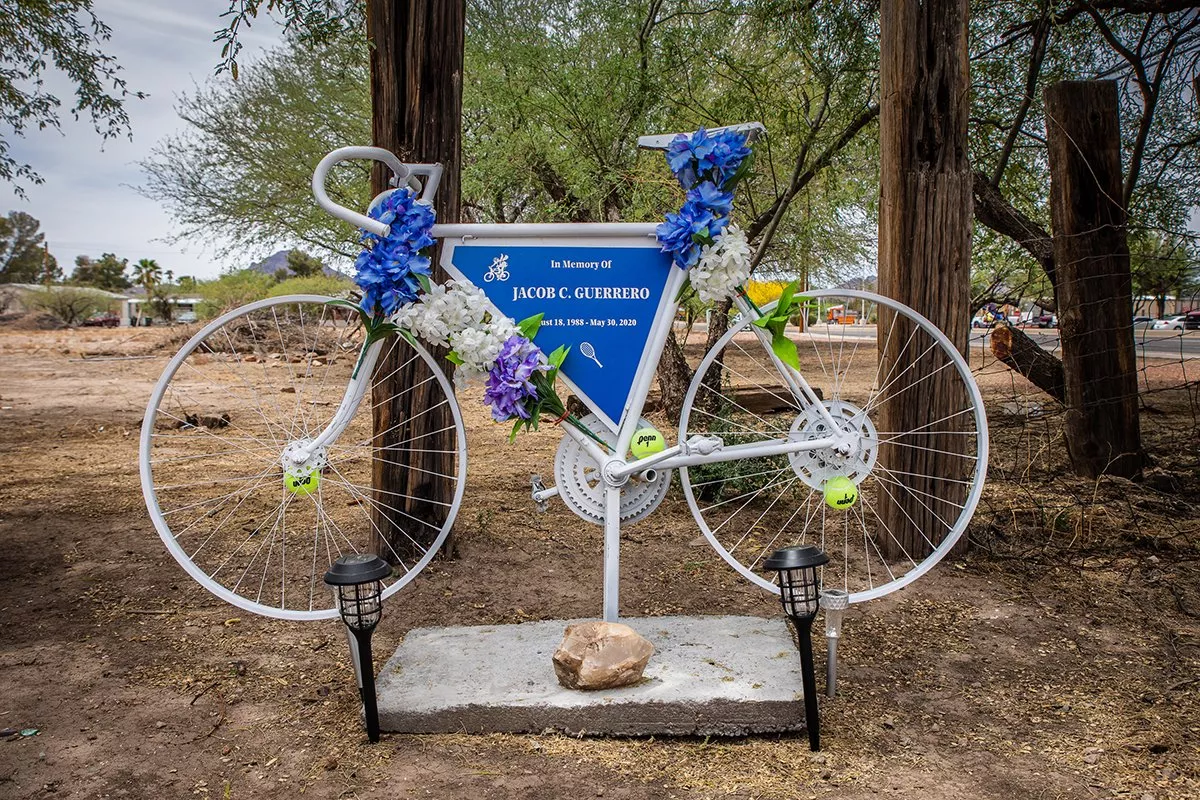
TUCSON – It was a Tuesday afternoon, two months into the pandemic, when Theresa Guerrero got the call from her brother-in-law: Her son, Jacob, had been found unresponsive.
She was standing in the middle of a Ross store in south Tucson picking out a pillow he’d asked for, throwing it to the floor as she raced toward the exit.
Jacob was a cyclist, a tennis player – a trusting, good man – but he’d grown lethargic of late and quit pursuing his active lifestyle. The pandemic only made things worse.
He’d been working as a Postmates driver for a couple of months. One day, his mother saw straws in his car and wondered whether he was using cocaine. But when she confronted Jacob, he brushed her off.
“He was, like so many other people, really lonely, and I remember he would go on drives by himself just to get out of the house,” Guerrero said. “I have to wonder if he had been able to see other people, would they have noticed what he was going through before I did?”
By the time she drove the seven miles to Jacob’s house last May 30, six paramedics hovered over him. Guerrero doesn’t remember a lot about that moment, other than screaming out to strangers as they loaded her only son into an ambulance, assuming their silence meant the inevitable was coming.
She followed the lights and sirens to the hospital, but due to COVID-19 regulations, she had to stay outside and wait.
And wait.
Monday, May 3, 2021
This week, Pima County and the Federal Emergency Management Agency (FEMA) are teaming up to launch mobile vaccination units to reach vulnerable communities with high risks of COVID-19 exposure and infection.
The operation includes two mobile vaccination units (MVUs), able to administer 250 vaccines per day each, along with administrative staff and federal vaccinators with 70 personnel from FEMA, Health and Human Services, the Environmental Protection Agency and Department of Labor, according to a county press release.
The units will run through June 26, operating at two concurrent locations for three days, with one day to tear down and move to the next location. The locations were selected based on census tract data and the Social Vulnerability Index of the area to identify highly vulnerable communities.
“We’re extremely grateful to FEMA for partnering with us on this effort to reach pockets of the community who may not have easy access to this life-saving vaccine,” said Pima County Administrator Chuck Huckelberry. “The ability to offer vaccines during evenings and weekends will enable us to reach folks whose work or school schedules prevent them from getting a vaccine now. With this effort, there’s truly no reason not to roll up your sleeve and get your shot so we can start putting this pandemic behind us.”
The sites will offer walk-up vaccinations of both the Moderna and Johnson & Johnson vaccine for those 18 and older on a first-come, first-served basis. Vaccinators will return to the same mobile site 28 days after their first visit to receive their second dose, following CDC guidance. Help will be available to all who need assistance with mobility, language or other accommodations.
Here are the planned mobile clinics:
May 7-9, 10 a.m. to 8 p.m.
- Casino del Sol, 5655 W. Valencia Road
- Desert Diamond Casino, 7350 S. Nogales Hwy.
May 11-13, 10 a.m. to 8 p.m.
- Greyhound Park, 2601 S. Third Ave.
- Wheeler Taft Library, 7800 N. Schisler Drive
May 15-17, 10 a.m. to 8 p.m.
- Rillito Race Track, 4502 N. First Ave.
- Curtis Park, 2110 W. Curtis Road
The county continues to offer vaccinations at several vaccination centers, mobile pop-up clinics and pharmacies. Visit pima.gov/covid19vaccine for more information.
No appointment necessary for the UA vax POD
You no longer need an appointment to get a shot at the UA vaccination point of distribution. The POD will now accept anyone over the age of 16 who comes in for a shot.
The pod has closed its drive-thru clinic because of rising temperatures, but still offers a sit-down clinic in the Ina E. Gittings Building (1737 E. University Blvd.) from 10 a.m. to 10 p.m. daily.
If you’d rather schedule an appointment, the state is expected to open new first-dose appointments daily at podvaccine.azdhs.gov. Call 602-542-1000 or 844-542-8201 for help in English or Spanish.
If you need help, call the COVID Ambassador Team hotline at 520-848-4045 between 7 a.m. and 7 p.m. daily or email [email protected].
Meanwhile, Pima County officials are shifting to indoor vaccination sites to avoid making staff and volunteers endure long days in triple-degree temperatures.
Tucson Medical Center has shut down its drive-thru vaccination clinics and transferred its operations to the Udall Center, 7200 E. Tanque Verde Road. The site is open 8 a.m. to 5 p.m. Monday, Thursday and Friday and 8 a.m. to 7 p.m. Tuesday and Wednesday. Register at https://vaccine.tmcaz.com/MyChart/OpenScheduling.
Pima County has opened a new indoor vaccine site at the Kino Event Center, where the county had earlier been doing COVID testing. That site is open 9 a.m. to 7 p.m., Monday through Saturday. Register at azdhs.gov.
The county has also opened an indoor vaccination POD at El Pueblo Center, 101 W. Irvington Road, which is open Monday, Wednesday and Friday from 9:30 a.m. to 1:30 p.m. No appointment is necessary.
The drive-through POD at Banner-South Kino Stadium, 2500 E. Ajo Way, is now offering appointments between 7:30 a.m. and 12:30 p.m. and will close permanently on May 14.
As of Sunday, May 2, 402,679 people in Pima County had received at least one shot of the virus, accounting for 38.5% of the population. A total of 322,792 people were fully vaccinated.
For more information or additional mobile clinics, visit pima.gov/covid19vaccineregistration or call 520-222-0119.
Many local pharmacies are now receiving vaccine doses. To find one near you, visit the ADHS website.
Get tested: Pima County has free COVID testing
Pima County is continuing to offer a number of testing centers and pop-up testing sites around town, including the northside Ellie Towne Flowing Wells Community Center, 1660 W. Ruthrauff Road. Schedule an appointment at pima.gov/covid19testing.
The University of Arizona’s antibody testing can determine if you have had COVID and now have antibodies. To sign up for testing, visit https://covid19antibodytesting.arizona.edu/home.
Today’s numbers
With 652 new cases reported today, the total number of Arizona’s confirmed novel coronavirus cases rose past 864,000 as of Monday, May 3, according to the Arizona Department of Health Services.
Pima County, which reported 72 new cases today, has seen 115,361 of the state’s 864,579 confirmed cases.
With no new deaths reported this morning, a total of 17,344 Arizonans have died after contracting COVID-19, including 2,395 deaths in Pima County, according to the May 3 report.
A total of 607 coronavirus patients were in the hospital as of May 2. That’s roughly 12% of the number hospitalized at the peak of the winter surge, which reached 5,082 on Jan. 12. The summer peak was 3,517, which was set on July 13, 2020. The subsequent lowest number of hospitalized COVID patients was 468, set on Sept. 27, 2020.
A total of 833 people visited emergency rooms with COVID-like symptoms on May 2. That number represents 35.5% of the record high of 2,341 set on Tuesday, Dec. 29, 2020. That number had peaked during the summer wave at 2,008 on July 7, 2020; it hit a subsequent low of 653 on Sept. 28, 2020.
A total of 189 COVID-19 patients were in intensive care unit beds on May 2, which roughly 16% of the record 1,183 ICU patients set on Jan. 11. The summer’s record number of patients in ICU beds was 970, set on July 13, 2020. The subsequent low was 114 on Sept. 22, 2020.
—with additional reporting from Austin Counts, Christina Duran, Jeff Gardner and Mike Truelsen

