

Thursday, January 7, 2021
PHOENIX – Sixty-three years ago today, the New York Times ran this headline on the front page of its sports section: “Jackie Robinson quits baseball.”
It marked the end of one of the most important eras in sports history, one that saw the first African American play Major League Baseball in the modern era.
The barriers Robinson broke remain important, but a recent decline in participation by African Americans has brought disappointment. According to a study by the Arizona-based Society of Baseball Research, participation by African American players in MLB has declined steadily since 1981 and by 2016 that number plummeted to 6.7%, the lowest percentage since 1957.
In April of 1947, Robinson made his debut with the Brooklyn Dodgers as the first African American player to appear in a Major League Baseball game. Three months later, Robinson was followed by Larry Doby and several others to break the color barrier between MLB and the Negro baseball leagues.
In a racially divided country, Robinson and company saw resistance from much of the white community but continued to play the sport he loved to give other African Americans an opportunity to play on baseball’s biggest platform.
During the 1981 season, 17 years removed from the Civil Rights Act of 1964, MLB saw its highest-ever African American representation at 18.7%, according to SABR.
By this point, Jim Crow laws of the South had become “unconstitutional,” but racism was prevalent. Many African Americans still had a passion to play baseball and continued the integration of the sport from the Robinson days all the way into the mid-1990s.
But 1994 is when researchers started to notice a decline of African Americans in the sport. While some MLB fans say the recent numbers must be inaccurate because they see a decent number of “Black” players, star such as Yasiel Puig, Yoenis Cespedes and Francisco Lindor are black Latinos, not African Americans.
Theories vary as to why African Americans continue to lose interest in the sport.
Tolleson High School baseball coach Scott Richardson believes baseball is becoming increasingly less affordable, particularly for minorities.
“I think one of the factors is the lack of opportunities, unless you have money at a young age, to play youth baseball,” Richardson said. “It used to be where everybody in your town played on the local Little League teams, and it was very affordable. But then, when the club and travel “elite” teams started being formed, it started (pushing away) people of diverse cultures.
“It’s not uncommon for a kid that wants to play club baseball (to pay) $800 a season (with) monthly dues. A lot of kids in poor populations have a tough time (paying for that). With basketball, all you need is a basketball, and you go down to the park by yourself. With baseball, you can’t do that (anymore).”
In Arizona, poverty rates were higher in 2019 for Black and African Americans (20.3%) than they were for white residents (13.2), according to the U.S. Census.
Richardson believes another factor is that baseball is more of a skill sport rather than one where athleticism can cover up deficiencies in fundamentals like basketball and football.
“You can be the fastest guy, the guy with the highest vertical jump, the strongest arm, but (baseball is) still kind of a skill game,” Richardson said. “To be successful at baseball, it takes a lot of time, a lot of repetitions, and unfortunately, today in the United States, you need to have some money to get those repetitions.”
Billy Wilson, a Tolleson High School alumnus who plays in the Cleveland Indians minor league system, feels that his team and the Indians organizations as a whole is more diverse than most organizations across professional baseball.
“With the Indians, I feel like we have a very large amount (of diversity) compared to other teams of Black players,” said Wilson, who is Black. “And we’re all pretty close, so it’s kind of cool. I think that’s something Indians probably feel like we’re pretty good (about in the) organization. They look out for that kind of stuff and try to harp on having a big blend of players. The majority group is the Latin, Dominican, Venezuelan and Cuban players in the minor leagues. Everybody else is sprinkled in here and there.”
Wilson also believes financial factors are a big reason why other organizations struggle to bring in African American players.
“Just looking based on statistics, socioeconomic status (for) African Americans (is) a little different than other groups in America,” Wilson said. “Of course, you’re not going to see many African Americans play baseball, and they probably aren’t going to have the resources to be good. With baseball being such a mentally draining sport, you’re not (going to be) really good early on, (so) you’re just going to hate it more and more. (At that point), why would you want to continue to pursue it?”
Former Oakland Athletics second baseman Shooty Babitt has noticed a demographic change in baseball since his last appearance in the MLB in 1981.
“Probably in about the last 10 years that I was playing is when you start to see the decline of African Americans in baseball,” said Babitt, who is Black. “We were at an all-time high at (about) 20% when I grew up playing.”
Baseball has struggled with improving its tempo as well as making it more interesting recently. MLB has made changes to try to adjust the tempo, such as decreasing the time allowed between pitches, but changes haven’t been significant. The lack of entertainment in the game has also contributed to African American kids being reluctant to play the sport, Babitt said.
“Baseball lacks action now,” he said. “It used to be a fun game. It wasn’t so analytically driven. It wasn’t smart people that were playing. It’s a bunch of robots in the game now.”
Babitt believes it is critical for baseball to greater promote African American MLB players to increase interest among young African American athletes.
“People that look like me don’t see themselves on the baseball field anymore,” Babitt said. “So why would they want to play?”
Despite the lack of African American players, baseball continues to grow in diversity. It is becoming more of an international sport, as the percentage of white players has actually declined from 70.3% in 1989 to 63.7% in 2016, according to SABR. This is due to an increase of Latino players in the sport. The number of Latinos has more than doubled since that time, increasing from 13.2% to 27.4%. The number of Asian players is expected to increase as well, as the percentage has increased to over 2% in 2016.
Wilson believes cultural differences in Latin America are the biggest reason many MLB players emerge from that region.
“In those countries, you are raised to be a baseball player, or you’re raised to do something else,” Wilson said. “Their escape is baseball, so obviously, they get really good at it. They have whole facilities designated to just baseball training out there. You don’t even go to school, (and) you just grind in baseball. (In the U.S.), you got options. As you’re getting beat up in baseball, you can just … quit and go do something else that you’re better at, is cheaper, and all your friends are doing.”
Sandra Day O’Connor High School baseball coach Jeff Baumgartner added to the narrative of the increasing number of Latin American players in the big leagues.
“Being in the Dominican, I’ve seen those players in the grind that they go through and not having anything to fall back on,” Baumgartner said. “If they don’t make it to the (major leagues), there’s nothing really else for them to fall back on. That’s really what drives them and keeps them determined, and that’s definitely something that’s pushed the Dominican players.”
Successful African Americans players might be the answer to attracting young players to the game, Baumgartner said.
“(There’s) Jo Adell, there’s some young guys coming up that I think are going to be pretty good,” he said. “(There’s) Riley Greene with the Reds, so there’s some guys coming up that hopefully will pop in and be big-time sensations that can generate the next (African American) youth movement.”
Phoenix East Valley Little League coach Demeitris Wauqua has noticed a low number of African American baseball players on his teams as well as back when he played Little League.
Wauqua noted that many African American baseball players play football or basketball as well. When it comes to choosing one sport, he said, athletes tend to shift away from baseball because of the NCAA’s baseball scholarship system.
“Colleges (only) provide a partial scholarship for baseball,” Wauqua said. “With football, they’re able to get a full ride. Possibly (football or basketball) is an easier route for (African American) athletes.”
Phoenix Little League parent Chris Davis started playing baseball when he was 9 years old. He immediately fell in love with the sport watching Mets star outfielder Darryl Strawberry, an African American who played from 1983-1999.
Davis also believes kids grow up with a stronger interest in sports like football and basketball. His kids play baseball and when he asks them what their favorite sport is, they always list baseball last.
“People talk about (athletes like) Odell Beckham,” Davis said. “They don’t talk about (African American) players in MLB. (There’s) Adam Jones, and I can’t even think of anyone (else) off the top of my head.”
Even as a baseball player, top athletes that come to his mind are football and basketball players like the NBA’s Steph Curry and LeBron James and the NFL’s Le’Veon Bell. Davis added that many kids overall are bored by the sport’s “standing around” and slow pace. Although the issue is not getting any better, he does believe that the sport could take steps to improve interest among African Americans.
“(The sport) definitely (needs to change) its marketing,” Davis said. “If you want to bring in more (African American) players, you definitely have to cater more towards (African American youth athletes), and if you have one (African American) player that’s doing well, then market that player. Kids are not going to get hyped up to go watch (free agent pitcher) Jon Lester.”
In addition to the sport failing to market key African American stars like Andrew McCutchen, Mookie Betts and Adam Jones, Davis believes that African Americans shy away from the sport because of how expensive it is to play.
For his son to play Little League it cost him $275 before buying a glove, bat and other gear. After buying all the equipment, Davis said that it can cost close to $1,000 per season, depending on what brand is purchased. Many African American families don’t have the financial resources for their kids to play baseball as opposed to football or basketball, which are relatively cheaper to play, Davis said.
“Look at (African American) players in hockey,” he said. “I mean there’s just no interest, and that’s (where) I see baseball going.”
MLB has seen growth in general youth participation in the sport, in large part due to the league’s “PLAY BALL,” an initiative designed to spark widespread participation in all forms of baseball activities among all age groups. According to the Sports & Fitness Industry Association’s Topline Participation Report, baseball has grown 20% in participation since 2014, which is the year prior to the launch of the initiative.
No statistical evidence of such growth among African American youth in baseball has been shown, but recently promoted Chief Baseball Development Officer, Tony Reagins, has put multiple diversity-focused programs in place.
Of those programs, the one that hopes to make the biggest impact on drawing baseball interest from African Americans is Reviving Baseball in Inner Cities (RBI) because of the belief inner-city youth heavily favor football and basketball. Programs like the Washington Nationals Youth Baseball Academy are expected to be key in reviving baseball interest in inner cities.
According to an article from health.gov, more than 90 percent of participants in YBA PLAY, one of the Academy’s most popular programs, said that their baseball skills improved, that they learned new things and that they want to keep practicing and getting better. Comparable programs that give youth these types of opportunities and development can cost families up to $4,000 a year.
In 1956, Robinson’s final year in the majors, African-Americans made up 6.7 percent of major league rosters. At the start of the 2020 season, that number was 7.8 percent, according to Major League Baseball, and several teams, including the Diamondbacks didn’t have an African-American player on their Opening Day roster.
The hope by many is that changes. Soon.
Tuesday, January 5, 2021
PHOENIX – Arizona State swim coach Bob Bowman has faced many challenges throughout a nearly 35-year-long coaching career, a portion of it guiding Michael Phelps, the most decorated Olympian.
However, Bowman never had to navigate the postponement of the Olympic Games and all of the potential ramifications of the delay.
Welcome to sports in the COVID-19 era.
When the International Olympic Committee announced in March that it was postponing the 2020 Tokyo Olympic Games, which were to take place July 24-Aug.9, because of the global pandemic, it left Olympic hopefuls and their coaches searching for the best ways to proceed with training.
The Games are now scheduled to unfold from July 23-Aug. 8, 2021.
Olympians face enough challenges while training to arrive at the Summer Games in top form, even without the added obstacle of a postponement. There is little precedent for them to know how to prepare for an event they have worked toward for four years when their plan is suddenly pushed forward a year and at a time when people are discouraged from gathering.
Tuesday, December 29, 2020
LOS ANGELES – Being locked up was supposed to be a punishment for Terry “Tank” Johnson. It also turned out to be an awakening.
In the early 2000s, the product of Tempe McClintock High and the University of Washington was basking in the spotlight of football success – playing seven NFL seasons with Chicago, Dallas and Cincinnati – but he was leading a double life. In 2007, while the Bears were getting ready to play in Super Bowl XLI, Johnson was navigating the criminal justice system.
As a young man looking to have fun, Johnson said, he put himself in “uncontrolled environments,” including his November 2005 arrest in a Chicago nightclub for unlawful possession of a handgun. He was convicted and given probation.
But there were subsequent brushes with the law, including illegal possession of weapons and drugs, culminating in a March 2007 court order remanding him to 120 days behind bars for violating the terms of his probation.
He languished at first, frustrated by his bad choices. He went to the Cowboys and then the Bengals, but his football career was essentially over. But because of what he witnessed during incarceration, Johnson turned that disappointment into motivation, and he now finds himself a key figure in a renewed debate about the role of private for-profit prisons.
Friday, December 25, 2020
PHOENIX – His story is full of chapters. Some are complete, defined by adversity and accomplishments, and others remain unwritten, blank pages waiting to be filled with more life experiences.
Former NBA standout Eddie Johnson is beginning his 20th year as the color analyst for the Phoenix Suns, who open their season tonight against the Dallas Mavericks. He also is completing his sixth year as a radio host on Sirius XM radio, and is a motivational speaker for businesses.
Johnson grew up in Chicago, first at Cabrini-Green, the now-demolished housing project that became a national symbol of crime and urban struggle, and later on the city’s West Side. After his father left when Johnson was young, the soon-to-be basketball star was determined to prove skeptics wrong and make a name for himself.
“It puts you in a position to make a choice, you know. Do you follow your peers and the things that they are doing that are not good? Or do you stay straight and lose friends and have successes?” Johnson said. “And that’s what I did. I was a very focused individual and I knew what I wanted.”
Basketball became his passion from an early age. He was also driven by his goal to take care of his mother. With the help of Janice Gehrke, a counselor at Westinghouse High School who kept Johnson on track, plus his own hard work, he was recruited by many schools.
Johnson chose the University of Illinois and played basketball there while majoring in history. Guided by his professor and now good friend, Art Goldsmith, he was presented with the idea to attend law school. But with his end goal of playing professional basketball in mind, Johnson went on to become the 29th pick in the 1981 NBA Draft, selected by the Kansas City Kings.
He played for 18 years. He competed for six NBA teams, including the Phoenix Suns, and also spent one season playing in Greece. At the time of his retirement in 1999, Johnson’s 19,202 points in 1,999 games was the 22nd highest total in the NBA.
After his time in the league, he had a choice: stay home and spend time with his family or coach and continue the life of traveling for games. He decided he’d prefer to be home with his kids, Justin and Jade, who were in middle school at the time, and his wife, Joy. That led him to stay in Phoenix and begin the first year of his career calling games for Arizona State basketball.
In the second year of his broadcast career, Johnson became the Phoenix Suns color analyst. After 20 years in the business, he is still going strong in his position with the Suns and has had many memorable experiences.
“I got a chance to call some games that Michael Jordan played in at the end of his career. You know, obviously the great Suns team with Amar’e (Stoudemire) and Steve (Nash). So those were the best especially when the Suns were doing well and they were beating the Lakers in the playoffs,” Johnson said. “Devin Booker’s 70-point game a couple years ago, it was thoroughly enjoyable calling that game when he did that. So a lot of great memories in a position I think a lot of people would love to have.”
Just like for the rest of the world, Johnson’s job looked different after the coronavirus pandemic struck. When the Suns went to the NBA bubble in Orlando to finish their 2020 season, Johnson stayed in Phoenix and used new technological developments and strategies to do his job. He tried to make his fans feel as though he was at the games in Orlando.
“It’s always much more difficult to be able to describe a game and call a game looking at the television, instead of actually being there and feeling the energy of the crowd and being able to see it up close and personal. So that was tough,” Johnson said.
Kevin Ray, Johnson’s longtime friend and play-by-play announcer for the Suns, reflected on the adjustment of covering games played in the Orlando bubble.
“First off, we were certainly thrilled and grateful to be able to continue working, being one of those 22 teams to continue working, and you understood it was going to be different.” Ray said. “The fact the communication was very clear and everything was upfront we knew exactly the type of environment we would be working in and you just learned to adapt.”
Although the bubble atmosphere was different, Johnson and Ray made the most of their experience. And Johnson continued to work with the goal of bringing the game experience to fans.
“We had fun calling games,” he said. “We were all just in a room here in Phoenix. We were watching the games and calling the games. And you know, a lot of fans thought we were there, so that made me feel really good, to know that I was doing a good job.”
While Johnson enjoys his position with the Suns, he also appreciates working as a motivational speaker for businesses and their employees with the goal of improving other people’s mindsets. When speaking, he tackles the topics of health, depression, staying focused and leadership.
“It’s those types of things that I love,” Johnson said. “Just being in a room with successful people who have a desire to get better and not be content on where they are.”
Johnson continued to spread his knowledge and message in his book “You Big Dummy,” published in 2013.
“In the book I just talk about a lot of things I motivate people with. I give them my story on where I came from, how tough it was, what I had to do,” Johnson said. “And just give them different advice based on, like I said, leadership, motivation, improving themselves, resume, being able to trick people, because that’s what a resume is, believe it or not. And so it’s just those things in the book.”
Johnson has continued to give back to the community in different ways. To Ray, this is why Eddie plays such a big role in the Suns community.
“For Suns fans, he’s a beloved figure just because of his time with the Suns, even when he was competing against the Suns, when he played for Seattle in the ‘93 playoffs,” Ray said. “But again, because he’s made himself visible in the community and made Phoenix his home, he’s made no secret about this is where he loves to be.”
While Johnson balances different careers, in his free time you can find him on the fairways.
“Eddie loves golf and he’s a pretty good golfer, so he loves to live on the course,” Ray said.
Johnson had to overcome adversity throughout his lifetime and has accomplished many goals he set for himself. With some chapters of his life complete, Johnson is ready for whatever may be written on the blank pages to come.
“That’s about it for me, but it’s not done. My story is not done.” Johnson said.
Monday, December 21, 2020
PHOENIX – From “Rookie of the Year” to “Little Giants,” sports movies captivated kids growing up in the 1990s.
One of those was a young girl from Chandler, who fell in love with an unlikely sport.
Hockey.
For a native of the Valley, hockey seemed as out of place as a cactus in Buffalo. As someone who found her love from the Mighty Ducks film franchise, the fast-paced, bone-chilling drama of Coach Gordon Bombay and his group of misfits overcoming the odds resonated with young Lyndsey Fry.
These days, the Olympic silver medalist in women’s hockey is a key figure in the Arizona Coyotes’ movement to increase youth hockey participation in the state, especially among non-traditional markets. With various youth development programs and outreach efforts, the Coyotes are making an impact.
“The youth hockey market and the growth (in Arizona) is phenomenal,” said Coyotes President and CEO Xavier A. Gutierrez, who took the job six months ago and became the first Latino to hold those positions in NHL history. “Every youth hockey fan that you can identify and convert leads to 3.3 more fans.”
The presence of the team has made an impact. Arizona ranks second among all U.S. NHL markets in total growth percentage over the past five years, according to a 2019 study by USA Hockey. In addition, Arizona ranked first in total percentage growth for female hockey players and first for total 8-and-under hockey participation percentage over the past five years.
Fry leads the Coyotes’ female development program, the Arizona Kachinas, which looks to promote female youth participation within the Valley in a welcoming environment, while growing the outreach efforts of the Coyotes statewide. The NHL club is also reaching out to youth in the Hispanic community, part of an overall initiative to connect with that market in Arizona.
Thursday, December 17, 2020
PHOENIX – Even as courses throughout Arizona stayed open, COVID-19 robbed local golfers of some of the smaller delights of a day at the links.
For example, pulling the flagstick is a sign that a player is about to accomplish the challenging feat of completing a hole. However, many courses have placed a circular piece of foam in the cup to discourage this satisfying tradition to help limit exposure to the coronavirus.
The foam barriers placed in golf holes are one of many changes Arizona courses had to make to keep players and staff safe amid the pandemic.
When the virus forced lockdowns in March, Arizona Gov. Doug Ducey kept golf courses open by declaring them as essential businesses. As part of his executive order, clubs had to close many indoor areas and facilities, but the courses themselves remained open for business.
For the most part, courses in the state did more than just stay open. Many saw their businesses thrive and even expand in some cases. Several courses have reported an increase in the number of rounds played since the onset of the virus earlier this year.
Golf is big business in the state. According to a 2016 study from the University of Arizona, golf contributes $3.9 billion to the state’s economy every year. And that number has likely increased, said Bob Sykora, the general manager of Mesa Country Club.
“We were already trending to grow in golf,” he said. “We are in a position to grow. We were in a position where we were looking to have accelerated growth in golf. … While the pandemic didn’t hurt us necessarily, we were already on that trajectory.”
According to the UA report, golf tourism, in which people come from out of state to either play or watch golf, is responsible for $1.1 billion of that nearly $3.9 billion output. In a year where people are traveling less and less, courses have had to rely on the business of locals for much of this year.
Monday, December 14, 2020
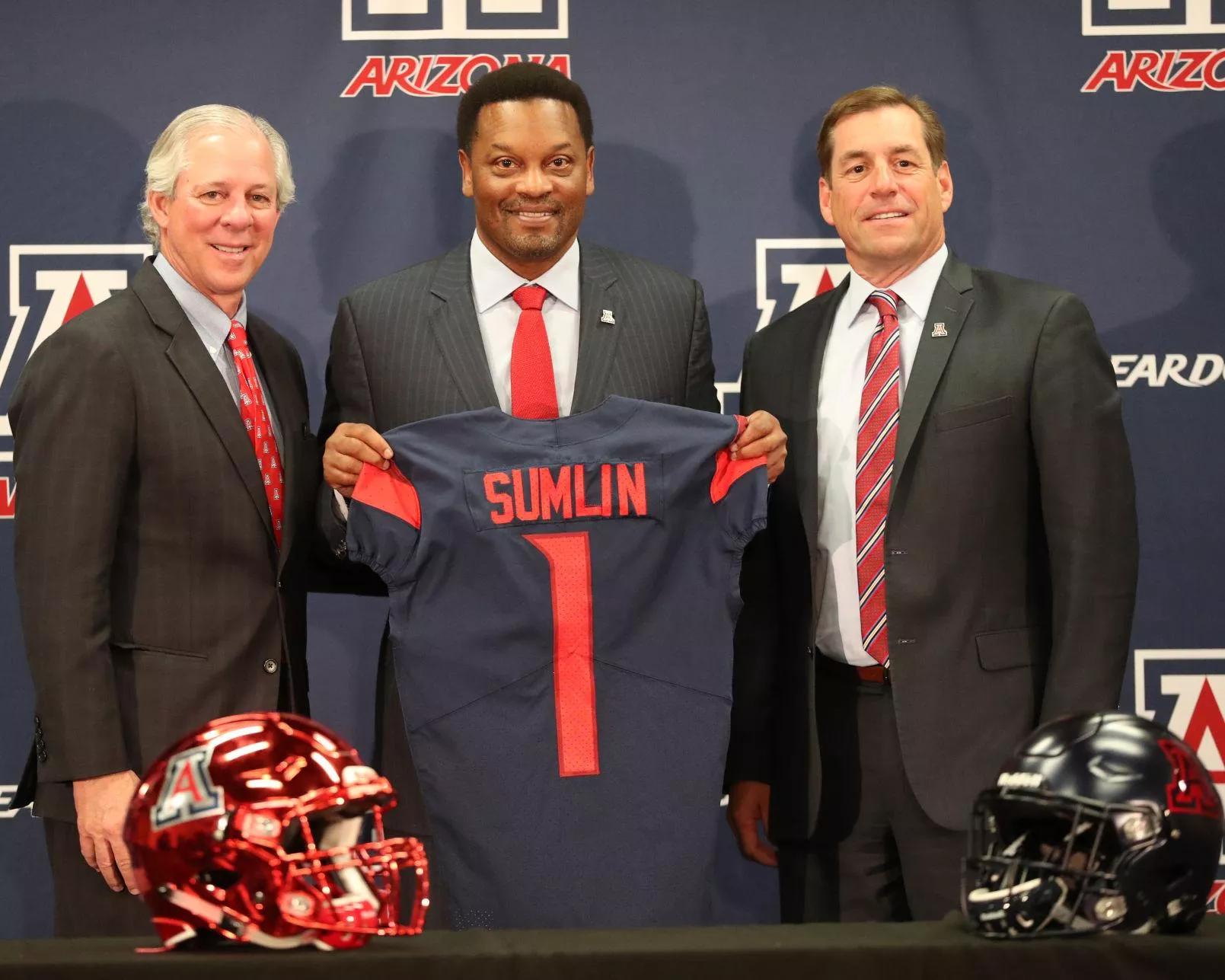
Some might say that they knew immediately, when, in Kevin Sumlin’s first game as Arizona football coach, his Wildcats played like dookie. Sloppy and listless, unable to take advantage of late-game opportunities, and having to deal with a suddenly mercurial quarterback who quite obviously had seen his own picture on the cover of Sports Illustrated, the Wildcats lost to a barely average visiting BYU team. (BYU would go on to lose home games that season to Utah State and—gulp!—Northern Illinois.)
The loss to BYU was bad enough—putting the Cats in a hole from which they would struggle to emerge the rest of the season—but what troubled some was Sumlin’s reaction to it. Or, more correctly, his lack thereof. Sumlin shrugged like a monk learning dinner would be crackers with no salt.
The next week, Houston smacked Arizona around like it was a bad kid at a Catholic boarding school. Again with the shrug. Suddenly, the season that had had eternally optimistic Wildcat fans engaging in serious debates of 8-4 vs. 9-3, looked bleak.
Arizona, bolstered by a huge upset of powerful Oregon, eventually got back to .500, standing at 5-5 with two games left. But through it all, Shruglin stayed the same. Was he sullen or just pensive? Did he not like to talk or did he have nothing worthwhile to say? Fans hungry for a winner tend to feel that there’s a very fine line between keeping an even keel and not giving a crap.
The Cats took a 40-point whuppin’ from Washington State, but the season was still salvageable. All they had to do was beat visiting ASU in the regular-season finale and all would be good. That win would mean that they had beaten ASU, that they would go to a bowl game, and, most importantly, that they had beaten ASU.
Arizona went into the fourth quarter that day with a whopping 19-point lead and then it all fell apart. Aided by a couple bad turnovers in the wrong part of the field, ASU stormed back to win, 41-40. That’s when I knew. The turnovers were bad (and so was the missed field goal attempt at the gun that would have given the Cats the win), but it was painfully obvious that, in that fourth quarter that determined the fate of the season, Sumlin had been out-coached. Not by ASU Coach Herm Edwards; Sumlin had out-coached himself.
Friday, December 4, 2020
PHOENIX – Suns fans are certainly excited for the arrival of Chris Paul, but center Deandre Ayton might be the most excited of all.
“We got CP3 in Arizona, y’all trippin’,” Ayton said Thursday in a press conference via Zoom. “We got Chris Paul in Phoenix!”
Arizona sports fans have endured a lot of heartbreak over the years, and Suns fans are no exception. After the team went 8-0 in the NBA bubble in Orlando, yet still failed to reach the 2020 playoffs, it felt like the latest in a long line of proverbial slaps to the face.
Once the Suns’ season reached its bitter end, trade rumors again began swirling around star guard Devin Booker, and fans prepared for the worst.
Every year, it seems like the same old story. Players and fans get excited at the chance to finally break the cycle of misery, only to be let down.
This time, however, there’s a legitimate reason to believe that cycle might end.
Fresh hope arrived when the Suns made waves across the NBA on Nov. 16 by acquiring Paul, the 10-time All-Star guard, from the Oklahoma City Thunder.
“He’s an ultra-competitor, and he’s been (one) for many long years, that’s why he has the resume that he has,” Booker said Thursday. “But his leadership, even in the short time (he’s been) here … just makes you want to work that much harder.”
The Suns also signed free-agent forward Jae Crowder to a three-year contract on Nov. 28, solidifying the team’s frontcourt.
Aside from the on-court talent the two veterans bring, a lot has been made of the improvements they can make to the culture around the team.
“I feel like the culture has definitely changed, even from the bubble to now,” Booker said. “I think with the additions of the players that we added, we have a depth team with a lot of (basketball) IQ and guys that know how to play the game.”
Booker also mentioned how this is an important step in Phoenix becoming a destination city for high-level players.
“That says a lot. I think that was what was most important for this organization and this team this summer, was having guys who wanted to come here,” Booker said. “A guy like Jae wanting to come here, a guy like Chris, a Hall-of-Fame guy wanting to come to Phoenix after what we’ve been through for the past five to 10 years, so I think that’s a step forward for this organization. People really see something’s brewing over here.”
The Suns will have a new look in 2021, and not just on the roster. A newly-renovated arena, brand new practice facility and the new ‘The Valley’ City Edition uniform are all contributing to the new identity the team is trying to build.
“It’s perfect timing, we have a new arena, new practice facility that we’re in now, so it’s a great culture around here, and it’s still building,” Booker said. “We’re having fun in here, the energy’s high, the personality’s out, and the competitiveness is there.”
The Suns are in a transition period, and the NBA is taking notice. Paul might not be the only new piece of the puzzle, but he’s certainly the most exciting.
“Just knowing the type of tradition, and the type of dude, and the type of career (Paul’s) had, and the foundation he’s laid in this league, it’s tremendous,” Ayton said. “And knowing that I’m going to be a part of his legacy? I can’t stop moving, I mean we’ve been working hard, I want to lift more weight, it’s go time.”
The Suns are tentatively scheduled to begin their 2020-21 season at home Dec. 23 against the Dallas Mavericks.
Tuesday, December 1, 2020
PHOENIX – After a disrupted 2019-20 season that ended in a bubble at Walt Disney World, the Phoenix Suns have undergone an offseason makeover that they hope will build on their surprising 8-0 run in Orlando that followed the COVID-19 interruption.
The Suns pulled off a blockbuster trade to acquire perennial All-Star point guard Chris Paul. They made a splash in free agency, signing big man Jae Crowder. They opened a new practice facility, the $45-million Verizon 5G Performance Center.
They even broke out new NBA City Edition alternative “The Valley” jerseys.
And earlier this month, the National Basketball Players Association and the NBA agreed to start a shortened and condensed 72-game schedule on Dec. 22.
The new-look Suns are set to start this week in a one-on-one bubble setting at the practice facility, with group workouts beginning Dec. 4, according to General Manager James Jones, who spoke with reporters in a Zoom media conference Monday.
Jones anticipates a challenging season amid the continuing spread of COVID-19, but believes the team can prosper if time is properly managed. Among other challenges, he said the 72-game season will be played in a shorter span, requiring more back-to-back games.
“We look forward to this week, where our guys can be on the court – one coach, one player,” he said. “(And) try to get ourselves back into game rhythm and shape, and then we’ll build up to our five-on-five group activities heading into next week.”
Jones said he feels good about what the club has added to its roster, and is confident new key players will fit right into a group that includes All-Star guard Devin Booker and center Deandre Ayton, who was the first overall pick in the 2018 NBA Draft and figures to benefit from the arrival of the 35-year-old Paul.
“I’m excited for them because this is a competitive environment, I’m looking forward to watching our guys compete. I know that we did some things this summer, as far as improving the team,” Jones said.
“Just adding guys to the team is never, and has never been, the goal. The goal for us is winning, the goal for us is … creating a playoff atmosphere and bringing a playoff approach to every single game.”
After the changes, the Suns are now regarded as a playoff contender. They have not appeared in the postseason since 2010 when they lost in the Western Conference finals to the Los Angeles Lakers.
The Lakers went on to win the NBA championship that season, and they won again last season. But the Lakers, Eastern Conference champion Miami and every other NBA team are faced with one of the shortest offseasons in NBA history, with only a seven-week break for the two finals teams.
Important matters like salaries, COVID-19 testing, and other health and safety issues are still being negotiated. James said Monday that he isn’t privy to discussions regarding vaccinating players for COVID-19, and hasn’t heard that taking a vaccine will be mandatory.
Providing athletes with a vaccine, once one is available, and with a healthy environment is a priority for James as the Suns prepare to tip off the preseason with a pair of games in Utah Dec. 12-13.
“The guys aren’t obligated to take it,” James said of a vaccine. “We will do whatever we can to make sure that we keep our guys healthy and safe, and administer it if we can for those who want it.
“Our best course of action is to continue to adhere to the NBA’s protocols, to isolate as much as we can, maintain distance. We will still have to interact with other teams and players. The hope is that, collectively as a league, we can keep this thing under control and try to mitigate the damage that will come from the positive test that eventually will happen.”
According to the Associated Press, the NBA saw revenues drop by 10% last season because of the pandemic, coming in $1.5-billion short of revenue projections.
The upcoming season is likely to have challenges as well.
Although the Suns have not yet made an official statement saying they will not allow any fans during their games, the Los Angeles Lakers and others have announced that they will not allow fans to attend games until further notice, noting the importance of health and safety for their fans, and working together in hopes to bring them back.
“We appreciate your continued support and look forward to coming together, when it is safe to do so, to celebrate the raising of our banner and the quest for another NBA championship,” the Lakers said in an announcement.
The NBA’s goal is to complete the 2020-21 season before the Tokyo Olympics, which are scheduled to start July 23rd, allowing them to return to their regular season in October.
Wednesday, November 25, 2020
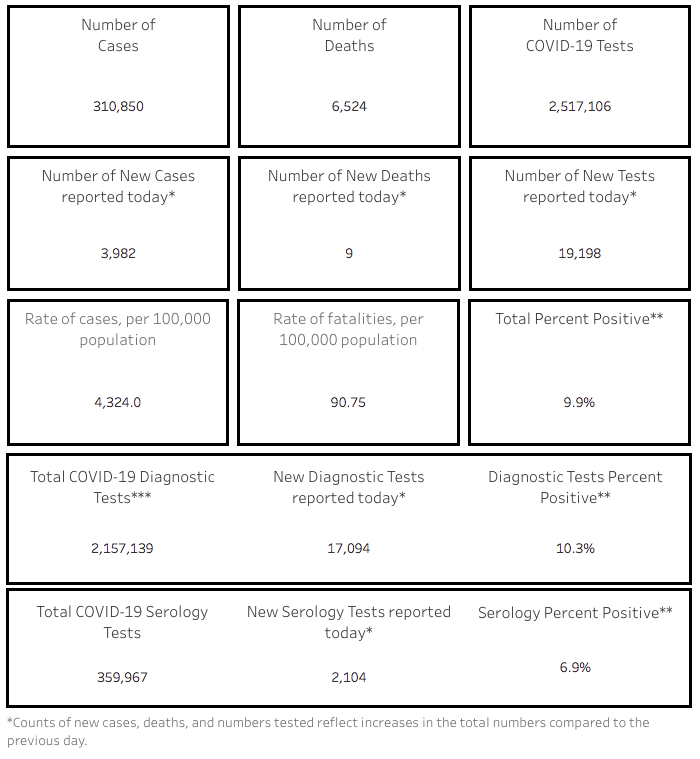
With nearly 4,000 new cases reported today, the number of Arizona’s confirmed novel coronavirus cases closed in on 310,000 as of Wednesday, Nov. 25, according to the Arizona Department of Health Services.

Pima County, which reported 532 new cases today, has seen 37,518 of the state’s 310,850 confirmed cases.
With nine new deaths reported yesterday, a total of 6,524 Arizonans had died after contracting COVID-19, including 679 deaths in Pima County, according to the Nov. 24 report.
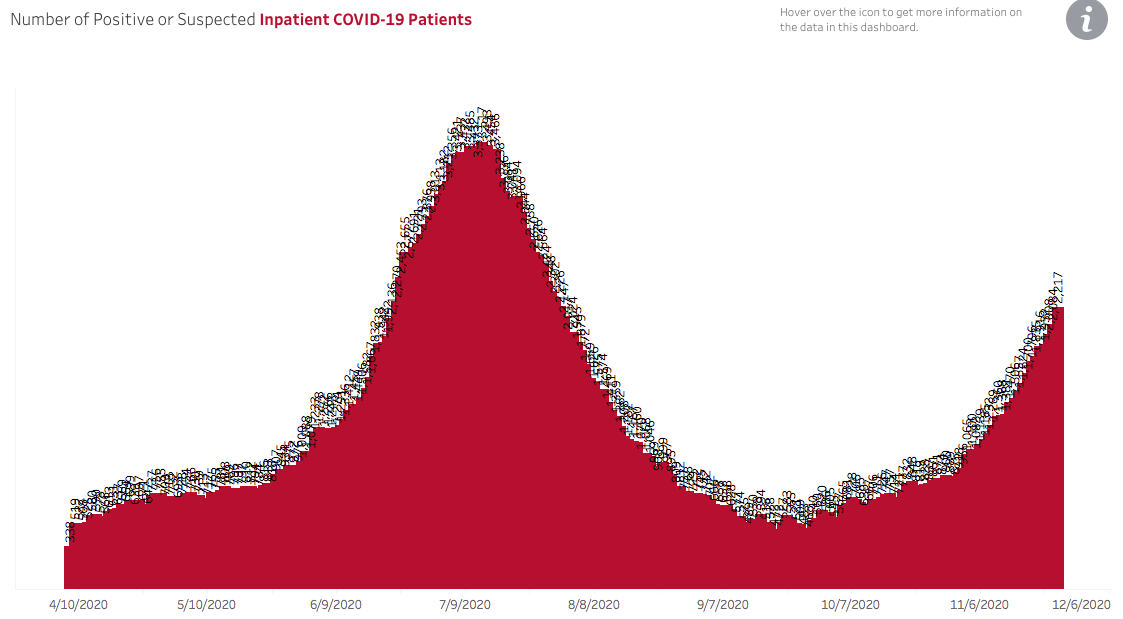
The number of hospitalized COVID cases statewide continues to climb upward as the virus has begun to spread more rapidly, putting stress on Arizona’s hospitals. ADHS reported that as of Nov. 24, 2,217 COVID patients were hospitalized in the state, the highest that number has been since July 31. That number peaked with 3,517 hospitalized COVID patients on July 13; it hit a subsequent low of 468 on Sept. 27.
A total of 1,593 people visited emergency rooms on Nov. 24 with COVID symptoms, the highest that number has been since July 15. That number peaked at 2,008 on July 7; it hit a subsequent low of 653 on Sept. 28.
A total of 531 COVID-19 patients were in intensive care unit beds on Nov. 24, the highest that number has been since Aug. 7. The number of COVID patients in ICUs peaked at 970 on July 13 and hit a subsequent low of 114 on Sept. 22.
On a week-by-week basis in Pima County, the number of positive COVID tests peaked the week ending July 4 with 2,452 cases, according to an Nov. 23 report from the Pima County Health Department. (Numbers in this report are subject to revision.)
Pima County is seeing a dramatic rise in cases in recent weeks. For the week ending Oct. 31, 1,348 cases were reported; for the week ending Nov. 7, 2,122 cases were reported; and for the week ending Nov. 14, 2,561 cases were reported; and for the week ending Nov. 21, 2,575 cases were reported.
Pima County Administrator Chuck Huckelberry noted last week that the county had seen 4,620 cases in the first 17 days in November.
“For the first 17 days in July, the worst month of COVID-19 case increases to date, there were 5,057 cases,” Huckleberry said in a Nov. 17 memo. “Therefore, we are on pace to exceed the total number of monthly COVID-19 infections in our previous worst month, July.”

