

Wednesday, December 2, 2020

PHOENIX – Recreational use of marijuana will soon be legal in Arizona, thanks to Proposition 207’s easy passage, but economic and logistical hurdles remain before Arizonans will feel the effects.
The measure – approved by more than 60% of voters in unofficial results from Nov. 3 – decriminalizes recreational marijuana use and possession for those 21 or older; allows minor, nonviolent marijuana offenders to petition to have their criminal records expunged; and imposes an excise tax to support underfunded programs across the state.
Once the Arizona Secretary of State’s Office certifies the proposition, which is expected to happen in December, the use and possession of up to 1 ounce of marijuana will be legal except in public spaces. Despite the law’s passage, however, marijuana possession, distribution and use remain federal crimes.
Dispensaries and growers, which have become a familiar presence in Arizona since voters narrowly approved marijuana for medical use in 2010, will have to wait for state approval to sell marijuana for recreational uses. Application for state licenses is expected to open in January, and organizers of Proposition 207 are predicting an April 5 launch for recreational sales.
“I think there’s going to be a lot of very curious people that want to walk into the dispensary because they weren’t able to do that before,” said Raul Molina, chief operations officer at the Mint Dispensary in Tempe.
Clearing criminal records
A key element of Proposition 207 is the opportunity to expunge a criminal record, which can impede employment, nullify the right to vote and harm reputations.
Proposition 207 is the first voter measure in Arizona that offers expungement, according to Jared Keenan, a senior staff attorney at American Civil Liberties Union of Arizona. But the process may differ in each of Arizona’s 15 counties, depending on the population and whether the county attorney supported the measure.
Prosecutors can petition against moves to expunge records. The Maricopa County Attorney’s Office has not given a stance on expungement but has announced it will immediately drop all pending and unfiled charges of marijuana possession based on “the will of the voters.”
Currently, Keenan said, all marijuana convictions are felonies, which means convicts could lose their right to vote, their access to public housing and food assistance, and their eligibility for federal student loans. A criminal record also makes it harder to get a job.
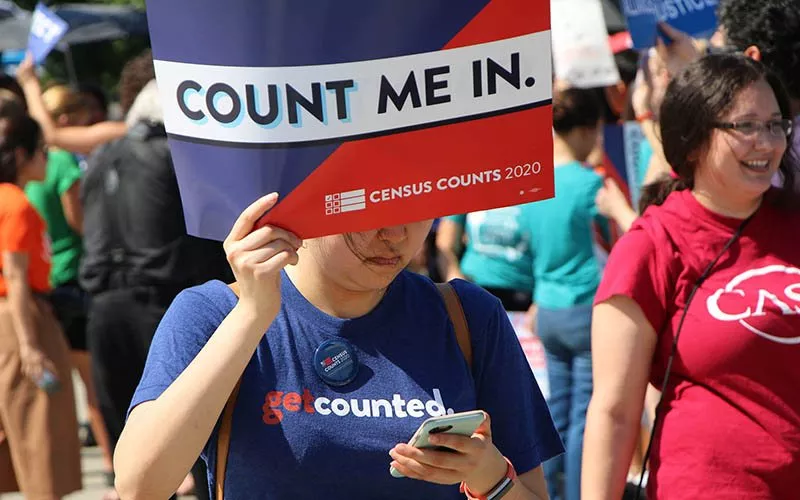
WASHINGTON – The Trump administration said it does not know how many immigrants might be excluded from the Census under a 2019 presidential order, but it still urged the Supreme Court to overturn lower courts that blocked the proposal.
That was one of the arguments raised as the court considered President Donald Trump’s order directing the Census Bureau to exclude undocumented immigrants from the census. The number in that report, which is supposed to be delivered to the president by Dec. 31, is used to determine everything from congressional representation to the allocation of trillions in federal funds over a decade.
Critics called the president’s plan a political attack on immigrants who have always been counted in the census, which requires the inclusion of every “person” living in the country on April 1, when the count is taken.
“We know that undocumented immigrants contribute in taxes, from sales taxes to property taxes,” said Karina Ruiz, executive director at the Arizona Dream Act Coalition. “It’s incredible that this administration’s not allowing us to be counted to be a part of the benefit that comes with the contributions that we make.”
But supporters of the president’s move say that including undocumented migrants in the census will “deny representation to Americans in some states and give it to illegal aliens who live in other states.”
“American citizens will be cheated out of representation, Congress cheated out of federal dollars,” if the justices do not rule in favor of Trump, said Ira Mehlman, a spokesman for the Federation for American Immigration Reform.
This is the second time in two years that the Supreme Court has heard a Census Bureau case against a tight deadline. The court last year said the bureau could not include a citizenship question on the 2020 Census because it had failed to follow proper procedures before announcing the change.
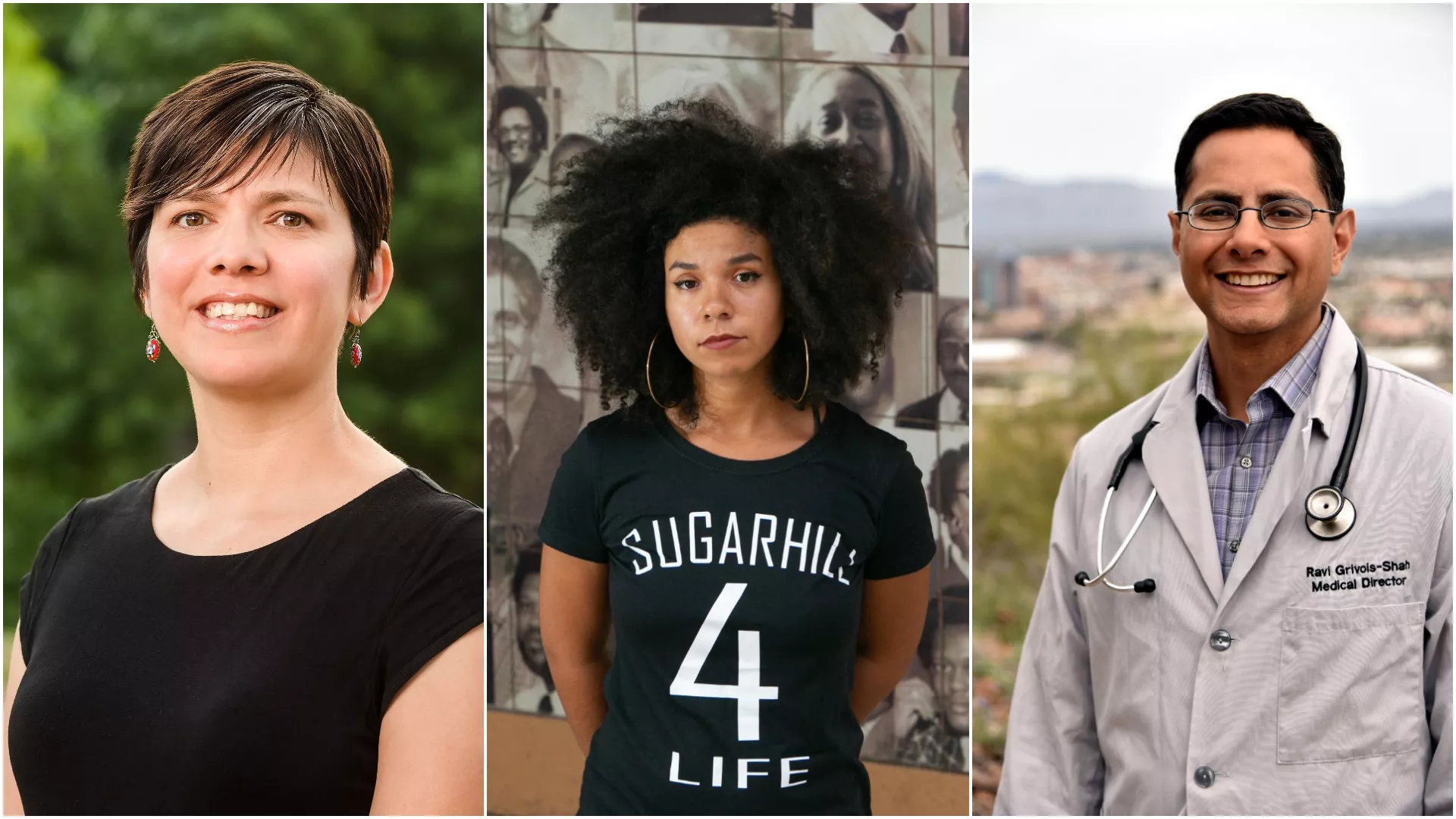
Pima County’s voters elected three new board members to Tucson’s largest school district this November, bringing a variety of new faces and experiences to the school board.
Of the three new board members elected to Tucson Unified School District’s Governing Board, Natalie Luna Rose was elected with 24% of the vote, Sadie Shaw with 18% of the vote and Ravi Grivois-Shah with 17%.
All three new board members have children in the district and will be joining current TUSD parents and board members Adelita Grijalva and Leila Counts, whose terms expire December 31, 2022.
All the incoming board members agree with Superintendent Gabriel Trujillo’s decision to delay implementing a hybrid learning plan throughout the district until January as COVID-19 spreads substantially throughout the county.
Luna Rose, the communications and outreach manager for the Arizona Center for Disability Law, is considering the possibility of the entire school year being remote as metrics tracking the spread of coronavirus reach alarming levels.
“Frankly, judging by the numbers right now, I don't think we're going back Jan. 4, and I'd be really surprised if we're even going to be going back at all,” Luna Rose said. “I saw news reports that they're going to try to start rolling out the vaccine very soon, probably after the first of the year, but even then, that's going to take months for it to even reach Tucson and how are they going to distribute that?”
Shaw, an artist, was pleased with the superintendent's decision due to concerns for students and staff members, but she doesn’t agree with the hybrid model the TUSD school board approved on Oct. 6, which has been put on hold until January.
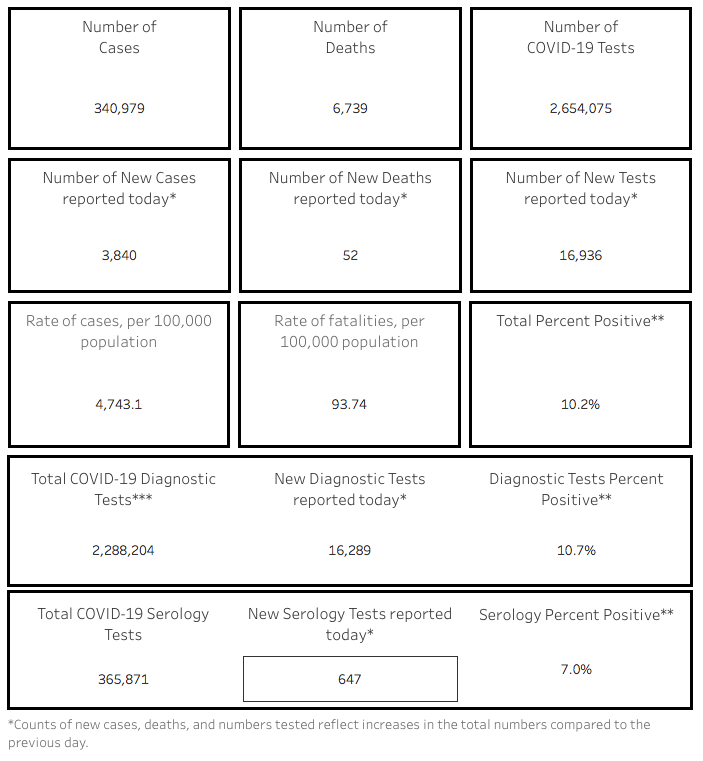
With more than 3,800 new cases reported today, the number of Arizona’s confirmed novel coronavirus cases closed in on 341,000 as of Wednesday, Dec. 2, according to the Arizona Department of Health Services.

Pima County, which reported 994 new cases today, has seen 41,313 of the state’s 340,979 confirmed cases.
With 52 new deaths reported yesterday, a total of 6,739 Arizonans have died after contracting COVID-19, including 697 deaths in Pima County, according to the Dec. 2 report.
The number of hospitalized COVID cases statewide continues to climb upward as the virus has begun to spread more rapidly, putting stress on Arizona’s hospitals. ADHS reported that as of Dec. 1, 2,699 COVID patients were hospitalized in the state, the highest that number has been since July 24 That number peaked with 3,517 hospitalized COVID patients on July 13; it hit a subsequent low of 468 on Sept. 27.
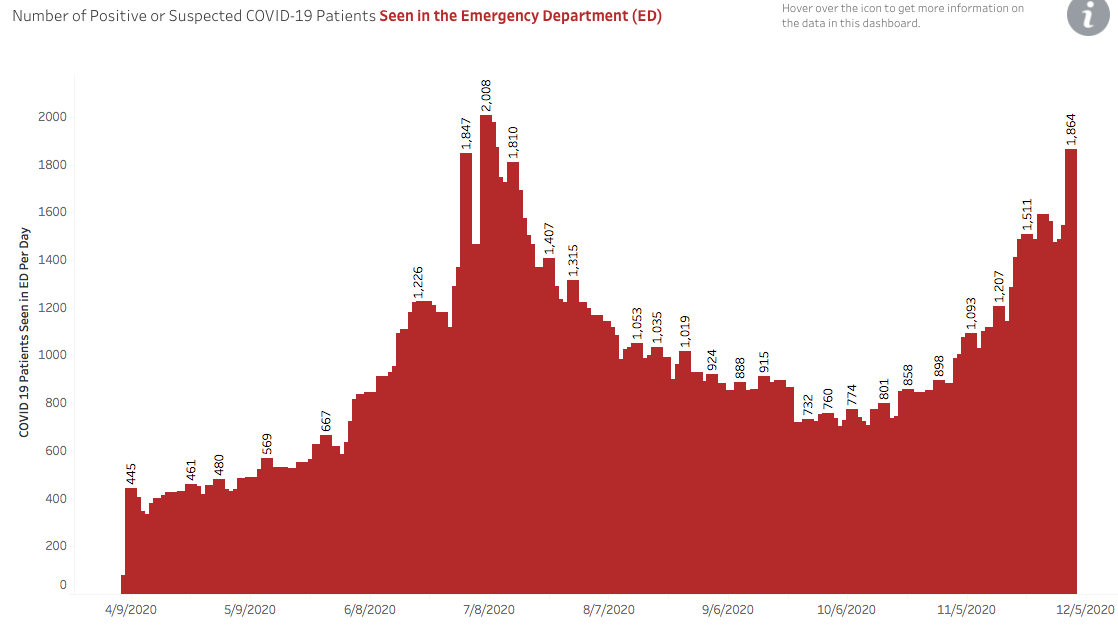
A total of 1,864 people visited emergency rooms on Dec. 1 with COVID symptoms, the highest that number has been since July 9. That number peaked at 2,008 on July 7; it hit a subsequent low of 653 on Sept. 28.
A total of 642 COVID-19 patients were in intensive care unit beds on Dec. 1, the highest that number has been since Aug. 1. The number of COVID patients in ICUs peaked at 970 on July 13 and hit a subsequent low of 114 on Sept. 22.
Judy Rich, president and CEO of Tucson Medical Center, told the Tucson City Council last night that local hospitals are near or at capacity.
“I believe stricter measures, like the ones we used earlier this year, are the only path to avert the impending crisis,” Rich told the council. “I recognize that the City might not have the legal authority to mandate such actions, but it should be the position of the City to advocate to state leadership that it is required to prevent unnecessary loss of life and illness.”
On a week-by-week basis in Pima County, the number of positive COVID tests peaked the week ending July 4 with 2,452 cases, according to an Nov. 25 report from the Pima County Health Department. (Numbers in this report are subject to revision.)
Pima County is seeing a dramatic rise in cases in recent weeks. For the week ending Oct. 31, 1,348 cases were reported; for the week ending Nov. 7, 2,119 cases were reported; and for the week ending Nov. 14, 2,578 cases were reported; for the week ending Nov. 21, 3,313 cases were reported.
COVID-related deaths in Pima County are down from a peak of 54 in the week ending July 4 but are on the rise. There were three deaths in the week ending Oct 10, one in week ending Oct. 17, six in the week ending Oct. 24; 10 in the week ending Oct. 31 and five in the week ending Nov. 7.
Hospitalization admission peaked the week ending July 18 with 221 COVID patients admitted to Pima County hospitals, but those numbers have been on the rise in recent weeks. In the week ending Oct. 31, 66 people were admitted; in the week ending Nov. 7, 90 people were admitted; in the week ending Nov. 14, 127 people were admitted; and in the week ending Nov. 21, 139 people were admitted.
Tucson City Council enacts 10 p.m. to 5 a.m. curfew
The Tucson City council voted to enact a citywide curfew from 10 p.m. to 5 a.m. daily that will go into effect Friday, Dec. 4 until Dec. 23.
The council voted 6-0, amending Tucson Mayor Regina Romero’s initial proclamation to set an 8 p.m. to 5 a.m. curfew that would have begun tonight.
On Nov. 23, the Pima County Health Department announced a voluntary overnight curfew from 10 p.m. to 5 a.m. every day until Dec. 31—but it’s not enforceable.
As part of the amended curfew agreement among the city’s council members, if Pima County changes their voluntary curfew time, Tucson’s curfew time will follow suit.
The proposed curfew would prohibit everyone from being in public places with the following exceptions:
Emergency response personnel
Traveling to and from work
Attending religious services
Caring for a family member
Seeking medical care
Fleeing dangerous circumstances
Traveling to perform or receive essential functions
Homeless persons
City Attorney Mike Rankin specified traveling to essential businesses such as grocery, home goods and hardware stores is allowed. Travel to restaurants for consumption off-premises is also allowed by means of take out, delivery, curbside and drive-thru food orders.
“The curfew does not order the closure of any business at any particular time, instead, what it does is it regulates when people can be in public places, which includes traveling on the public streets,” Rankin said at the council’s meeting. “It does not, as presented, prevent people from traveling to or from any essential activity or essential functions, even during the curfew hours.”
Offenders of the curfew will be subject to a civil infraction that holds a fine of up to $300.
Get tested: Pima County opening new sites alongside existing spots for free COVID testing
Pima County offers a number of testing centers around town.
You’ll have a nasal swab test at the Kino Event Center (2805 E. Ajo Way) the Udall Center (7200 E. Tanque Verde Road) and downtown (88 E. Broadway).
The center at the northside Ellie Towne Flowing Wells Community Center, 1660 W. Ruthrauff Road, involves a saliva test designed by ASU.
In addition, the Pima County Health Department, Pima Community College and Arizona State University have partnered to create new drive-thru COVID-19 testing sites at three Pima Community College locations. At the drive-thru sites, COVID-19 testing will be offered through spit samples instead of nasal canal swabs. Each site will conduct testing from 9 a.m. to noon, and registration is required in advance. Only patients 5 years or older can be tested.
Schedule an appointment at pima.gov/covid19testing.
The University of Arizona’s antibody testing has been opened to all Arizonans as the state attempts to get a handle on how many people have been exposed to COVID-19 but were asymptomatic or otherwise did not get a test while they were ill. To sign up for testing, visit https://covid19antibodytesting.arizona.edu/home.
—with additional reporting from Austin Counts, Jeff Gardner, Nicole Ludden and Mike Truelsen

WASHINGTON – The good news for prospective citizens is that they will soon have more time to take the civics test that has long been a critical part of the citizenship process.
The bad news is that, beginning next week, the test will be twice as long. And harder. And there’s no bonus for getting a passing score early.
“It’s the position … of this administration of making life harder, not only for undocumented immigrants but also for immigrants that are currently in a legal process,” said Manuel Gutierrez, an immigration specialist at Promise Arizona. “It’s making it tough for everybody.”
But while advocates like Gutierrez see the changes as part of a larger USCIS move to discourage immigrants, the agency said the changes are just part of a decennial review of the naturalization test aimed at “updating, maintaining, and improving a test that is current and relevant.”
The test is the best known, and usually final, step in a citizenship process that can take years for some immigrants and the changes, which take effect Tuesday, have been in the works for close to 18 months.
A passing grade will still be 60% correct, but the new test doubles the number of questions from 10 to 20 and expands the pool of questions that could be included on any test from the current 100 to 128. That means would-be citizens will have more to master before sitting down to take the test – and more to potentially get wrong.
Tuesday, December 1, 2020
The Tucson City council voted to instate a citywide curfew from 10 p.m. to 5 a.m. daily that will go into effect Friday, Dec. 4 until Dec. 23.
The council voted 6-0, amending Tucson Mayor Regina Romero’s initial proclamation to set an 8 p.m. to 5 a.m. curfew that would have begun tonight.
On Nov. 23, the Pima County Health Department announced a voluntary overnight curfew from 10 p.m. to 5 a.m. every day until Dec. 31—but it’s not enforceable.
As part of the amended curfew agreement among the city’s council members, if Pima County changes their voluntary curfew time—whether voluntary or mandatory—Tucson’s curfew time will follow suit.
The proposed curfew would prohibit everyone from being in public places with the following exceptions:
- Emergency response personnel
- Attending religious services
- Caring for a family member
- Seeking medical care
- Fleeing dangerous circumstances
- Traveling to perform or receive essential functions
- Homeless persons
City Attorney Mike Rankin specified traveling to essential businesses such as grocery, home goods and hardware stores is allowed. Travel to restaurants for consumption off-premises is also allowed by means of take out, delivery, curbside and drive-thru food orders.
“The curfew does not order the closure of any business at any particular time, instead, what it does is it regulates when people can be in public places, which includes traveling on the public streets,” Rankin said at the council’s meeting. “It does not, as presented, prevent people from traveling to or from any essential activity or essential functions, even during the curfew hours.”Offenders of the curfew will be subject to a civil infraction that holds a fine of up to $300.
The council also voted 6-0 to approve a $6 million financial aid package comprised of federal CARES Act funds to be distributed throughout Tucson as follows:
- $3 million for small businesses
- $2 million for workers and families
- $375,000 for arts and culture organizations
- $375,000 for entertainment venues
- $250,000 for child care
To help those who might be impacted by the curfew passed tonight, my colleagues and I also approved additional relief...
Posted by Mayor Regina Romero on Tuesday, December 1, 2020
PHOENIX – After a disrupted 2019-20 season that ended in a bubble at Walt Disney World, the Phoenix Suns have undergone an offseason makeover that they hope will build on their surprising 8-0 run in Orlando that followed the COVID-19 interruption.
The Suns pulled off a blockbuster trade to acquire perennial All-Star point guard Chris Paul. They made a splash in free agency, signing big man Jae Crowder. They opened a new practice facility, the $45-million Verizon 5G Performance Center.
They even broke out new NBA City Edition alternative “The Valley” jerseys.
And earlier this month, the National Basketball Players Association and the NBA agreed to start a shortened and condensed 72-game schedule on Dec. 22.
The new-look Suns are set to start this week in a one-on-one bubble setting at the practice facility, with group workouts beginning Dec. 4, according to General Manager James Jones, who spoke with reporters in a Zoom media conference Monday.
Jones anticipates a challenging season amid the continuing spread of COVID-19, but believes the team can prosper if time is properly managed. Among other challenges, he said the 72-game season will be played in a shorter span, requiring more back-to-back games.
“We look forward to this week, where our guys can be on the court – one coach, one player,” he said. “(And) try to get ourselves back into game rhythm and shape, and then we’ll build up to our five-on-five group activities heading into next week.”
Jones said he feels good about what the club has added to its roster, and is confident new key players will fit right into a group that includes All-Star guard Devin Booker and center Deandre Ayton, who was the first overall pick in the 2018 NBA Draft and figures to benefit from the arrival of the 35-year-old Paul.
“I’m excited for them because this is a competitive environment, I’m looking forward to watching our guys compete. I know that we did some things this summer, as far as improving the team,” Jones said.
“Just adding guys to the team is never, and has never been, the goal. The goal for us is winning, the goal for us is … creating a playoff atmosphere and bringing a playoff approach to every single game.”
After the changes, the Suns are now regarded as a playoff contender. They have not appeared in the postseason since 2010 when they lost in the Western Conference finals to the Los Angeles Lakers.
The Lakers went on to win the NBA championship that season, and they won again last season. But the Lakers, Eastern Conference champion Miami and every other NBA team are faced with one of the shortest offseasons in NBA history, with only a seven-week break for the two finals teams.
Important matters like salaries, COVID-19 testing, and other health and safety issues are still being negotiated. James said Monday that he isn’t privy to discussions regarding vaccinating players for COVID-19, and hasn’t heard that taking a vaccine will be mandatory.
Providing athletes with a vaccine, once one is available, and with a healthy environment is a priority for James as the Suns prepare to tip off the preseason with a pair of games in Utah Dec. 12-13.
“The guys aren’t obligated to take it,” James said of a vaccine. “We will do whatever we can to make sure that we keep our guys healthy and safe, and administer it if we can for those who want it.
“Our best course of action is to continue to adhere to the NBA’s protocols, to isolate as much as we can, maintain distance. We will still have to interact with other teams and players. The hope is that, collectively as a league, we can keep this thing under control and try to mitigate the damage that will come from the positive test that eventually will happen.”
According to the Associated Press, the NBA saw revenues drop by 10% last season because of the pandemic, coming in $1.5-billion short of revenue projections.
The upcoming season is likely to have challenges as well.
Although the Suns have not yet made an official statement saying they will not allow any fans during their games, the Los Angeles Lakers and others have announced that they will not allow fans to attend games until further notice, noting the importance of health and safety for their fans, and working together in hopes to bring them back.
“We appreciate your continued support and look forward to coming together, when it is safe to do so, to celebrate the raising of our banner and the quest for another NBA championship,” the Lakers said in an announcement.
The NBA’s goal is to complete the 2020-21 season before the Tokyo Olympics, which are scheduled to start July 23rd, allowing them to return to their regular season in October.
PHOENIX – The number of COVID-19 infections in Arizona’s most populous county probably is far higher than what official counts show, according to a survey that found 1 in 10 residents have likely had the novel coronavirus that causes the disease.
As health experts worry about a new spike in infections, a study by the Maricopa County Department of Public Health, in partnership with Mayo Clinic and Arizona State University, estimates that 10.7% of the county’s 4.49 million residents have antibodies for the virus.
That means about 470,000 people have potentially been infected in Maricopa County alone, officials said. That’s far more than the 197,000 cases officially reported, and it would surpass the statewide total of 337,000 positive cases.
Marcy Flanagan, executive director of the Maricopa County Department of Public Health, said the results show the need for precaution over the holidays when social events could push numbers even higher.
“Unfortunately, we really would recommend that individuals limit their social gatherings and their family gatherings for the holidays,” she said. “I would really encourage families to think about eating outside with their household family members and being creative to do Zoom check-ins for mealtime and other things with family that can’t come to town.”
The findings stem from an 11-day study conducted in September that tested 260 participants in 169 households across strategically selected areas of Maricopa County to look for the presence of coronavirus antibodies.
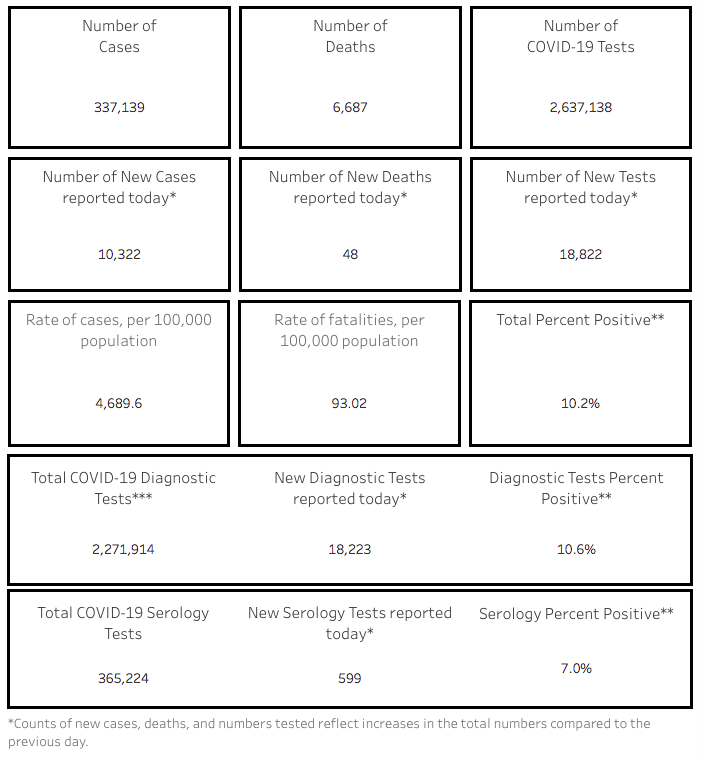
With more than more than 10,000 new cases reported today, the number of Arizona’s confirmed novel coronavirus cases topped 337,000 as of Tuesday, Dec. 1, according to the Arizona Department of Health Services.

Pima County, which reported 994 new cases today, has seen 40,803 of the state’s 337,139 confirmed cases.
ADHS Director Cara Christ said the large number of cases was a result of flow processing of tests over the holiday weekend.
“Most days, local health agencies review and classify newly reported cases (identifying them as confirmed, probable, or not a case),” Christ said in a prepared statement. “They will follow up with healthcare providers and laboratories if there are any questions about details on a case, which may take additional time over the holidays. The confirmed and probable cases identified are then reported out on our dashboard the next day as the number of new cases. With the long weekend, classification was delayed for a large portion of cases, resulting in much higher numbers than usual.”
With 48 new deaths reported yesterday, a total of 6,687 Arizonans had died after contracting COVID-19, including 695 deaths in Pima County, according to the Dec. 1 report.
The number of hospitalized COVID cases statewide continues to climb upward as the virus has begun to spread more rapidly, putting stress on Arizona’s hospitals. ADHS reported that as of Nov. 30, 2,594 COVID patients were hospitalized in the state, the highest that number has been since July 26. That number peaked with 3,517 hospitalized COVID patients on July 13; it hit a subsequent low of 468 on Sept. 27.
A total of 1,545 people visited emergency rooms on Nov. 30 with COVID symptoms. That number peaked at 2,008 on July 7; it hit a subsequent low of 653 on Sept. 28.
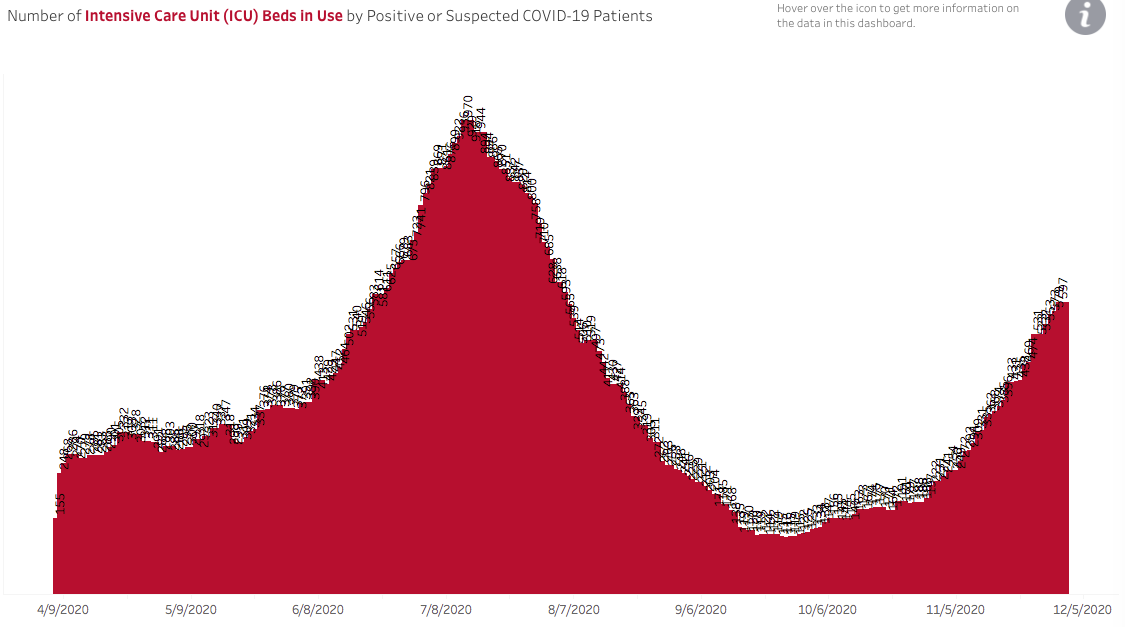
A total of 597 COVID-19 patients were in intensive care unit beds on Nov. 30, the highest that number has been since Aug. 4. The number of COVID patients in ICUs peaked at 970 on July 13 and hit a subsequent low of 114 on Sept. 22.

