

Friday, November 27, 2020

Six days after President Donald Trump lost his bid for reelection, the U.S. Department of Agriculture notified food safety groups that it was proposing a regulatory change to speed up chicken factory processing lines, a change that would allow companies to sell more birds. An earlier USDA effort had broken down on concerns that it could lead to more worker injuries and make it harder to stop germs like salmonella.
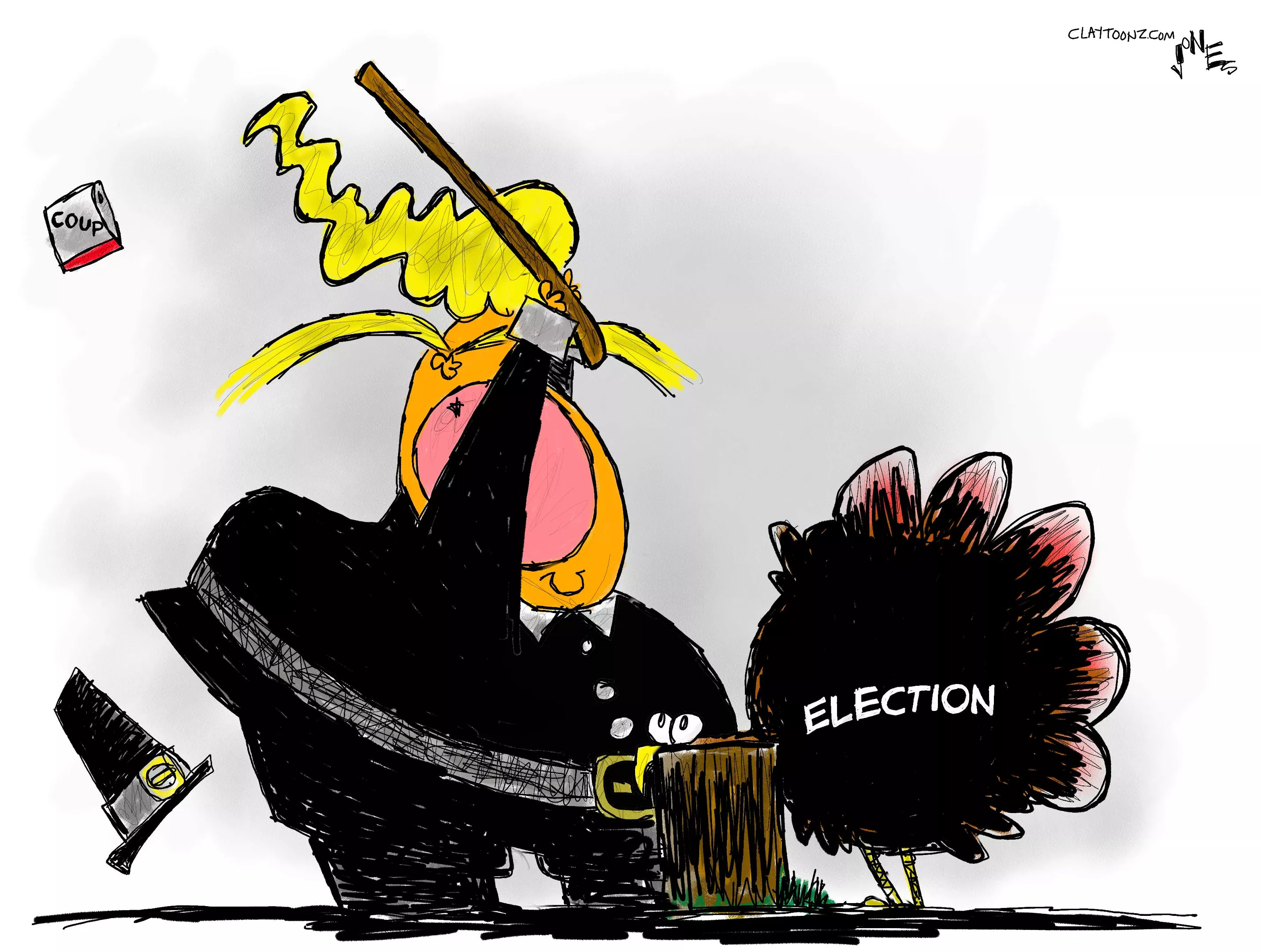
Ordinarily, a change like this would take about two years to go through the cumbersome legal process of making new federal regulations. But the timing has alarmed food and worker safety advocates, who suspect the Trump administration wants to rush through this rule in its waning days.
Even as Trump and his allies officially refuse to concede the Nov. 3 election, the White House and federal agencies are hurrying to finish dozens of regulatory changes before Joe Biden is inaugurated on Jan. 20. The rules range from long-simmering administration priorities to last-minute scrambles and affect everything from creature comforts like showerheads and clothes washers to life-or-death issues like federal executions and international refugees. They impact everyone from the most powerful, such as oil drillers, drugmakers and tech startups, to the most vulnerable, such as families on food stamps, transgender people in homeless shelters, migrant workers and endangered species. ProPublica is tracking those regulations as they move through the rule-making process.
Every administration does some version of last-minute rule-making, known as midnight regulations, especially with a change in parties. It’s too soon to say how the Trump administration’s tally will stack up against predecessors. But these final weeks are solidifying conservative policy objectives that will make it harder for the Biden administration to advance its own agenda, according to people who track rules developed by federal agencies.
“The bottom line is the Trump administration is trying to get things published in the Federal Register, leaving the next administration to sort out the mess,” said Matthew Kent, who tracks regulatory policy for left-leaning advocacy group Public Citizen. “There are some real roadblocks to Biden being able to wave a magic wand on these.”
In some instances, the Trump administration is using shortcuts to get more rules across the finish line, such as taking less time to accept and review public feedback. It’s a risky move. On the one hand, officials want to finalize rules so that the next administration won’t be able to change them without going through the process all over again. On the other, slapdash rules may contain errors, making them more vulnerable to getting struck down in court.
The Trump administration is on pace to finalize 36 major rules in its final three months, similar to the 35 to 40 notched by the previous four presidents, according to Daniel Perez, a policy analyst at the George Washington University Regulatory Studies Center. In 2017, Republican lawmakers struck down more than a dozen Obama-era rules using a fast-track mechanism called the Congressional Review Act. That weapon may be less available for Democrats to overturn Trump’s midnight regulations if Republicans keep control of the Senate, which will be determined by two Georgia runoffs. Still, a few GOP defections could be enough to kill a rule with a simple majority.
Thursday, November 26, 2020
Wednesday, November 25, 2020
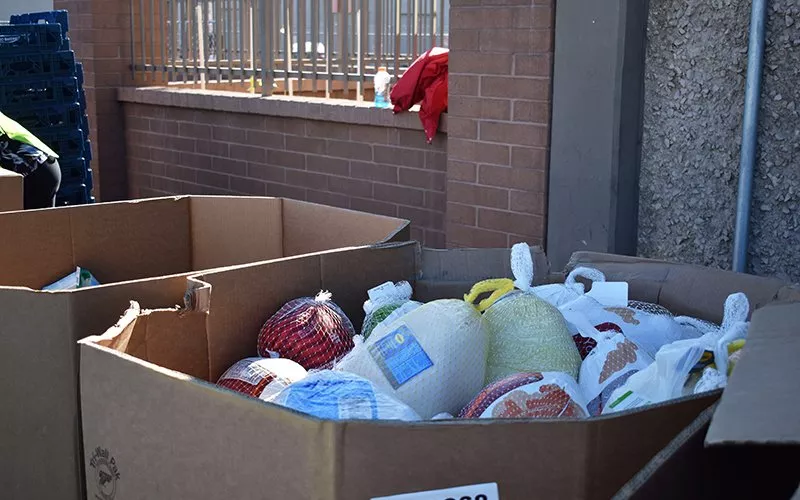
PHOENIX – At one point Tuesday, cars came through at a rate of one every minute, six lanes across, to get boxes and bags of turkeys, potatoes and canned food from St. Mary’s Food Bank.
Members of the National Guard and volunteers in neon-orange vests, all wearing masks or bandanas, loaded up one car trunk after another to help hundreds from going hungry as the holidays approach.
“Number 6!” “Number Four!” shouted the volunteers as uniformed members of the guard and others brought the boxes to cars and trunks. People also could walk up to get goods, but drive-thru dominated the operation Tuesday.
Hunger has soared in the COVID-19 pandemic, which has cratered the economy, snatched away jobs and removed the assurance that there always will be food on the table. To alleviate the suffering, local governments and nonprofit organizations are providing federal dollars.
A spokesperson for St. Mary’s, the state’s largest food bank, said it set a record – distributing an average of 10 million pounds of food a month since the pandemic hit in March. That’s the most the organization has distributed since it opened its doors more than a half-century ago.
Arizona has given food banks $1.6 million, with $600,000 of that going to St. Mary’s, which also has served the Navajo Nation.
Phoenix has put CARES Act dollars, federal money targeted for pandemic relief, to work by contracting with the Local First Arizona Foundation, a community and economic development organization. The foundation has recruited local restaurants, farmers and other businesses to help prepare and deliver meals.
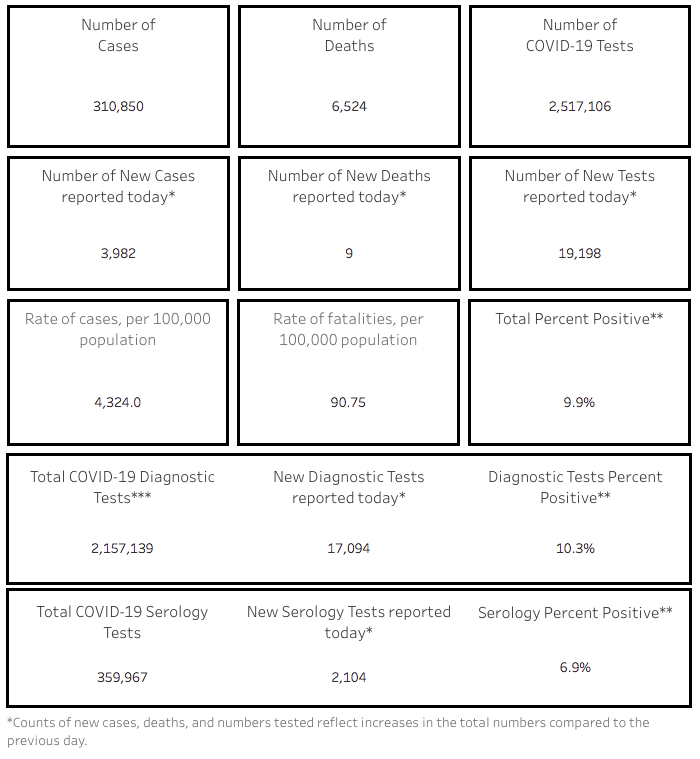
With nearly 4,000 new cases reported today, the number of Arizona’s confirmed novel coronavirus cases closed in on 310,000 as of Wednesday, Nov. 25, according to the Arizona Department of Health Services.

Pima County, which reported 532 new cases today, has seen 37,518 of the state’s 310,850 confirmed cases.
With nine new deaths reported yesterday, a total of 6,524 Arizonans had died after contracting COVID-19, including 679 deaths in Pima County, according to the Nov. 24 report.
The number of hospitalized COVID cases statewide continues to climb upward as the virus has begun to spread more rapidly, putting stress on Arizona’s hospitals. ADHS reported that as of Nov. 24, 2,217 COVID patients were hospitalized in the state, the highest that number has been since July 31. That number peaked with 3,517 hospitalized COVID patients on July 13; it hit a subsequent low of 468 on Sept. 27.
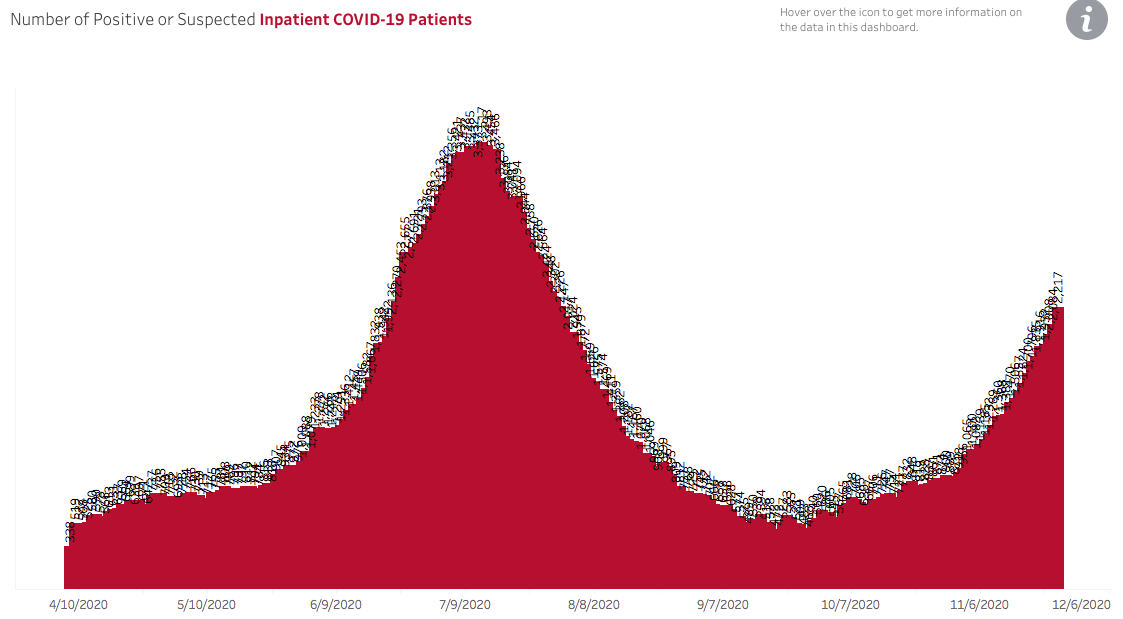
A total of 1,593 people visited emergency rooms on Nov. 24 with COVID symptoms, the highest that number has been since July 15. That number peaked at 2,008 on July 7; it hit a subsequent low of 653 on Sept. 28.
A total of 531 COVID-19 patients were in intensive care unit beds on Nov. 24, the highest that number has been since Aug. 7. The number of COVID patients in ICUs peaked at 970 on July 13 and hit a subsequent low of 114 on Sept. 22.
On a week-by-week basis in Pima County, the number of positive COVID tests peaked the week ending July 4 with 2,452 cases, according to an Nov. 23 report from the Pima County Health Department. (Numbers in this report are subject to revision.)
Pima County is seeing a dramatic rise in cases in recent weeks. For the week ending Oct. 31, 1,348 cases were reported; for the week ending Nov. 7, 2,122 cases were reported; and for the week ending Nov. 14, 2,561 cases were reported; and for the week ending Nov. 21, 2,575 cases were reported.
Pima County Administrator Chuck Huckelberry noted last week that the county had seen 4,620 cases in the first 17 days in November.
“For the first 17 days in July, the worst month of COVID-19 case increases to date, there were 5,057 cases,” Huckleberry said in a Nov. 17 memo. “Therefore, we are on pace to exceed the total number of monthly COVID-19 infections in our previous worst month, July.”

WASHINGTON – The recent surge in COVID-19 cases could push hospital staff and hospital bed capacity to the limit in coming weeks, particularly if people are not careful over Thanksgiving, an Arizona hospital official said Tuesday.
Marjorie Bessel, chief clinical officer for Banner Health, said its projections show the system will be using 125% of its licensed hospital beds by Dec. 4 as it grapples with the usual winter rise in patients and the sudden spike in COVID-19 cases. She compared this holiday weekend to Memorial Day weekend, when unrestricted gatherings were followed by a sharp spike in coronavirus cases.
“If you reflect back in May, you know that Memorial Day weekend was a significant catalyst that caused continued exponential growth of our COVID pandemic here in the state of Arizona,” Bessel said in a press conference Tuesday.
Unlike May, however, when Arizona was one of the few states facing a COVID-19 surge, the current outbreak is widespread. That means hospitals in the state will be hard-pressed to find relief workers from other states, Bessel said, even if they can work around the shortage of beds.
“We have been accumulating pharmaceutical supplies, beds and ventilators since the surge in the summer and we believe that we are prepared,” she said. “What we will have a shortage of will be staff.”
A spokesperson for the Arizona Department of Health Services said the agency is not able to comment on projections from Banner or any other external organization. But Holly Poynter said that while “hospital ICU bed availability has decreased over the past few weeks, there is still adequate capacity in Arizona’s hospitals.”
Tuesday, November 24, 2020

The superintendent of Tucson Unified School District announced the remainder of the district’s football season has been suspended today after considering guidance from the Pima County Administrator’s Office and public health recommendations from the Pima County Health Department, according to an email announcement.
Superintendent Gabriel Trujillo announced all winter sports practices and after-school performing arts rehearsals “are temporarily suspended and will be revisited on December 7th,” according to the email.
“Please know that Tucson Unified is not the only district to take this action as all southern Arizona school districts have also canceled the remainder of their respective game schedules which leaves our schools without opponents to play,” Trujillo said in the email. “I want to thank all of the hard-working coaches, athletes, and supportive parents that worked so hard to make this shortened season possible.”
TUSD initially allowed full-contact football practice after parents signed a waiver of release of all future claims against the district for any COVID-19 related damages, Trujillo said in a press conference on Nov. 12.
At the press conference, the superintendent said the district’s football games wouldn’t have public attendance, transportation was to be provided by parents and communal areas such as locker rooms and showers were off-limits.
Now, winter contact sports like soccer and basketball will also be postponed until further notice.

Three Arizona Wildcats and a former Arizona high school standout were among the players who heard their name called during the 2020 NBA Draft.
The event was conducted remotely with teams making their selections from their headquarters while players got the news surrounded by friends and family in their homes.
Wildcats Josh Green, a 6-foot-6 swingman, and Zeke Nnaji, a 6-foot-11 center, were taken in the first round of the draft and point guard Saben Lee, who graduated from Tempe’s Corona del Sol High and played at Vanderbilt, went early in the second round.
And a player who might have been expected to go ahead of all of them a year ago, lasted until the 48th overall before the Golden State Warriors nabbed him.
Nico Mannion, a 6-foot-3 point guard, was considered one of the top college prospects in the country when he signed with the Wildcats after a standout career at Pinnacle High School in Phoenix. Mannion even played for Italy’s national team as a teenager.
Mannion expected to hear his name called much earlier in the evening, but he might have landed in the ideal location.
The Pima County Health Department issued a voluntary curfew Monday as the county remains in a state of substantial spread of coronavirus, according to a media release from the department.
Individuals are asked to observe the curfew from 10 p.m. to 5 a.m. every day until Dec. 31 after Pima County reported its highest daily case count of 878 on Sunday.
The week of Nov. 16 saw the highest weekly case count of 2,575, and now the health department is asking all Pima County residents to stay indoors during the curfew, “except those individuals who have no fixed address,” according to the release.
The health department says residents are allowed to leave home for essential activities like attending work or obtaining food or medical care.
"It is necessary to take this additional step due to the accelerating nature of the pandemic in our community," Pima County Health Director Theresa Cullen said in the release. "While we appreciate the efforts of the majority of residents to slow the spread of the virus, a segment of the population continues to participate in social gatherings and resist the use of masks which exacerbates an already critical situation."
In addition to voluntarily adhering to the curfew, the health department is asking residents to continue wearing a mask, social distancing and frequently sanitizing.

