Friday, November 6, 2020
Thursday, November 5, 2020
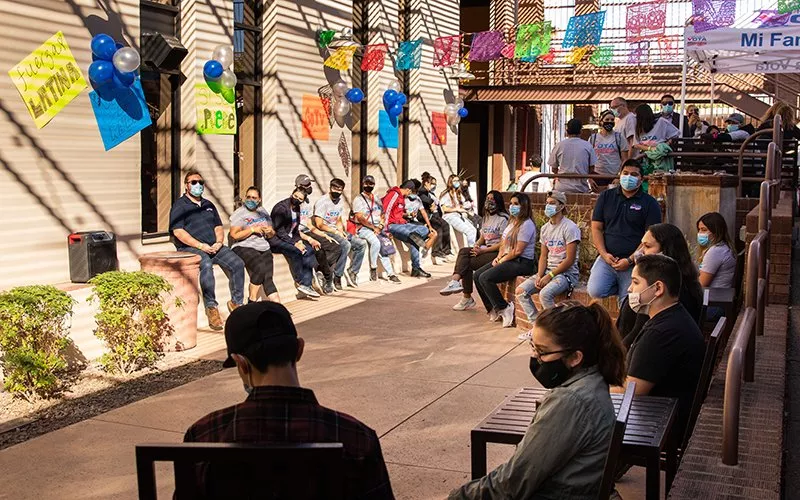
PHOENIX – Latino voters fueled by the Trump administration’s failures to curb COVID-19 and the lingering impact of the anti-immigration law known as SB 1070 helped turn Arizona blue after decades of entrenched Republican rule, according to organizers who have spent years working toward this moment.
“This feels like a victory lap,” said Eduardo Sainz, director of Mi Familia Vota in Arizona. He spoke hours before Wednesday’s early returns indicated that Democrat Joe Biden had likely won Arizona. Democrats celebrated a second Senate seat, and they should hold a majority of the state’s congressional seats, according to unofficial early returns.
Attention in the 2020 election cycle was riveted on Latino voters, who now make up the largest minority ethnic voting bloc in the country. In Arizona, nearly 1 out of 4 eligible voters are Latino, according to the Pew Research Center.
The Biden campaign hoped to capture 70% of those voters in its bid to flip a state that hasn’t voted for a Democratic presidential candidate since Bill Clinton in 1996. According to an early poll by American Election Eve, Biden reached that number.
Sainz, 27, said the victory in Arizona is a long time coming.
“This feels like looking at all of the hard work we’ve been able to do over the past 15 years, looking at real change, looking at real power, looking at our communities holding the keys to the White House,” he said.
Still, activists and other experts caution against the mistaken assumption that Latinos are a huge, unified group that leans to the left politically.
“What we have seen time and again is that our communities are treated as a monolith. And there’s so many cultural nuances, racial differences, ethnic differences,” said Alejandra Gomez, co-executive director of the advocacy group LUCHA.
Martha Figueroa, 46, exemplifies those nuances.
When she voted Tuesday in Laveen, a neighborhood in the southwest corner of Phoenix, she recalled a trope that President Donald Trump famously wields – and then voted for him in spite of it.
“Latinos, we are not rapists and we are not criminals,” said Figueroa, who this year changed her voting registration from Democrat to Republican.
“We need to make a better America and Biden is not the one to lead us. Whoever is here from another country, let’s get them papers, and whoever wants to come needs to come legally. We need to know who is here.”
In Florida, about 55% of the Cuban Latino voting bloc voted to reelect Trump, according to NBC News’ exit polls.
Trump and Biden came to Arizona, a state that shares a border with Mexico, intent on courting Latino voters, but it was Biden who triumphed.
In Nevada, where Latino voters make up 20% of the electorate, the presidential race remains too close to call, but their role is crucial. In 2016, Hillary Clinton won Nevada by just 2 percentage points.
Hector Sanchez Barba, chief executive of Mi Familia Vota, called it irresponsible to assume that Latinos vote as one bloc that shows up at the polls.
“This is the first question the media asks me: ‘When is the sleeping giant going to wake up?’” Sanchez Barba said. “Which is extremely denigrating and lacks the basic understanding of how to work in our democracy – that a democracy that is extremely imperfect – and doesn’t really understand how hard it is for a community to participate in the process.”
In Arizona and other parts of the country, some observers said, COVID-19 – which has disproportionately affected people of color – bent the Latino vote toward Biden.
Polling from American Election Eve and phone banking by Mi Familia Vota suggest the ongoing pandemic was the most important election issue for Latinos. The Centers for Disease Control and Prevention said Latino communities in Arizona were some of the hardest-hit by COVID-19.
But the foundation for the 2020 election flip was likely SB 1070, a decade-old Arizona law that upended immigration policies and drew international attention as one of the toughest anti-immigration laws in the country.
As a teenager, Sainz was galvanized by SB 1070, known as the “Show me your papers” law, which gave law enforcement the legal right to stop people they suspected of being in the country illegally and, as the ACLU and others charged, led to rampant racial profiling. Though the law is still on the books, it has been stripped of some of its controversial parts.
During that time, activists also launched a campaign to oust Maricopa County Sheriff Joe Arpaio, who, in 24 years in office, targeted undocumented immigrants and created what he called his own “concentration camp” to house them.
“I literally was able to see how people were so terrorized, that they packed everything that they own into vehicles and travel back to Mexico or to other states, et cetera,” Sainz said. “And looking at their fear … was something that I knew, I didn’t want communities and other individuals to go through.”
Gomez of LUCHA also was involved in the protests against Arpaio. She said she found herself at a vigil at the Arizona Capitol with just seven people in 2010. But it eventually drew thousands and lasted 103 days.
Yara Marin, 24, is the political director for Mi Familia Vota. Before she was able to vote, she was canvassing and phone banking during the fight against SB 1070. She continues that tradition of activism in Mi Familia Vota’s office.
This time around, the presidential election was just as crucial.
“Everything was on the ballot,” Marin said. “The people you vote for are going to decide whether or not you have access to high quality, affordable health care, whether or not our teachers and our students get good textbooks and good education, small classes. There is so much on the ballot that’s really going to define rights for everyone.”
To make that happen, advocates said they had to fight attempts at voter suppression and intimidation. Mi Familia Vota and advocates nationwide noted a series of robocalls targeting Latinos nationwide, with messages in both English and Spanish claiming that the polls would be open the day after the election, or declaring that a candidate had already won.
That is where groups like LUCHA and Mi Familia Vota step in, Gomez said.
“Communities at the margins are left with the challenges of voter suppression, the challenges of misinformation, and also accessibility for our communities while juggling the pandemic, job loss, childcare, homeschooling,” she said. “Our communities are trying to figure out how to survive, let alone how to find their polling location.”
The final push to get out the vote came Tuesday, Election Day. Many of the people working the get-out-the-vote phone bank were teenagers. Kevin Rosas, 16, said he got involved because he had a lot of family members working with Mi Familia Vota. Felix Cordova, also 16, said he took the job for pay but quickly realized the value of the impact he could make.
According to Marin, Mi Familia Vota registered nearly 15,000 new voters this cycle, and then an additional 35,000 after a lawsuit to extend Arizona’s voter registration deadline. The group made more than 27,000 phone calls. LUCHA said its volunteers knocked on 54,000 doors and made more than 8 million phone calls.
That level of investment, Sanchez Barba said, is what the political parties increasingly targeting Latino voters have been missing. Mi Familia Vota operates in six states, but the chief executive chose to spend the final hours of Election Day in Arizona.
“Looking at political power, and not the transactional one that historically we have seen in the Latino community, politicians come in and out to us last minute to do the work, just for turnout for that particular election,” he said. “But Arizona is showing that we can do it better.”
Still, advocates said, there’s more work to do. Sainz and Marin pointed out health care and education as key issues they’re pushing to reform.
“We continue to organize,” Sainz said. “We’re never going to stop.”
Cronkite News reporter Anthony J. Wallace contributed to this article.

The IRS is warning about a new text scam that attempts to trick people into disclosing bank account information by promising they’ll receive an “Economic Impact Payment” of $1,200, according to a news release from the Internal Revenue Service.
The scam message includes a link to a fake phishing web address and reads: “You have received a direct deposit of $1,200 from COVID-19 TREAS FUND. Further action is required to accept this payment into your account. Continue here to accept this payment.”
The phishing URL leads to a fraudulent website impersonating the IRS “Get My Payment” website. If recipients of the text enter personal financial information, those behind the scam will have access to it.
“The IRS, states and industry, working together as the Security Summit, remind taxpayers that neither the IRS nor state agencies will ever text taxpayers asking for bank account information so that an EIP deposit may be made,” the release said.
IRS Commissioner Chuck Rettig said the scammers behind the texts are “relentlessly using COVID-19 and Economic Impact Payments as cover to try to trick taxpayers out of their money or identities,” according to the release. “This scam is a new twist on those we’ve been seeing much of this year. We urge people to remain alert to these types of scams.”
The IRS says anyone who receives the text scam should take a screenshot of it and email the photo to [email protected] with the following information:
Date/Time/Timezone that they received the text message
The number that appeared on their Caller ID
The number that received the text message
Those who think they qualify for Economic Impact Payment should visit IRS.gov, but the government agency will never send unsolicited texts or emails.
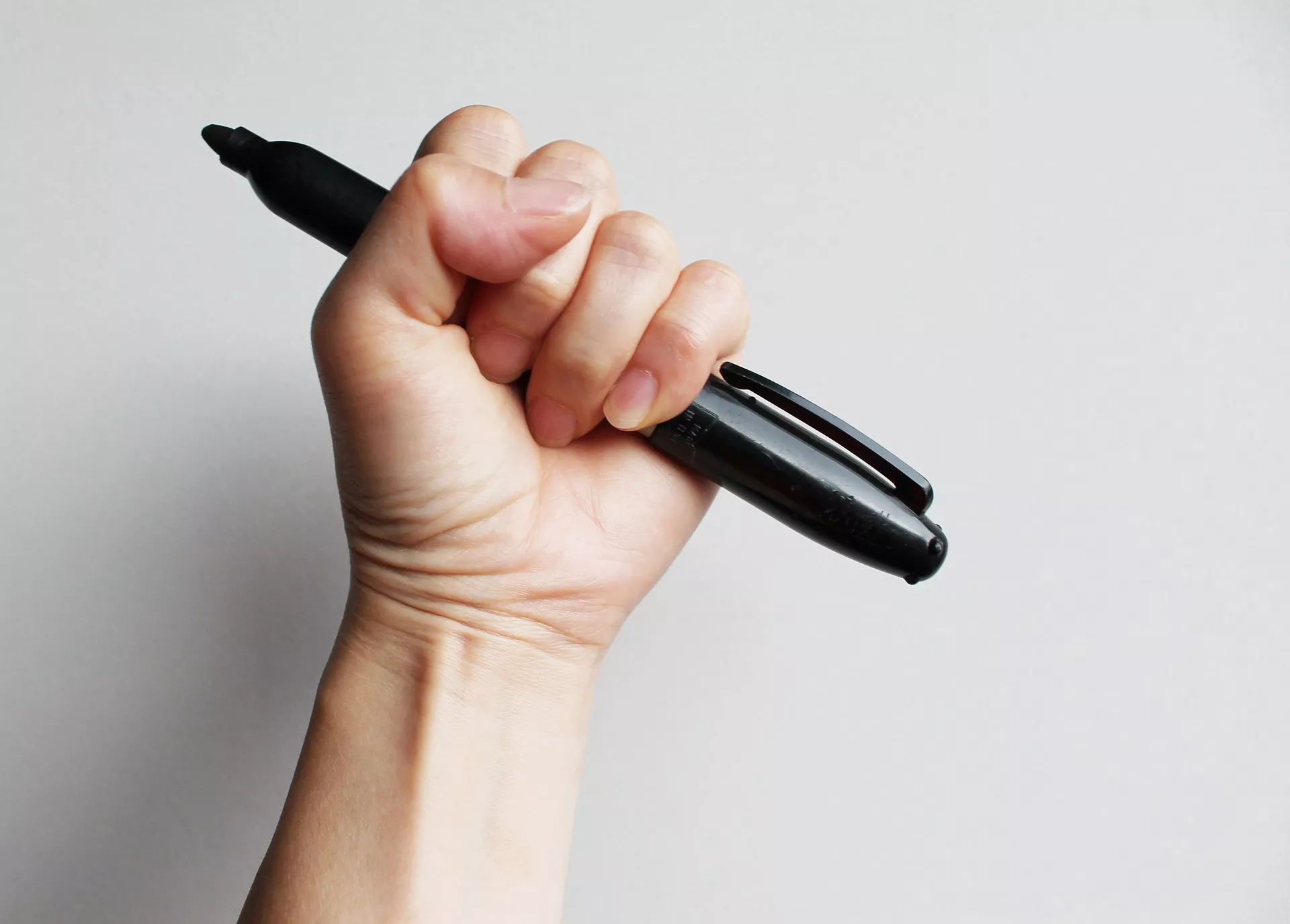
WASHINGTON – Voter intimidation, Russian hacking, stolen ballots and, now, Sharpies.
The popular marker has been cited in social media claims as part of a clever strategy to invalidate ballots by using Sharpies, because their ink reportedly cannot be detected by ballot-scanning machines. That claim has since been picked up by at least two Arizona elected officials calling for answers.
But Arizona Secretary of State Katie Hobbs has a ready answer: It just ain’t so. The pens are used because their ink dries quickly, she said, and any ballot marked with one will be counted.
“IMPORTANT: If you voted a regular ballot in-person, your ballot will be counted, no matter what kind of pen you used (even a Sharpie)!” Hobbs said in a tweet Wednesday.
She was responding to a video that began circulating election night on Facebook. The video – since flagged by Facebook as “false information” – shows a woman describing how Maricopa County poll workers gave voters Sharpies to fill in their ballots, which she claimed tabulation machines were subsequently not able to read.
“Sharpie-gate” began to spread on social media, with people who said they voted in-person and later checked their vote status, had it come in as “canceled.” They blamed the pens.
Arizona election officials quickly began to challenge the claims that Sharpies would invalidate a ballot. Megan Gilbertson, communications officer for Maricopa County Elections Department, said there’s a simple reason Sharpies are used.
“We use Sharpies on Election Day because it is the fastest-drying ink,” Gilbertson said, “As the voter is marking the ballot, we need to make sure that when they put it through that precinct-based tabulator that the ink does not smudge.”
But the social media claims still caught the attention of Arizona’s Attorney General Office.
“We have received hundreds of voter complaints regarding the use of Sharpie brand markers to fill out ballots on Election Day at voting centers in Maricopa County,” Arizona Deputy Solicitor General Michael Catlett wrote Wednesday to the Maricopa County Elections Department.
“Voters are concerned that the use of Sharpies may have caused their ballots to be rejected, spoiled, or cancelled,” Catlett wrote. He asked for information on which polling sites used Sharpies and to what extent were they used.
The story was also picked up by Rep. Paul Gosar, R-Prescott, who, fresh off an election night victory, took to Twitter to push back against fact checkers, like the Associated Press and the Arizona Republic, who he said were missing the point.
“The issue is that hundreds of people who voted with Sharpies have checked online and their votes were not counted,” Gosar wrote. “There may be an issue with the machines reading the Sharpie.”
But Hobbs said there could be other reasons for “canceled” ballots, including someone who asked for a mailed ballot but decided to vote in person. The mail-in vote would be canceled, which would show up in a check of the county’s Ballot-by-Mail/Early Ballot Status update, but the in-person vote would still be counted, Hobbs said.
In past Maricopa County elections, Sharpies were discouraged because they could bleed through the arrow-style ballot used by the county until 2019. That could have shown up as a ballot mark on the backside of the form.
“In 2019, the Maricopa County Elections Department invested in new tabulation equipment and along with that equipment came a new ballot style,” Gilbertson said. “Those ballots have offset columns so if a voter marks the ballot and the ink bleeds through to the backside it would not impact tabulations.”
So Sharpies are OK now for elections officials. But not for Arizona Attorney General Mark Brnovich.
“Confidence in our elections is paramount. Rumors are not helpful,” Brnovich said on Twitter, where he encouraged people with legitimate voter fraud information to report it. “If you have evidence of voter fraud, file an election complaint with our office.”

On
Tuesday night, Arizonans joined four other states to pass some form of cannabis
legalization, when citizens voted in favor of the Smart and Safe Arizona Act, Prop
207, which legalized the use of marijuana for persons over the age of 21.
Citizens
of Arizona joined with voters in New Jersey, Montana and South Dakota to
approve measures legalizing recreational marijuana, while Mississippi approved
the use of medical marijuana for people with “debilitating conditions.”
Smart
and Safe passed, with nearly 60 percent voting in favor. As of Thursday, Nov.
5, the measure was leading In Maricopa County by nearly 360,000 votes and in
Pima County, it was leading by more than 120,000 votes.
“It
appears the vast majority of Arizonans and Americans admit the War on Drugs has
been a complete failure,” said Steve White, founder and CEO of Harvest
Enterprises, Inc., which supported the measure with nearly $1.5 million in
donations. “When you put a significant amount of time and money into the hands
of other people, it’s scary. I’m thankful that 60 percent of Arizonans made the
right choice.”
Once
the final votes are certified, marijuana possession for persons over the age of
21 will be legal, although the rules regulating commercial retail likely won’t
be in place before March and expungement of low-level marijuana-related
convictions will begin in July. A 16 percent excise tax will be imposed the
sale on recreational cannabis, which is expected to generate $250 million in
annual revenues to be dispersed for programs including enforcement, school
funding and administration of the program through the Arizona Department of Health
Services.
AZDHS,
or any successor agency to that department, will oversee the medical marijuana
program and has been given the task of writing policy within the guidelines of
the measure.
Under
the new law, individuals can grow up to six plants for personal use, with
severe penalties for anyone caught selling cannabis on the black market.
Municipalities
will also have control over whether there are recreational retail shops within their
jurisdictions, although they are not allowed to ban sales where a medical
marijuana dispensary exists.
On
Oct. 26, the Town of Sahuarita pre-emptively set restrictions in place, prohibiting
cannabis on public property—which is already part of the law—prohibiting
recreational retail sales with the exception of a “dual licensee” operating out
of a shared location, as well as banning future testing facilities that are
expected in response to a state testing mandate that started on Nov. 1, 2020.
Hana Meds is the sole dispensary in Sahuarita, so the restriction would allow that dispensary to open a recreational retail shop in the same location should it receive a dual license from the state in 2021.
Ballot Counting Continuing in Pima County; Last Night's Count Didn't Change Any of Tuesday's Results

Meanwhile, the County Recorder's Office has verified another 22,000 ballots for tabulation later today, according to a press release from Pima County. The Recorder's Office is continuing to verify early ballots and will ship them over to the Elections Department for counting later today.
The Weekly will update with new numbers as they are posted by county officials.
As of yesterday, county officials estimated between 26,000 and 34,000 ballots remained to be counted in Pima County. Yesterday afternoon, 5,354 of those ballots were counted.
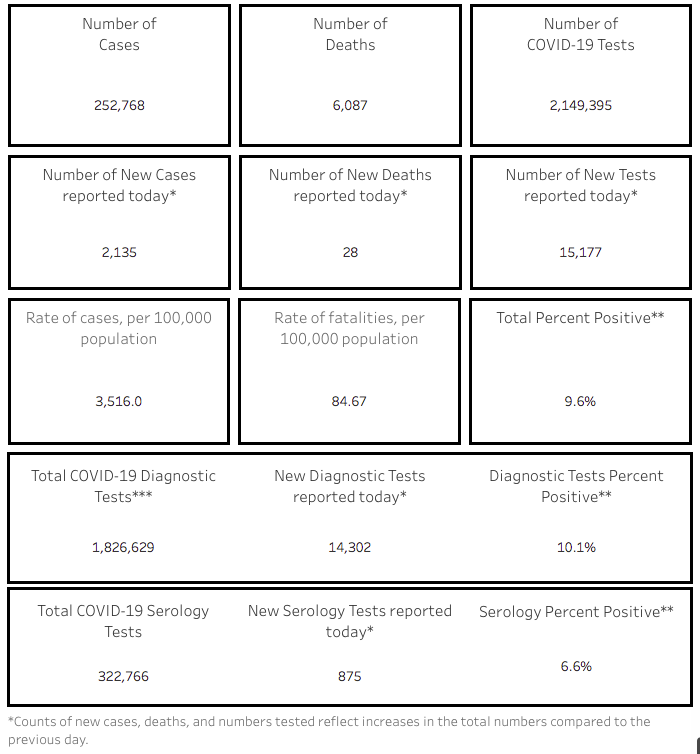
With 2,135 new cases reported today, the number of Arizona’s confirmed novel coronavirus cases topped 252,000 as of Thursday, Nov. 5, according to the Arizona Department of Health Services.

Pima County, which saw its number of cases jump by 165 yesterday, had seen 29,456 of the state’s 252,769 confirmed cases.
With 28 new deaths reported yesterday, a total of 6,087 Arizonans had died after contracting COVID-19, including 650 deaths in Pima County, according to the Nov. 5 report.
Although the current rise in COVID-19 cases is alarming, Gov. Doug Ducey warned last week there’s even worse to come.
“We know that there is a storm ahead of us, yet it’s not here,” Ducey said. “But those simple guidelines of wearing a mask, washing our hands, being socially distanced and using common sense have served us very well to date.”
However, the governor doesn’t plan on imposing new safety restrictions to prevent further spread of COVID-19.
“The mitigation that we’ve put out, the plan we put into effect remains in effect. I am proud that Arizona is open, that our economy is open, that our educational institutions are open and our tourist destinations are open,” Ducey said. “While at the same time, we do have mitigation steps in place that have allowed us to protect lives while protecting livelihoods, and we’re gonna continue to do that.”
But public health officials are warning that unless trends reverse, the state could face a “staggering” death toll, according to Cronkite News.
The number of hospitalized COVID cases statewide has declined from July peaks but has ticked upward in recent weeks as the virus has begun to spread more rapidly. ADHS reported that as of Nov. 4, 1,100 COVID patients were hospitalized in the state, the highest it has been since Aug. 18. That number peaked with 3,517 hospitalized COVID patients on July 13; it hit a subsequent low of 468 on Sept. 27.
A total of 1,007 people visited emergency rooms on Nov. 4 with COVID symptoms, topping 1,000 for the first time since Aug. 26. That number peaked at 2,008 on July 7; it hit a subsequent low of 653 on Sept. 28.
A total of 254 COVID-19 patients were in intensive care unit beds on Nov. 4. The number of COVID patients in ICUs peaked at 970 on July 13 and hit a subsequent low of 114 on Sept. 22.
On a week-by-week basis in Pima County, the number of positive COVID tests peaked the week ending July 4 with 2,452 cases, according to an Oct. 29 report from the Pima County Health Department.
Pima County saw a big bump in cases following the return of UA students, followed by a steady decline and then a big bump upward. For the week ending Sept. 19, 1,230 cases were reported; for the week ending Sept. 26, 615 cases were reported; for the week ending Oct. 3, 533 cases were reported; for the week ending Oct. 10, 465 cases were reported; for the week ending Oct. 17, 512 cases were reported; and for the week ending Oct. 24, 829 cases were reported.
Deaths in Pima County are down from a peak of 54 in the week ending July 4 to 10 in the week ending Sept. 5, one in the week ending Sept. 12, three in the week ending Sept. 19, four in the week ending Sept. 26, four in the week ending Oct. 3, two in the week ending Oct 10, and zero in the subsequent weeks.
Hospitalization peaked the week ending July 18 with 221 COVID patients admitted to Pima County hospitals, but it has been on the rise in recent weeks. In the week ending Sept. 19, 17 patients were admitted; in the week ending Sept. 26, 15 people were admitted; in the week ending Oct. 3, 20 patients were admitted; in the week ending Oct. 10, 27 people were admitted; in the week ending Oct. 17, 35 people were admitted; and in the week ending Oct. 24, 28 people were admitted. (Recent weeks are subject to revision.)
Get tested: Pima County offers free COVID testing, UA offering antibody testing
The Pima County Health Department has four free testing centers around town with easy-to-schedule appointments—often with same-day availability—with results in 24 to 72 hours.
You’ll have a nasal swab test at the Kino Event Center (2805 E. Ajo Way) the Udall Center (7200 E. Tanque Verde Road) and downtown (88 E. Broadway). The center at the northside Ellie Towne Flowing Wells Community Center, 1660 W. Ruthrauff Road, involves a saliva test designed by ASU.
Schedule an appointment at pima.gov/covid19testing.
The University of Arizona’s antibody testing has been opened to all Arizonans as the state attempts to get a handle on how many people have been exposed to COVID-19 but were asymptomatic or otherwise did not get a test while they were ill.
To sign up for testing, visit https://covid19antibodytesting.arizona.edu/home.
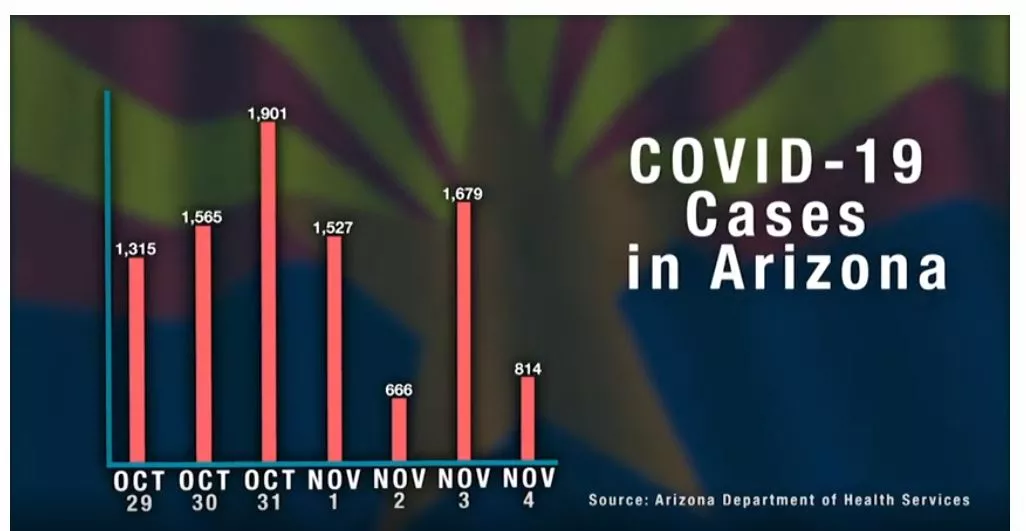
PHOENIX – Health officials Wednesday warned of a “staggering” death toll in Arizona as cases of the novel coronavirus continue to rise unabated, citing fatigue over COVID-19 and crowded holiday gatherings as potential dangers.
Dr. Joshua LaBaer, executive director of Arizona State University’s Biodesign Institute, said its team attributes a resurgence of cases in Arizona and nationwide to a potential new era in the pandemic – one in which Americans weary of eight months of isolation return to pre-COVID-19 routines of work, school and play. That could lead to a rise that surpasses even the state’s spike last summer, when nearly 1 out of 4 tests were positive.
About two weeks ago, LaBaer cautioned that cases were about to reach 1,000 a day. That estimate turned out to be conservative.
“Arizona’s moving average is now around 1,300, almost 1,400, new cases a day,” he said. “It’s not rising quite as rapidly as it did at the end of June, but it is rising consistently day-over-day and that’s a concern.”
He recommended minimal mingling during the holidays and a return to pandemic precautions of wearing masks, social distancing and frequent testing for the disease, which since January has killed more than 6,000 people in Arizona and 230,000 across the nation.
“I would suggest, for the upcoming holidays, that people really limit it to their immediate family this year. I don’t think it’s a great year for big family get-togethers,” LaBaer said.
Nearly 10% of tests in Arizona are positive, according to the Arizona Department of Health website, and half the 250,000 cases of the virus reported in Arizona are in Maricopa County, the state’s most populous.
LaBaer said Arizona has some confusing markers. A number of people have recovered from COVID-19 and appear to be immune for up to six months, which should mean a slowdown in the transmission of the disease. But that hasn’t happened.
“The fact that the transmission rate is as high as it was back then means that people are doing a better job of transmitting it, which is not good,” he said. “People are interacting more, and some of that may be COVID fatigue, some may be that people are back at work more often, but we really need to be attentive to reducing that sort of thing.”
As the global race for an approved COVID-19 vaccine pushes on, more people are getting the coronovirus that causes the disease.
“We’re hitting a milestone here where the seven-day average for new cases is approaching 100,000 new cases a day. To put that in some perspective, the number of new cases we saw yesterday was around 90,000. That is more than the total number of cases in the original Wuhan outbreak,” LaBaer said, referring to the industrial city in central China where COVID-19 emerged late last year.
Herd immunity has never been achieved without a vaccine, he said. Despite the widespread devastation and death toll caused by the virus, Arizona and the rest of the world are nowhere near the necessary 60% level to achieve herd immunity.
ASU has managed to keep the number of new cases low, LaBaer said.
ASU in January drew national attention when an ASU student became one of the nation’s first recorded cases of COVID-19. The student, who had returned from a trip to Wuhan, has recovered.
Regularly aggregated data on ASU’s COVID-19 management website recorded 86 of the 91 total known positive cases, as of Nov. 2, as off-campus students. Sixteen faculty and staff members have tested positive.
“We’re lucky there,” LaBaer said. “I personally believe that part of the reason our numbers are so good is because we do such regular testing.”
ASU has tested more than 106,000 students and employees since Aug. 1, using a saliva-based test the university developed that also is available to the public. The test has since been used at Northern Arizona University.
In previous months, health officials across the country have warned against potential spikes in cases after national holidays, such as the Fourth of July and Labor Day, though LaBaer did not share the same concern over the possibility of a post-Halloween surge among ASU students.
“I think our student population has been pretty well behaved,” LaBaer said, referring to those living on campus. “The harder part, for me, is the off-campus population, because those folks are in the community and it’s clear that our community numbers are rising and hard for them to escape that. I think that’s probably the likely bigger source of the issue.”
Will Humble, executive director for the Arizona Public Health Association, and other health officials also see a similar difference between on-campus and off-campus student behavior.
“The off-campus behavior has a direct impact on the success of the whole reentry program,” said Humble, former director of the state health department. “That’s why it’s so key to have a partnership between ASU and the city of Tempe.”
Humble agreed that ASU’s system of regular mass testing is effective.
“The standard is not perfection, the standard is to do the best you can. ASU had a great plan, and still does have a great plan on campus,” he said, but school officials need to work more closely with community officials and law enforcement to monitor off-campus behavior.
ASU shifted all classes online after Thanksgiving. LaBaer encouraged students to get tested before traveling and again before returning to campus in the spring to avoid the likelihood of spreading the coronavirus.
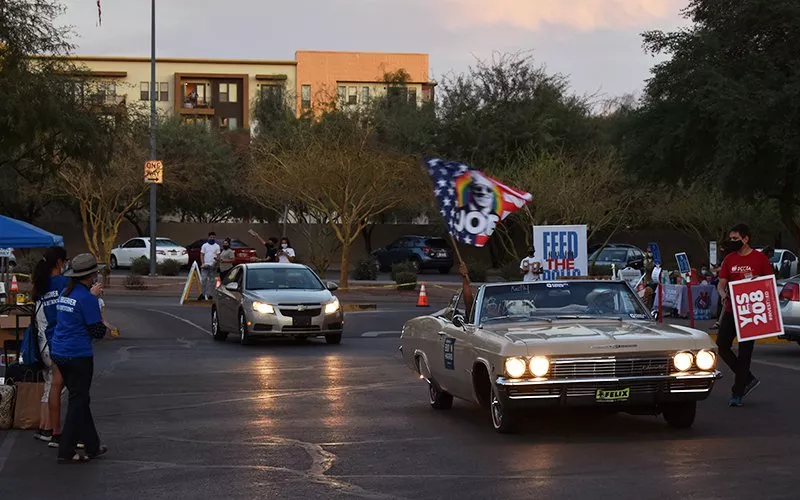
PHOENIX – Amid a pandemic that changed the way Americans live and vote, Joe Biden was the projected winner over Donald Trump in Arizona, leading a blue wave to flip a longtime Republic stronghold that chose a Democratic for the White House for only the second time since 1952.
Mark Kelly also was projected to beat Republican incumbent Martha McSally in a tough U.S. Senate race. He’ll join Kyrsten Sinema as part of the first all-Democrat Senate delegation from the state since the early 1950s.
In a speech before 10 p.m. Tuesday night in Tucson, Kelly, the ex-astronaut and retired Navy pilot, spoke about his desire to work for all Arizonans, especially as the COVID-19 pandemic wears on.
“My top priority is making sure we have a plan to slow the spread of this virus and then getting Arizonans the resources our state needs right now, so they can make ends meet,” he said.
The Associated Press called Arizona for Biden at 12:50 a.m. local time after its analysis of ballots cast statewide concluded there were not enough outstanding to allow Trump to catch up.
The Secretary of State’s Office results website on Wednesday morning showed Biden ahead of Trump by about 94,000 votes, or just more than 3 percentage points. Kelly was up 5 percentage points over McSally.
But as the website itself notes, “elections don’t end on Election Day.” There were thousands of early and provisional ballots still left to count.
Arizonans also voted to legalize recreational marijuana and approve a tax increase for high-earners to fund teacher raises and public education.
In an election largely seen as a referendum on the past four years under Trump – be it his take on immigration, rhetoric on race relations, impeachment for abuse of power or leadership during COVID-19 – more than 2.6 million ballots had been cast in Arizona before polls even opened Tuesday morning. Those early votes exceeded the number of all votes cast in 2016.
“What really motivates people is whether you like Trump or you don’t like Trump,” said David Berman, a political scientist at Arizona State University. “There are a lot of Democrats that would march through hell to get him out of office. Trump is the issue.”
As officials nationwide grappled with a rise in early voting and scrambled to verify and tabulate ballots, neither Biden nor Trump had secured the 270 electoral votes needed to win come Wednesday morning. And Trump was vowing to contest: “We’ll be going to the U.S. Supreme Court — we want all voting to stop,” he said early Wednesday.
Some voters prepared for Election Day morphing into “Election Week,” and braced themselves for possible protests no matter which candidate wins. A few Arizona businesses were boarded up as a precaution, and Phoenix Police Sgt. Maggie Cox said authorities would be monitoring for any problems.
After seeing the results, Montana Ludlow, 23, of Queen Creek said she was both excited and surprised. Ludlow voted for Biden, saying she wanted Trump out because of his stance on LGBTQ+ rights and Planned Parenthood funding.
But she remained worried about the potential for unrest.
“I have seen a couple of posts on social media already from Republicans saying that it’s still too early to really settle what the end results will be,” Ludlow said by text late Tuesday night. “I wouldn’t be surprised in any way if there was a strong negative reaction.”
Still others were prepared to wait for an outcome, and hoped the public could stay calm while the process plays out.
“I’m excited to learn the results however long they take,” said Pavi Shetty, a poll observer in Queen Creek. “I can be patient.”
Arizona law allows early ballots to be counted starting two weeks ahead of Election Day, but in any tight races, final tallies weren’t expected immediately.
It took six days for Sinema to be declared the winner over McSally in the 2018 Senate race. McSally actually held a slim lead on election night, but once all votes were counted, Sinema won by fewer than 56,000 votes.
“When elections are close, it always takes days to have the outcome,” said Alex Gulotta, state director of the voting rights organization All Voting Is Local. “There’s nothing improper or questionable about that. That’s how the process works, because we want to count every vote.”
Election Day 2020 unfolded amid a pandemic that has killed more than 1 million people globally – including over 230,000 in the U.S. and 6,000 in Arizona – and cost millions their jobs.
COVID-19 was at the forefront of many voters’ minds, with cases on the rise again both nationally and in the state. Only a month ago, Trump himself was diagnosed with the virus. After three nights in the hospital, he was released and soon returned to the campaign trail – maskless before packed crowds.
Lessie Serrano, 62, a former Democrat turned Republican, showed up at a Glendale polling site to support Trump. She brought two masks for extra protection, but said everything went smoothly.
“I think we are all just nervous because this is the quietest line I’ve ever been in,” she said.
Jared Bahley, 39, said he was “Trump all the way” when dropping his ballot at the Signal Butte Marketplace in Mesa.
“Most people are scared to voice who they are for right now, because it can be such a trigger. People get so emotionally invested in all this,” said Bahley, who works as a distribution account manager.
Many voters acknowledged they were, indeed, emotionally invested, and they blamed Trump for failing to lead the country through the pandemic.
At a gathering in Phoenix to rally turnout among Latinos, Kristin Urquiza, wearing a face mask that read “Vote,” expressed rage over the state’s and country’s response to the virus.
Urquiza, 39, co-founded an organization called Marked by COVID after her father died of the disease in June. She blames Republican politicians, including Trump and McSally, for underplaying the danger.
“Whenever we let the disease run its course that means that more Latino, Black and Indigenous siblings of ours get sick, have long-term health consequences and die,” she said.
On the Navajo Nation, which has been devastated by COVID-19, Franklin Sage is a self-described independent who has voted for both Republican and Democratic candidates.
This year, he said, he went with Democrats down the ballot, primarily because of his dissatisfaction with Trump’s handling of the pandemic and his stoking of racial division.
“I think he doesn’t think it (the pandemic) is a huge deal,” said Sage, director of the Diné Policy Institute in Tsaile.
“He goes around claiming that he survived. Well, if you’re the president of the United States, you’re going to get the best health care in the world,” Sage said, adding that far too many others weren’t so lucky, “especially on the reservation.”
The Navajo Nation has a per capita COVID-19 death rate higher than any U.S. state, statistics show. More than 580 people have died on the reservation, home to 173,000 people.
Sage said Trump’s downplaying of the virus hasn’t sat well there, adding, “Our health care system is not equivalent to most affluent communities.”
Four Directions, a Native voting rights organization, filed a lawsuit in August attempting to ensure the 67,000 eligible voters in the Arizona part of the reservation had a chance to vote safely by mail during the pandemic.
Arguing that it can take six full days for a ballot sent from tribal lands to reach a county recorder’s office, the lawsuit asked that ballots received through Nov. 13, instead of Nov. 3, be counted. The case was rejected.
Although obstacles to voting are always an issue, the virus was a new variable this year. The state’s official guidance for mitigating COVID-19 risks at polling places emphasized adequate personal protective equipment for poll workers, physical distancing and masks.
Those under quarantine with COVID-19 who hadn’t requested an early ballot were encouraged to reach out to their county’s special election board for a special ballot delivery; voting by video also was a possibility in certain circumstances.
Gulotta, of All Voting Is Local, said the precautions ensured that polling places were “safe and sanitary,” and first-time voter Jay Cay said he felt secure after voting in downtown Phoenix.
“They did a fantastic job … making sure that everything is clean, sanitized, everybody’s got their masks on, staying 6 feet apart,” said Cay, who felt the need to vote in person because of recent problems with his mail. Millions of others went the opposite route.
Almost 2.8 million ballots were cast in this election, an increase from the 2.6 million votes cast in 2016, when Trump defeated Hillary Clinton both in Arizona and nationally.
While turnout was big, some out-of-staters reported having issues voting by mail.
Diana Solorio, spokeswoman for the Maricopa County Recorder’s Office, said the office had received calls from people wondering why they never received mail-in ballots, but such calls come every election and those cases may be a result of mishandled paperwork on the part of voters.
Rhetta Eubanks, a University of Notre Dame student from Chandler, said she requested her ballot be mailed but it never arrived, despite a confirmation text from the county that it would be sent. Ultimately, she resigned herself to sitting out the election.
“To not be able to vote … is very upsetting.”
In the past four years, the number of registered voters in Arizona has increased by nearly 700,000, according to state data, and political analysts said a turn from red to blue was contingent on how many new voters, as well as Latinos and young voters, cast ballots.
Luis Ávila, founder of Aquí Se Vota, attributes Arizona’s transition to battleground state to groups like LUCHA and Mi Familia Vota, which have worked to mobilize the state’s burgeoning Latino community for over a decade.
He said the persistent “sleeping giant” narrative – that Latinos overwhelmingly don’t vote, despite the impact they could have both nationally and at the local level – is a thing of the past.
“It’s not true. We are here, and we’re voting in really high numbers compared to the last year,” Ávila said. “Despite the social inequities, our community is coming out in historic numbers, and that’s the story that is missing.”
In all 50 states, the share of white eligible voters has declined in past years, while Hispanic voters are increasingly a larger percentage of the electorate, according to a Pew Research Center analysis.
In Arizona, Hispanics represented 15% of eligible voters in 2000. That grew to 24% in 2018.
From 2010 to 2019, Maricopa County was the fastest-growing in the nation, adding more than 600,000 people, according to the Census Bureau. The state’s largest county went for Trump in 2016, but flipped this year to Biden, by 99,000 votes.
All of these shifting demographics concerned some Republican voters.
Chad and Nancy Boukhzam, both 36, of Cave Creek showed up at 9 a.m. Tuesday to vote in person for Trump – “the guy for our country,” as Chad put it. Nancy was nevertheless worried that Arizona would go blue, noting she’d seen more Democratic supporters in her town than in years past.
“Everyone coming from California: Please stop bringing your politics,” she said. “They are all leaving their states and coming here and voting the same way.”
But eligible voters are not always eventual voters. For example in 2016, according to Pew, the number of eligible Latinos who didn’t vote nationally – 14 million – exceeded the number of those who did – 12.7 million.
Jasmin Estrada and Sinahy Mendoza spent the last two months canvassing with Mi Familia Vota, knocking on doors seven days a week. Despite their dedication to getting out the Latino vote, they weren’t able to cast their own ballots – they’re both 16.
Estrada started working with Mi Familia Vota after seeing how excited her 66-year-old grandpa, who’s from Mexico, was about becoming a U.S. citizen and voting for the first time this year. This Election Day, she started knocking on doors at 5 a.m.
“I think it’s very inspirational, especially for people who can’t vote yet like me,” she said, looking ahead two years, when she, too, will be able to vote. “It just makes me want to be part of the democracy when I get older and have a voice.”
Like Estrada, Michelle Viscara, 17, of Los Angeles also couldn’t vote this go-round, but that didn’t stop her from doing her civic duty. Viscara volunteered to work the polls at Dodger Stadium to aid voters in both English and Spanish, and to get a preview of what voting is like.
As a Latina, she worries about racial inequality in the U.S.
“How can we treat people equally when not everyone has equal rights?” she said.
She hoped her experience this Election Day would help her be “better prepared and informed” when it’s time to cast her ballot, and she said the past four years had taught her a lot.
“It’s been a lot of, ‘How can people do that?’” she said, “and the fact that people can do some cruel things to other people.”
Reporters Jake Santo, Haleigh Bartow, Patty Vicente and Jimmy Cloutier contributed to this report.