

Thursday, September 17, 2020
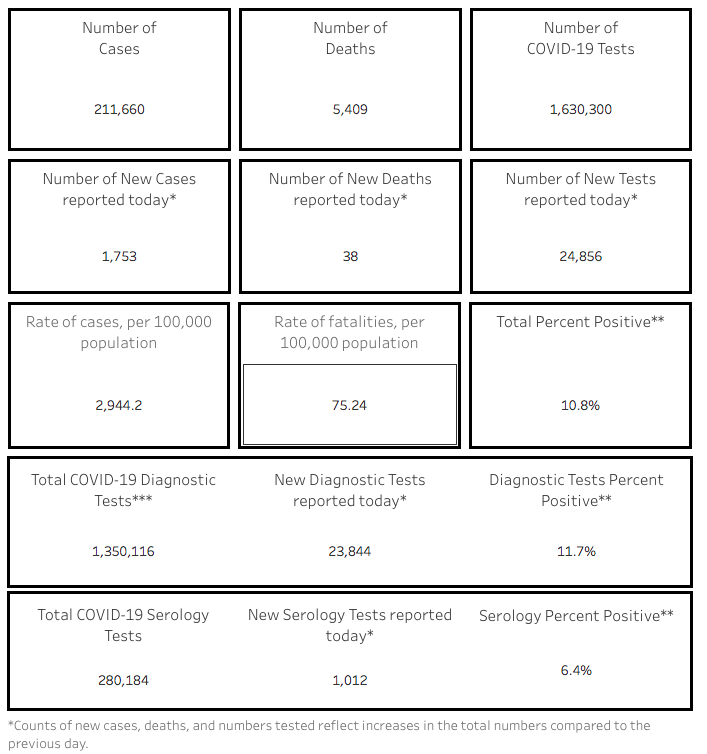
With 1,753 new cases reported today, the number of Arizona’s confirmed novel coronavirus cases topped 211,000 as of Thursday, Sept. 17, according to the Arizona Department of Health Services.

Pima County had seen 23,563 of the state’s 211,660 confirmed cases.
The dramatic increase in cases was a result of the state including a big batch of antigen tests, according to Arizona Health Department Director Cara Christ, who said she anticipated another jump in numbers tomorrow as the department processes the new tests, many of which are coming from the University of Arizona’s testing of students. Antigen tests are not as reliable but provide faster results, according to Christ. As a result, not all positive antigen tests have been counted in Arizona’s COVID-19 tally, although they will be in the future.
“Moving forward, we are expanding how we define cases to include anyone with a positive antigen test in the probable case category, which is consistent with the recently updated national case definition for COVID-19 from the Council of State and Territorial Epidemiologists (CSTE),” Christ wrote on her blog.
With 38 new deaths today, a total of 5,409 Arizonans had died after contracting COVID-19, including 612 deaths in Pima County, according to the Sept. 17 report.
The number of hospitalized COVID cases continues to decline from July peaks. ADHS reported that as of Sept. 16, 594 COVID patients were hospitalized in the state. The number of hospitalized COVID patients peaked at 3,517 on July 13.
A total of 863 people visited emergency rooms on Sept. 16 with COVID symptoms. That number peaked at 2,008 on July 7.
A total of 119 COVID-19 patients were in intensive care unit beds on Sept. 16. The number of COVID patients in ICUs peaked at 970 on July 13.
On a week-by-week basis in Pima County, the number of positive COVID tests peaked the week ending July 4 with 2,396 cases, according to a Sept. 11 report from the Pima County Health Department. While a vocal minority continues to insist that masks do no good, the spread of the virus began to decline within weeks of Pima County’s mask mandate, as more people began wearing them in public, although the level of new cases has essentially plateaued in recent weeks rather than continuing to drop. For the week ending Aug. 22, the number of new cases dropped to 528; for the week ending Aug. 29, 514 new cases were reported; and for the week ending Sept. 5, a total of 527 cases were reported. (Recent weeks are subject to revision.)
Deaths in Pima County are down from a peak of 55 in the week ending July 4 to 19 for the week ending Aug. 15, 13 for the week ending Aug. 22 and nine in the week ending Aug. 29. (As above, these numbers are subject to revision as recent deaths may not have been reported.)
Hospitalization peaked the week ending July 18 with 239 COVID patients admitted to Pima County hospitals. For the week ending Aug. 29, 36 COVID patients were admitted to Pima County hospitals and in the week ending Sept. 5, 21 patients were admitted to Pima County hospitals. (Numbers are subject to revision.)
County discourages trick-and-treating this Halloween
The Pima County Health Department today announced recommendations for how to safely enjoy Halloween during COVID-19. They continue to advise against large gatherings in favor of drive-thru events and maintained social distancing. PCHD is also getting creative, stating how wearing facemasks can even be incorporated into your Halloween costume.
Instead of attending Halloween carnivals or door-to-door trick-or-treating, PCHD recommends:

WASHINGTON – Facebook and Twitter opened investigations this week into a number of Arizona teenagers’ social media accounts for operating fraudulent profiles and spreading misinformation in support of the Trump campaign, reportedly for pay.
The campaign was first reported by the Washington Post, which said Wednesday that Phoenix-based Turning Point Action recruited teenagers to take part in a mostly secretive social media campaign.
The posts contain similar language but were hard to detect as a coordinated effort because they were made by the young people to accounts under their names or through a fake account, the Post said. The profiles did not disclose an affiliation with Turning Point Action.
One Arizona political consultant said the thought of using young people for an under-the-table social media campaign is “sickening.”
But Jake Hoffman, president and CEO of Rally Forge, said in an emailed statement Wednesday that the posts were nothing more than “real kids, operating their real social media profiles and promoting mainstream American values.”
“What these young Arizona activists are doing is honest and sincere political activism in the 21st century and in the age of COVID-19,” said Hoffman, whose firm was linked by the Post to the Turning Point project. He did not respond to questions about his own involvement.
Neither Turning Point Action nor the affiliated Turning Point USA responded to requests for comment Wednesday. Turning Point is a conservative youth outreach organization and its founder, Charlie Kirk, was a featured speaker at the Republican National Convention that renominated President Donald Trump last month.
Facebook and Twitter did not identify the accounts or the posts Wednesday. A Twitter spokesperson said only that it has begun investigations into the profiles and will “take action in line with the Twitter Rules if Tweets are found to be in violation.”
Both social media platforms have removed a number of accounts associated with the activity for violating community guidelines, such as creating fake accounts on Facebook. Twitter has specifically taken action against tweets and profiles for “coordinating with or compensating others to engage in artificial engagement or amplification, even if the people involved use only one account.”
Scott Talan, a professor of communications at American University, said Turning Point likely use teenagers partly because they are so active online and partly because they are amenable to suggestion.
“This is why you have educational systems to teach kids, because they do not yet have the ability or maturity to make the best decisions, especially if they’re offered money,” Talan said.
“You’re using young people, paying them, so that means they don’t really believe in your cause, or they may or may not believe in your cause,” he said. “And then you get these ethical questions about spreading misinformation.”
For Jason Rose, a political consultant with Rose + Moser + Allyn, there is no question.
“Can you imagine someone running a fake commercial on television, and how foreign a concept that would be? But somehow if you do it on social media that’s OK,” said Rose, the consultant who said it was sickening.
Jacob Rubashkin, a reporter and analyst for Inside Elections, said the effort demonstrates the fact that the internet is an increasingly important tool in politics.
“Every election cycle, what happens on the internet is more important than in the last one,” he said. “So it’s not particularly surprising to me that a group affiliated with the president, such as Turning Point USA, would try and use the levers of the internet and social media to try and help their campaign.”
Rubashkin also said he is not surprised “that we’re seeing these kinds of concerted efforts from political groups to influence and perhaps even misinform or deceive people online. We’ve seen that happen from foreign actors and now we see it from domestic actors.”
Rose said he does not take issue with minors working with Turning Point, whose target audience is younger voters, but with the misinformation and fake profiles.
“That’s just wrong to do and it doesn’t matter if it’s for the president or mayoral campaign. There are certain things that are out of bounds,” he said.
Officials with Democratic presidential nominee Joe Biden’s campaign declined to comment on the story Wednesday. Steve Cortes, a senior Trump campaign advisor, said he had not read the Post’s report and declined to comment, but added, “I do love Turning Point.”
Wednesday, September 16, 2020

ProPublica is a nonprofit newsroom that investigates abuses of power. Sign up to receive our biggest stories as soon as they’re published.
This article is co-published with The Texas Tribune, a nonprofit, nonpartisan local newsroom that informs and engages with Texans. Sign up for The Brief weekly to get up to speed on their essential coverage of Texas issues.
The U.S. government late Monday deported a crucial witness in an ongoing investigation into allegations of sexual assault and harassment at an El Paso, Texas, immigrant detention center, the witness’s lawyers said.
The 35-year-old woman has been held in the facility, which is overseen by Immigration and Customs Enforcement, for about a year and told lawyers about a “pattern and practice” of abuse there, including that guards systematically assaulted her and other detainees in areas that were not visible to security cameras.
A committee chair is ratcheting up a fight over an investigation into potential conflicts of interests in the NLRB’s repeated efforts to undo an Obama-era rule that expanded liability for corporations like McDonald’s.
ProPublica is a nonprofit newsroom that investigates abuses of power. Sign up to receive our biggest stories as soon as they’re published.
House Democrats are set to issue a subpoena Tuesday to compel the National Labor Relations Board to hand over documents as part of an inquiry into potential ethical lapses at the board, according to congressional aides. The move, by Democrats on the House Committee on Education and Labor, marks a significant escalation of a long-running investigation and follows the repeated refusal by the NLRB’s chairman, John Ring, to produce the documents voluntarily.
The subpoena demands that the labor board produce a set of documents linked to its efforts, under the Trump administration, to undo one of the landmark decisions of the Obama-era NLRB, which expanded worker protections by broadening what is called the “joint employer” rule. That decision left companies on the hook for labor law violations against workers not directly employed by them, like temp staff and employees of fast-food franchisees. It meant that a parent corporation like McDonald’s, one of the companies embroiled in litigation over the rule, could be held liable for a franchise owner’s wrongdoing, such as retaliating against workers for trying to unionize. That had implications for the profits of corporations that operate on a franchise model and for contract-staffing firms, like cleaning services.
House Democrats see the documents, which include ethics reviews written by NLRB lawyers, as key to addressing their concerns that the actions by the Trump-era NLRB — the agency made three separate attempts to overturn or undermine the Obama-era rule before succeeding — were tainted by conflicts of interest, as well as potential violations of federal contracting law.
In a Sept. 1 letter to Ring, Rep. Bobby Scott, D-Va., who chairs the House Committee on Education and Labor, accused the labor board of obstructing his committee’s oversight efforts and suggested that its refusal to produce certain documents indicated that the NLRB has “something to hide.” (ProPublica obtained a copy of the letter, which has not been reported previously.) “The Committee is left to conclude that the NLRB’s sole motivation for refusing to produce requested documents is to cover up misconduct,” Scott wrote.
In a statement provided by NLRB spokesman Edwin Egee, the board called the committee’s subpoena “unprecedented” and noted that the agency had allowed the committee’s staff to review some documents at its headquarters in an effort to accommodate the committee’s requests while also “protecting the Agency’s legitimate confidentiality interests.” Other documents, the statement said, were withheld to protect the board’s internal deliberative processes. The statement included a quote attributed to Ring, which said that the NLRB had been “fully cooperative,” accused the committee of seeking documents it “knows it is not entitled to” and called the subpoena “a made-up controversy solely for political theatre.”
The statement is consistent with Ring’s position in earlier negotiations with the committee. In a May 14 phone call with Scott, described in his letter, Ring refused to turn over documents sought by the committee unless a federal judge ordered him to.
As other House committees have seen firsthand in recent months, resort to the courts would likely leave the subpoena in limbo for months. This fight is likely to persist. Because NLRB board members serve fixed five-year terms, the agency’s Trump-appointed majority will remain in place until August 2021.
The NLRB has experienced periods of intense congressional oversight in the past. During Obama’s first term, for example, the Democratic-run board faced wide-ranging document requests and subpoenas from House Republicans. Although the board withheld some documents, it willingly turned over tens of thousands of pages to congressional committees, according to Wilma Liebman, who served on the NLRB across three administrations, from 1997 through 2011. “We always thought that, as excruciating and time-consuming as it was, we had an obligation to comply with requests from Congress,” Liebman said. “They’re the source of our budget, for heaven’s sake.”
The documents the board held back in the past, according to Liebman, contained records of its internal deliberations in ongoing cases — documents that, if disclosed, could confer an advantage on one party to a labor dispute. In its statement, the NLRB points to this precedent to justify refusing to turn over the documents sought by the House committee. But, Liebman said, the logic that supported withholding documents doesn’t apply to the current fight because this one centers on allegations of conflicts of interest.
The House inquiry began after the NLRB’s first attempt to roll back the Obama-era expansion of the joint-employer rule, in a 2017 decision titled Hy-Brand Industrial Contractors. A Trump appointee named William Emanuel cast the deciding vote in that case — only to have the NLRB undo that vote after its inspector general and an ethics officer concluded that Emanuel should have recused himself because of the involvement of the law firm where he had previously worked, Littler Mendelson, in the Obama-era case it overturned.
The new subpoena focuses on the unusual lengths the labor board’s Trump-appointed majority subsequently went to as it sought to get rid of the more expansive joint-employer rule. House Democrats argue those efforts raise additional ethical concerns.
Starting in 2012, workers at McDonald’s franchises claimed they were fired or otherwise retaliated against for their involvement in protests seeking union representation and higher wages as part of the “Fight for $15” campaign. The Obama-era NLRB filed complaints not only against the franchise owners but also against McDonald’s itself, as a “joint employer” of the franchisees’ workers.
But once Trump appointees took control of the NLRB, the agency went in a different direction. By the spring of 2018, the NLRB’s then-new general counsel, Peter Robb, reached a settlement viewed as favorable to McDonald’s and its franchisees. That summer, an administrative law judge rejected the settlement, noting that, among other defects, it largely sidestepped a core question — whether McDonald’s was a joint employer. McDonald’s appealed, and last December, the labor board reversed the judge’s decision and authorized the settlement, with Emanuel again casting the deciding vote in a 2-1 opinion.
Representatives of McDonald’s workers had asked Emanuel to recuse himself, citing Littler Mendelson’s legal work for McDonald’s as the fast-food behemoth sought to help franchisees fend off the protests over wages and unionization. Emanuel declined to recuse himself, on the grounds that Littler Mendelson had never represented McDonald’s before the NLRB. (A hotline the law firm set up to field questions from franchise owners remained active as of Monday.) Emanuel explained in a footnote to the majority opinion in the McDonald’s case that he sought an opinion from the labor board’s ethics officer — a document that is among those subject to the impending subpoena — but did not disclose the ethics officer’s advice.
The House committee has sought to review the ethics memorandum, in part, to determine whether Emanuel complied with its recommendations. Concerns among Democrats on the committee grew after the NLRB issued an unusual report on its recusal process last November, spurred by the earlier controversy around Hy-Brand. The report observed that a board member could “insist on participating” in a case, even when the ethics officer has determined that the member should be recused.
Ring refused to give the House committee a copy of the ethics memorandum in the McDonald’s case, but he agreed to let committee staff review it at NLRB headquarters. But Ring added a new caveat: The House staffers could only view the ethics memorandum after the McDonald’s case was completed. That has yet to happen, because representatives of the workers involved asked the board to reconsider its December ruling. In his Sept. 1 letter, Scott described that condition as an “indication that the NLRB is attempting to cover up malfeasance or misfeasance.”
The subpoena also seeks a separate set of documents. In September of 2018, the NLRB majority moved for a third time to curtail the Obama-era joint-employer rule, this time through a rulemaking process. The labor board hired a contractor to help it categorize comments submitted in response to the new rule it had proposed.
As ProPublica reported last year, contracting documents indicated the temp staff might be involved in substantively assessing the comments, which could violate federal contracting rules. The labor board, which denied that the temp staff had handled any substantive work, refused to disclose documents showing how the contractors were instructed to categorize the comments, claiming they reflected the board’s internal deliberative processes and so were shielded from disclosure.
The new subpoena seeks those documents as well as another ethics opinion provided to Emanuel. Emanuel had decided to participate in the rulemaking after the ethics opinion cleared him to do so.
A more permissive conflict-of-interest standard applies to rulemaking, and critics, including one of Emanuel’s fellow NLRB members, voiced concerns that the labor board’s resort to that process aimed to circumvent recusal rules. “By pursuing rulemaking rather than adjudication,” the board member, an Obama appointee named Lauren McFerran, wrote in a dissent from the proposed rule, “the Board is perhaps able to avoid what might otherwise be difficult ethical issues.”
When staffers on Scott’s committee reviewed the ethics opinion at NLRB headquarters, they found it lacked substantive analysis of those concerns and of how Emanuel’s earlier conflicts of interest affected them. “A more fulsome public examination of that opinion is in order,” Scott wrote in comments he and a Senate colleague submitted to the NLRB.
The plea went unheeded, and the NLRB issued its employer-friendly rule in February.

PHOENIX – Refugees living in Arizona are struggling to navigate the impacts of COVID-19. In response, nonprofit organizations boosted assistance programs after they noticed more refugees losing their jobs or having their hours cut. Families say they also are struggling with complicated government aid applications written in a language in which they may not be fluent.
There are 82,982 refugees in Arizona, according to the latest numbers by the Arizona Department of Economic Security. Refugees make up less than 1% of Arizona’s total population of 7.3 million.

WASHINGTON – Just more than two in five Arizona adults got a flu shot last year, a number state officials are desperate to improve on before the onset of both influenza and the ongoing COVID-19 pandemic this fall.
State officials late last month announced plans to increase Medicaid funding for flu shots, let some pharmacists administer the shots and make them available along with COVID-19 testing in an effort to head off a surge on hospitalizations from one or both of the viruses.
Tags: flu , covid , coronavirus , Image

Tucson Electric Power will continue to suspend service disconnections and late fees for nonpayment till the end of 2020 in an effort to help those affected by the pandemic.
The disconnection moratorium, approved by the Arizona Corporation Commission, was slated to end on Oct. 15.
“We know that many families and small businesses are facing financial hardships right now, so we want to be as flexible as we can to support them,” said TEP COO Susan Gray “We also want to help customers avoid falling too far behind on bills during this difficult period.”
TEP is creating payment plans for residential customers with overdue balances starting Oct. 15, to help avoid future service interruptions as the new year begins.
The electric company encourages customers with overdue balances to call 520-623-7711 for assistance with payment extensions or customer assistance programs.
Last March, TEP voluntarily suspended service disconnections to help alleviate financial hardships due to statewide closures in an effort to slow the spread of COVID-19. Soon after, the Arizona Corporation Commission approved a moratorium on the disconnection of residential electric service from June 1 to Oct.15.
TEP serves more than 430,000 customers in Southern Arizona.

