

Monday, August 3, 2020
ProPublica is a nonprofit newsroom that investigates abuses of power. Click here to read their biggest stories as soon as they’re published.
A New York grand jury on Thursday indicted two former leaders of the Mexican federal police force, including one who oversaw the anti-narcotics units that were specially vetted by the U.S. Drug Enforcement Administration and were linked to two brazen massacres in Mexico that left dozens, possibly hundreds, of people dead and missing.
The indictments marked a stunning fall from grace for Ramón Pequeño García and Luis Cárdenas Palomino, who had been celebrated by U.S. national security and diplomatic officials as trusted partners in the fight against Mexican drug cartels.
On Thursday, a federal grand jury found that instead of combating the cartels, there was evidence that the men had been collaborating with and accepting millions in bribes from them. Cárdenas Palomino had served as the director of regional operations for the federal police force between 2006 and 2012. During that time, Pequeño was head of the federal police anti-narcotics division, which controlled the DEA’s Sensitive Investigative Units.
A New York grand jury on Thursday indicted two former leaders of the Mexican federal police force, including one who oversaw the anti-narcotics units that were specially vetted by the U.S. Drug Enforcement Administration and were linked to two brazen massacres in Mexico that left dozens, possibly hundreds, of people dead and missing.
The indictments marked a stunning fall from grace for Ramón Pequeño García and Luis Cárdenas Palomino, who had been celebrated by U.S. national security and diplomatic officials as trusted partners in the fight against Mexican drug cartels.
On Thursday, a federal grand jury found that instead of combating the cartels, there was evidence that the men had been collaborating with and accepting millions in bribes from them. Cárdenas Palomino had served as the director of regional operations for the federal police force between 2006 and 2012. During that time, Pequeño was head of the federal police anti-narcotics division, which controlled the DEA’s Sensitive Investigative Units.
ProPublica is a nonprofit newsroom that investigates abuses of power. Click here to read their biggest stories as soon as they’re published.
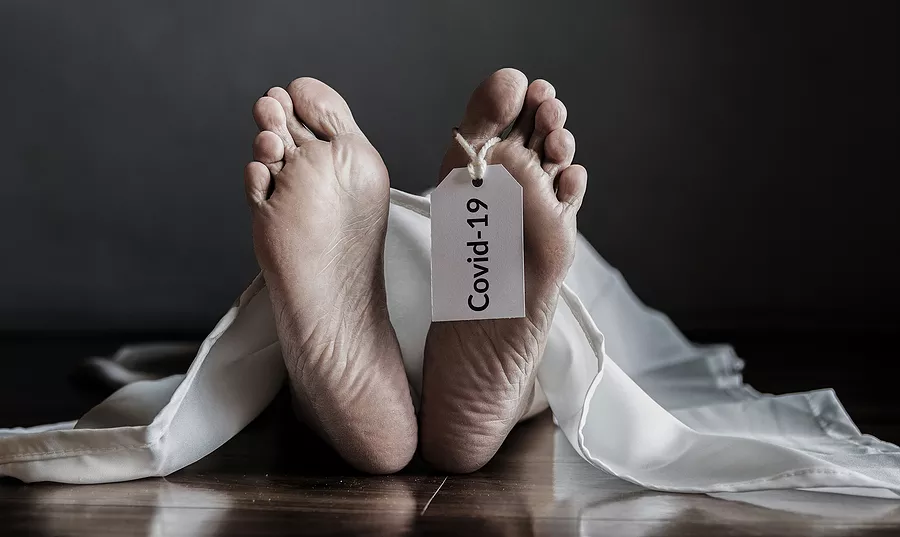
When police discovered the woman, she’d been dead at home for at least 12 hours, alone except for her 4-year-old daughter. The early reports said only that she was 42, a mammogram technician at a hospital southwest of Atlanta and almost certainly a victim of COVID-19. Had her identity been withheld to protect her family’s privacy? Her employer’s reputation? Anesthesiologist Claire Rezba, scrolling through the news on her phone, was dismayed. “I felt like her sacrifice was really great and her child’s sacrifice was really great, and she was just this anonymous woman, you know? It seemed very trivializing.” For days, Rezba would click through Google, searching for a name, until in late March, the news stories finally supplied one: Diedre Wilkes. And almost without realizing it, Rezba began to keep count.
The next name on her list was world-famous, at least in medical circles: James Goodrich, a pediatric neurosurgeon in New York City and a pioneer in the separation of twins conjoined at the head. One of his best-known successes happened in 2016, when he led a team of 40 people in a 27-hour procedure to divide the skulls and detach the brains of 13-month-old brothers. Rezba, who’d participated in two conjoined-twins cases during her residency, had been riveted by that saga. Goodrich’s death on March 30 was a gut-punch; “it just felt personal.” Clearly, the coronavirus was coming for health care professionals, from the legends like Goodrich to the ones like Wilkes who toiled out of the spotlight and, Rezba knew, would die there.
When police discovered the woman, she’d been dead at home for at least 12 hours, alone except for her 4-year-old daughter. The early reports said only that she was 42, a mammogram technician at a hospital southwest of Atlanta and almost certainly a victim of COVID-19. Had her identity been withheld to protect her family’s privacy? Her employer’s reputation? Anesthesiologist Claire Rezba, scrolling through the news on her phone, was dismayed. “I felt like her sacrifice was really great and her child’s sacrifice was really great, and she was just this anonymous woman, you know? It seemed very trivializing.” For days, Rezba would click through Google, searching for a name, until in late March, the news stories finally supplied one: Diedre Wilkes. And almost without realizing it, Rezba began to keep count.
The next name on her list was world-famous, at least in medical circles: James Goodrich, a pediatric neurosurgeon in New York City and a pioneer in the separation of twins conjoined at the head. One of his best-known successes happened in 2016, when he led a team of 40 people in a 27-hour procedure to divide the skulls and detach the brains of 13-month-old brothers. Rezba, who’d participated in two conjoined-twins cases during her residency, had been riveted by that saga. Goodrich’s death on March 30 was a gut-punch; “it just felt personal.” Clearly, the coronavirus was coming for health care professionals, from the legends like Goodrich to the ones like Wilkes who toiled out of the spotlight and, Rezba knew, would die there.
ProPublica Illinois is a nonprofit newsroom that investigates abuses of power.
As violent crime continued to climb in Chicago and other cities across the country, Attorney General William P. Barr announced that the U.S. Department of Justice was mobilizing to help: Dozens of federal agents would be sent to work with local police to combat gangs and illegal guns.
“Our message to gangs, gang leaders and gang members is this: When we throw the federal book at you, it will be a knockout blow,” Barr said.
That was in 1992, during Barr’s first stint leading the Justice Department, under former President George H.W. Bush.
If it sounds too recent or familiar to have happened nearly three decades ago, that’s because Barr, now attorney general under President Donald Trump, made a strikingly similar announcement on July 22.
Some of the details were different, of course. In 1992, Barr said the FBI was shifting about 300 agents from monitoring spies from the recently collapsed Soviet Union to taking on gangs and violent crime in American cities. Eighteen of the agents would be redeployed to Chicago.

As violent crime continued to climb in Chicago and other cities across the country, Attorney General William P. Barr announced that the U.S. Department of Justice was mobilizing to help: Dozens of federal agents would be sent to work with local police to combat gangs and illegal guns.
“Our message to gangs, gang leaders and gang members is this: When we throw the federal book at you, it will be a knockout blow,” Barr said.
That was in 1992, during Barr’s first stint leading the Justice Department, under former President George H.W. Bush.
If it sounds too recent or familiar to have happened nearly three decades ago, that’s because Barr, now attorney general under President Donald Trump, made a strikingly similar announcement on July 22.
Some of the details were different, of course. In 1992, Barr said the FBI was shifting about 300 agents from monitoring spies from the recently collapsed Soviet Union to taking on gangs and violent crime in American cities. Eighteen of the agents would be redeployed to Chicago.
Editor’s Note: Coronavirus has devastated Native American communities and put a spotlight on some long-standing problems in Indian Country that have made this pandemic that much worse. But at the grassroots level, everyday heroes have stepped up to help. Part of a series.
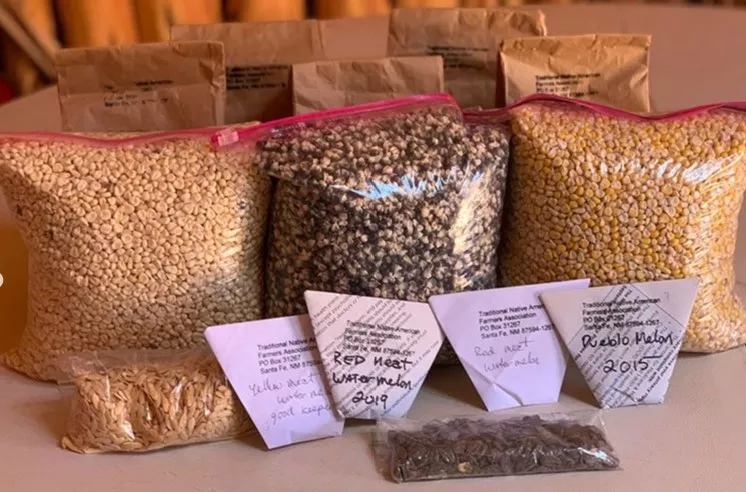
PHOENIX – From a traditional hogan in a remote area on the Utah-Arizona line, Cynthia Wilson spent much of her spring sourcing drought-resistant seeds, packing them in small manila envelopes and labeling them to ship to families across the Four Corners.
Seeds for corn – white, blue and yellow. For squash. For melons. For many of the foods that long sustained her Navajo ancestors, before their land was carved into a reservation and the government started shipping in commodities. And long before the COVID-19 pandemic emptied grocery store shelves of necessities.
PHOENIX – From a traditional hogan in a remote area on the Utah-Arizona line, Cynthia Wilson spent much of her spring sourcing drought-resistant seeds, packing them in small manila envelopes and labeling them to ship to families across the Four Corners.
Seeds for corn – white, blue and yellow. For squash. For melons. For many of the foods that long sustained her Navajo ancestors, before their land was carved into a reservation and the government started shipping in commodities. And long before the COVID-19 pandemic emptied grocery store shelves of necessities.
ProPublica is a nonprofit newsroom that investigates abuses of power. Click here to read their biggest stories as soon as they’re published.
In late April, as an escalating pandemic shut down most of the country and the federal government shelled out billions of dollars to untested contractors for protective masks, Juanita Ramos got a call from a friend in the marijuana business.
Her friend and some other ganjapreneurs were buzzing over a potentially huge payday. They had in their possession a $34.5 million purchase order from the U.S. Department of Veterans Affairs. A contractor hired by the VA to provide 6 million N95 respirators to the nation’s largest hospital system had searched for weeks but found none of the potentially life-saving masks. So he had reached out far and wide for help, offering to cut in anyone who could help him finance, purchase and deliver masks by his deadline.
His PO, as it’s commonly called, had made its way to players in the cannabis industry, where deals are made quickly and often in cash. The friend asked Ramos: Did she want in on the action?
In late April, as an escalating pandemic shut down most of the country and the federal government shelled out billions of dollars to untested contractors for protective masks, Juanita Ramos got a call from a friend in the marijuana business.
Her friend and some other ganjapreneurs were buzzing over a potentially huge payday. They had in their possession a $34.5 million purchase order from the U.S. Department of Veterans Affairs. A contractor hired by the VA to provide 6 million N95 respirators to the nation’s largest hospital system had searched for weeks but found none of the potentially life-saving masks. So he had reached out far and wide for help, offering to cut in anyone who could help him finance, purchase and deliver masks by his deadline.
His PO, as it’s commonly called, had made its way to players in the cannabis industry, where deals are made quickly and often in cash. The friend asked Ramos: Did she want in on the action?
The number of Arizona’s confirmed novel coronavirus cases topped 179,000 as of Monday, Aug. 3, according to the Arizona Department of Health Services.
Pima County had seen 16,741 of the state’s 179,497 confirmed cases.
A total of 3,779 Arizonans had died after contracting COVID-19, according to the Aug. 3 report.
Arizona hospitals remain under pressure although the number of patients has declined from a peak earlier this month. ADHS reported that as of Aug. 2, 2,017 COVID patients were hospitalized in the state, down from a peak of 3,517 on July 13 and the lowest number hospitalized since June 22, when 2,136 were hospitalized.
A total of 1,138 people visited ERs on Aug. 2 with COVID symptoms. The number of ER visits hadn’t dipped that low since June 29, when 1,077 people with COVID symptoms visited ERs. That number peaked at 2,008 on July 7.
A total of 628 COVID-19 patients were in ICU beds on Aug. 2. That’s the lowest it’s been since June 26, when 657 COVID-19 patients were in ICU. The number in ICUs peaked at 970 on July 13.
Grijalva Tests Positive for Coronavirus
Congressman Raul Grijalva has tested positive for the coronavirus.
Grijalva, 72, had been in self-quarantine after being in contact during hearings with Republican Rep. Louie Gohmert of Texas, who tested positive last week.
Grijalva, a Democrat who has represented Southern Arizona since he was first elected to Congress in 2002, said he felt fine and was showing no symptoms.
In a prepared statement, Grijalva was critical of Republican members of Congress who refuse to wear masks.
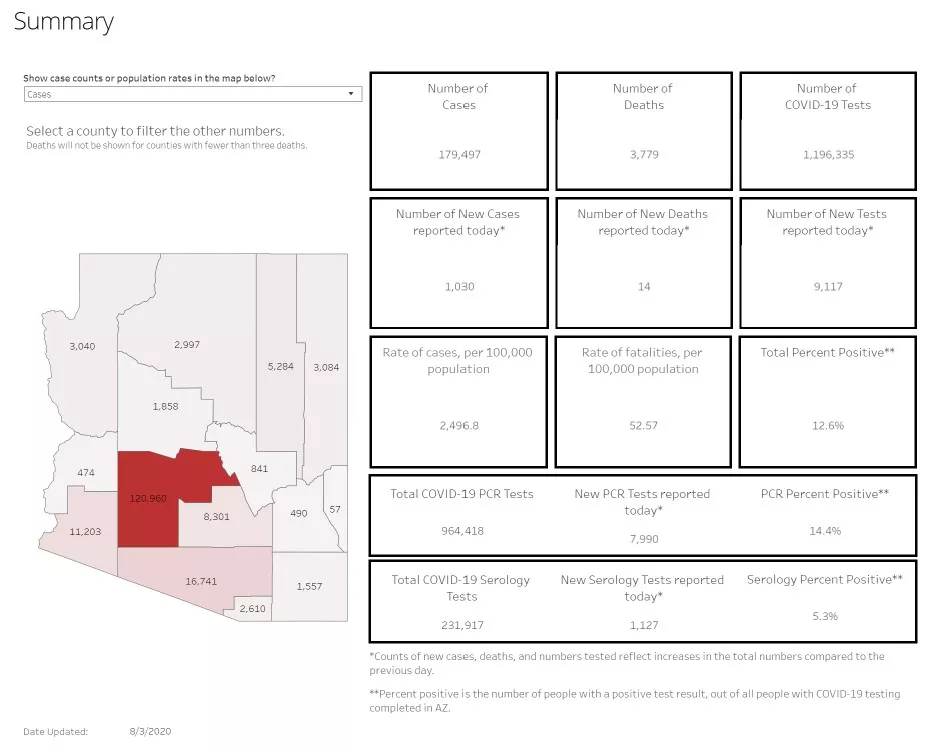
Pima County had seen 16,741 of the state’s 179,497 confirmed cases.
A total of 3,779 Arizonans had died after contracting COVID-19, according to the Aug. 3 report.
Arizona hospitals remain under pressure although the number of patients has declined from a peak earlier this month. ADHS reported that as of Aug. 2, 2,017 COVID patients were hospitalized in the state, down from a peak of 3,517 on July 13 and the lowest number hospitalized since June 22, when 2,136 were hospitalized.
A total of 1,138 people visited ERs on Aug. 2 with COVID symptoms. The number of ER visits hadn’t dipped that low since June 29, when 1,077 people with COVID symptoms visited ERs. That number peaked at 2,008 on July 7.
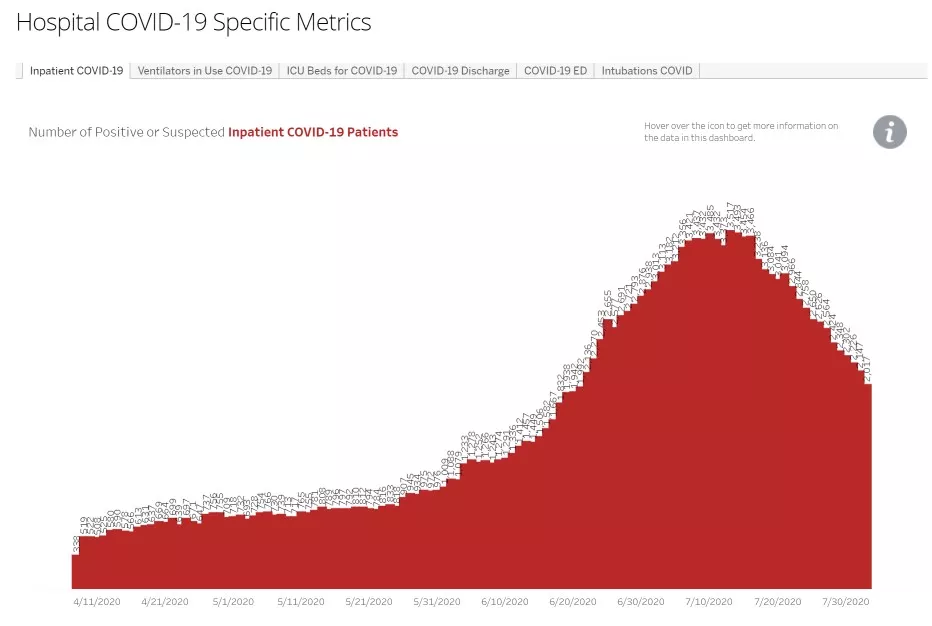
A total of 628 COVID-19 patients were in ICU beds on Aug. 2. That’s the lowest it’s been since June 26, when 657 COVID-19 patients were in ICU. The number in ICUs peaked at 970 on July 13.
Grijalva Tests Positive for Coronavirus

Congressman Raul Grijalva has tested positive for the coronavirus.
Grijalva, 72, had been in self-quarantine after being in contact during hearings with Republican Rep. Louie Gohmert of Texas, who tested positive last week.
Grijalva, a Democrat who has represented Southern Arizona since he was first elected to Congress in 2002, said he felt fine and was showing no symptoms.
In a prepared statement, Grijalva was critical of Republican members of Congress who refuse to wear masks.
For more Claytoonz, click here.
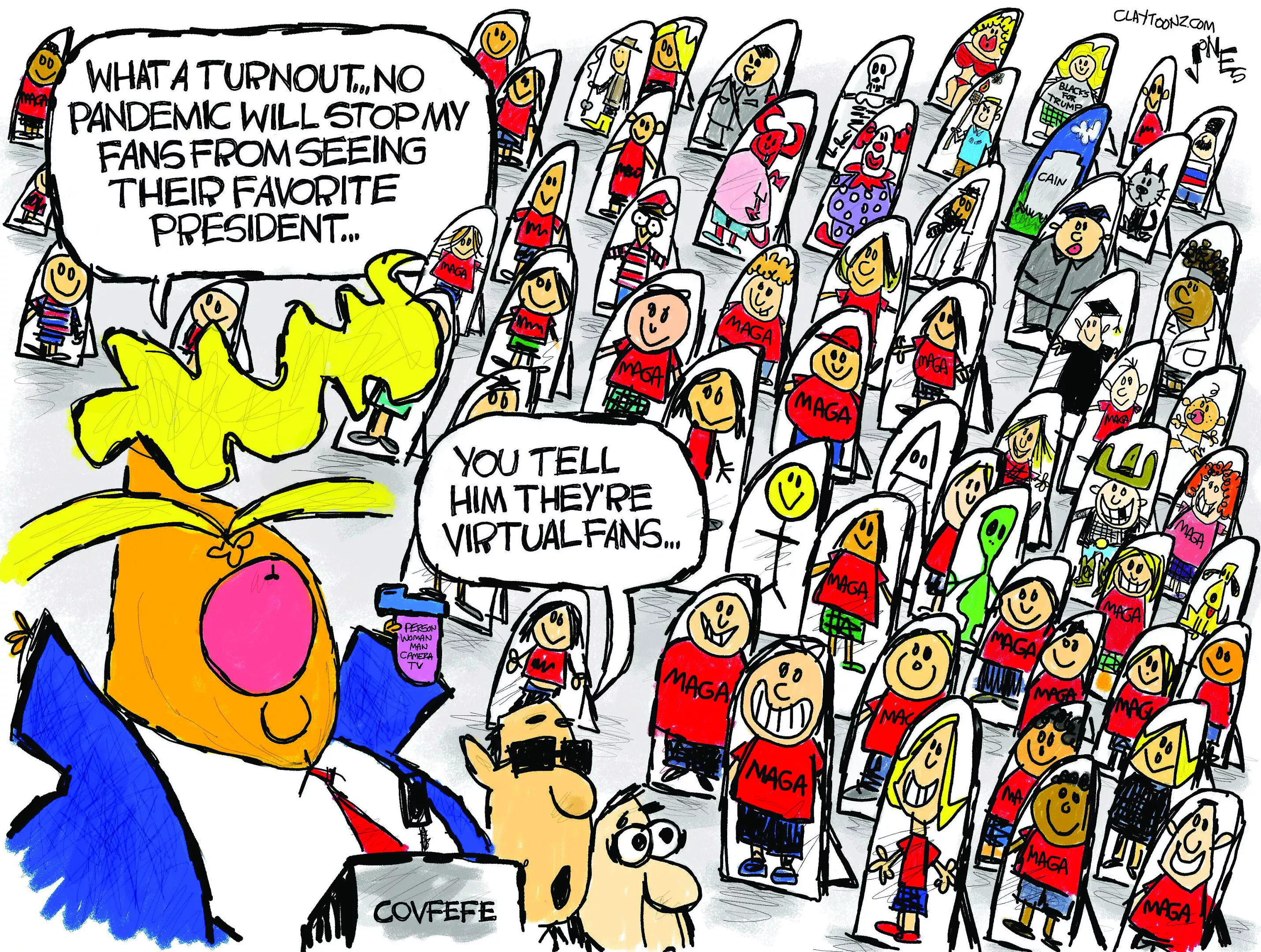
Tags: maga , trump , rally , virtual , fans , cardboard , political , cartoon , claytoonz , Image
Saturday, August 1, 2020
Congressman Raul Grijalva, a Democrat who was first elected to serve Southern Arizona in Congress in 2002, announced today that he had tested positive for COVID-19.
Grijalva, 72, had been in self-quarantine after Republican Rep. Louie Gohmert of Texas tested positive earlier this week. He said he felt fine and was showing no symptoms.
Grijalva's comment:
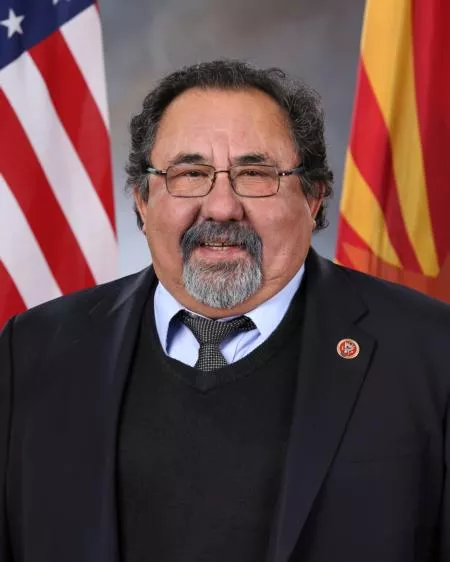
Grijalva, 72, had been in self-quarantine after Republican Rep. Louie Gohmert of Texas tested positive earlier this week. He said he felt fine and was showing no symptoms.
Grijalva's comment:
The Attending Physician of the Capitol informed me that I tested positive for COVID-19. As a result, I will be self-isolating in quarantine at his recommendation. I currently have no symptoms, feel fine, and hope to make a quick and speedy recovery.
While I cannot blame anyone directly for this, this week has shown that there are some Members of Congress who fail to take this crisis seriously. Numerous Republican members routinely strut around the Capitol without a mask to selfishly make a political statement at the expense of their colleagues, staff, and their families. I’m pleased that Speaker Pelosi has mandated the use of masks at the Capitol to keep members and staff safe from those looking to score quick political points. Stopping the spread of a deadly virus should not be a partisan issue.
I urge all of us to recognize the severity of this virus and follow the CDC guidance to keep our family, friends, and loved ones safe. We can all play a part in stopping the spread of COVID-19 in our communities.
Friday, July 31, 2020
The Loft's streaming series continues this week with a wide range of cinematic treats for you to enjoy at home. No doubt, this week's offerings are some of the most eclectic, interesting, and entertaining looking films of the series so far.
Here are the six new films now available for streaming...visit their website for details on how to order:
Lake Michigan Monster
This one looks nuts. Absolutely nuts. Made with a an oddly retro look, it looks like a hallucinatory cousin to the recent The Lighthouse, a movie that already made you feel like you were on acid when you were watching it.
The Cuban
Academy Award winner Louis Gossett Jr., having a nice recent comeback (sweet appearance in The Watchmen) stars as an aging musician with dementia.
The Fight
A new documentary from the makers of Weiner and RBG chronicling the court fights involving your dopey President's many attacks on your civil rights. For more info on The Loft's screening for this film, see Jeff Gardner's write-up here.
Rebuilding Paradise
A couple of years ago, I drove through the wonderful Paradise, California on a quick trip to the west coast. Beautiful place. A week later, it had all burned to the ground. Director Ron Howard's documentary tells the story of the community's recovery efforts.
Days of the Whale
Two graffiti artists create a tagged art collective in Medellin in this drama from director Catalina Arroyave Restrepo.
Gordon Lightfoot: If You Could Read My Mind
Holy cow, somebody has finally made a documentary about Canadian singer-songwriter Gordon Lightfoot! I've been on a Lightfoot kick recently (I often command Alexa to provide me with his tunes when I'm in dire need of settling down). Artists (Including members of Rush!) reflect on the now 80-year old's contributions to musical history.
Here are the six new films now available for streaming...visit their website for details on how to order:
Lake Michigan Monster
This one looks nuts. Absolutely nuts. Made with a an oddly retro look, it looks like a hallucinatory cousin to the recent The Lighthouse, a movie that already made you feel like you were on acid when you were watching it.
The Cuban
Academy Award winner Louis Gossett Jr., having a nice recent comeback (sweet appearance in The Watchmen) stars as an aging musician with dementia.
The Fight
A new documentary from the makers of Weiner and RBG chronicling the court fights involving your dopey President's many attacks on your civil rights. For more info on The Loft's screening for this film, see Jeff Gardner's write-up here.
Rebuilding Paradise
A couple of years ago, I drove through the wonderful Paradise, California on a quick trip to the west coast. Beautiful place. A week later, it had all burned to the ground. Director Ron Howard's documentary tells the story of the community's recovery efforts.
Days of the Whale
Two graffiti artists create a tagged art collective in Medellin in this drama from director Catalina Arroyave Restrepo.
Gordon Lightfoot: If You Could Read My Mind
Holy cow, somebody has finally made a documentary about Canadian singer-songwriter Gordon Lightfoot! I've been on a Lightfoot kick recently (I often command Alexa to provide me with his tunes when I'm in dire need of settling down). Artists (Including members of Rush!) reflect on the now 80-year old's contributions to musical history.
PHOENIX – Six months after the first case of COVID-19 was confirmed in Arizona, the disease is well on its way to becoming the third-leading cause of death in the state this year, following cancer and heart disease, according to state data.
As of Friday, July 31, the Arizona Department of Health Services reported 3,694 deaths from COVID-19, which was first reported in the state on Jan. 26. That number has grown by 631 in the last week alone.
If COVID-19 deaths continue at the current pace, that would put the disease squarely between cancer, which killed 12,097 Arizonans in 2018, and accidents, which killed 4,211 people that year, the most recent for which state mortality numbers are available.
A health department official cautioned against reading too much into the numbers at this time, however, noting that the cause of death will not be official until analysts can review death certificates, something that is not likely to happen until late 2021.
“Final death certificate information can take weeks or months to collect, depending upon the complexity of each case and whether testing or autopsy is required through the medical examiner,” said Holly Poynter, the department spokesperson, adding that final counts “tend to be lower than the counts produced” by daily reporting.
But other health experts in the state said the disease could “easily” become one of the biggest killers in the state this year.
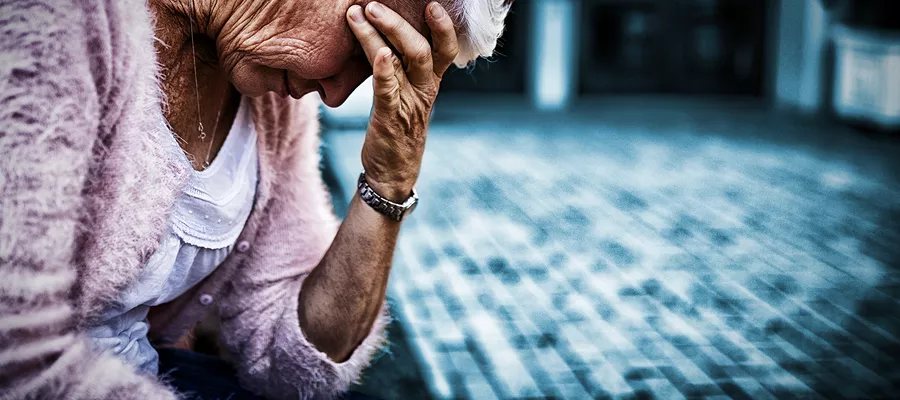
As of Friday, July 31, the Arizona Department of Health Services reported 3,694 deaths from COVID-19, which was first reported in the state on Jan. 26. That number has grown by 631 in the last week alone.
If COVID-19 deaths continue at the current pace, that would put the disease squarely between cancer, which killed 12,097 Arizonans in 2018, and accidents, which killed 4,211 people that year, the most recent for which state mortality numbers are available.
A health department official cautioned against reading too much into the numbers at this time, however, noting that the cause of death will not be official until analysts can review death certificates, something that is not likely to happen until late 2021.
“Final death certificate information can take weeks or months to collect, depending upon the complexity of each case and whether testing or autopsy is required through the medical examiner,” said Holly Poynter, the department spokesperson, adding that final counts “tend to be lower than the counts produced” by daily reporting.
But other health experts in the state said the disease could “easily” become one of the biggest killers in the state this year.

