Wednesday, June 2, 2021

Thanks to some amateur bakers from Arizona, we can get free donuts on Friday in honor of National Donut Day.
The three submitted winning flavor entries in Bashas' donut flavor competition, the grocery store chain announced in a news release.
Braxton B., 12, from Queen Creek, one the kids’ category with his Italian-inspired Kinder Joy Donut. It's filled with buttercream, topped with chocolate hazelnut spread and covered with crushed wafer cookies.
Heather Hirsch from Phoenix won the grown-up category with a Greek-inspired Baklava Donut made with cinnamon, dipped in a honey glaze and topped with chopped pistachios.
Mesa resident Kristine Pearce, who works at the Bashas’ supermarket at Baseline and Crismon Roads, won the member/employee category. Her Peruvian-inspired Delirium Donut is filled with Bavarian cream, topped with chocolate icing, sprinkled with crushed pecans and drizzled with caramel.
The winning donuts will be available for purchase starting Friday. Bashas' will give customers six free donuts when they purchase a dozen.
Bashas’ will donate 10% of its donut sales on June 4 to the Salvation Army, which established National Donut Day in June 1938 to honor volunteers who served the sweet treats to soldiers on the frontlines.
In addition to being named Bashas’ Official Donut Ambassadors for 2021, Braxton, Heather and Kristine will each receive one dozen donuts every month for a year, and $500 worth of prizes including a Bashas’ grocery gift card and baking/cooking gadgets.

WASHINGTON – Both sides agree on one thing about President Joe Biden’s decision to raise this year’s cap on refugee admissions from a historic low of 15,000 to as many as 62,500.
The U.S. is not going to come close to hitting that new ceiling.
“It’s not realistic, it’s just a kind of virtue signaling,” said Lora Ries, senior research fellow for homeland security at the Heritage Foundation.
Biden had said in April that he planned to keep the historically low 15,000-refugee cap imposed last year by President Donald Trump. That decision was immediately criticized by Biden supporters and sent the administration scrambling to back off, with officials promising within hours that a higher cap would be announced by May 15.
Biden unveiled the new cap on May 3, but even as he announced it he conceded that it was aspirational.
“The sad truth is that we will not achieve 62,500 admissions this year. We are working quickly to undo the damage of the last four years,” Biden said in a White House statement.
At the time of the announcement, the U.S. had admitted just 2,334 refugees, or just over 15% of the original limit of 15,000 refugees for fiscal 2021, according to the most recent refugee admissions report from the Refugee Processing Center. The Arizona Department of Economic Security said 161 refugees had been resettled in the state through May 17.
Numbers for the month of May will not be released until next week, but no one thinks the U.S. will be able to admit 60,000 more refugees in the five months left in the fiscal year.
But just setting a higher target will “very likely result in increased admissions beyond what would have happened, and it lays the groundwork for a bigger expansion next year,” said Mark Greenberg, director of the Human Services Initiative at the Migration Policy Institute.
The limit was set at 85,000 in President Barack Obama’s last year in office, but Trump lowered the ceiling to 50,000 in his first year and cut it every year thereafter until admissions were capped at 15,000 for this fiscal year.
Biden’s new cap “is still below the traditional one before Trump,” said Dany Bahar, senior fellow in the Global Economy and Development program at the Brookings Institution, but he expects the number will increase “very rapidly” because the number of people seeking refuge remains high.
Bahar said the higher cap on refugees was expected and that it should be “further increased because it is definitely not meeting the demand.” When he announced the new fiscal 2021 cap, Biden said he wants to raise the cap to 125,000 next year.
“That goal will still be hard to hit,” Biden said then. “We might not make it the first year. But we are going to use every tool available to help these fully-vetted refugees fleeing horrific conditions in their home countries.”

Tuesday, June 1, 2021
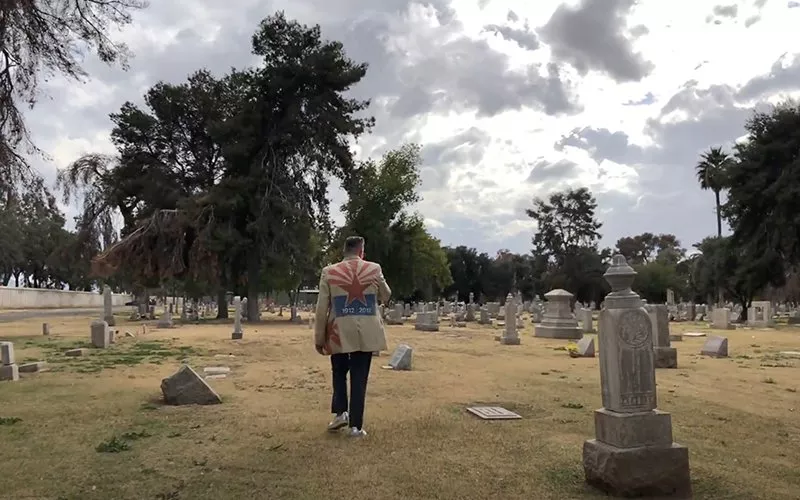
PHOENIX – Arizona’s Hip Historian Marshall Shore is known for his vivid storytelling, a cult-like following and expertise on the state’s history.
From his regular Arizona History Happy Hour to his ghost tours of the Valley, Shore has become a local celebrity. Part of the appeal is his study of under-represented groups and his interest in rewriting history with equity in mind.
Through the support of his followers, Shore was able to raise funds to purchase a headstone for a transgender man who was buried without one in the early 1900s.
The Greenwood Memory Lawn Mortuary & Cemetery in Phoenix opened in 1906 and holds the remains of some of the people who defined Arizona, including John T. Alsap, Phoenix’s first mayor, and William S. Hancock, who laid out the Phoenix townsite, according to the Arizona Republic. It also has been the site of controversy, including a movement to remove a Confederate veterans memorial.
“You can tell a lot about a city by going and visiting a cemetery and seeing its history,” Shore said.
To Shore, each stone in Greenwood cemetery represents a life with a story to share – but in the case of Nicolai De Raylan, the absence of a headstone was much more significant.
“It’s a really amazing story,” he said.
Shore learned about De Raylan in 2016 and said he was curious to learn about the secret life of a “gender pioneer” who died in Arizona in 1906.
Nicolai de Raylan emigrated from Russia to pursue a government job in Chicago. There, he married his first wife. Shore said De Raylan quickly got divorced, reportedly because he was “a little amorous with chorus girls.”
Shortly after, De Raylan married his second wife, Anna Davidson, and became a stepfather to her 10-year-old son.
In 1906, De Raylan was diagnosed with tuberculosis, and he visited Arizona to receive treatment. At the time, Arizona was known for its clean air.
“It didn’t go so well for him, he wound up passing away a few months later,” Shore said.
De Raylan left behind mounds of wealth and his beloved wife.

Monday, May 31, 2021